Rome on foot: a notebook from the Pantheon to Bernini
Some cities you visit. Rome you cross — the way you turn the pages of a book whose heroes you already know. Yesterday I walked. No…
Rome on foot: a notebook from the Pantheon to Bernini
Some cities you visit. Rome you cross — the way you turn the pages of a book whose heroes you already know. Yesterday I walked. No guidebook route, no schedule — just my own steps, from the Pantheon to Piazza della Repubblica, by way of the Trevi Fountain, Bernini’s Ecstasy of Saint Teresa, an imperial arch by the Forum, and Agrippa’s dome at blue hour. Here is what the city gave me that day.
Piazza Navona, first set
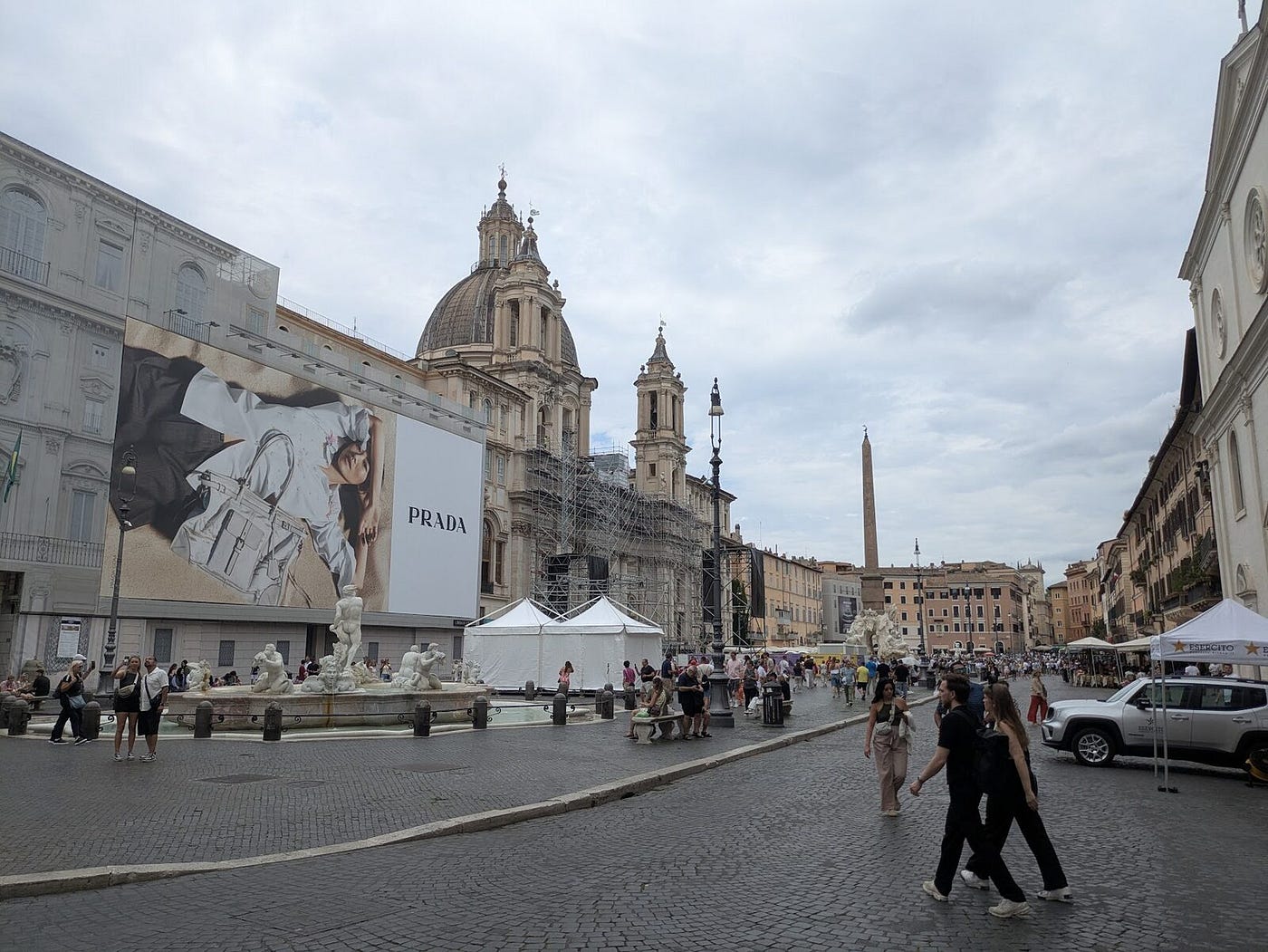
In the morning, Piazza Navona doesn’t yet smell of cold coffee and postcards. The dome of Sant’Agnese in Agone, the obelisk taken from Maxentius’ circus, the Fontana del Moro — it’s all there, in stereo. And then that giant Prada ad, posted like a contemporary canvas at the foot of the Baroque: Rome is never afraid to stack centuries. It is a city that collaborates with itself.
I linger a few minutes. I think of Brussels, my art-city where murals and street furniture answer each other — Rome does the same, four hundred years earlier, with an unlimited marble budget.
The Trevi Fountain: the cliché that holds up

You arrive at the Trevi Fountain knowing exactly what you’ll see. And still. The mass of Palazzo Poli, water so pale a green it looks like glass, Ocean on his chariot pulled by Pietro Bracci’s sea-horses — it works. The cliché holds because it was designed to. Nicola Salvi, in 1762, knew he was drawing a stage set, not a fountain.
The crowd is part of the décor. You throw the coin with your right hand over your left shoulder, you make the inner wish — to come back. It’s the most reliably kept Roman promise in the history of tourism.
Living marble: the Moses Fountain and its lions

Walking up toward Termini, you stumble on the Fontana dell’Acqua Felice, commissioned by Sixtus V at the end of the 16th century. Four reclining marble lions spit water from an aqueduct put back into service after a thousand years of silence. The stone is worn, one lion’s moustache is split, the trickle is steady. Urbanism that drinks.
Piazza della Repubblica: the Naiads and the scooter

Piazza della Repubblica spins at full speed: taxis, scooters, police buses, the Esercito on standby. In the middle, Mario Rutelli’s Fontana delle Naiadi (1901) — four bronze nymphs riding aquatic creatures, with central Glaucus. Black bronze against the pale stone of the Umbertine palaces: a museum contrast, crossed by a guy on a scooter in a white helmet. Very Italian mobility, a thousand kilometres from the self-driving car.
Santa Maria degli Angeli: Michelangelo inside the baths

Just behind, you step into the Basilica of Santa Maria degli Angeli e dei Martiri. And there, a shock. Michelangelo, at 86, turned the frigidarium of the Baths of Diocletian into a church — without demolishing. The fourteen-metre monolithic granite columns are the ones the Romans raised in AD 300. The floor is a chessboard of precious marbles. The octagonal vault is ancient. One of the rare places where imperial and Christian Rome literally occupy the same volume.
Santa Maria della Vittoria: stepping into a theatre

A few streets further, Santa Maria della Vittoria. From outside, nothing. Inside, you walk into a theatre — purple breccia columns, Cerrini’s ceiling frescoes, stucco everywhere. And at the back of the Cornaro Chapel, the piece everyone comes for.

Bernini’s Ecstasy of Saint Teresa (1647–1652) is not a sculpture, it’s a staging. Gilded bronze rays fall from a hidden window, the saint floats in her drapery, the angel smiles with an almost loving cruelty, the arrow rests on her heart. You understand why Stendhal fainted in Florence — here, you sway a little.
Moses at the Fontana dell’Acqua Felice: the tablets of the twelve tribes

Walking up toward the Quirinal, I come across the Fontana dell’Acqua Felice, known as the Fountain of Moses — commissioned by Pope Sixtus V in 1585 to celebrate the restoration of an ancient aqueduct. The colossal Moses, carved by Prospero Antichi and Leonardo Sormani, holds the Tablets of the Law — inscribed with the names of the twelve tribes of Israel. The statue was long mocked for its stiff proportions — legend says its sculptor died of grief. But the gesture holds: the prophet descending the mountain, water gushing at his feet, Rome inventing once again a biblical memory in the middle of its pagan stones.
The Pantheon at blue hour

Then evening, the Pantheon. The inscription M·AGRIPPA·L·F·COS·TERTIVM·FECIT — Marcus Agrippa, son of Lucius, in his third consulship, built this — dates from 27 BC. The current building is Hadrian’s (around AD 125), who kept the inscription out of elegance. The sixteen monolithic columns of Egyptian grey granite are twelve metres tall, each. The original bronze door weighs twenty tons and still turns.
At blue hour the stone goes mauve, the portico empties, you hear your own steps. It’s been (almost) free for two millennia — Agrippa’s gift to posterity.
The panorama from Trinità dei Monti

You end at the top of the Spanish Steps, in front of Trinità dei Monti. The city unfolds its ochre rooftops, flowered terraces, satellite dishes, domes. Centre: Sant’Ambrogio e Carlo al Corso. Far right: a glimpse of St. Peter’s. One of the rare places where you see Rome as a real city — with its laundry, its gardeners, its rooftop bars — and not as an open-air museum.
What a day walking Rome gives you
A day in Rome gives you two things. First, sore calves — the sampietrini are merciless, you cover ten to twelve kilometres without noticing. Second, a sensation no other European city offers: that of having crossed every era without changing street. If you want to stay in Latin Europe, I also wrote about three other Italian regions for the summer.
Frequently asked questions
How many days do you need to visit Rome on foot?
Three full days cover the historic centre without rushing: one day for the Vatican, one for the Forum-Colosseum-Palatine, and one free day for the Trevi Fountain, the Pantheon, Piazza Navona and the baroque basilicas. Rome is earned by foot — count on ten to twelve kilometres a day.
Which baroque church should you visit in Rome to see a Bernini?
Santa Maria della Vittoria, near Piazza della Repubblica, holds the Ecstasy of Saint Teresa (1647–1652) — Bernini’s absolute masterpiece, staged in the Cornaro Chapel with natural zenithal light. Entry is free and the church is rarely crowded.
Do you need to book to enter the Pantheon in Rome?
Since 2023, entry to the Pantheon is ticketed (€5) and weekend booking is recommended. But the outer portico — Agrippa’s inscription and the monolithic columns — remains freely accessible, and at blue hour it is one of the most beautiful free sights in Europe.
Which fountain should you see in Rome besides the Trevi?
The Fontana delle Naiadi (Piazza della Repubblica), the Fontana dell’Acqua Felice with its marble lions, the Fontana del Moro and Bernini’s Four Rivers on Piazza Navona, and the small Barcaccia at the foot of the Spanish Steps. Rome has over 2,000 working fountains — the Acqua Vergine has been flowing since 19 BC.
What is the best free viewpoint over Rome?
The forecourt of Trinità dei Monti, at the top of the Spanish Steps, offers a panorama over the ochre rooftops of the centre, with St. Peter’s dome in the distance. The Pincio nearby, the Janiculum (Gianicolo) and the Vittoriano terrace (paid) complete the quartet.
메타데이터
- post_id
- 326e2b4d6edf
- slug
- rome-on-foot-a-notebook-from-the-pantheon-to-bernini-326e2b4d6edf
- url
- https://medium.com/@gabsous/rome-on-foot-a-notebook-from-the-pantheon-to-bernini-326e2b4d6edf
- canonical_url
- https://medium.com/@gabsous/rome-on-foot-a-notebook-from-the-pantheon-to-bernini-326e2b4d6edf
- author_url
- https://medium.com/@gabsous
- status
- ok
- fetched_at
- 2026-06-21 07:44:09