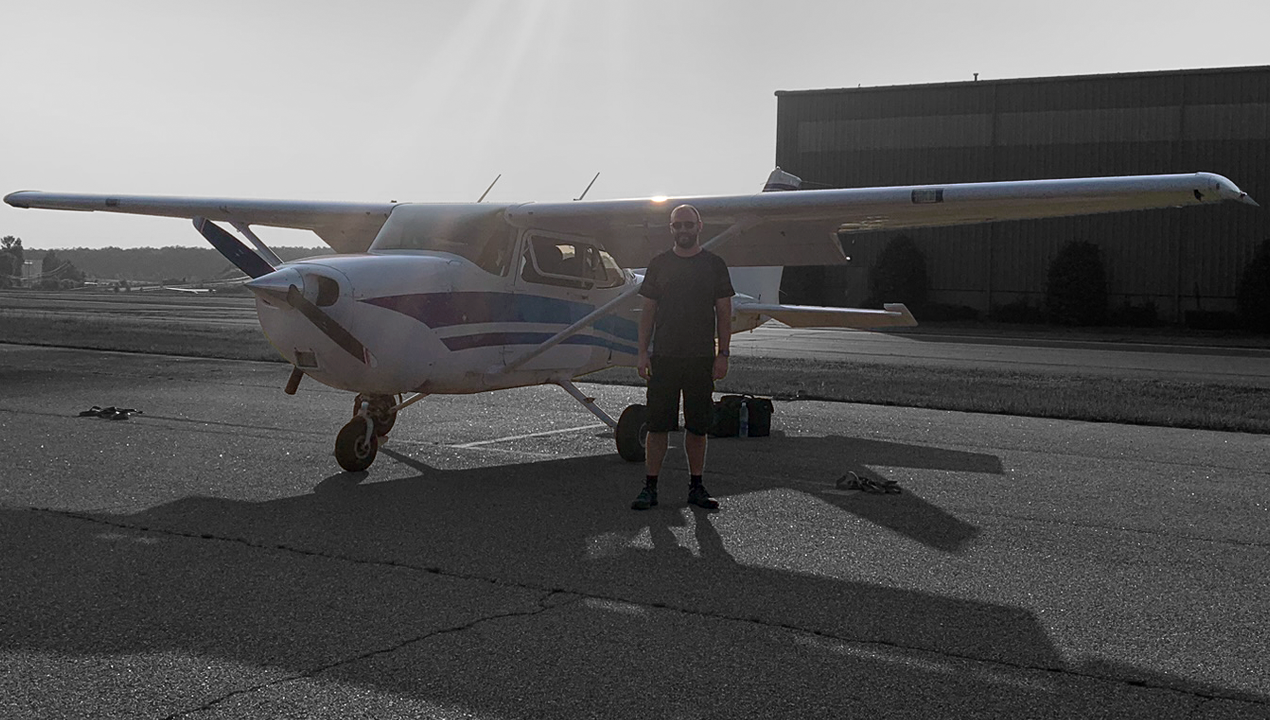
My First Solo Flight — Student Pilot
Piper PA-28 Warrior 161 First Solo G-EVIE — Stall Warning on Landing
My First Solo Flight — Student Pilot
Piper PA-28 Warrior 161 First Solo G-EVIE — Stall Warning on Landing
One circuit of runway 27 at Dundee, in a Piper Warrior I came to know as Evie, and the first time it was just me and the aircraft.
This is the story of my first solo flight, flown in a Piper PA28 Warrior from runway 27 at Dundee. It was the first time I took an aircraft into the air with no one else on board, and it remains one of the most significant things I have ever done.
I came to flying the long way round. Before the flight deck I spent thirteen years as a mechanical engineer in oil and gas, much of it offshore. So when I finally started training for my Private Pilot Licence at Tayside Aviation in Dundee, I arrived with an engineer’s instinct to understand the why behind everything, not just the how. Tayside has since closed its doors, which gives this footage a quiet sense of history now. At the time it was simply where I was learning to fly.
The moment before
A first solo does not arrive out of nowhere. On the day itself you typically fly three or four circuits with your instructor sitting beside you, and only when you are both satisfied does the instructor step out and leave you to it. There is one small detail that stays with me. The instructor leaves their headset in the aircraft, just in case the student has a technical problem with their own during the solo. You climb out alone, but you are never entirely cut loose.
What follows is one circuit. A take-off, a left-hand pattern, and a landing. Written down it sounds almost trivial. Lived through, for the first time on your own, it is anything but.
Setting up
Everything in light aircraft flying runs on checklists, and I am a believer in them. For this flight I used the same Piper PA28 checklist I had used throughout my PPL. At the holding point I ran the power checks: 2,000 RPM, carburettor heat, left and right magnetos, a glance at the suction gauge and the ammeter to confirm the vacuum and the charge, then back to idle to check the engine was happy at low power.
Dundee is a controlled aerodrome, which is worth a word of explanation for anyone more used to smaller fields. At an uncontrolled airfield you make a series of position radio calls as you fly the circuit. At Dundee, local procedures mean some of those calls are simply not required, because Air Traffic Control is managing the picture for you. If parts of my radio work sound sparse compared to what you might expect, that is why.
With pre-take-off checks complete and clearance given, I lined up on runway 27. As I did, I ran a short set of memory checks that conveniently spell out the licence I am working towards. A for approach, confirm it is clear. T for transponder, set to ALT. P for pitot heat, as required. L for lights, on as I enter the runway. ATPL. A small thing, but the kind of habit that becomes second nature when you build it early.
Alone, and climbing
The take-off itself is where the difference hits you. Almost every student notices it on their first solo, and I was no exception. Without the weight of an instructor in the right-hand seat, the aircraft performs noticeably better, and the climb rate of Evie was considerably stronger with just me on board. It is a strange feeling. The machine you have flown dozens of times suddenly feels lighter and keener, as if it knows the day matters.
If you have ever flown Evie yourself, or you have a connection to that particular aircraft, I would genuinely love to hear from you. There is something about a specific airframe, with its own registration and its own character, that stays with the people who have flown it.
Downwind, and a lesson in priorities
Turning downwind, I worked through the pre-landing checks, and I say them out loud. Brakes, undercarriage, mixture rich, fuel on the correct tank, instruments scanned, charge and consumption confirmed.
Two moments in that sequence are worth pulling out, because they say something about how flying actually works.
The first is that I paused halfway through the checks. The engine RPM was not quite set where it should have been, so I stopped, corrected it, and only then picked the checklist back up. That is not a mistake to be hidden. It is the whole principle of aviate, navigate, communicate in miniature. Fly the aircraft first. Get it right, then carry on. A checklist is there to serve the flying, not to be rushed through for its own sake.
The second is that I still call “undercarriage down” even though the Warrior has fixed landing gear that never moves. There is nothing to lower. I say it anyway, every time, because I intend to fly more complex aircraft in the future, and the habit of always confirming the gear is one you want long before the day it can actually kill you. Good habits are cheap to build now and expensive to learn later.
The landing
On base I was looking for 70 knots with two stages of flap. Turning final, I ran the finals checks: carburettor heat as required, runway confirmed clear, approach stabilised, permission to land granted. Then I settled the Warrior down the approach at 65 knots with full flap.
Just as the wheels touched, you can hear the stall warning sound briefly. For anyone unfamiliar, that is not a fault and it is not a near miss. It is quite normal in light aircraft to hear the stall warner just as you settle onto the runway, because a good landing is flown slow, with the nose held up, touching down close to the minimum flying speed. Hearing it at that moment is often the sign of a nicely judged landing rather than a botched one. After all the build-up, the landing was the part I was most quietly pleased with.
I vacated onto taxiway Charlie, and that was it. First solo complete.

A nice touch from Dundee
I want to single out the Air Traffic Control team at Dundee, who were excellent throughout my PPL. As I taxied back in to collect my instructor, the controller offered a word of congratulations over the radio. It is a small gesture and it costs nothing, but on a day like that it means a great deal.
There is a warmth to general aviation, and to the people who quietly make it work, that does not always get talked about.
What it taught me
I should be clear about what this flight is and is not. It was recorded during my first solo, and I am not a flight instructor. Nothing here is instruction. It is one student’s experience, shared honestly.
What the flight taught me is hard to overstate. It is the moment the responsibility becomes entirely yours, and it changes how you understand everything that came before it. The checklists, the habits, the discipline of fixing one problem before moving to the next, all of it exists so that when you are finally alone, you have something solid to stand on.
This was also the very first video I uploaded to my channel, Jayviating, and it felt right that it should be this one. I am working through the rest of the journey now, the ATPL theory, the commercial licence and the instrument rating, and I plan to document it as I go. If you flew into Dundee in the past, trained at Tayside, or simply remember your own first solo, I would love to hear about it.
From the rigs to the flight deck.
Aviate, Navigate, Communicate.
Jason
https://youtu.be/d4XnNFopTl0?si=TPmCSP_U0vxNG4qq

메타데이터
- post_id
- 32731bcd51e2
- slug
- my-first-solo-flight-student-pilot-32731bcd51e2
- url
- https://medium.com/@jayviating/my-first-solo-flight-student-pilot-32731bcd51e2
- canonical_url
- https://medium.com/@jayviating/my-first-solo-flight-student-pilot-32731bcd51e2
- author_url
- https://medium.com/@jayviating
- status
- ok
- fetched_at
- 2026-07-28 04:04:50