Antibodies — Structure Meets Stardom!
If we had a ‘Paris Fashion Week’ in the human body, Antibodies would definitely be the show stopper.
Antibodies — Structure Meets Stardom
If we had a ‘Paris Fashion Week’ in the human body, antibodies would definitely be the showstoppers.
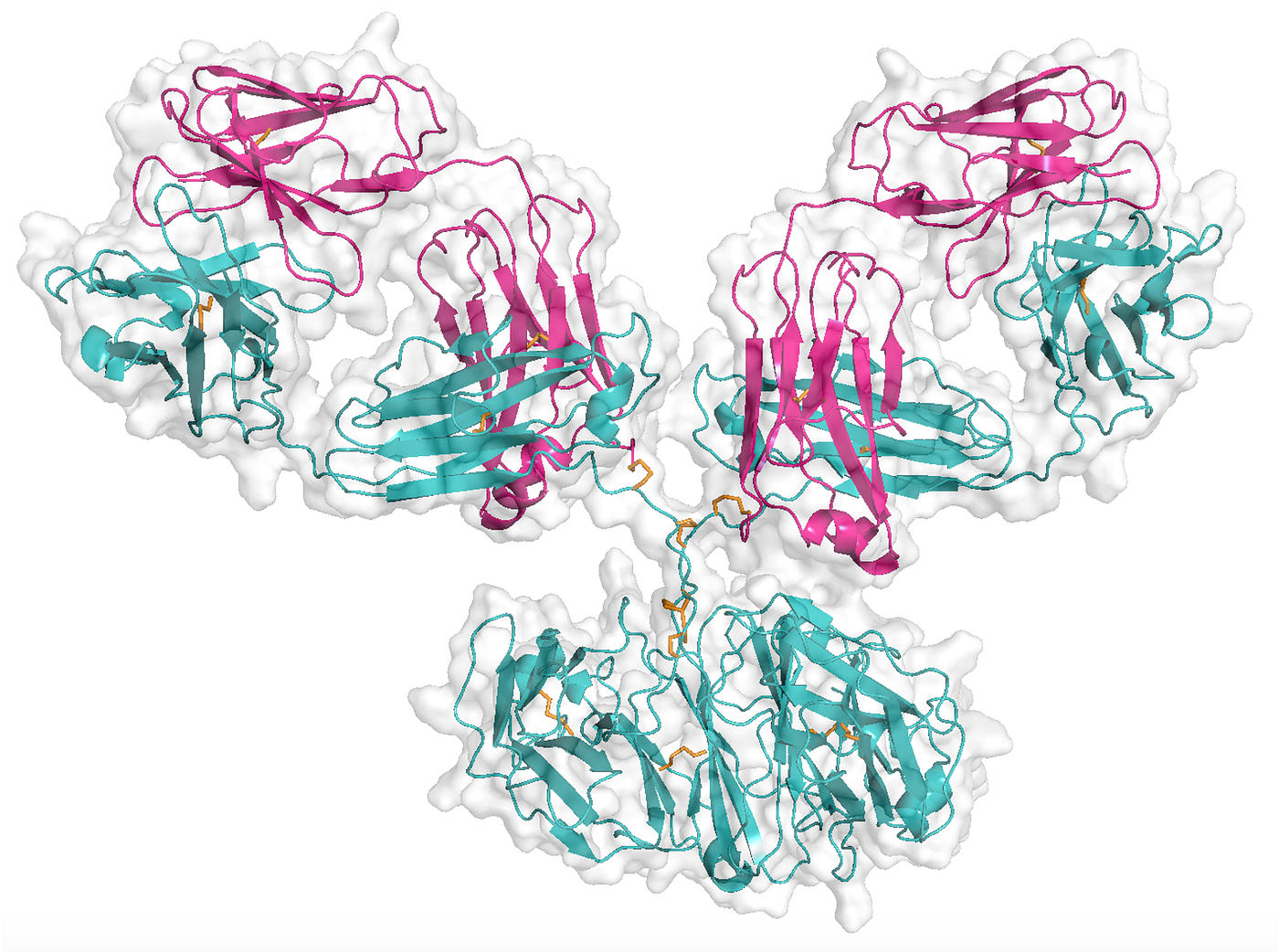
PDB image of Immunoglobulin 1IGY
What are Antibodies?
Draped in an elegant design with a beautiful contour, antibodies, also called immunoglobulins, are proteins (1) made by the B-cells (2) of the human immune system. You guessed it right! As a component of the immune system, their main role is to find foreign bodies likes viruses or bacteria that we are constantly surrounded by, bind them, and neutralize them. Basically, without them, we would be… umm dead! :) And these were the fascinating molecules I decided to focus on for 4.5 years during my PhD, where our love story began.
History
Who doesn’t love a good history lesson! Antibodies have existed ever since humans have existed. We only started studying them as late as the 1890s, when Paul Ehrlich began calling them “antibodies.” A good way to remember any term in the field of biology is to break it down: ‘anti’ to the ‘body’. Exceptions exist everywhere, of course! In this case, it is ‘anti’ against ‘something’ for the ‘body’. Oh well. Hence, the name was widely debated for many years, and people called it Antikörper, Immunkörper, Zwischenkörper, and many other hard-to-spell names (as though Biology spelling gets any easier), before everyone settled on antibody.
It took just a few more years before we understood what this beautiful structure was. In 1959 (the same decade the DNA structure was discovered — talk about a bunch of overachievers), Gerald M. Edelman (Rockefeller University, USA) and Rodney R. Porter (University of Oxford, UK) independently elucidated the structure of an antibody. Talk about international telepathy! They jointly shared the **1972 Nobel Prize in Physiology or Medicine.**
Utility of Antibodies
I know, you’re probably asking — why should I care about these molecules? What’s in it for me?! Well, for starters, you wouldn’t be alive without them. And on a less grim note, antibodies today don’t just work inside your body — they are widely used in diagnostics and therapeutics.
Remember your COVID lateral flow tests? Without antibodies, you wouldn’t see a line and wouldn’t know if you had COVID-19. Lab-made antibodies are incorporated into these tests so that when they bind a specific foreign object, they light up and scream positive.
Apart from diagnostics, antibodies are also used in therapeutics. Ever heard of Herceptin (used to treat HER2+ breast cancer) or Humira (used to treat autoimmune conditions such as rheumatoid arthritis)? Both are antibody-based drugs, also called biologics, and have become increasingly popular off late.
Photo by Medakit Ltd on Unsplash
Structure of the Antibody
Remember when I called them showstoppers? Here’s why. Immunoglobulins are fascinating Y-shaped molecules, and their entire structure dictates their function!
If we look at the structure of Immunoglobulin IgG, the most common antibody in humans, it consists of two chains: the heavy chain (teal) and the light chain (magenta). There are two sets of these chains connected by disulphide bonds (3, orange lines), which hold the structure in its iconic Y-shaped configuration.

Schematic Diagram of an Immunoglobulin
Just as humans have a face, hands, legs, an upper and lower torso, and yet each of us looks different due to variations in these components, antibodies also have constant regions (Fc) and variable regions (Fv). Each heavy and light chain has one variable region, and these Fv regions contain three nuanced regions called complementarity-determining regions (CDRs), the dark stripes in the circled region.
These CDRs provide maximum diversity, allowing our bodies to recognize, bind, and neutralize countless pathogens (4). The antibody finds complementary regions on pathogens called antigens.
Think of it as a lock-and-key mechanism. If all keys were the same, they wouldn’t really serve their purpose, would they?
The site of the antibody that binds the antigen is called the paratope, and the site on the antigen where the antibody binds is called the epitope. You’ll hear these terms thrown around quite a bit here. Collectively (and colloquially), this region is known as ‘The Binding Site,’ hence the name of this publication. :)
That’s it for today! Next, we’ll explore how CDRs generate diversity in an elegant process called homologous recombination. Stay tuned!
Some Simplified Mumbo Jumbo
- Protein: Think of them as the legos or building blocks of your body that carry out every single function. Each protein has a specific purpose, a true calling, and does its job finely. One mishap, and diseases arise.
- B-cell: A special type of white blood cell (the soldiers of the human body).
- Disulphide Bond: A strong bridge between two sulfur atoms.
- Pathogen: A microorganism such as bacteria or a virus that causes disease. Microorganisms that don’t cause disease are simply called microorganisms.
메타데이터
- post_id
- 32aa9ebdc7d7
- slug
- antibodies-structure-meets-stardom-32aa9ebdc7d7
- url
- https://medium.com/@pondernwonder/antibodies-structure-meets-stardom-32aa9ebdc7d7
- canonical_url
- https://medium.com/@pondernwonder/antibodies-structure-meets-stardom-32aa9ebdc7d7
- author_url
- https://medium.com/@pondernwonder
- status
- ok
- fetched_at
- 2026-07-29 03:12:20




