The Rise of Philipeius the Warrior
Over two thousand years ago, Philippeius was born on the coldest night of January. Barely any babies in Greece, born that winter, survived…
The Rise of Philipeius the Warrior
Over two thousand years ago, Philippeius was born on the coldest night of January. Barely any babies in Greece, born that winter, survived, but Philippeius did. However, his mother did not. He was born in a small fishing village on the coast of eastern Macedonia. His father and older brother were fishermen, but they did not make much money. On a good day, they might have made two drachmas, but most days they barely made one.
Because of the poverty in which Philippeius was raised, his father sold him into slavery on his eighth birthday. He was sold for just a bit less than 100 drachmas. The money made his father and brother forget all about him. By the end of August, Philippeius had been bought by the Royal Macedonian Navy. He started as a servant to the trierarch of the ship named the Pythios. That was how Philippeius heard the stories about the trierarch and how the trierarch’s grandfather had stolen Apollo’s sword from Hermes. The sword had been given to the trierarch as a gift from his father when he was awarded the rank of trierarch.
To match the name of the prior owner of the sword he bore, the trierach’s father had named him Apollonius. However, all of those who sailed the Eastern Mediterranean knew him as Apollonius the Brute. He was given this name by the few people who survived his attacks. He was given the name for his brutal warfare strategies, in which nearly no one ever survived. He was known for charging into small fleets, alone, and coming out victorious. He would commonly split ships in half by ramming their sides. However, his most famous accounts came from when he was engaged in conflict with only one other ship. In these occurrences, he thought it was fun to get some use out of Apollo’s sword.
Apollonius would order the crew to pull the ship up alongside the enemy vessel. Then, he and an elite squad of his fighters, hand-picked by Apollonius himself, would board the enemy vessel, cut down the soldiers, and steal any valuables before sending the ship to the depths below. Apollonius, of course, called this elite squad Apollonos Cheir, hand of Apollo. Out of the dozen-and-a-half men of Apollonos Cheir, Apollonius was the most skilled fighter. Apollonius was a large man. His muscles seemed to be chiseled out of marble. His speed and reflexes were unmatched, as if Hermes had enchanted the sword of Apollo to give the wielder the speed of Hermes. A man of his size, moving at the speeds he did, was a terrifying sight for anyone standing in his way. This is before mentioning that Apollo’s sword could slice through solid bronze like it was butter. The men joked that Apollonius was created by the gods after mixing the souls of Achilles and Hercules.
When Philippeius turned twelve, they transferred him from servant to rower. The job was beyond brutal. It was not a job for Philippeius’s young and small stature. Even as he grew older, Philippeius did not grow to the same height as the rest of the rowers. However, his strength eventually managed to surpass nearly all of them.
After nearly a decade of being a rower, Philippeius’s muscles grew to a fantastic size. He was still considered short, but his muscles rivaled those of Apollonius. Philippeius knew he was one of the strongest men on the Pythios, so he often begged Apollonius to initiate him into Apollonos Cheir. Despite his begging, Apollonius never agreed, and Philippeius’s begging would frequently be met with five floggings. Forever a rower, Philippeius would be, so Philippeius begged the gods to deliver him to where he could become a better warrior than Apollonius. He knew the gods would be too busy to deal with such a petty request, but one day, his fortunes changed in a rather dramatic way.
On the first of January, Apollonius and the Pythios answered the royal call to set sail for Tyre. They would be following the great armies of King Alexander III of Macedonia to pierce the Persian blockade and begin the conquest of the Persian Empire. So, within the week, the Pythios was sailing just a few miles west of the coast of Tyre.
The Pythios sailed with the grand fleet of over 200 warships. Apollonius delivered the news to the men. “King Alexander demands that we destroy this blockade. We must defeat this blockade. With this blockade still in our way, we cannot deliver Alexander’s armies to conquer Persia. We must destroy this blockade, for King Alexander, for Macedonia, for Greece!” yelled Apollonius with an echoing roar. The men aboard the Pythios roared their approving cheers in response.
It was not long before the Persian fleet was in sight. Upon seeing the wall of sails on the horizon, Apollonius gave the command. “Deploy oars! Archers, to battle stations! Apollonos Cheir, prepare your swords for blood!” he called. Phillipeius’s row pushed their oar’s paddle out of the ship and waited for the officer to start the cadence. A few moments later, Apollonius gave a second command, “Charge!”. The officer began. The rowers dipped their oars into the sea and began to row. Slowly, the officer quickened the cadence.
The strength of the Pythios’s rowers made them one of the first ships to reach the blockade. This was just what Apollonius wanted, glory. Philippeius could hear the battle pursuing overhead. He could hear the battle cry of the soldiers and Apollonius yelling commands, but all he could do was row.
Suddenly, Philippeius heard a different command from all the rest. “Brace!” roared Apollonius. It was only a few seconds' warning until the wall, behind Phillippeius, burst open. Phillippeius was the furthest away from the point of impact, but when he turned around, he realized how lucky he was. He saw the ramhead and hull of a Persian warship in the place where over a hundred rowers used to be. Water started gushing in from the hole the Persian ship had made. That’s when Philippeius noticed something strange: the enemy vessel had not gone all the way through the Pythios; they were stuck together.
Philippeius and the surviving rowers evacuated to the top deck. The sight he saw was even worse than below. A giant Persian warship was halfway through the Pythios’s hull. Persian soldiers began flooding the decks of the Pythios, swords drawn. All the soldiers aboard the Pythios wasted no time defending their sinking ship. Deafening battle cries could be heard from both sides. Then, it happened.
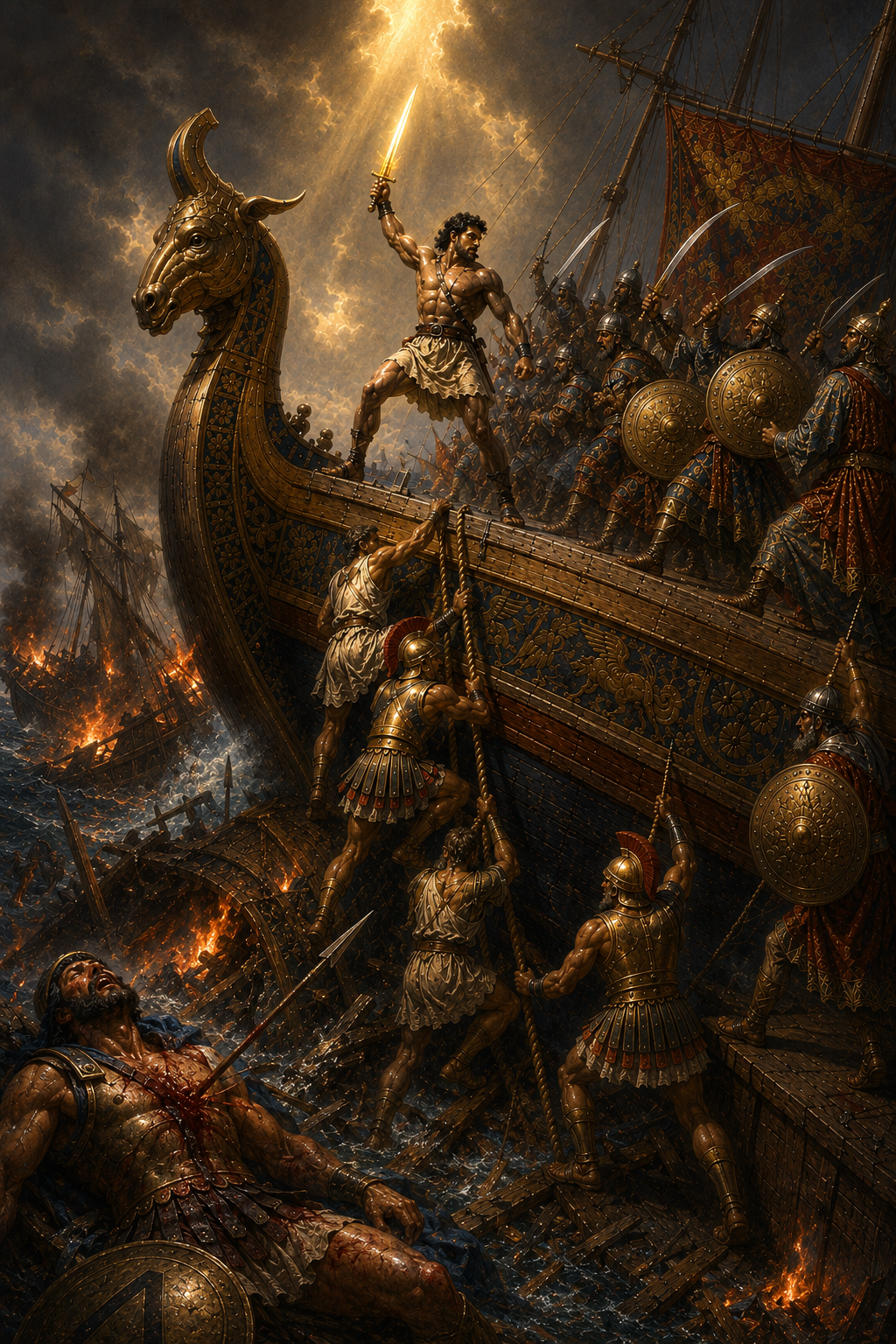
Apollonius had just begun charging at the invading soldiers when a spear, thrown from the deck of the Persian ship, struck him in the chest. With the sword of Apollo still raised, Apollonius tipped over and lay on the deck, motionless. The battle cries on the Pythios stopped. The Brute had been slain. Time seemed to slow for Philippeius as Apollonius fell. He watched the sword clatter on the deck. It seemed to glow with a near-blinding light. Then, he heard it. A whisper, coming from nowhere. “You asked for this. Here is your chance. Take the sword. Cut down the enemy in my name. In the name of Apollo.” Philippeius could not believe what he was hearing. Was a god really speaking to him? It didn’t matter because Philippeius began sprinting to where the sword lay, without any self-command to do so. A Persian soldier swung his sword at him. Philippeius ducked under the blade and rose for a near-lethal blow to the Persian’s head. He grabbed the sword and immediately felt the strength and speed of the gods flow through him.
Philippeius swung the sword in the direction of two Persian soldiers, who instantly fell to the floor. He turned to face the crew, who were still standing there in shock at the death of Apollonius. “Soldiers and rowers, with me!” Philippeius bellowed with a deafening roar. The crew immediately snapped out of it and followed after Philippeius, who had cut down three more Persians and had begun climbing the hull of the Persian ship.
Philippeius swung the sword in the direction of two Persian soldiers, who instantly fell to the floor. He turned to face the crew, who were still standing there in shock at the death of Apollonius. “Soldiers and rowers, with me!” Philippeius bellowed with a deafening roar. The crew immediately snapped out of it and followed after Philippeius, who had cut down three more Persians and had begun climbing the hull of the Persian ship.
Upon boarding the ship, a soldier charged Philippeius. Philippeius sliced through the soldier’s sword and body in one swift swing. The army aboard the ship was great, but guided by Apollo, Philippeius ran his sword through over half of them before the men from the Pythios even reached the deck. With their help, Philippeius defeated the last Persian aboard the ship. There he stood, at the helm of the Persian ship, drenched in Persian blood and holding the sword of Apollo. Philippeius turned to his crew, who all began to chant his name as they stood on the blood-soaked deck. Philippeius raised the sword above them. “For Apollo! For Apollonius!”
메타데이터
- post_id
- 32b1fbeb51ea
- slug
- the-rise-of-philipeius-the-warrior-32b1fbeb51ea
- url
- https://medium.com/@jaxdegen08/the-rise-of-philipeius-the-warrior-32b1fbeb51ea
- canonical_url
- https://medium.com/@jaxdegen08/the-rise-of-philipeius-the-warrior-32b1fbeb51ea
- author_url
- https://medium.com/@jaxdegen08
- status
- ok
- fetched_at
- 2026-08-10 16:44:30