The Hidden Governance Weakness That Shows Up in Form 990
Most nonprofits treat Form 990 as a compliance task. Gather financials, answer the questions, file on time, move on.
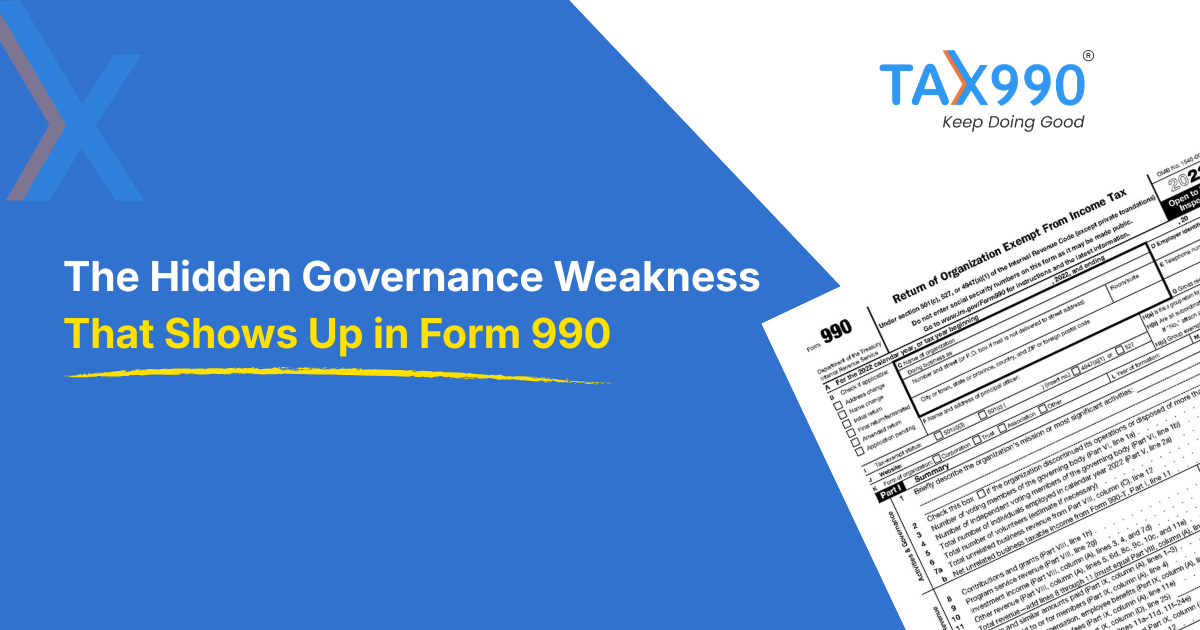
The Hidden Governance Weakness That Shows Up in Form 990
Most nonprofits treat Form 990 as a compliance task. Gather financials, answer the questions, file on time, move on.
But here’s the reality: Form 990 is not just a tax return. It’s a governance document.
And if you look closely, it often exposes something deeper — gaps in how an organization is actually being run.
Not intentionally. Not obviously. But consistently.
Form 990 is a Mirror, Not Just a Form
Every section of Form 990 tells a story. Not just about revenue and expenses, but about how decisions are made, documented, and reviewed.
When governance is strong, the form reads clean, consistent, and aligned.
When it’s not, small inconsistencies start to surface:
- Board oversight appears unclear
- Policies exist, but aren’t consistently applied
- Financial controls feel reactive rather than structured
These aren’t always red flags on their own. But together, they point to a pattern.
Where the Weakness Usually Shows Up on Form 990
The most telling section is Part VI — Governance, Management, and Disclosure.
This is where nonprofits answer questions about how they operate internally. And this is where subtle governance gaps become visible.
A few common signals:
1. “Yes, we have policies”… but no process behind them Many organizations check “Yes” for conflict of interest, whistleblower, or document retention policies. But when asked how those policies are enforced or reviewed, the answers are vague or inconsistent.
A policy without a process is just documentation.
2. Board review of Form 990 is unclear or absent
One of the most overlooked questions:
“Has the organization provided a complete copy of this Form 990 to all members of its governing body before filing the form?”**
If the answer is “No” or “Not consistently,” it signals a deeper issue. The board isn’t fully engaged in oversight.
And that’s not just a compliance gap. That’s a governance gap.
3. Compensation decisions lack structure Form 990 doesn’t just ask what executives are paid. It asks how those decisions are made.
Stronger organizations describe:
- Independent review
- Use of comparable data
- Documented approvals
Weaker responses tend to rely on informal practices. That lack of structure raises questions about accountability, even if the compensation itself is reasonable.
4. Related-party transactions aren’t clearly tracked When transactions involving insiders aren’t well documented or disclosed, it doesn’t always mean wrongdoing. But it does mean there’s likely no robust system in place to monitor them.
That’s a control issue.
Governance Signals Beyond Part VI
Governance weaknesses don’t stay confined to one section. They show up across the form.
Schedule O: The consistency test
This is where organizations explain their answers.
Clear, consistent explanations signal intentional governance. Reactive or minimal explanations suggest the form is being completed to satisfy requirements, not to communicate structure.
Part VII & Schedule J: Transparency in compensation
This isn’t just about numbers.
- Are roles clearly defined?
- Do compensation figures align with responsibilities?
- Are additional benefits explained clearly?
When disclosures lack clarity or consistency, they raise questions that go beyond compensation itself.
Part VIII & IX: Financial alignment with mission
Revenue and expenses should support the organization’s stated purpose.
If the connection between financial activity and mission isn’t clear, it suggests internal misalignment between program execution and financial reporting.
That’s not a formatting issue. It’s an operational one.
How to Strengthen What Form 990 Reveals
You don’t need a governance overhaul. But you do need intentional structure.
Focus on a few high-impact areas:
- Make policies operational, not just documented Define how each policy is implemented, reviewed, and enforced. Assign ownership.
- Bring the board into the process Ensure Form 990 is shared before filing. Even a brief review creates accountability and alignment.
- Document key decisions Compensation, major transactions, and approvals should have a clear audit trail.
- Standardize disclosures If something is reported one year, it should be consistent the next — unless there’s a clear reason for change.
Why This Matters More Than You Think
Form 990 isn’t just reviewed by the IRS. It’s publicly available.
Donors, grant makers, watchdog organizations, and even journalists use it to evaluate nonprofits. And they’re not just scanning numbers. They’re reading governance signals.
A nonprofit with:
- Clear policies
- Documented processes
- Active board oversight
Builds trust instantly.
One with vague or inconsistent answers creates doubt — even if the mission is strong.
The Bigger Insight
What Form 990 ultimately does is remove ambiguity.
It takes what an organization believes about its governance and asks it to be stated clearly, consistently, and in writing. And in that process, gaps surface — not because something is broken, but because it hasn’t been fully defined.
That distinction matters. Not for compliance alone, but for credibility.
메타데이터
- post_id
- 32d0798d9bf2
- slug
- the-hidden-governance-weakness-that-shows-up-in-form-990-32d0798d9bf2
- url
- https://medium.com/nonprofits-tax-filing/the-hidden-governance-weakness-that-shows-up-in-form-990-32d0798d9bf2
- canonical_url
- https://medium.com/nonprofits-tax-filing/the-hidden-governance-weakness-that-shows-up-in-form-990-32d0798d9bf2
- author_url
- https://medium.com/@Tax990
- status
- ok
- fetched_at
- 2026-06-10 15:53:41