A Short History of Propaganda
A hundred years ago, Edward Bernays wrote a book about the “invisible government” that constitutes “the true ruling power” of the United…
A Short History of Propaganda
A hundred years ago, Edward Bernays wrote a book about the “invisible government” that constitutes “the true ruling power” of the United States.
“We are governed,” he wrote, “our minds are molded, our tastes formed, our ideas suggested, largely by men we have never heard of.”
The book was called Propaganda.
Bernays was not peddling conspiracy theories. Nor did he write the book to warn the masses of the unseen forces by which they were being manipulated.
Propaganda was an instruction manual. It was written not for the masses but for the “invisible governors” of the United States and other modern democracies. It was, in a sense, the modern Prince.
The Prince — written by Niccolò Machiavelli in the early sixteenth century and dedicated to Lorenzo de’ Medici, Lord of Florence and Duke of Urbino — offered advice to aspiring rulers on how to obtain and maintain power. But power, in the sixteenth century, was more or less absolute. While a ruler did have to keep the opinions of the mob in mind to some extent (according to Machiavelli’s advice, he wanted the people to think that he was moral; he also wanted them to love and fear him), he did not have to worry about winning elections: his power was not derived from the consent of the governed.
In modern constitutional democracies, however, the powerful are confronted with an obstacle to the free use of their power: namely, the people. They cannot, as in former times, “[lay] out the course of history, by the simple process of doing what they [want],” because they “can no longer do what they want without the approval of the masses.” For this reason, Bernays explained, “they find in propaganda a tool which is increasingly powerful in gaining that approval.”
Bernays’s book provided the powerful with a conceptual schematic of this “tool,” its aim being “to explain the structure of the mechanism which controls the public mind.”
In this regard, Propaganda traces its genealogy all the way back to ancient Athenian democracy and to Gorgias’s Encomium of Helen. Like Bernays, Gorgias taught aspiring rulers how to manipulate the public mind. “The supervention of persuasion on the spoken word,” he wrote, “moulds the mind as it wishes.” Though he called his art rhetoric or persuasion rather than propaganda, and compared it to a drug rather than to a tool, the object was the same: to exercise power over others by making “the eyes of belief” see what one wants them to see. “[P]ersuasion may not have the appearance of compulsion,” Gorgias wrote, “but it has the same power.”
The art of manipulating the public mind is as old as democracy itself. But it has come a long way since ancient Greece. For Gorgias, the primary vehicle of persuasion was the spoken word: by rhetoric, he says in Plato’s Gorgias, “I mean the power to convince by your words the judges in court, the senators in Council, the people in the Assembly, or in any other gathering of a citizen body.” Although ancient Greek rhetoric aimed to “persuade multitudes,” its range was necessarily limited to those who were within earshot.
By the early twentieth century, however, when Bernays published his book on propaganda, the printing press had already been around for five hundred years. Newspapers, magazines, and pamphlets had proven to be much more effective vehicles of persuasion than the spoken word. And even more effective technologies were constantly being invented and perfected, including radio and film. “The radio is at present one of the most important tools of the propagandist,” Bernays wrote. In fact, “[t]here is no means of human communication which may not also be a means of deliberate propaganda.”
The development of mass media in the twentieth century made it possible to reach audiences all across the nation and even the world, audiences of which Gorgias could have only dreamed.
Another development that gave modern propaganda an advantage over ancient Greek rhetoric was the rapid advancement of the human sciences. When Propaganda was published in 1928, Ivan Pavlov had already conducted his famous experiment demonstrating that unconscious physiological responses can be deliberately induced in dogs. And if the experimenter can condition dogs to salivate at the ringing of a bell, why should the “invisible governors” of the United States not be able to play an analogous trick on the American people? Ring the right bell, so to speak, and they will vote for a certain candidate, support a certain policy, or buy a certain product.
“Mass psychology is as yet far from being an exact science,” Bernays wrote, but it may one day enable us to “effect some change in public opinion with a fair degree of accuracy by operating a certain mechanism, just as the motorist can regulate the speed of his car by manipulating the flow of gasoline.”
The more we learn about this “mechanism,” Bernays believed, the more effectively will we be able to “operate” it. Like the automobile, the public mind is nothing more nor less than a technology to be used.
And in the hundred years since the publication of Propaganda, the technology of persuasion has evolved no less rapidly than the automobile. Television, computers, the internet, social media, handheld devices, AI: all of these things have helped in some way to extend the reach of the propagandist. A hundred years ago, individuals were exposed to propaganda whenever they opened a newspaper or sat down to listen to the radio. Now, thanks to cell phones and other devices, they are exposed to it around the clock: it is virtually inescapable.
Meanwhile, the knowledge provided by neuroscience, genetic research, statistics, internet data collection, and so on, has enabled the propagandist to operate the mechanism of the public mind more effectively. “Neuromarketing” and “neuropolitics” are names that we have given to the newest form of propaganda, a propaganda that utilizes knowledge about the human brain in order to “capture” the unconscious behaviour of consumers and voters.
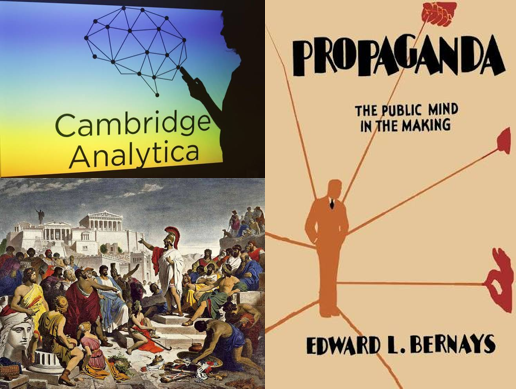
In 2016, for example, Donald Trump’s election team hired a “data analytics” firm called Cambridge Analytica, which “harvested millions of Facebook profiles of US voters […] and used them to build a powerful software program to predict and influence choices at the ballot box” (Cadwalladr and Graham-Harrison, The Guardian, 3/17/2018). With its “treasure trove of data,” the firm was able to identify and exploit the “emotional triggers” of “persuadable” voters by exposing these voters to, e.g., “images of immigrants ‘swamping’ the country” (Cadwalladr, The Guardian, 5/7/2017). While its methods were new and its technology modern, Cambridge Analytica’s object was essentially no different from that of Gorgias: to “mould the minds” of the people and thereby direct their voting behaviour.
The 2016 Trump campaign is only one example of many. Cambridge Analytica has been used by the Brexit campaign and by politicians and political parties around the world, and it is by no means the only company in the data-analytics business. Its methods are currently being used in Alberta by “foreign actors” who are attempting to spread disinformation, promote separatism, and sow division in Canada. Patrick Lennox, former RCMP director of intelligence, warns that “narratives […] are being constructed from outside of the organic Alberta domestic political process and are being imported in order to influence the discourse and the outcome of the political process” (Prince-Thauvette, CBC, 3/4/2026).
The technology of persuasion — “neuromarketing,” “neuropolitics,” “propaganda,” “rhetoric,” whatever we wish to call it — is omnipresent in the modern world. It is used by both the right and the left, and may be used for evil or for good. In Propaganda, Bernays was not arguing for how things ought to be; rather, he was attempting to describe how things were. Like Machiavelli, he was a political realist. And as a realist, he considered propaganda to be neither good nor bad in itself: “whether, in any instance, propaganda is good or bad depends upon the merit of the cause urged, and the correctness of the information published.”
Good or bad, propaganda is a powerful tool. And it is a tool that tends to be picked up by the worst people and used for the worst purposes. Adolf Hitler rose to power only five years after the publication of Bernays’s book, and his propaganda minister, Joseph Goebbels, read Bernays very closely. Today, in the United States, billionaires (and one trillionaire) exert a profound influence over state and federal elections, enriching themselves at the expense of the American people. Since, as Bernays put it, these “invisible governors” cannot “do what they want without the approval of the masses,” they strive to persuade the masses to want what they want: tax cuts for the wealthy, deregulation of private industries, cuts to entitlement programs, private rather than public health care, etc.
Propaganda is nothing new. It has been around, in one form or another, for thousands of years. But modern science and technology are making it more effective and more ubiquitous than ever. Since we cannot escape it, we must learn to recognize it. We have to recognize when our minds are being “moulded” and our unconscious behaviour “captured,” and for what purposes. We must endeavor, above all, to serve our own interests, the public interest, rather than the sinister interests of our “invisible governors.”
메타데이터
- post_id
- 32d63c8a3bb4
- slug
- a-short-history-of-propaganda-32d63c8a3bb4
- url
- https://medium.com/@seandonaghuejohnston/a-short-history-of-propaganda-32d63c8a3bb4
- canonical_url
- https://medium.com/@seandonaghuejohnston/a-short-history-of-propaganda-32d63c8a3bb4
- author_url
- https://medium.com/@seandonaghuejohnston
- status
- ok
- fetched_at
- 2026-08-22 21:39:42