Exploring Cologne & Bonn
Day 3 — Cologne is cool, Bonn is bonnie
Exploring Cologne & Bonn
Day 3 — Cologne is cool, Bonn is bonnie
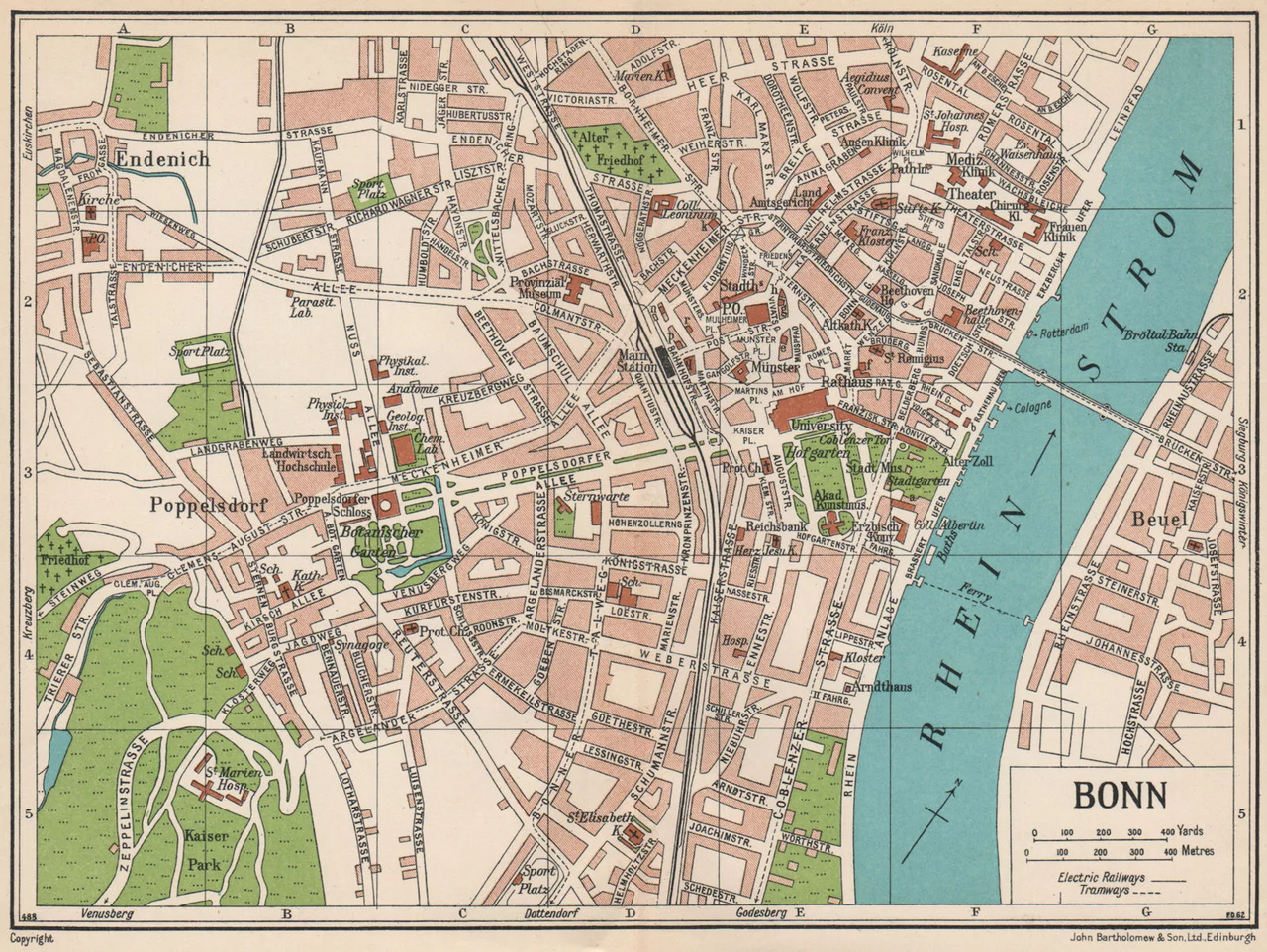
Map of Bonn from 1933 — John Bartholomew, Public domain, via Wikimedia Commons.
Since the moment the Köln trip came to mind, I had the idea to also go to Bonn. Partly because — as I touched on in my previous post — the cities are located so close to each other, and partly because Bonn had come up in some research I’d done for a historical article.
That said, on day two of the trip I was still debating whether I should visit the former West German capital. Since my stay would be short, I wondered whether I should just focus on Köln, and visit Bonn some other time. But, considering how long it took me to make the trip to the region in the first place, I eventually decided to go for it. And so after breakfast on Wednesday morning, I headed straight to the train station.
After spending some time searching for a ticket machine inside the station and on the platform, I realize I can use the Deutsche Bahn app for the local service as well. The train rolls in just a few moments later, and I spend the next 30 minutes gazing out over the southern parts of Köln, and onto the open fields that make up the space between the two cities.
My plan is to first wander through the city center, make my way to the Rhein (specifically, the Rheinpavillion café — again, related to my research), walk north along the river, then catch the cherry blossoms on Breite Straße/Dorotheenstraße, and maybe throw in some Beethoven-related stops along the way. (As a former musicology student, I do feel somewhat obliged.)
I arrive smoothly and make my way out of the train station. From there, it only takes a few minutes to get to the Münsterplatz, the central square where the beautiful (!) Bonn Minster and the Beethoven memorial statue are the main eye-catching features.

Bonner Münster. Photo by author.

Beethoven memorial statue. Photo by author.
On the opposite side of Münsterplatz, there’s a café with tables directly on the square. The sun is shining and I haven’t had coffee yet, so I sit down for a cappuccino and another short reading session.
At this point it’s already clear that what I’ve read about Bonn is true. Compared to (today’s capital) Berlin, Bonn definitely has the feel of a provincial town, and it is quite strange to imagine that it once was half the country’s hauptstadt. Compared to neighboring Köln, Bonn is greener, the pace is slower, and there’s more space here. When I’ve finished my coffee, I walk past the minster, cross Martinsplatz and continue on Am Neutor. The street soon opens up to Kaiserplatz, a green slope framed by pedestrian paths with benches and trees, and an open view which stretches all the way to Poppelsdorfer Schloß (Poppelsdorf Palace).

Kaiserplatz. Photo by author.

Kaiserplatz, with Poppelsdorfer Schloß in the distance. Photo by author.
As someone who’s visited a lot of palaces and the like for a day out with family, I wonder whether I should add Poppelsdorfer Schloß to my itinerary. While I stroll contemplating the idea, another vast, green space opens up on my left.

Hofgarten. Photo by author.
At the top of it stands an impressive, palace-looking building, which turns out to be the main building of Bonn University. Congratulations to you, students of Bonn. The building’s aesthetic is explained by the fact that it was meant to be a Kurfürstliches Schloß (Electoral Palace) for prince-elector and archbishop Joseph Clemens of Bavaria. It was designed by his court architect Enrico Zuccalli and built between 1697 and 1705.
After its completion, the palace stood for just over 70 years before being badly damaged in an extensive fire, which spread to a powder chamber and caused a big explosion. Reconstruction of the palace was initiated, but before too long (in 1794) French revolutionary troops arrived in Bonn, marking the end of the building’s use as residence for the Archbishop-Electors. Ownership eventually passed to the Prussian crown, and in 1818 king Friedrich Wilhelm III donated it to the newly founded Rheinish Friedrich Wilhelm University of Bonn.
I make my way across the Hofgarten, cross Adenauerallee and follow the sloping Erste Fährgasse down to the river Rhein. Immediately to my right is the Rheinpavillon.

The Rheinpavillon: not a bad place to go for a drink. Photo by author.

Such cool design. Photo by author.
The café offers outdoor seating on multiple levels right next to the river, as well as indoor seating on the raised level, which is shaped like a rounded rectangle, fitted with panoramic windows. The protruding flat roof, the tiled facade, the lanterns on the walls and on the terrace make for an irresistible retro aesthetic, which must’ve seemed so futuristic when the pavilion was built. I think about the part this place played in the story I researched, pause to gaze out over the river for a while and then continue my walk north.

The river Rhein, looking south. Photo by author.
Walking next to the majestic Rhein, I’m struck by how Bonn almost feels like a seaside town. This stretch along the river is spacious and clearly intended for the enjoyment of the city’s residents and visitors. In comparison, Köln’s central riverside has much more of an urban feel and is flanked by busy roads.

A pleasant walk along the Rhein. Photo by author.
When I’ve walked for a little while, observing both Belgian and Dutch flags on passing commercial ships, my gaze falls on a building facing the river, raised a little bit above the Fritz-Schroeder-Ufer.

The swanky-looking Beethovenhalle. Photo by author.
I’m absolutely mesmerized by this building, with its cool, 1950s look and by how the blue tiles perfectly match the sky above. It turns out this is the Beethovenhalle, a concert hall and event venue that reopened in 2025 after nearly 10 years of renovation.
The current Beethovenhalle is the third concert hall in Bonn to be named after the city’s big star: composer Ludwig van Beethoven. The first hall — a temporary venue built to the north of the town center — was completed about 20 years after Beethoven’s death, in 1845, to commemorate the unveiling of the monument at Münsterplatz. In 1870, a new, permanent concert hall was built closer to the river, to celebrate what would’ve been the composer’s 100th birthday. The second Beethovenhalle stood for about 70 years, before it was destroyed in WWII.
The third and current concert hall was designed by Siegfried Wolske and completed in 1959. It’s located slightly north of where the second Beethovenhalle stood. The building complex is made up of a number of different irregularly shaped cubes, all placed around the central structure — an impressive dome which contains the Great Hall. When designing the new Beethovenhalle, Wolske applied so-called “organic architecture” and, among other things, designed the dome to appear as if rising out of the Rhein, like a wave. He also had a platanus tree planted in the southern area of the site, and subsequently shaped the surrounding buildings around it.
I continue my walk and eventually turn left up Rosental. The seaside town-feel increases even more here, as I gaze at the bright residential buildings with big windows and balconies that face the river. As I walk up the incline I pass some very pretty streets with pink-blossom trees that shimmer in the spring sunshine.

A pretty name for a pretty street: Rosenstraße. Photo by author.
Further up Rosental, this Bonn street — unexpectedly and all of a sudden — turns into a road in Brighton’s Kemptown area. It’s 2009 and I can hear the seagulls crying and smell the salty sea air.

Bonn or Brighton? Photo by author.
I walk to the end of Rosental, cross Kölnstraße and decide to stop for a lunch bagel at café Milo.
Satisfied, I set off again on Heerstraße, soon realizing that I’m too early for the cherry tree blossoms. I look up at the buds on the trees lining the street, undoubtedly available in flowering form next week or the week after that.
But egal, this area north of the city center is nonetheless lovely to stroll through. It’s slim streets are very pedestrian-friendly with limited traffic, and it’s got nice-looking cafés and independent shops dotted all around.

Paulstraße. Photo by author.

Crossing Heerstraße/Dorotheenstraße. Photo by author.
I turn left on Dorotheenstraße and aim for the city center. I cross Berliner Platz and walk down Sterntorbrücke, smiling to myself as I pass by a brewery. The local beer in Köln is called Köllsch — this brewery advertises the Bonn version, Bönnsch.
I’m on my way to tick off another one of the Beethoven sights: the house where the composer was born. The pink stone house on Bonngasse 20 is unique, not only because of its former inhabitant, but also because it’s one of the city’s few remaining houses from the 18th century. Electoral court singer Johann van Beethoven and his wife Maria Magdalena moved into the garden wing of this address in 1767, and their son Ludwig was born three years later. During the four years that the young composer-to-be lived here, he must’ve been downright marinated in music, since several other court musicians also lived in the front building, across the street and in the immediate area.

The Beethovenhaus. In the background: the Namen-Jesu-Kirche church. Photo by author.
The Beethovenhaus was founded in 1889 and today the building on Bonngasse 20 houses a museum, whereas the adjacent buildings accommodate a research center and a chamber music hall.
My Bonn visit is slowly drawing to a close, as I want to fit in the Wallraff-Richartz Museum in Köln later. But as I make my way toward the train station, via the market square and Münsterplatz, I’m still considering the option of checking out Poppelsdorfer Schloß. It’s still early in the afternoon, and from the station the walk should only take about 12 minutes, so I decide to go for it.
Striding down Meckenheimer Allee gives me plenty of opportunities to gawk at some more amazing residential buildings and spring blossoms.

Prime real estate on Meckenheimer Allee. Photo by author.

Lovely lovely magnolia blossoms. Photo by author.
Just like the Electoral Palace (see above), the Poppelsdorfer Schloß was a project initiated by Archbishop-Elector Joseph Clemens. The planning and building of this Lustschloß (“pleasure palace”) started 10 years after Clemens’ residential palace was completed, in 1715. French architect Robert de Cotte sketched a sumptuous maison de plaisance, without having visited the site. Clemens asked de Cotte’s assistant in Bonn to simplify the plan, since the palace would be a mere “cannon shot from town” and because most of his posse would be returning to the city at night.

Poppelsdorfer Schloß. Photo by author.
Under Prussian rule, Poppelsdorf Palace was —again, like the Electoral Palace — donated to Bonn University in 1818. Today it houses the university’s mineralogical museum and various scientific institutions focused on e.g. geology, paleontology and zoology. It’s also shrouded in Bonn University’s botanical gardens.
I stroll along the pond that surrounds the gardens, then turn to walk deeper into the greenery and look at some of the plant beds. I follow the Sachs-Ring — stopping to remove my jacket, which has become superfluous in the mild weather — then arrive at another section of the pond, where some people have crouched down to take a closer look at a turtle.

Botanical bliss. Photo by author.

Potentially a Turkish Wood Spurge. Photo by author.

Spring flowers in the botanical gardens. Photo by author.
Wandering around the sunny botanical gardens is a lovely end to my Bonn visit. Once I’ve completed the round, I walk back to the train station, find the next train, and spend the journey back to Köln digesting the day’s impressions.
Back in Köln, I walk directly to the Wallraff-Richartz art museum. They’re supposed to have a temporary “travels of Van Gogh and contemporary peers” exhibition. I get a ticket with the Museum Card I bought the day before, drop off my backpack in the wardrobe and make my way through the glass door at the far end of the foyer. Compared to Museum Ludwig the day before, the Wallraff-Richartz is quite empty and — to be honest — not as inviting. Walking across the big, mostly empty space that makes up the foyer, through an automatic glass door and arriving on an equally empty, cold stairwell feels like entering an intimidating government authority building.

The Wallraff-Richartz Museum. Photo by author.

Palpable institutional seriousness. Photo by author.
Signs indicate that the different floors contain art from different time periods, i.e. Middle Ages, the Baroque era, etc. I can’t see any indications of Van Gogh or where the temporary exhibition is located, though. After confusedly walking up and down some of the stairs, I ask two guards where I can find it. They tell me it’s already gone to Japan. Hold on — what? I remember Japan being mentioned in connection with the exhibition on the website, but I thought that was in reference to the paintings’ motifs. It later turns out that what I thought was information about a temporary exhibition in the museum, was an update about some of the collection’s paintings going on tour in Japan.
My mistake: not reading the information on the website properly. The museum’s mistake: placing the “What’s on” tab and its content under the “Exhibitions” tab in the website menu.
A bit disappointed, I still decide to go down to the bottom floor and check out the 19th century collection, which does have some nice pieces.

Morning Sun in the Autumn by Francis Picabia (1898). Photographed by author in the Wallraff-Richartz Museum.

Walchensee-Panorama, Blick von der Kanzel by Lovis Corinth (1924). Photographed by author in the Wallraff-Richartz Museum.

Four Girls on the Bridge by Edvard Munch (1905). Photographed by author in the Wallraff-Richartz Museum.
After the tour of the basement floor, I decide to end the overall not-so-enthusiastic first visit to the Wallraff-Richartz Museum. While strolling back up Unter Goldschmied, my eyes are drawn to NOORHAUS Coffee, a small café sandwiched in on Kleine Budengasse. I bring my coffee and cake to one of the window seats and settle there with my book.
To make the most of the last rays of the day, I walk back to Heinrich-Böll-Platz, then cross the Hohenzollernbrücke to Köln’s Deutz district. Directly after the bridge on the right hand side is the Rheinpromenade — a riverside walk with steps perfect for enjoying the sunset and the Köln skyline.

Crossing the lock-clad Hohenzollernbrücke. Photo by author.

The mighty Rhein. Photo by author.

The Rheinpromenade. Photo by author.

A new perspective on Köln. Photo by author.
Read about the final day of my trip in the next post.
[embed]Write for True Travel Tales Submission Guidelinesmedium.com
메타데이터
- post_id
- 32e0fcc0837b
- slug
- exploring-cologne-bonn-32e0fcc0837b
- url
- https://medium.com/true-travel-tales/exploring-cologne-bonn-32e0fcc0837b
- canonical_url
- https://medium.com/true-travel-tales/exploring-cologne-bonn-32e0fcc0837b
- author_url
- https://medium.com/@sofia.hedberg89
- status
- ok
- fetched_at
- 2026-06-29 01:02:39