Finding Your Footing When the Ground Shifts
How does the recent Supreme Court decision on tariffs impact your right livelihood?
Finding Your Footing When the Ground Shifts
How does the recent Supreme Court decision on tariffs impact your right livelihood?

Every few years, something reminds us that small business does not live in a protected bubble.
We operate inside larger systems — economic, political, ecological — and those systems shift whether we are ready or not.
This week (2/20/2026) brought one of those reminders.
The Supreme Court of the United States issued a ruling that reshapes how broad tariffs can be imposed in this country. The legal details are complex, and the economic effects will unfold slowly. Some tariffs may unwind. Others may reappear under a different authority. Prices may soften in some places and tighten in others.
For many small business owners, the immediate takeaway is simple:
Conditions are changing again — not dramatically overnight and not uniformly, but enough to stir uncertainty. And uncertainty is something small business owners know intimately.
For solo operators, tiny teams, artists, tradespeople, farmers, consultants, and service providers, tariffs don’t show up as policy debates. They show up as higher material costs, unpredictable supplier pricing, thinner margins, delayed projects, disrupted supply chains, and cautious customers. They show up as that familiar tightening in the chest when the numbers shift — again.
Large corporations can hedge risk and spread shocks across global systems. Small businesses feel change directly, in their bodies and their bank accounts. That makes this less a political story and more a human one.
Right livelihood doesn’t promise stability
There’s a quiet misunderstanding about meaningful work.
People sometimes assume that if your work is aligned with your values — if you care about community, fairness, or craftsmanship — things will become smoother.
They don’t.
Right livelihood doesn’t promise stability. It offers coherence. It offers the ability to stay oriented when the terrain shifts.
Mindfulness, in this context, isn’t a spiritual luxury. It’s a practical discipline. It’s the ability to pause between stimulus and response and to notice fear without being driven by it. It’s feeling uncertainty without collapsing into it and facing the facts clearly, without adding drama.
That pause — the space between what happens and how we react — is one of the most powerful business tools we have.
It’s also where creativity lives.
The terrain and the cracks
The bigger economic and social systems create the terrain — and the cracks we’re looking for. People — customers, suppliers, partners, community, family, and friends — are the relationships that actually sustain our businesses. Systems shape conditions. Relationships create resilience.
For decades, in communities of small business owners, I’ve heard a simple phrase:
Learn to live with joy in the cracks.
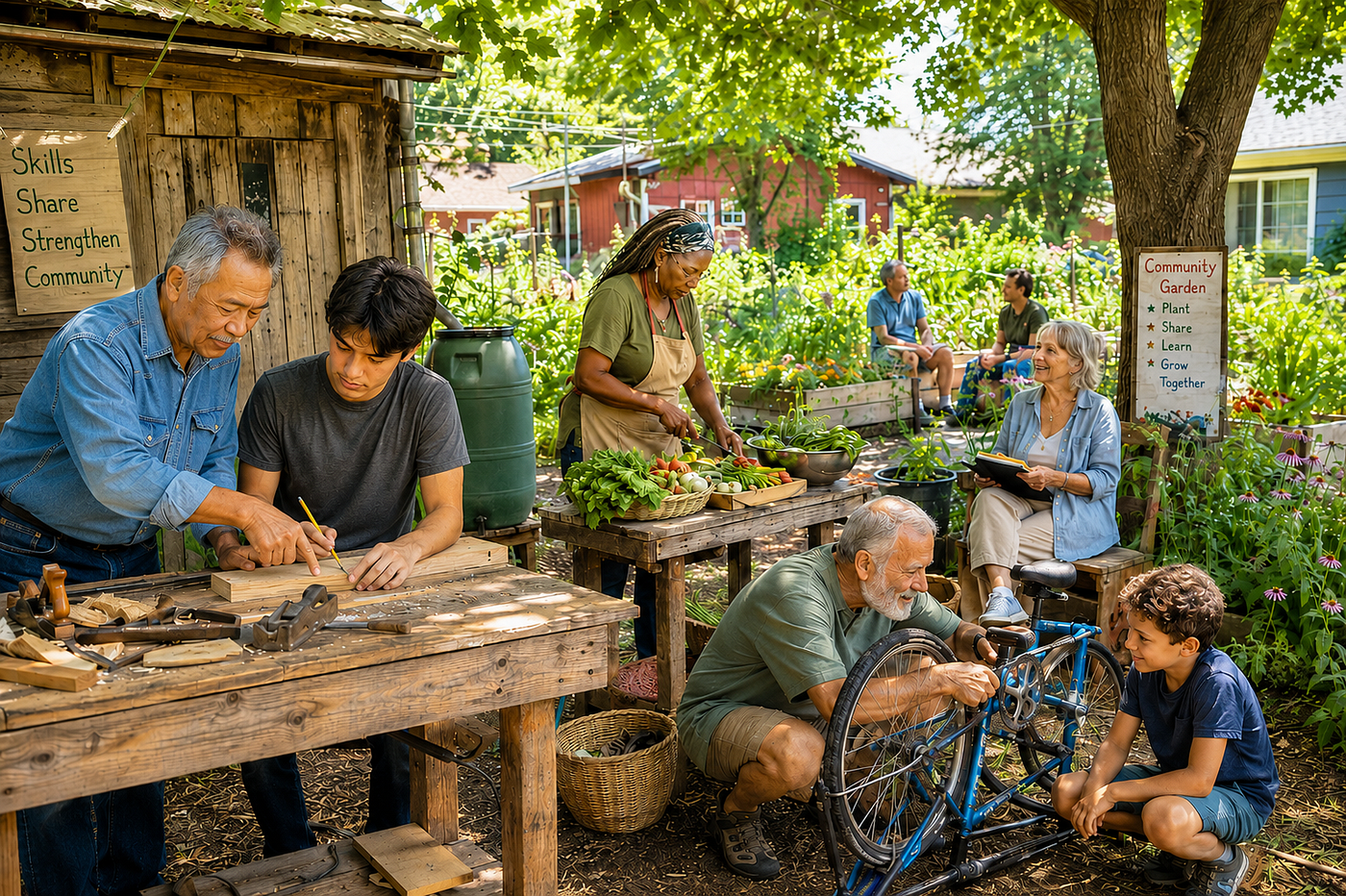
The cracks are the spaces between dominant systems. They are the local niches, the overlooked markets, the direct relationships, the small collaborations and the human-scale opportunities too small to interest large institutions.
They’re also internal. They are the pauses between decisions, the moment before sending the reactive email, or the quiet space where intuition surfaces.
Working in the cracks is both an economic strategy and a mindfulness practice.
Economically, it means building enterprises that are relational rather than transactional, adaptable rather than rigid, small enough to pivot, and clear enough to understand.
Internally, it means staying connected to your deeper orientation — even when the headlines change.
A pattern I’ve watched for decades
I’ve been involved in small business communities for more than fifty years. I’ve seen recessions, inflation spikes, regulatory shifts, technological disruption, and cultural upheaval.
Each time, the same pattern appears. Some businesses freeze. Some chase every new tactic. Some burn themselves out trying to outrun uncertainty. And some — often the smaller, steadier, more relational ones — slow down just enough to see clearly.
They simplify. They talk honestly with customers and renegotiate thoughtfully with suppliers. They adjust pricing transparently and reduce unnecessary complexity. They deepen trust, but they don’t try to outmuscle the system. They work within it, or they work around it. They work in the cracks.
And those businesses tend to endure. Not because they predicted the future but because they stayed present.
A mindful response to shifting conditions
If the ground feels like it’s moving under your business right now, here are a few gentle practices to consider. This is not a rigid checklist. Consider it, rather, an orientation.
Face the facts — without drama
Look calmly at your largest expenses. Where are you most exposed to change? Which assumptions need revisiting?
Clarity reduces fear.
Simplify where possible
Is there a product line to pause, a process to streamline, or a relationship to deepen? Simple living applies to business too. It means fewer moving parts and more breathing room.
Complexity is expensive — financially and emotionally.
Strengthen relationships
When external systems wobble, human connection matters even more.
Have one honest conversation with a customer. Schedule one open exchange with a supplier. Indulge in one thoughtful check-in with a collaborator.
Trust is not sentimental. It’s structural.
Do the numbers gently
You don’t need to obsess. But you do need to know where you stand. Cash flow clarity steadies the nervous system. A steadier nervous system makes wiser decisions.
Remember your deeper orientation
Why did you start this work? What value are you trying to create?
Meaningful work isn’t defeated by changing conditions. It adapts.
Creative resilience in the second half of life
For those of us in the second half of life, business often becomes less about expansion and more about alignment; less about conquest and more about coherence.
Creative breakthroughs don’t usually come from pressure. They come from spaciousness, from that small pause between reaction and response, from the willingness to stand in uncertainty long enough for something wiser to emerge.
That is mindfulness. That is meaningful work.
That is living in the cracks.
A brief reflection
If the shifts discussed in this essay have stirred something in you, take a few quiet minutes with these questions:
- Where am I feeling uncertainty most strongly?
- What part of this is outside my control — and what part isn’t?
- Where could I simplify, even slightly?
- Who could I reconnect with this week?
- What small, grounded action would restore steadiness?
Pause. Take one slow breath. Feel your feet on the floor. Notice that you are here.
From this place, choose your next small step. Not the entire strategy. Just the next honest movement.
Right livelihood doesn’t promise smooth terrain. It offers something better:
The capacity to stay human inside changing systems.
To continue meaningful work without abandoning yourself.
And to remember that some of the most resilient paths are found — not on the main roads — but in the quiet spaces between.
Want to Go Deeper?
📩 If this idea resonates with you, subscribe to ***Claude Whitmyer’s Meaningful Work Letters* **on Substack for practical reflections, case studies, and mindful tools for building a business with heart and purpose.
Want Support?
Reach out with questions or ideas — I’d love to hear from you.
📆 Schedule a free 30-minute discovery call (on Zoom)
👉 Reach out anytime — I’d love to hear what you’re working on, dreaming about, or struggling with.
You can visit my website contact page: https://meaningfulwork.com/contact-me/
Another place to join the conversation is by posting comment replies to any essay
👉 Share this with a friend who’s ready for their second act.
~#~
Claude Whitmyer
Author: — In the Company of Others: Making Community in the Modern World — Running a One-Person Business: Business as Lifestyle — Mindfulness and Meaningful Work: Explorations in Right Livelihood
메타데이터
- post_id
- 32e262fb5a5a
- slug
- finding-your-footing-when-the-ground-shifts-32e262fb5a5a
- url
- https://medium.com/@claude.whitmyer/finding-your-footing-when-the-ground-shifts-32e262fb5a5a
- canonical_url
- https://medium.com/@claude.whitmyer/finding-your-footing-when-the-ground-shifts-32e262fb5a5a
- author_url
- https://medium.com/@claude.whitmyer
- status
- ok
- fetched_at
- 2026-07-30 06:21:33