The SEC's quiet betrayal of main street investors
By reducing quarterly reporting to semi-annual, the agency that was created to police Wall Street is now serving it.
The SEC's quiet betrayal of main street investors
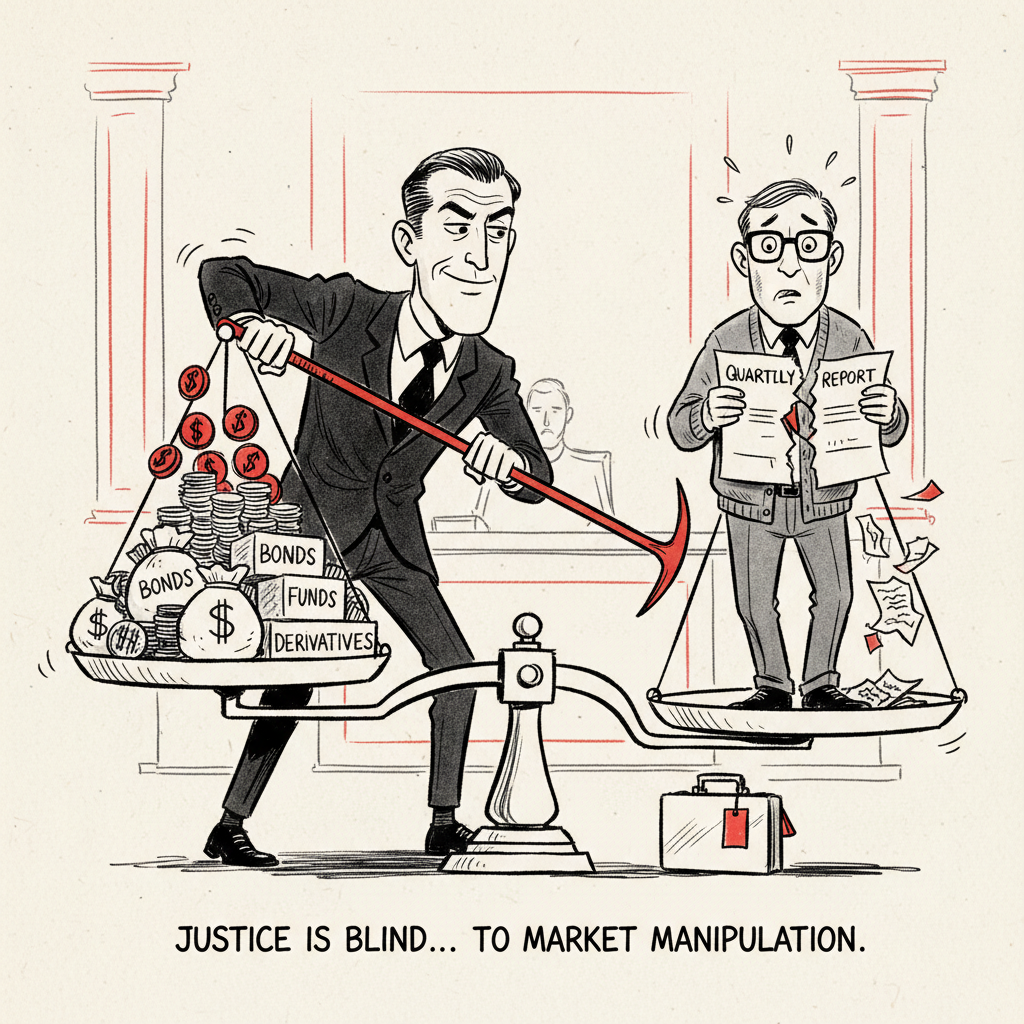
By reducing quarterly reporting to semi-annual, the agency that was created to police Wall Street is now serving it.
The mission that got inverted
On June 6, 1934, President Franklin Roosevelt signed the Securities Exchange Act into law. The legislation created the Securities and Exchange Commission with a mandate that was, by the standards of the New Deal, startlingly direct: protect investors from the people selling them stocks. FDR had watched the 1929 crash destroy millions of ordinary Americans who had been sold worthless paper by men in polished shoes. He wanted a cop on the beat.
Ninety years later, the cop has switched sides.
Last month, the SEC quietly finalized a rule change that reduces mandatory corporate reporting from quarterly to semi-annual for a broad swath of publicly traded companies. The stated rationale was "reducing regulatory burden" and "encouraging long-term thinking." The actual effect is simpler: investors—particularly retail investors who lack access to private briefings and whispered conference calls—will now receive half the information they used to get about what they own.
Richard Field, a former compliance officer who now runs a small investor advocacy group in Chicago, put it bluntly on social media last week: "Prime mover behind our rigged financial system is the SEC ... it came into existence to protect Main Street from Wall Street ... since the Reagan Administration, SEC has pursued Wall Street as its client instead."
Field is not wrong about the timeline. The agency that once forced Goldman Sachs to disclose its internal emails during the 1930s is now the same agency that, in 2024, let the New York Stock Exchange charge for market data that used to be free. The same agency that, in 2021, approved a rule allowing companies to keep executive compensation details hidden for longer periods. The pattern is not a drift. It is a surrender.
The mechanism of capture
How does a regulator become a servant of the regulated? The answer is not conspiracy. It is structure.
Consider the SEC's budget. In 2023, the agency received $2.1 billion from Congress. That same year, the securities industry earned roughly $500 billion in revenue. The industry employs former SEC commissioners as lobbyists—at salaries three to four times what they made in government. The revolving door is not a metaphor. It is a mechanical pump.
The quarterly reporting reduction is a case study in how capture works in practice. The Business Roundtable and the U.S. Chamber of Commerce had been pushing for this change since 2019. Their argument: quarterly earnings pressures force CEOs to cut research budgets and avoid long-term investments. This argument has been made for three decades. It has never been supported by empirical evidence. A 2022 study from Harvard Business School examined 2,100 companies and found no correlation between reporting frequency and investment horizon. Companies that reported quarterly did not invest less in R&D than companies that reported semi-annually.
But the lobbying machine kept running. According to OpenSecrets, the securities and investment industry spent $128 million on federal lobbying in 2024. That is more than the oil and gas industry. More than the defense sector. The SEC's five commissioners heard from industry representatives 47 times during the rule-making process. They heard from consumer advocacy groups exactly three times.
The institutional capture of information
Kristen Shaughnessy, a market structure analyst who has tracked SEC policy for fifteen years, posted a fragment from a 1990s insider that has been circulating among regulatory critics. It reads: "Neither the government regulators nor the financial industry self-regulatory organizations can correct the problem because they ARE the problem. This is the very definition of what I have come to call a Regulatory Crisis."
The observation is thirty years old. It has aged like wine.
The SEC's shift on reporting frequency is not an isolated event. It sits inside a larger transformation of market structure that has been underway since the late 1990s. When the Glass-Steagall Act was repealed in 1999, commercial banks were allowed to merge with investment banks. J.P. Morgan Chase swallowed Bank One. Citigroup became an insurance company that also ran a brokerage. Risk that had been separated by law was now concentrated under single roofs.
The result was not just the 2008 financial crisis, which cost American households an estimated $12.8 trillion in lost wealth. The result was a permanent reorientation of regulatory philosophy. The SEC stopped asking whether a product was safe for investors. It started asking whether the product generated fees for the institutions that sold it.
What semi-annual reporting actually means
Let's be concrete about the rule change. Under the old system, a company like Amazon would file a 10-Q quarterly report within forty days of the end of each fiscal quarter. Investors could track revenue trends, margin shifts, and management commentary four times a year. Under the new rules, companies with less than $700 million in public float—roughly 40% of all publicly traded U.S. firms—can now file twice a year.
For a retail investor in Omaha who owns shares in a mid-cap manufacturing company, this means an information gap of up to six months. In that time, the company could lose a major customer, face a regulatory investigation, or experience a supply chain collapse. The investor would not find out until the semi-annual report arrived—assuming the company did not quietly disclose the news in a press release buried on its website at 4:30 PM on a Friday.
The SEC's argument that this encourages "long-term thinking" is, charitably, naive. What it actually encourages is information asymmetry. Institutional investors—the hedge funds and mutual funds that sit on quarterly earnings calls, that have analysts on retainer, that can call the CFO directly—will still get the information. They always do. The SEC rule simply ensures that retail investors will get it later.
The client shift
The SEC's original mandate was structured around a simple principle: the person selling a security has more information than the person buying it. The law's job was to force disclosure. To make the seller tell the truth.
That principle has been inverted. Today, the SEC's enforcement actions against insider trading have declined 38% since 2010, according to a 2025 analysis by the Corporate Integrity Project. The number of whistleblower tips has doubled, but the number of cases opened has barely moved. The agency's Division of Enforcement is understaffed and underfunded relative to the complexity of modern markets.
Meanwhile, the SEC's Division of Corporation Finance, which writes the rules that companies must follow, has become a de facto consulting arm for the industry. Corporate lawyers call the division's staff for "no-action letters"—informal guidance on whether a proposed transaction will trigger enforcement. The division answers within weeks. The same division took three years to finalize the climate disclosure rule that would have required companies to report their greenhouse gas emissions. It then watered down the rule before finalizing it.
The pattern is clear: speed and accommodation for the industry, delay and dilution for the public.
The regulatory crisis
The SEC is not the only regulator that has lost its way. The Commodity Futures Trading Commission has not brought a major enforcement action against a Wall Street bank since 2016. The Federal Reserve's supervision of regional banks collapsed in 2023, leading to three bank failures in a single week. The Office of the Comptroller of the Currency approved a merger between two of the largest crypto custodians without requiring a single additional capital buffer.
But the SEC's failure is the most consequential because the SEC sits at the center of the market. Every stock trade, every bond issuance, every corporate filing passes through its jurisdiction. When the SEC stops enforcing the rules, the market stops functioning as a fair venue for capital allocation. It becomes a casino where the house knows the odds and the players do not.
The irony is that the SEC's own data proves the problem. In 2024, the agency published a study showing that retail investors now account for 22% of all equity trading volume, up from 10% in 2010. These are the people the SEC was created to protect. These are the people the SEC is now abandoning.
Alexander Lorenzo, a former SEC attorney who now teaches securities law at Georgetown, summed it up in a recent post: "Bank lobby groups are pushing for lighter rules on crypto than the ones they live under for stocks. To understand why regulators are alarmed, you need to see how tight the current cage actually is."
The cage is not tight. It has been pried open, one rule change at a time, by an industry that has learned that the best way to escape regulation is to capture the regulator.
메타데이터
- post_id
- 32e749cd3660
- slug
- the-secs-quiet-betrayal-of-main-street-investors-32e749cd3660
- url
- https://medium.com/@paulafraides_7063/the-secs-quiet-betrayal-of-main-street-investors-32e749cd3660
- canonical_url
- https://medium.com/@paulafraides_7063/the-secs-quiet-betrayal-of-main-street-investors-32e749cd3660
- author_url
- https://medium.com/@paulafraides_7063
- status
- ok
- fetched_at
- 2026-08-10 19:13:05