The Pulse of Financial Stability: Mastering ITSM in the BFSI Sector
In the modern financial landscape, technology is no longer just a support function, it is the product itself. Whether it is a cross-border…
The Pulse of Financial Stability: Mastering ITSM in the BFSI Sector
In the modern financial landscape, technology is no longer just a support function, it is the product itself. Whether it is a cross-border payment gateway or a high-frequency trading terminal, the underlying IT service management (ITSM) framework determines the organization’s resilience. In the BFSI (Banking, Financial Services, and Insurance) sector, where the margin for error is non-existent, Incident and Service Request management act as the primary safeguards for operational integrity.
Incident Management: Protecting Market Liquidity
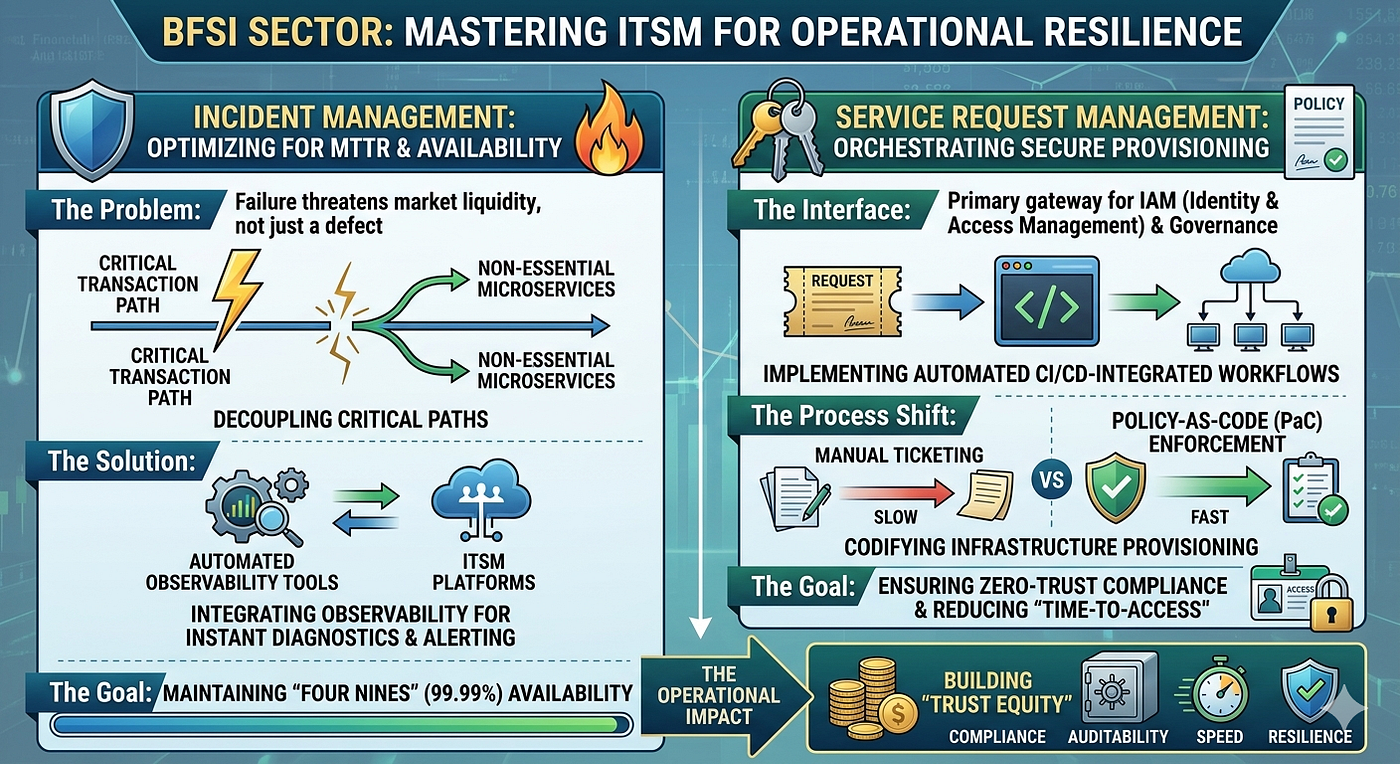
In high-frequency trading and real-time payment systems, incident management is critical because a system failure directly threatens market liquidity rather than being merely a software defect. To maintain 99.99% availability, BFSI organizations must aggressively reduce Mean Time to Resolve (MTTR) by integrating automated observability tools directly with ITSM platforms for instant alerting and diagnostics. This architectural resilience is further strengthened by decoupling critical transaction paths from non-essential microservices, ensuring that a failure in a secondary component does not trigger a cascading outage across the core financial engine.
Service Request Management: The Foundation of Zero-Trust
Service request management serves as the technical gateway for Identity and Access Management (IAM) and corporate governance, transforming how financial institutions handle secure provisioning. By implementing automated workflows integrated directly into CI/CD pipelines, organizations can replace manual ticketing with Policy-as-Code (PaC) enforcement to codify infrastructure changes. The ultimate objective is to achieve a zero-trust security posture while significantly reducing the “Time-to-Access” for authorized personnel, ensuring that compliance and speed coexist within the operational framework.
The Operational Impact: Building “Trust Equity”
For BFSI leaders, the integration of these two pillars leads to a “Shift-Left” approach to operational excellence. When incidents are resolved through automated correlation and requests are fulfilled through pre-approved, code-based guardrails, the business gains more than just uptime. It gains Trust Equity.
In an industry regulated by strict frameworks like DORA (Digital Operational Resilience Act) or SOX, having an auditable, automated, and resilient ITSM strategy isn’t just a technical advantage, it is a competitive necessity. By moving away from reactive “firefighting” and toward proactive reliability engineering, financial institutions can ensure that their digital services remain as stable as the currency they manage.
How is your organization evolving its ITSM strategy to meet the demands of modern finance? Let’s discuss in the comments.
메타데이터
- post_id
- 32e84b7ef217
- slug
- the-pulse-of-financial-stability-mastering-itsm-in-the-bfsi-sector-32e84b7ef217
- url
- https://medium.com/@jayadilshanchristopher/the-pulse-of-financial-stability-mastering-itsm-in-the-bfsi-sector-32e84b7ef217
- canonical_url
- https://medium.com/@jayadilshanchristopher/the-pulse-of-financial-stability-mastering-itsm-in-the-bfsi-sector-32e84b7ef217
- author_url
- https://medium.com/@jayadilshanchristopher
- status
- ok
- fetched_at
- 2026-06-20 20:29:01



