Stephen King’s Female Characters: The Eyes of the Dragon Has No Princesses
King’s fantasy novel doesn’t deserve its hate… but it’s still one of his sparser outings when it comes to women
Stephen King’s Female Characters: The Eyes of the Dragon Has No Princesses
A note: I have tried to recap the story of Stephen King writing the story for Naomi, often referred to as his daughter, while also respecting the pronouns/gender identity I’ve seen for Naomi King. I hope nothing written here has missed the mark.
Welcome back to Stephen King’s Female Characters! I apologize for the delay in posting; I spent the last week in Colorado, at the first annual Creepaway Camp — which was absolutely wonderful! But jet lag has put me a bit behind in this article, wherein we tackle King’s infamous fantasy novel — infamous perhaps for the fan response, almost universally dismissive — The Eyes of the Dragon.
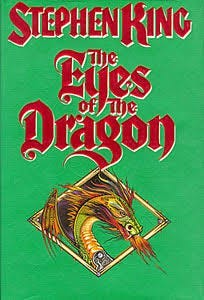
The Eyes of the Dragon is unique for a few reasons: though it wasn’t King’s first foray into fantasy, it was perhaps the most overt; it was published in a limited edition run initially, before being printed more widely three years later; and it was written in an attempt to appeal to King’s oldest child, Naomi. Bev Vincent writes,
“By the age of thirteen, … Naomi, was an avid reader but hadn’t read any of his books[1], even though [their] younger brother, Joe, had already read two. [Their] mother pushed [them] to read some horror with the idea that it would be another way for [them] to know [their] father. However, [Naomi] made it clear to him that [they] had ‘very little interest…’ He asked her what [Naomi] did like and [they] told him [they] liked dragons… Naomi, he admits, took hold of the manuscript with a marked lack of enthusiasm, but he was rewarded. The story kidnapped [them] and the only thing wrong with it, [they] told him later, was that [they] didn’t want it to end.”

Though King originally was only writing for Naomi, he eventually decided to publish a limited run for Christmas presents, as he had done previously. He called it a story aimed just as much at children as adults. Reportedly, however, fans weren’t happy with the so-called shift in genre: George Beahm’s *The Stephen King Story claims that fan reactions to TEOTD inspired Annie Wilkes in Misery. James Smythe describes hating the book as a teenager, before a reread. Richard Chizmar admits to having waited nearly thirty years to pick up his copy. Gregory Quinn wrote a 2020 article called “Why Does No One Love ‘The Eyes of the Dragon?’” While love for this book has come to the forefront in the age of the Internet, it’s still arguably one of the least talked-about books in King’s backlist, and one of the few with no adaptations (attempted or otherwise). It’s almost funny, in the age of Game of Thrones* spin-offs, that no one has tried to make a miniseries about the kings of Delain…

I came to TEOTD late myself, reading it at work in ’23. It’s not my favorite King, but I don’t hate it at all — it reminds me of some of my favorite plotlines from ASOIAF/Game of Thrones, and I’m almost always down for a medieval fantasy romp. Additionally, as much as I want more of a certain kind of novel from King (I’m guilty! I admit it!)… I also hate the idea of writers being forced and trapped in a niche — like Paul Sheldon, like King. Most of my favorite authors either work in cross-genres, or dabble in many different genres; and it’s what I want for myself someday. Personal preferences aside, I hate that King apparently caught a lot of flack for venturing outside of his genre — something he did for a loved one! But I’m glad he had fun with it, and I’m glad it exists.
I debated whether or not to include TEofD in SKFC… after all, I said no Dark Tower, and I decided not to do The Talisman or Insomnia (at least not yet), for the sake of simplicity. Now, I haven’t read either of those books, and I’ve heard that Talisman doesn’t get explicitly Tower-y til Book 2. But I have read Eyes of the Dragon before this series… and aside from hints at the multiverse at the end, the only Tower-link I can identify is Flagg… who originates in The Stand, which I’ve already covered. Two other major factors: Dragon is short, and it barely has any female characters to evaluate. In theory, that allows for a simple article.

The Eyes of the Dragon is a fairytale, written explicitly in fairytale style (complete with an omniscient narrator, described alternatively as “an omniscient wizard… with a personality” and soothing — “it feels almost as if King is sitting next to you, shutting a book and telling you it’s time for bed” — by Smythe). It holds up as a piece of epic fantasy that could arguably stand with Tolkien (a big influence on King), C.S. Lewis, or George R.R. Martin. TEOTD keeps a gripping pace with short chapters, plotting magicians, a royal family in turmoil, rebels, romance, and all the courtly medieval-esque action you could hope for. Chizmar calls the novel
“Stephen King channeling William Shakespeare… ghostly visions and foreboding dreams. Double-crossing villains and wrongly imprisoned heroes and dark secret passages that look upon a King’s lair. We have treachery and secrets and deceit galore. Balancing the scale, we have wisdom and courage and loyalty. All this wrapped up in a timeless ancestral power struggle.”
Its fantasy setting doesn’t prevent flares of King-like nastiness: boogers, farts, kicking dogs to death, poison that burns your insides, messages written in blood. A huge, destructive storm accompanies the climax, as in It, Bag of Bones, or Duma Key. Randall Flagg, the “Dark Man” from The Stand, appears in what is arguably a more menacing role than in his first appearance. Additionally, TEOTD is not without some King-cringe sexytime scenes (what the Loser’s Club podcast calls “Pound Cake”), including the first introduction of Peter and Thomas’s mother, Sasha: “When, on that occasion, she observed his flaccid penis, she asked with great interest: ‘What’s this, husband?’ […] ‘It is King’s Iron[…] before the forge.’” Additionally, after Naomi Reechul kisses Ben, he “[looks] as if he might be on the verge of ‘bursting his brains.’” (Gregory Quinn: “Stephen King wrote this book for his then 13-year old daughter. This sounds adorable until you read it and by like page five, Stephen King is describing in detail the waning libido and erectile dysfunction of the Delain king… Oh, to have Stephen King as a dad.”)
There’s also barely any dragons.

The titular Eyes of the Dragon refer to the method which Thomas uses to spy on his father, Roland… and through which he witnesses Flagg’s murder of Roland. Flagg’s murder weapon is a poison called Dragon Sand. But the only dragon we see that isn’t a taxidermied head is the dragon, Niner, that Roland kills and beheads at the beginning of the novel.

The original title for the book was apparently Napkins, which makes a lot of sense: napkins almost have more to do in this story than dragons, a disappointment for some readers. Richard Chizmar recounts his reaction to this:
“I even found myself emailing Steve one morning in early May and mentioning my wariness in passing and asking (in a hopeful moment) if there were at least maybe a lot of cool dragons in the book. Steve answered something to the effect of, ‘Well, actually, there’s only one dragon, Rich, and it dies right in the beginning of the book.’My mind immediately flashed a warning siren: Son of a bitch! I knew it!”

TEOTD is a Martin-esque drama of kings, dragons, loyal servants and friends, questions of heirs, and what it means to be a good man. The story is as follows: King Roland has two sons, Peter (who everyone adores), and Thomas (who resembles his father). The scheming magician Flagg frames Peter for Roland’s poisoning, believing Thomas will be an easier king to control… but the titular eyes of the taxidermied dragon means Flagg had a witness: the new King Thomas. It’s short (for King) and simple, a familiar tale, but with King’s own brand of character development and sympathy.
The interesting thing about this fairytale written for King’s daughter is that there are almost no women in it. One of the sole two important female characters is explicitly named for her (Naomi Reechul for Naomi Rachel). The novel provides lots of fantasy fun… but for a story written for King’s daughter, The Eyes of the Dragon has a stunning lack of dragons or women doing things. Like a lot of King’s books, the default character in this story is pretty much “man,” from Peter to Thomas to Flagg, to King Roland, to Ben Staad and Dennis and Peyna, to pretty much every servant we see in the castle. Women are referred to as a part of the society, and a couple get narrative chapters. A midwife, Anna Crookbrows, kills Queen Sasha for Flagg (because Flagg had healed her son). Brandon’s wife and Dennis’s mother — called “Mrs. Brandon” — narrates the chapter setting up Peter’s imprisonment, and the kingdom’s view. King Roland was the successor not of his father, but of his mother, the Dowager Queen Lita, an “ugly but good-hearted and strong-willed” woman who chokes to death on a lemon slice. And maybe it makes sense that women have almost nothing to do in this pseudo-medieval society… except I can’t really understand why a kingdom would let a dowager queen — a woman presumably not born into royalty — rule for years after her husband’s death… but not let any other women have important roles in society.
Why couldn’t any other characters have been women?! Ben, Dennis, Anders Peyna… even Thomas or Peter could have been very interesting, if gender-swapped. Roland’s preference for one child over another could be rooted in gender; Flagg’s control over the throne could boil down to misogyny: believing a queen would be easier to manipulate; or perhaps, being more intent on preventing a female Peter from being crowned, the spitting image of her mother. Dragons and princesses is an ancient trope: Perseus and Andromeda, St. George and the dragon, Daenerys Targaryen, even 1959’s Sleeping Beauty. It almost seems a given that there would be women in peril from dragons, women fighting dragons, or both; but that’s not the way this story goes.

“Dragon and Captive painting” by dashinvaine
Maybe it’s ridiculous to make a fuss, knowing that one of King’s major inspirations was Tolkien, of the few women characters… but C.S. Lewis was also surely an inspiration; and though I didn’t read all the Narnia books, I know they’re full of interesting women: Susan and Lucy Pevensie, Jill Pole, Mrs. Beaver, Polly Plummer. But in The Eyes of the Dragon?
In the end, there’s really only two women important enough for us to discuss.
Three, if you count the dog.
Queen Sasha
Sasha, the young wife of Roland, mother of Peter and Thomas, and beloved queen of Delain, is portrayed as the moral center of the book. She is dead before the story begins, fridged by Randall Flagg — who is sure she will foil his Dastardly Plans — but her beliefs, lessons, and influence color the rest of the story, keeping her name invoked until the end. Peter is good because he is like his mother, and was taught the best of his philosophy by her. Thomas is led astray partially because he never knew his mother — and partially because his father prefers his brother, disliking the parts of Thomas that resemble Roland himself.

“A Little Prince likely in Time to bless a Royal Throne” by Edmund Blair Leighton (1853–1922)
Sasha’s characterization is pretty slight: she is “good” and “beloved.” Roland chooses her, out of a selection of brides presented by Randall Flagg, because “she seemed the quietest and the meekest… and the least likely to frighten him.” Her goodness is defined simply: she creates a hospital, lowers taxes, influences the end of bearbaiting. Despite Roland’s genuine love for his wife (as we are told), he has relations with her infrequently, and usually after Flagg gives him a potion for stamina. The exception is the conceiving of Peter, which happens after Roland has killed a dragon and eaten its raw heart. Flagg orchestrates the conception of Roland’s second son, Thomas — whose birth Flagg is “the author of… and the Chief Warder of his life” — and Sasha dies giving birth. This is revealed to be a piece of Flagg’s plot: he blackmails a midwife, whose son he’d healed, to murder Sasha because “Sasha had broken Flagg’s power over Roland a little,” through kind, just, and practical advice. It was not his first attempt to do so, ruined only because Flagg was sure he’d be caught.

Flagg’s first attempt
On first glance, Sasha might seem like nothing more than Flagg’s first victim, intended to make the reader sad and angry. And she does serve this function; but she also, as I’ve mentioned, is the story’s moral center. It’s Sasha who gives Peter, the good boy born to be king, the lessons he carries throughout his life, which ultimately save him. The first motif Sasha introduces is the near-eponymous napkin: after an important dinner with his father, Sasha scolds Peter for not using his napkin, and teaches him the “two natures of men”: GOD and DOG… “most bad people are more like dogs than devils… When dogs are excited and confused, they may bite; when men are excited and confused, they may fight… if a pet is all a man is, he is a bad man, I think.” This is one of the last lessons — perhaps the last lesson Sasha delivers, as she dies shortly after.
The second artifact Sasha leaves her son is her dollhouse… one of the few personality traits we get for Sasha outside of “good” and “meek.” Sasha had a beloved dollhouse as a child, which she missed upon marriage; Roland commissioned a new dollhouse for his wife, with multiple working appliances, including a stove, spinet, spinning wheel, and hand pump. Though Sasha does not play with this new dollhouse, the way she did as a child — “There was no fun making ready for a pretend party at which the Queen would be in attendance when she was the Queen… being a grown-up was not quite what she suspected it would be” — it becomes Peter’s favorite toy. Flagg advises Roland that Peter should not be playing with a dollhouse, and Roland permits him to continue because he sees Peter keeping Sasha alive through the dollhouse.
Sasha disappears from the story early, physically… but she haunts the narrative throughout. And it is her lesson about napkins, as well as her dollhouse, which helps to orchestrate Peter’s escape. The narrative reiterates the idea that Peter playing with the dollhouse is unseemly and unmanly; Flagg notes it, as does Roland and Peyna. But it is Peter’s sensitivity that saves him, right alongside the children’s toy with a functioning loom. All of this because of Sasha’s influence on her son. In fact, the memory of Sasha teaching Peter about the nature of man is what Flagg sees when he is begging to understand what is happening. Peter hears his mother’s voice as the voice of reason during his terrifying escape.

As the moral center, and arguably the lynchpin, of the whole story, Sasha occupies a unique role. It’s a shame she’s not given more to do on the page.
Naomi Reechul
Naomi Reechul first appears in the build up to Dragon’s climax. When Judge Peyna and his butler Arlen go to find exiled rebels, Naomi — the oldest daughter of a husky farmer who runs correspondence — is the one who guides them. She drives a team of twelve huskies, smokes an “evil-smelling” cigar, carries a shortsword, and collaborates with the rebels. She’s knowledgeable about dogs and the weather, and Ben Staad describes her as “fearsome enough alive” when she jokes of haunting him.

“I can read the clouds as well as you, Ben Staad. And the fairies have made a ring around Prince Ailon’s head.” — Naomi, Chapter 94
Naomi is, of course, named after King’s daughter; and Ben Staad is named for Ben Straub, the son of Peter Straub, King’s good friend and co-writer. The Loser’s Club episode on *Eyes of the Dragon* jokes about how weird that might have been for the eponymous Ben and Naomi; but it’s far from the first time a writer has named characters after real people! One can see the fatherly intention behind creating a strong female character who is also surrounded by beloved dogs. Naomi is a fun, interesting character, clearly meant to appeal to the fantasy-loving kid she was named for — and in this vein, I feel she mostly succeeds. My biggest complaint is that there isn’t more of Naomi… that she only appears in the latter 70% of the book.
The plotline of the rebels is tragically underdeveloped, and Naomi is the only rebel we really get to know (besides Ben and Dennis). We stay with Peter and Thomas for most of the story, so the first whispers of rebellion we hear are rumors that fleeing nobles have banded together in the woods to “plan an overthrow of the throne.” We see these rebels only briefly, when Naomi takes Anders Peyna to Ben Staad, and has to deliver a password. After that, we are only on the road with Naomi, Ben, Frisky, and eventually Dennis.

“Whiteout Run,” by Kiliii Yuyan
In her sparse appearances, Naomi is characterized as wise, experienced, and very loving to her dogs, with an ounce of sarcasm and wit as she trades flirty insults with Ben Staaad. She’s characterized almost as a tomboy: “‘I’ve never been one of your skittish little girls who screeches at the sight of a mouse or a spider… but I wake from that dream wanting to scream aloud.’” She has premonitory dreams about Flagg, and references “fairies” or “the gods” more often than most characters in this novel. The only time she messes up in the novel is when she calls out for Frisky in fear, when Frisky has fallen through the frozen moat. She’s also the one to initiate the romance with Ben, kissing him first after they’ve spent most of her scenes flirting. She has a lot of autonomy and a strong will; but the narrative doesn’t give Naomi much to do with those characteristics, besides bicker/flirt with Ben, and worry about her dog.
One of the more frustrating parts is that Naomi is there for the climax… but after a certain point, all she does is gasp, cringe, and kiss Ben. Her last line of dialogue is “‘Why doesn’t he move? What’s wrong with him?’” when Peter is dangling from the tower. (Also, Naomi’s cry is what alerts Flagg to the rebels’ presence, a throwback to Naomi shrieking for Frisky, that altogether leaves a bitter taste in my mouth: why is she shown messing up so often?) Naomi helps pile up the napkins, to break Peter’s fall, but she’s not the only one who works on this. Frisky is given lots more specific tasks and roles than her mistress by the end.

Not pictured: Naomi and co stacking napkins
Even Frisky is given more to do in the final scene than Naomi, who just sits around while everyone else talks. I suppose, in King’s defense, Ben doesn’t do all that much, either, after a certain point (apparently Ben, Dennis, Brandon, and others had an increased role in the rewrites)… but it’s still frustrating that in a fairy tale written for his daughter, King has two female characters (aside from unnamed mothers), and one of them stops passing the Sexy Lamp Test before the end of the book. We’re told in the final lines that Naomi and Ben marry, and that’s it.
You could even argue that Naomi doesn’t have that much effect on the plot after she takes Peyna to the rebels’ fort. Sure, she is the one who suggests that Frisky tracks Dennis… but after that, Frisky is the one leading the charge, not Naomi. Ben and Naomi spend long pages tracking Dennis, and then Naomi stands around while Frisky does all the heroic work. We even spend more time in Frisky’s head than Naomi’s after a certain point.

Not pictured: Naomi and co. standing off to the side
The romance between Ben and Naomi is cute, and Naomi is a fascinating and capable character… in what little time she’s given. But Eyes of the Dragon is a short book (for King) with a lot going on, and this is the subplot of a subplot. You even get the sense that King wouldn’t have bothered to include this character at all, if he didn’t want to pay tribute to his daughter… and even then, it’s kind of baffling to me that the story has so little to do with 1. dragons, and 2. women. I’m not here to speculate about how Naomi King’s reading tastes or how they reacted to the book; King family stuff is none of my business, and reportedly Naomi enjoyed the novel! But since this is the story — King wrote a fantasy book for his daughter; it’s the origin I’ve heard for TEOTD long before I ever picked it up — I can’t help but evaluate its intended purpose, vs how it actually lands. And while TEOTD is a gripping, fun fantasy novel, a children’s tale, I was genuinely surprised, when I finally read TEOTD, because the book veered pretty far off from my preconceived expectations — tiny though they were… that there might be more than one or two important women running around.
On paper, Naomi is great, and easy to enjoy: she’s badass and fearsome, ready to do sword battle for her king. Maybe Naomi being the most forward female character (despite affecting the plot the least) is an attempt by King to be feminist… and indeed, it doesn’t entirely fail. But as I’ve said before, the strength of female characters, to me, does not mean physical strength; but rather, characters written with the same complexities as men. When we get so many different types of men — good, bad, misguided, manipulated, and more on the morally grey side — it’s disappointing that Naomi and Sasha are so one-note: the Good Queen; the Strong, Capable Rebel.
Frisky

Frisky is an Anduan husky, Naomi’s favorite (and a mistress Frisky loves deeply), and the smartest, with “almost human [grey-green] eyes.” She is skilled among the other dogs, seemingly not even winded after a hours-long run that exhausts her fellow dogs, and she waltzes in victory with her mistress, Naomi. She’s also an expert tracker, leading Naomi’s huskies in a quest to find Dennis, the butler, her nose “like the eyesight of a man with the gaze of a hawk.” She’s shown to be highly capable in the final quest for freedom, first locating Dennis with her nose; and she’s implied to be the bravest: “Even Frisky, with her brave heart, felt afraid [of Flagg].”
It’s worth mentioning that Frisky, is also a girl… a welcome change from the wonderful — but mostly male — pets of the King canon: Kojak, Cujo, Church, none of which I can discuss as they deserve because they’re boy dogs. (If there’s a stranger or more pedantic sentence to write, I can’t think of it.) (Also, it’s a shame the first major female animal character’s name is tantamount to a sex joke… but, I mean, this is King we’re talking about.) BUT! Frisky was not always a female dog! Bev Vincent writes that “Other changes reflected the fact that the book hadn’t been previously copyedited. The genders of Frisky the dog and Peony the horse switched back and forth in the original.”

The locket Dennis carries to safety
Frisky’s narration is almost identical to Cujo’s or Kojak’s: Naomi is THE GIRL, Ben is THE TALL BOY. King uses the omniscient voice to provide details the dog couldn’t possibly know, but still gives us enough of the pooch’s interior to give us an impression of who she is: a loyal dog to the end, of course.
If King has written a true BADDOG, I don’t know about it. Frisky gets her own GOODDOG moment: “Now she bit down on something and dragged it out of the loose powder. She turned to Naomi, eyes asking: Now am I a good dog or what? What do you think?” She almost seems to have telepathy with Naomi at times, knowing when to keep quiet and follow a scent. It is also Frisky that figures out that the bad smell, in the pipe where they find butler Dennis, is the remaining Dragon’s Sand — the poison that killed King Roland. She stays with our heroes til the final celebration, and King Peter even pours her some wine of her own, “which she [lapped] with cheerful enthusiasm (she liked the smell, which was a cool, velvety purple; not as good as the taste, but almost).”

If there’s anything King does well, it’s writing animals with all the sympathy and complexity of humans, and Frisky is no exception. Though you could arguably cut her, she ends up having as much significance in the story as the mice Flagg tests his poison on. It’s ironic, though, that she is arguably given more to do than either major female character; even more when you realize Frisky was originally a boy. Does King think only men can get anything done? A larger look at his backlist says No, but in the world of Delain, women don’t get much to do besides standing around being inspirational. All the coolest roles for women (who aren’t gender-swapped dogs) are almost entirely offscreen.
Still, Frisky is a GOODDOG to remember. It’s too bad King Peter probably killed her by giving her wine.
Does the small amount of women doing interesting things ruin The Eyes of the Dragon? I definitely don’t think so… the same way Tolkien’s sausage-fest doesn’t ruin Lord of the Rings. TEOTD is still a fun book, that most fantasy readers can enjoy; and maybe I’m being too hard on King. Naomi and Sasha are interesting, despite their flaws. In fact, my main complaint isn’t about what’s on the page, so much as I wish there were more of it. Part of the idea behind SKFC is to push back against the idea that the default character is male. It’s an idea King defies often, in women-focused books — *Carrie, Dolores Claiborne, Rose Madder* — but struggles with in his early works. That’s why so many of the characters we’ve discussed so far are wives, mothers, or love interests. For every Carrie White, there’s a Susan Norton. For every Donna Trenton, Charlie McGee, Charity Camber, or Sue Snell, there is a woman defined simply as Good; or a woman getting outshined by her dog.

Many of you might be expecting me to walk away from this series with a straightforward verdict: Stephen King is great at writing women! or King can’t write a woman to save his life! I don’t really expect that myself. There may be a surprise around the corner, but I suspect my verdict will be the same in a year as it is now: It’s complicated. Sometimes he’s on fire, and sometimes it feels lazy. When King tries, he’s usually really cooking, but…
In the end, it’s all about the nuance.
(Join me next time for a nuanced favorite: IT, Beverly Marsh, and the novel’s complicated legacy)
메타데이터
- post_id
- 32efa0cd6696
- slug
- stephen-kings-female-characters-the-eyes-of-the-dragon-has-no-princesses-32efa0cd6696
- url
- https://medium.com/@graceterryfier/stephen-kings-female-characters-the-eyes-of-the-dragon-has-no-princesses-32efa0cd6696
- canonical_url
- https://medium.com/@graceterryfier/stephen-kings-female-characters-the-eyes-of-the-dragon-has-no-princesses-32efa0cd6696
- author_url
- https://medium.com/@graceterryfier
- status
- ok
- fetched_at
- 2026-07-08 18:29:56