The Learning Rate: The Number That Decides Whether a Model Learns or Fails
There is a moment in every training run when everything hangs in balance.
The Learning Rate: The Number That Decides Whether a Model Learns or Fails
There is a moment in every training run when everything hangs in balance.
- The architecture is ready.
- The dataset is cleaned.
- The loss function is defined.
- The GPU is set.
After that, training begins.
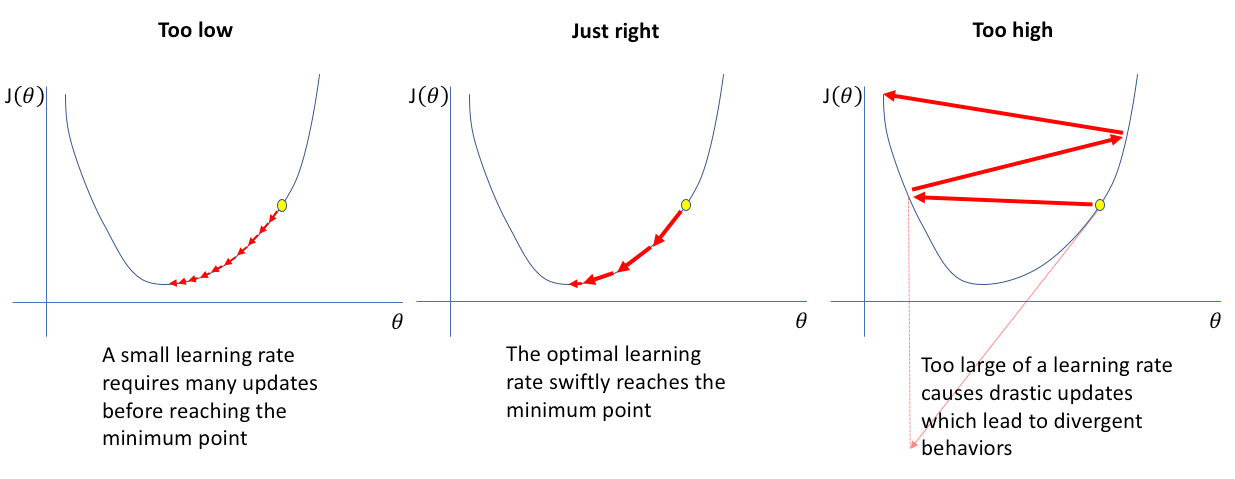
Source image
What most people don’t realize is that at this very moment, one small number decides whether the model will learn beautifully, struggle endlessly, or collapse entirely.
That number is the learning rate.
It does not attract attention like transformers or billion-parameter models. It does not appear in research headlines. Yet from the first gradient update to the final convergence, the learning rate controls the speed, stability, and convergence during training.
Training Is Motion
At its core, machine learning training is a process of motion through a landscape.
Imagine a vast terrain of hills and valleys.
- The height of the terrain represents the loss
- The error between predictions and ground truth.
- The model’s parameters are like a traveler trying to descend to the lowest valley.
- The gradient tells us which direction slopes downward.
- The learning rate decides how large a step we take in that direction.
Too large a step, and we leap over the valley. Too small a step, and we barely move.
Training is not just about direction. It is about controlled movement.
And the learning rate controls that movement.
When the Learning Rate Is Too High: Chaos Disguised as Speed
A high learning rate feels ambitious. Progress looks fast. Loss might even drop sharply in the first few iterations.
But then something important happens.
Instead of descending smoothly, the model begins to bounce. It overshoots the minimum. It jumps from one side of the valley to the other. The loss fluctuates wildly.
In deep networks, this instability can cascade. Large updates amplify activations. Amplified activations inflate gradients. Gradients explode. Numbers overflow. Loss becomes NaN.
Training doesn’t fail because the model is unintelligent.
It fails because the system became dynamically unstable.
A high learning rate injects more energy into the optimization process than the landscape can absorb. The model stops learning and starts oscillating.
Speed without control becomes destruction.
When the Learning Rate Is Too Low: Safety That Stalls Progress
Now consider the opposite extreme.
The learning rate is small. Very small.
Updates are stable. Nothing explodes. The loss decreases slowly, carefully, politely.
But it barely decreases.
The model crawls. What could have been learned in ten epochs now takes hundreds. Flat regions of the loss surface trap the model. Shallow local minima become resting places. Training consumes time and computational resources without meaningful improvement.
Worse, the model may appear underpowered. It seems to underfit, not because it lacks capacity, but because it was never allowed to move far enough to discover richer representations.
Too little energy, and the system never escapes inertia.
The Real Role of the Learning Rate: Stability vs Progress
The learning rate is not merely a hyperparameter. It is a stability regulator.
It balances two opposing forces:
- Progress
- Control
Too much progress without control leads to chaos. Too much control without progress leads to stagnation.
The optimal learning rate sits in that narrow region where movement is decisive but stable where the model descends steadily rather than violently.
This is why learning rate tuning is not cosmetic. It is foundational.
Optimizers Help But They Do Not Replace It
Modern optimizers like Adam adaptively scale gradients. They normalize updates. They track momentum. They make training more forgiving.
But even Adam bows to the learning rate.
The global learning rate still sets the scale of updates. Too high, and divergence returns. Too low, and learning slows dramatically.
Adaptive methods refine direction. The learning rate defines magnitude.
Magnitude remains decisive.
Why Modern Training Rarely Keeps It Constant
In sophisticated systems, transformers, large language models, vision foundation models the learning rate is rarely static.
Instead, it evolves.
Training often begins with a warmup phase, where the learning rate starts small and gradually increases. This prevents early instability when gradients are unpredictable.
Later, it decays. As the model approaches a minimum, smaller steps allow fine-grained refinement.
This dynamic scheduling mirrors how humans learn:
Big conceptual adjustments early. Precise refinements later.
A constant learning rate ignores the changing needs of the optimization process. A scheduled one respects it.
The Hidden Impact on Generalization
Here is something even more subtle.
The learning rate does not only affect how fast a model converges. It influences where it converges.
Research has shown that higher learning rates can help models escape sharp, narrow minima and instead settle into flatter regions of the loss landscape regions often associated with better generalization.
So the learning rate shapes not just training stability, but the very geometry of the final solution.
It influences whether the model memorizes or understands.
The Small Number with Enormous Authority
From the first update to the last, the learning rate determines:
- Whether gradients stabilize or explode
- Whether training converges or diverges
- Whether optimization is efficient or wasteful
- Whether the final model generalizes well
Architecture defines possibility. Data defines knowledge. Loss defines objective.
But the learning rate determines whether learning meaningfully unfolds.
It is the quiet authority behind every successful training run.
Final Reflection
In machine learning, we often chase complexity. Larger models. Deeper layers. More parameters. More compute.
Yet sometimes success hinges not on adding more but on choosing the right step size.
The learning rate is a small number with disproportionate power. It is the difference between motion and instability. Between noise and convergence. Between effort and mastery.
In the end, training is not just about intelligence. It is about balance.
And balance begins with the learning rate.
메타데이터
- post_id
- 32f4fc2e13d1
- slug
- the-learning-rate-the-number-that-decides-whether-a-model-learns-or-fails-32f4fc2e13d1
- url
- https://medium.com/@ml-point/the-learning-rate-the-number-that-decides-whether-a-model-learns-or-fails-32f4fc2e13d1
- canonical_url
- https://medium.com/@ml-point/the-learning-rate-the-number-that-decides-whether-a-model-learns-or-fails-32f4fc2e13d1
- author_url
- https://medium.com/@ml-point
- status
- ok
- fetched_at
- 2026-07-18 10:24:39