The Backbone of Longstanding Community-Driven Impact
Learnings From Pioneers in the Sustainable Agriculture and Organic Farming Movement in Chiang Mai in Northern Thailand

The Backbone of Longstanding Community-Driven Impact
Learnings From Pioneers in the Sustainable Agriculture and Organic Farming Movement in Chiang Mai in Northern Thailand
The sun is starting to rise up gently behind the misty mountains and the lush green skyline, covering the thick forests, rice fields and wooden thatched houses in an orange hue that stretches into the distance as far as the eye can see. The mild fog and freezing cold from the night are gently dissipating, welcoming the morning reddish sun rays and the warmth they bring along. Roosters around the numerous farming lands and villages crow in a harmonious chorus to the magnificent sunrise, while the Karen people, inhabitants of Chiang Mai and major indigenous people of Thailand, greet the new day with the closeness of their family around a peaceful yet vigorous bonfire.
What makes the region of Chiang Mai in Northern Thailand so extraordinary beyond its breathtaking landscapes, community-oriented lifestyle and wholehearted people? Chiang Mai is a role model on sustainable agriculture and organic farming, and key to their success is their shared societal and cultural beliefs, needs, behaviours and practices for a long-lasting and community-driven impact.
This article deep-dives into this topic and presents insights and conclusions collected through observations, interactions and interviews with different inspiring initiatives across districts in the region of Chiang Mai for two weeks in December 2019. In total, four pioneers within the sustainable agriculture and organic farming movement were interviewed: Nor Yatee Salaithongpres from Huay E-Khang, Amnnay Niyompainiwet (Kwiv) from Lapato Organic Coffee in Nong Tao, Mathana Aphaimool (Pui) from Mae Tha Sustainable Agriculture Cooperative, and Suwitra Wongwaree from Chant Calm Village. You can get to know more about the interviewees and their inspiring initiatives at the end of this article.
While every initiative and its leader are unique, they share four commonalities that compose a strong backbone to support meaningful and sustainable impact. All four initiatives place community and the environment at the core of change and driver of all decisions, with a shared purpose to facilitate community self-empowerment. In order to achieve this, they maximise civic engagement and challenge business-as usual and ultimately create and sustain an open systemic framework for self-sufficiency, leadership, knowledge exchange and co-creation of impact.
These sustainable agriculture leaders and pioneers in Chiang Mai have been able to not only challenge the system limitations, society’s beliefs and agriculture restrictions, but also mobilise entire communities for being their own drivers and implementors of enduring meaningful change.

Landscape and farming fields around Mae On district in the province of Chiang Mai
Farming practices in Thailand: The paradox of agricultural progress
As the world evolves around us so do the societal beliefs, systems and behaviours. The proliferation of the world has opened up opportunities once upon beyond imagination, but it also has imposed challenges and detrimental consequences on our society that can critically affect a sustainable management of our lands and forest and hence the environment and wellbeing of communities.
In the early 1950s, the agriculture industry changed dramatically. More commercial agriculture practices embedded with chemical use started to take off, having considerable consequences from a sustainable, health and financial perspective. Agriculture expenses kept increasing due to the use of herbicides and pesticides. This led to both challenges in supporting educations and younger generations needing to migrate to cities and smaller towns such as Bangkok in the pursuit of opportunities and a better life, as well as villagers starting to borrow to sustain these new farming practices, indebting many of them.

Pui’s family home and organic farm in Mae On
In the 1980s a common consciousness and an intrinsic motivation to challenge modern agriculture started to rise, questioning their real health, environment and community consequences and advocating for a return to organic farming. Multiple initiatives and movements were born and continue to rise up in the region of Chiang Mai to bring back what once was standard agriculture practice. As shared by the interviewees, at its core organic farming has an impact on the environment by using more sustainable processes and positively maximising natural resources, as well as on the society by facilitating fair trade, increasing health and empowering the community. Advocates of chemical farming arose as well, challenging the value of organic farming and the financial implications of these agriculture practices. The paradox at hand is that the price of pesticides and herbicides keeps growing, leading to unfair prices, high production costs and farmers’ debt.
There is a societal fallacy that places organic farming as a less viable option due to its low potential for high quantity of produce and scalability. However, organic farming is a long-term investment as revenues keep getting higher and expenses lower as time passes by. On the contrary, conventional farming has become more and more expensive to practice as the pesticides and herbicides prices keep getting higher and the soil quality deteriorates. Furthermore, there are high environmental implications due to ecosystem degradation, chemicals in crops and soil degradation.
“Why organic farming? Prices of fertilisers and pesticides are going higher and higher, the health is going down and the price of the produce decreases as well.” — Kwiv (Lapato Organic Farming)

Villagers working on their farms around Huay E-Khang
“Before all pesticides were introduced, my dad’s parents relied on organic farming procedures, and it worked. […] His biggest challenge was getting started and breaking taboos from people about the success potential of organic farming. There is a whole paradox of money: unfair price, high production costs and debt” — Pui (Mae Tha Sustainable Agriculture Cooperative)
What made those initiatives possible and facilitated them to not only to challenge people’s beliefs and the system on the value of and the need for organic farming, but also brought people together and provided the foundations to achieve a common goal? What is the backbone of these initiatives that achieved such an exceptional longstanding community-driven impact?

Who: Community and environment as the beating heart of change
Highlighting the meaningful purpose from these initiative that drives all decision-making and action-taking processes helps understand their progress. What all of the interviewees’ stories have in common are purpose-driven roots towards their community and the environment around them: they aim to make the world a better place. At the core of these initiatives, people and planet become the never-changing North Star that supports them in the identification, definition and execution of each and one of their decisions and actions. Success for these initiatives is not measured by financial achievements, but rather by the real impact created on a society- and environment-level.
“If you want to take this journey, it’s not about the money.” — Suwitra (Chant Calm Village)
“Find what makes you passionate and dedicate your energy and time to it. Share your passion and support others with it. If you are only driven by profit that’s not going to be enough, you need to have a more meaningful purpose.” — Kwiv (Lapato Organic Coffee)
People
The community, and family in its purest form, is a fundamental pillar not only for personal development on both an individual and a collective level, but also as a source of happiness and wellbeing. This is especially observable in smaller indigenous Karen villages such as Huay E-Khang, where the belief of the family as key to a healthy and meaningful life is shared amongst all villagers. It is both inspiring and reflective to see how these mindset and lifestyle clash with the individualistic perspective of, for example, the life in cities or those in Western countries, where the independence of the individual and more social distance are claimed as sign of personal development, strength and satisfaction.
“Family is the core of support and development, we work in the fields but we have a more meaningful and fulfilled life.” — Yatee (Huay E-Khang)
On the one hand and looking at the process, organic farming is seen as community-driven and teamwork-based: relying on family and sharing the effort to move together, as well as involving the community and other farmers. On the other hand and from a result perspective, organic farming aims to have a positive impact on the community from both a health and financial perspective.
“There is a belief that organic farming won’t support farmers. But it’s not only about yourself: you cannot do organic farming alone, it’s a community effort.” — Pui (Mae Tha Sustainable Agriculture Cooperative)
Planet
The core of these initiatives is a shared respect to and embracement of the planet, by bringing more sustainable practices while maximising natural resources in a symbiotic way. Their goal is to ultimately fight ecosystem degradation, chemical in crops and soil degradation.
“The path to a meaningful success is being more mindful about the resources and the environment when setting up solutions for change.” — Kwiv (Lapato Organic Coffee)

Our team enjoying the company of Yatee and her family during lunch in Huay E-Khang
Why: Facilitate community self-empowerment
In the case of the observed initiatives and the interviewed pioneers, sustainability and social development go hand in hand in the pursuit of a common shared goal: challenge the status quo, create meaningful change and bring impact for future generations.
Their shared baseline is a lack of reliability and support from other external parties (such as the government or the pesticides companies) to get things done and achieve that goal. They realise along the way that they need to be independent if they want to thrive. Change has to happen from within the community, and instead of relying on external parties these initiatives have a shared ownership for change to happen and for the community to develop.
They hence aim to facilitate community self-empowerment to be able to achieve their aimed change. This self-empowerment is constructed upon two principles:
- For the community, by the community. The community becomes the own driver, promoter and implementer of impact. They do not wait for or rely on the government and other external parties to support them, but rather are themselves the intrinsic force of change.
- Being proactive rather than reactive, taking change on their own hands.
In all the interviewees’ cases their ideas required a shift of society’s perspective, mindset and beliefs in order to join efforts to make their ideas happen and bring the impact they aim:
- Yatee, from Huay E-Khang: Her case is specially focused on the defense of rights and development of their village and the villagers that co-exist with her, as well as the natural surroundings and lands. They needed to protect their national park and where they live to not be displaced, but realised along the way that they could not rely on the government to defend those rights and those of their lands, which created a shared responsibility over the problems the community faced.
- Kwiv, from Lapato Organic Coffee: More and more farmers rely on external companies for pesticides and fertilisers, and they become financially dependent on those materials to execute and success on their work. Communities realise that they need to be independent to thrive.
“For younger generations, once they understand the system and the food chain manipulation that exists in farming, they’re prepared for it, can survive in and take advantage of it.” — Kwiv (Lapato Organic Coffee)
- Pui, from Mae Tha Sustainable Agriculture Coop: In monocrop farming farmers relied on a middleman to bring and sell the produce, creating high risks and dependencies over their business and finances. By creating a big community group for shared support, they skip this middleman present in conventional pesticide-based farming and are able to buy and sell products themselves. Furthermore, once the cooperative was established they also experienced a lack of things being done as well as of real support from the government. They had protests because their lands are at the Doi Khun Tan National Park and they needed to protect their forest. They took it in their own hands and went to talk to the leader of the local government, to set up their own legislations and laws regarding forest management. Now every village has a committee for forest management, and every time that for example someone wants to build a house or do something that affects the forest, they first need to consult with that committee.
“Local and city governments also joins the meetings of Mae Tha Coop. Even the Prime Minister joined 5 years ago, when he gave us a certificate to spend 30 more years doing organic farming in the national park. He said that we’re a role model for other provinces in Thailand.” — Pui (Mae Tha Sustainable Coop)

Suwitra helping out at Pui’s organic farm in Mae On
How: Maximise civic engagement and challenge business-as-usual
Based on the paradigm shift required to change society’s beliefs and political systems over the value of going back to organic farming practices, these initiatives needed to achieve a level of awareness and adoption within the community through civic engagement and by challenging business-as-usual.
Civic engagement through sustainable activism and community trust
Sustainable activism makes use of vigorous campaigning, communication and engagement of the community and facilitates people’s awareness regarding the current situation, the necessity of change and the opportunity to do so by working together. Furthermore, in order to make the community believe in it and work together, there needs to be trust. In some cases such as Yatee, being the daughter of the leader of Huay E-Khang and being born in the community, trust is a given (although it needs to be nurtured). On the other hand, as an outsider of the community, trust needs to be organically constructed for you to become part of the community. In the case of Suwitra, her friendship with Yatee kept growing stronger as new interactions, sharing of experiences kept happening, and once invited to her house, she organically became part of it while respecting their culture, taking part of her activities and contributing to it, e.g. as a chef sharing her skills as well as her love for food with Yatee’s family and cooking for them.
“Trust is key to work with these communities: you need to make them trust you […] One day, Yatee’s family said ‘this is so beautiful and delicious, you’re part of us now’. ” — Suwitra (Chant Calm Village)
Challenge business-as-usual through exposing yourself to different worlds and building a strong purpose-driven corporate identity
The interviewees’ initiatives achieve an outstanding and inspiring balance between old- and new- thinking: they have an intense pride of their history, origin and vision and use them as a core to drive their escalation and growth, while at the same time they share a fast-forward thinking to evolve as the world changes around them. In order to challenge business-as-usual, we observed that the interviewees both involve themselves and learn from diverse worlds and experiences, as well build and maintain a strong purpose-driven corporate identity and business rationale.
On the one hand, all interviewees expose themselves to different worlds and points of view (e.g. culinary, corporate, research, city vs. village), as well as live diverse experiences, which provide them with such a wide spectrum of skills and multidisciplinarity that they are able to gain this systems thinking and navigate the problem-solving space in a better way. Participants were exposed to different types of thinking, people and experiences that gave them hands-on life and business skills to tackle future problems. Examples include Suwitra, whom during her career gained experience from the culinary, corporate and research worlds that facilitated her to increase their network and drive more impact-oriented initiatives; or Yatee, who went to study in a bigger city, where she met people, got in contact with other Thai and internationals. She learnt about business and other culture’s practices, gained hands-on knowledge about how to sell for example things such as avocado, fruits and textiles. She also grew her network and gained deep understanding of crucial applicable market skills, such as market fluctuations and how offer-and-demand work.
“Being abroad opened my perspective on consuming only cared resources: products that take care of soil and the future of next generations.” — Suwitra (Chant Calm Village)
On the other hand, and as basis of any social entrepreneurship endeavour, it is key to build a strong purpose-driven corporate identity and business rationale: having a primary mission or focus on giving back or making the world a better place, while leveraging the advantages of being a for-profit. As truthfully, meaningful and idealistic any initiative might be, bringing change in the world needs to be financially sustainable in the longer run, otherwise nothing will happen. What all interviewees have in common is that their initiatives started to take shape and transformed into a business, while they never lost sight of what the purpose of their idea was and its community-driven vision. They built a strong corporate identity around their ideas, as well as rethought the business rationale and processes around it without loosing sight of their meaningful core. This sets them apart from traditional business structures and beyond social entrepreneurship. For example, Kwiv knew that agricultural practices from conventional farming are not a one-fits-all solution that can be directly applied to organic farming and models cannot be interchanged. In the case of Mae Tha Sustainable Coop in order to make organic farming economically viable they had to build strong network and systems to support their future success and escalation. This is why the cooperative was established in 2001. It was built upon a CSA (Community-Supported Agriculture) business model, through which consumers put money in advance as an investment for the farmers, and they get the produce after. They moved from a house delegate delivering the produce around Chiang Mai to a Community Enterprise without changing its core.
“My dad was always different, challenging the conventional farming techniques. His biggest challenge was getting started and breaking taboos from people about the success potential of organic farming.” — Pui (Mae Tha Sustainable Coop)

Yatee preparing the hemp for charcoal in Huay E-Khang
What: Open systemic framework for self-suffiency, leadership, knowledge exchange and co-creation of impact
In order to achieve the above mentioned, all these initiatives make use of an open systemic framework based on self-sufficiency, community leadership, knowledge exchange and co-creation of impact. Key to understand this open systemic framework is Suwitra’s Chant Calm Village, aimed at connecting and bringing people together through travel for a meaningful purpose. As she explained to us, she wants people to come not only for the long-term but for really executing work that matters and exchange knowledge for a good purpose. She envisions Chant Calm Village as a platform to connect people and the wider community, to attract those that embrace meaningful work and are happy about what they do.
“I get this amazing feeling when working together with people, not even on a formal set-up. We’re quite informal, we’ll do things along the way and we don’t really need media to connect with each other” — Suwitra (Chant Calm Village)
There are four common denominators of this open systemic framework within sustainable agriculture and organic farming: self-sufficiency, leadership, knowledge and experience exchange, and co-creation.
Self-sufficiency
Sufficiency economy is the name of a Thai development approach attributed to the late King Bhumibol Adulyadej’s “sufficiency economy philosophy” (SEP). It has been elaborated upon by Thai academics and agencies, promoted by the Government of Thailand, and applied by over 23,000 villages in Thailand that have SEP-based projects in operation. All these initiatives follow self-sufficiency as principle and philosophy through two lenses. On the one hand, core of organic farming in Chiang Mai is about fulfilling yourself before the rest of the market: first make sure you produce to sustain your own life, your family and then the community and ultimately serve the rest to the market (Suwitra and Kwiv). On the other hand, self-sufficiency is also about being satisfied and moderate about who you are and what you have (Pui). This ultimately has an impact on the increase of awareness and empowerment of local produce. We tend to wrongly assume that international is better and at many times underestimate the real quality of local produce. These initiatives believe in this and the potential of local networks to take the community and their sustainable resources to the next level.
“You cannot be successful if you don’t understand what self-sufficiency means, it’s the organic farmers’ mindset.” — Suwitra (Chant Calm Village)
Leadership
These initiatives need an inspiring initiator and people-driven leader that not only makes the community believe in an idea and involve them for pushing it forward, but also has the holistic understanding and know-how for implementation. These leaders also have a connector personality: people who thrive from facilitating people to have opportunities for change and being exposed to knowledge and experiences as them. They are innate at identifying people’s skills and willingness and connect them with other initiatives for a symbiotic thrive.
“My dad was a change-maker: you need a strong leader who believes and empowers the idea and pushes it forward no matter what.” — Pui (Mae Tha Sustainable Coop)
Knowledge and experience exchange
Being exposed to other cultures, experiences, knowledge and ways of thinking is the best way to broaden your mind and look at things from a different way: that one of achieving a better care for the people around you rather than yourself, as well as for the environment. For example, at Mae Tha Sustainable Coop they are open to both conventional (pesticide- and chemical- based mono crops and contract farming) and traditional organic agriculture, to learn from each other. If those who practice conventional farming want to make the change, the cooperative supports them. Furthermore, one of their key strategies is rooted in building group participation by exchanging knowledge and experience between members, as well as connecting business partnerships in the community. Within this context, education plays a vital role in as means of connection: teaching each other different skills and empowering self-growth through interaction and connection. As Suwitra explained her learning model with us, it is about matching professionalism with the local context.
“You need to communicate the meaning of the environment to everyone and set a dialogue between each peer […] At the end of the day those who understand it and can exchange knowledge really involve and embrace sustainability.” — Kwiv (Lapato Organic Coffee)
Co-creation
It is crucial to have a good mix of multidisciplinary and diverse skilled people, with hands-on knowledge to mobilise findings and more people. As the interviewees stated, it is about working together, hands-on on solving sustainable projects: e.g. involving the real farmers and producers in the co-creation and execution of the process (Suwitra).
“There are two aspects to make people understand sustainability: hands-on, showing people the benefits, and connections, people and network.” — Kwiv (Lapato Organic Coffee)

Landscape and farming fields around Mae On district in the province of Chiang Mai
Looking back and reflections
It does not stop to cease me the power of truly purpose-driven connections, and how knowledge, mutual understanding and a shared mindset can lead to meaningful change.
From this highly educative and reflective experience and the conversations with the interviewees some mismatches between mindsets, lifestyles and generations stood out to me. Of course nothing is back or white and there is no single truth and one mindset, lifestyle or generational perspective that fits-it-all.
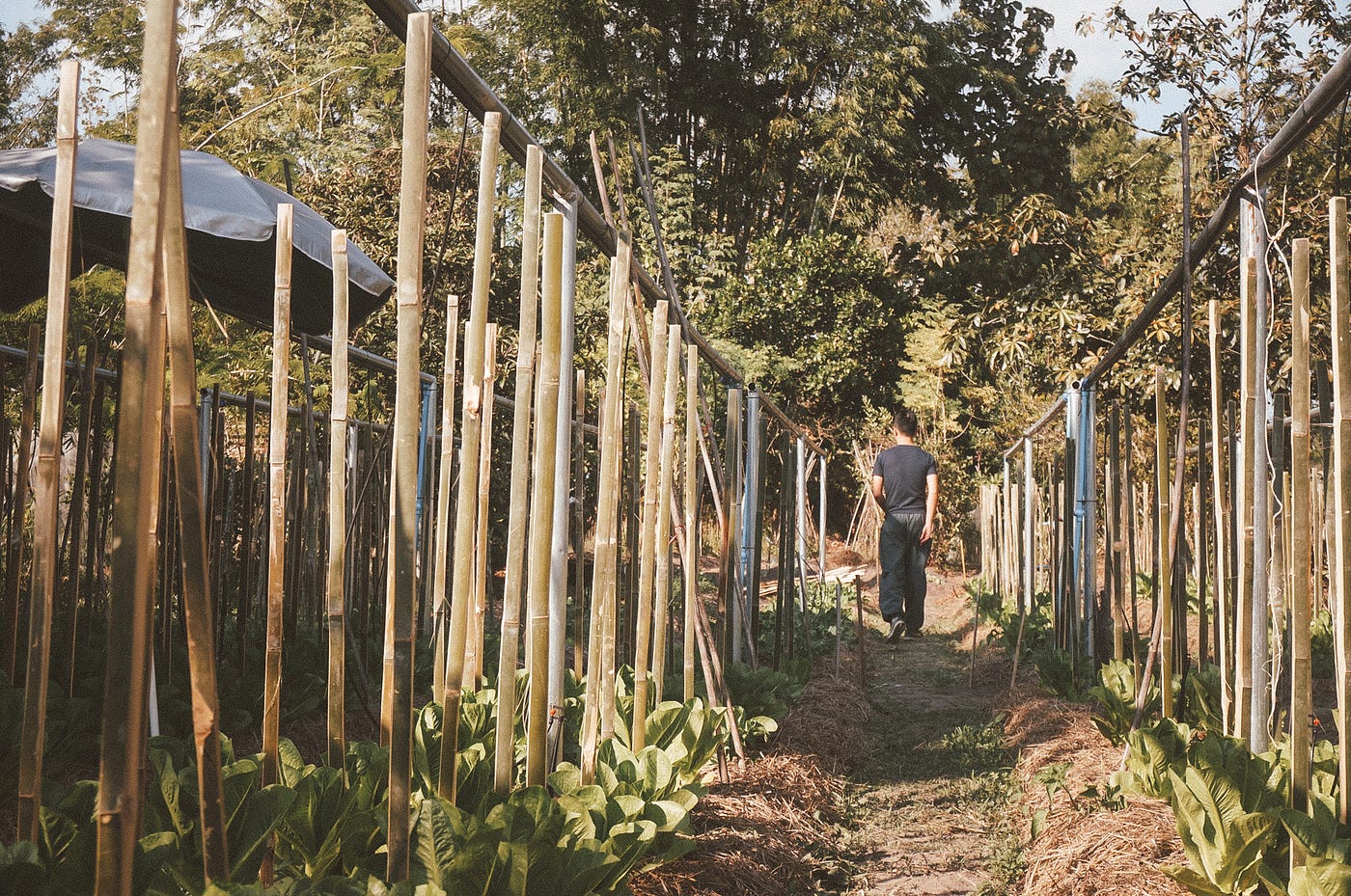
Aik walking around Pui’s organic farm in Mae On
Mismatch #1 — Mindset: developed countries (individualistic and dependant) vs. developing countries (collectivistic and self-empowered)
Some developing countries and societies can be experienced as more collectivistic, for which the key to a meaningful life is growing in a community, support each other and being connected in a human way. On the other hand, more considered developed countries are becoming more individualistic and separating from what it is the core of the human-kind: socialisation. It can be even questioned whether there is a shared feeling of community and true belonging anymore. Some efforts from companies and even the government are happening to bring this sense of community back, which is a paradox in itself as this feeling cannot be forced or pushed and needs to happen gradually and naturally.
“If you have family, you have everything you need.” — Yatee (Huay E-Khang)
Furthermore, on more developed countries society is dependent on external parties to solve our problems, which leave us in a disadvantageous way and people have become more reliant on others. More developing countries and communities might be hence seen as more self-empowered.
“We live in a world with intense diversity. We need connection, make people connect to each other easier and make them feel a sense of fraternity and to care beyond themselves.” — Kwiv (Lapato Organic Coffee)

Collective lunch with Yatee’s family in Huay E-Khang
Mismatch #2 — Lifestyle: city vs. village
People in the cities tend to look down on the people at the village, there is a stereotype that they are uneducated and they do the hard labour simply because they might not be able to do anything else. But people in the villages are skilled with hands and execute problem-thinking and -doing through their hands.
Furthermore, some younger generations go in search for the promised “good life” in the city, to realise that they become slaves of the system and how much happier they were before when they lived in the village. But sometimes even if they become aware of that they cannot up upon it as they have a big debt with the government for the studies, which they need to pay off by staying and working in the big city.
“Everyone in the village goes to the city in search of ‘the good life’. Then they realise of the good life here with the family.” — Yatee (Huay E-Khang)

Farming fields around Huay E-Khang
Mismatch #3 — Generation: older vs. younger
As in every society but specially visible in this context, younger generations are modernising and traditions are gradually shifting. This is not a bad thing, but experienced problems with younger generations is that sometimes they gradually forget about the life in the village and the family and become more individualistic and leave the village (mismatches 1 and 2) and they need to start valuing more and worrying about each other and beyond one-self.
“We need more young leaders for sustainable agriculture and community resilience.”— Pui (Mae Tha Sust Coop)

Yatee’s family at an evening collective bonfire in Huay E-Khang
In conclusion, it was identified that there are four key ingredients for longstanding community-driven impact: placing community and the environment at the core of change and driver of all decisions, facilitating community self-empowerment, maximising civic engagement and challenging business-as usual and ultimately creating and sustaining an open systemic framework for self-sufficiency, leadership, knowledge exchange and co-creation.
Within those there are five key takeaways that determine the success of any meaningful and purpose-driven endeavour:
- Connection and education as means for change, and building meaningful relationships where there is symbiosis in the form of knowledge exchange and human growth. The community needs to be a safe space for sharing, where all members are educators, as well as knowledge providers and receivers. From the lens of education, children become the advocators and implementers of change. There is a key value of education as a driver to produce this change, to make change happen from within by activating and empowering the younger generations.
- People-oriented mindset, where the focus is shifted from organisations into specific individuals that, not only will be impacted by the initiative, but also will be part of it, and where success is measured by the impact on society and the planet. This can fail when people look exclusively at the financial terms and uniquely at income, instead of long-term benefits in terms of e.g. skills, expertise and knowledge exchanged and community growth.
- Long-term view where contribution is placed based on real impact and longer interventions: e.g. meaningful ecotourism, where communities get in-depth experience and exchange real development.
- Iterate and co-create: Let people in those communities evaluate their success framework and what the index is. Test collaboration and cooperation for each of the initiatives that take place, specially for ecotourism.
- You need strong leaders and connectors. People are afraid to change, so you need to create the community and shared belief for something better through leadership and connection.
“They push the human race forward, and while some may see them as the crazy ones, we see genius, because the people who are crazy enough to think that they can change the world, are the ones who do.” — Steve Jobs
The incredible people who made this happen ❤️
I cannot be thankful enough for the amazing adventure I was able to take part during those two weeks in December 2019. Co-living, truly connecting, interviewing and learning from pioneering local communities and leaders in the sustainable agriculture and community resilience movement in Chiang Mai in Northern Thailand.

Thai flag blowing in the wind in Bangkok
This project resulted from a conjoined cooperation aimed to boost ecotourism and sustainable agriculture in Thailand, together with a group of sustainability activists and education advocates from both Thailand and Singapore. The purpose was to interact, interview, learn and support pioneers within the sustainable agriculture and the organic farming movement in Chiang Mai. The goal was to collect and make tangible their stories in order to share it with the people and inspire others around the globe to start such a movement.
I am speechless about the learnings and inspiration gained from these amazing people, their meaningful stories and priceless insights on what drives them and their ideas, as well as what it takes to mobilise an entire community for a true people- and environment-driven goal. We most of the times come here to support them, but we should reflect more on the countless things we can learn from them and admire how self-empowered and driven these indigenous communities are.

The team (Aik, Ethel, Yongsong and me) together with Kwiv and his family at Lapato Organic Coffee
Thank you for making me feel so welcome and teaching me so much about community empowerment, sustainable agriculture, self-sufficiency, persistence and moving forward with a common rooted goal combined with fast-forward thinking.
Thank you to the amazing and wonderful Suwitra, for taking us as one and making basically everything happen, you are truly an inspiration. Thank you to the rest of the team (Aik, Ethel and Yongsong) for the heartening discussions, your curious and creative mindset, the laughs and the problem-solving breakthroughs — and of course, thanks for the professional pictures.
My warmest thank you to each and one of the participants, for opening not only their homes but also their hearts to us, and for making us part of something greater than ourselves and for showing us that change is possible, if you believe it and work hard together.

Nor Yatee Salaithongpres from Huay E-Khang village, a Karen indigenous village.
Matriliniar village is composed of more or less 600 people, counting with around 150 households. Karen people are also inhabitants of parts of Burma, Laos and Thailand, practiced rotational farming, cultivating rice and seasonal vegetables. Practices of Animism, Buddhism and Christianity, Karen people’s traditions are roots are well-grounded into their community, social and cultural affairs, and their lands. Karen people build a sense of community and purpose as they face together challenges such as the Thai Government’s non-recognition of their rights over their land, the change and limitations of conventional agriculture practices and the modernisation and mismatch between Karen youths and older generations. Nor Yatee Salaithongpres is the daughter of the village leader and involved and working with Suvitra for social development and sustainability. Empowerment of the community. Went to study in the city, looking for the “good life”and in the end she came back because the village is truly the good life to her. She’s been an inspiration for many other people of their generation.

Huay E-Khang Village, 13/1 m. 1 Mae Win, Mae Wang, Chiangmai. Education Program and Visitors: +66 85 715 9679. Nor Yatee Salaithongpres, Founder #womanwhofarms: Che su mo, Karen Textile, Organic Sugarcane Syrup, Organic Heirloom Rice, Organic Avocado, Organic Honey, Organic Persimmon and Seasonal Foraged and Wild Plants.
Amnnay Niyompainiwet (Kwiv), founder of Lapato Organic Coffee.
Lapato Organic Coffee is located under the shade of forest and along the edge of paddy field in Maewin subdistrict, where coffee trees have grown fruitfully for over 20 years. It is an economic crop generating income for many Karen households who have relied on forest for their living. Lapato Organic Coffee truly believes that there is no need for chemical fertilizer because the falling leaves is a good natural compost. Kwiv was offered a scholarship for studying but he’s a true believer of the philosophy of passion and learning by doing. Find your passion, whatever it is, and dedicate yourself to it. Explore and experiment. He had a dream of coffee beyond a commodity, but rather something that everyone can enjoy and brings people together.

Lapato Organic Coffee, Nong Tao Village. 104 m.4 Mae Win, Mae Wang Chiangmai. Mr. Amnuay Niyompainiwet (Kwiv), Founder and Head Producer (+66 84 687 7945): Learning about wisdom and sustainable living, organic and shade grown coffee production, internship and visitors. Organic products and Coffee Merchandise: Ms. Sunanta — Co Founder (+66 81 7166913).
Mathana Aphaimool (Pui), from Mae Tha Sustainable Agriculture Cooperative.
Mae Tha is a community in the region of Chaing Mai, just at the border with the region of Lampang, sub-district of Mae On. It’s located in a valley and is composed of 7 villages. Most people star in the area near the Mae On river, and there are around 4,500 people, 99% of those being farmers. Just outside of Chiang Mai, a community called Mae Tha has long been known for its dedication to organic farming. In 2000, a group of farmers formed the Mae Tha Sustainable Agriculture Cooperative and committed their farms to the organic methods. This began as a small endeavour, but has since grown to now include 500 members. Organic farming in Mae Tha, however, did not begin with the co-op. The farmers today take pride in telling me about their families’ long history of organic farming. Spurred by environmental concerns and the health risks farmers face from the harsh chemicals, their ancestors abandoned chemicals and started using sustainable methods to farm before “organic” was mainstream. Maethana Aphaimool, 2nd generation of the pioneers into organic farming and sustainable agriculture, following the example of her dad Pat Aphaimool. Their mission statement is “Young Leaders for Sustainable Agriculture and Resilience”.

Contact: mataorganic@hotmail.com. Mathana — Organic Seeds (+66 85 032 6642), Maetha Organic Cafe and Coop (+66 88 7704643), Mr. Apisak — Visitors Information (+66 87 1915595) and Mr. Doe — Maetha Organic Delivery (+66850326642).
Suwitra Wongwaree, chef, community leader and sustainable activist, from Chant Calm Village.
Interviewee was our host during our 8-day stay, and she’s a real connector between sustainable initiatives, sustainable activist and community leader. She started as a chef and also worked doing some research, plus she gained experience in the corporate world working as an assistant of a real estate professor. Connecting initiatives and using food and education as a means of connection, growth and change drive and implementation. She envisions CCV as a platform to connect people, to attract those that embrace meaningful work and are happy about what they do. She wants a platform to connect to the wider community. Connecting projects and initiatives.

Chant Calm Village Gallery and Bed, 58/2 m. 3 Pa Bong, Saraphi, Chiangmai. Chef Suwitra Wongwaree, Founder (+66 94 603 8222): Accommodation, fine dining and education services.

In loving memory of Pat Aphaimool. Thank you for teaching us all that change is possible if you believe and work hard enough for it, together 💛
Thanks for reading! What are your thoughts on the impact of sustainable agriculture and organic farming practices? Do you have any experience with implementing longstanding community-driven change? I’d love to hear about them, so please share your comments and remarks below!
If you enjoyed this article, be sure to click the clap icon👏 to applaud and so others will see it.
메타데이터
- post_id
- 32fc8376e50d
- slug
- the-backbone-of-longstanding-community-driven-impact-32fc8376e50d
- url
- https://medium.com/@everoots/the-backbone-of-longstanding-community-driven-impact-32fc8376e50d
- canonical_url
- https://medium.com/@everoots/the-backbone-of-longstanding-community-driven-impact-32fc8376e50d
- author_url
- https://medium.com/@everoots
- status
- ok
- fetched_at
- 2026-06-20 20:29:01





