I Built a Database to Fix the One Thing Universities Are Embarrassingly Bad At
Somewhere in a university right now, a faculty coordinator is digging through their inbox trying to find a research paper submitted three…
I Built a Database to Fix the One Thing Universities Are Embarrassingly Bad At
Somewhere in a university right now, a faculty coordinator is digging through their inbox trying to find a research paper submitted three semesters ago. It’s buried under 847 unread emails, sandwiched between a reminder about a faculty potluck and a reply-all chain about parking permits.
The paper exists. Probably. Maybe. In a folder called final_final_v2_REAL.xlsx.
This is the state of academic research management at most institutions — and I decided to do something about it.
The Problem Nobody Talks About (But Everyone Suffers Through)
Universities produce an enormous volume of research every year: student submissions, faculty publications, conference papers, journal articles, department archives, reviewer feedback. The knowledge is there. The organization is not.
The result? Duplicate records nobody catches. Missing metadata that makes papers unsearchable. No centralized storage, poor collaboration, and zero access control. And somewhere in every department — one exhausted faculty member holding the entire system together through sheer institutional memory, one resignation away from total collapse.
Modern research platforms have already solved this: searchable metadata, structured repositories, collaborative workflows, version tracking. The tools exist. Most universities just haven’t built them internally.
So I built one.
What I Built: University Research Paper Management System
The University Research Paper Management System is a database-driven platform designed to organize, manage, and streamline research workflows inside a university environment — built from the ground up using SQL and relational database design principles.
**View the GitHub Repository →**
The goal wasn’t just storage. It was solving real administrative pain through smart, intentional schema design.
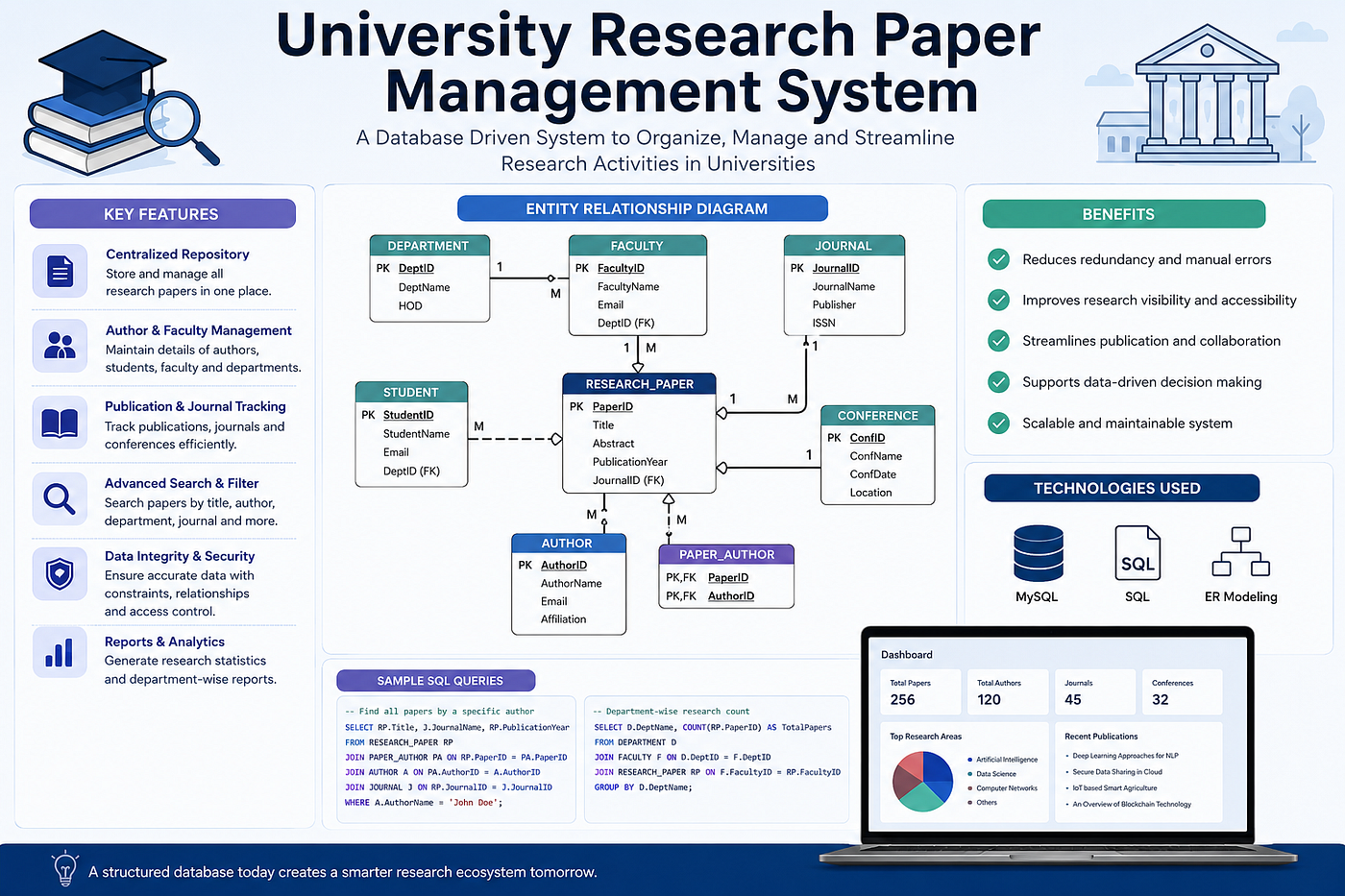
Designing the Architecture: Where the Real Work Happens
Every good database project starts with the same question: how do these things actually relate to each other?
I mapped that out with an Entity Relationship (ER) Diagram before writing a single line of SQL. The main entities in the system:
- Research Papers
- Authors (Students & Faculty)
- Departments
- Journals & Conferences
- Publications
The relationships between them mirror how research actually works in practice: one paper can have multiple authors, one department houses many researchers, one journal publishes many papers, one faculty member supervises multiple student submissions. Getting these connections right at the design stage is what separates a system that scales from one that quietly breaks under real-world use.
Normalization: Because Messy Data Is a Bug, Not a Feature
One of the biggest architectural goals was eliminating redundancy before it could cause problems — duplicate author entries, repeated publication data, department names stored seventeen slightly different ways across the database.
Normalizing the schema delivered three things that matter in production:
- Data consistency — every fact lives in exactly one place
- Scalability — the system grows without the structure unraveling
- Query reliability — results you can actually trust
Normalization is one of those concepts that feels abstract until you’re debugging a system where nothing joins correctly because the same person is stored as “Dr. Smith,” “D. Smith,” and “Smith, D.” depending on who entered the record. Building this project made it concrete in a way no textbook example ever did.
What SQL Actually Does Under the Hood
This project went far beyond basic SELECT statements. Here’s what was implemented:
Table Creation — Relational tables with primary keys, foreign keys, and integrity constraints that enforce data rules at the database level, not the application level.
Complex Queries — Search papers by keyword, filter by department, retrieve all publications by a given author, pull journal metadata, generate research statistics across the entire database.
Views — Simplified, reusable lenses into the data: faculty publication summaries, department-wise research activity, student submission tracking. Write the complex logic once, query it simply, forever.
Triggers — Automated database behavior: validation on insert, automatic updates when records change, consistency enforcement without anyone having to remember to do it manually.
SQL isn’t just a query language. At this level, it’s an automation and integrity engine. This project was where I genuinely understood the difference.
Tech Stack
- SQL / MySQL — core implementation
- Relational Database Design — schema architecture and normalization
- ER Modeling — structural planning via draw.io
The focus was entirely on backend data architecture — no UI layer, no decorative abstraction. Just the structural logic that would power a real platform.
What I Actually Learned
Schema decisions compound. A shortcut at the design stage becomes a maintenance nightmare at scale. Getting relationships right early isn’t a nice-to-have — it’s the entire game.
Normalization has real stakes. Every normalized table prevented a real category of operational failure: orphaned records, inconsistent query results, data that quietly can’t be trusted. It stopped being theoretical the moment I saw what happens without it.
SQL is consistently underestimated. Most people encounter it as a way to fetch rows. It’s also a system for automation, access control, analytics, and integrity enforcement. This project used all of it — and that shift in how I think about SQL has carried into everything since.
What’s Next
The foundation is solid. Future expansions I’d like to build on top of it:
- User authentication and role-based access control
- Research paper uploads with PDF storage integration
- Full-text search across paper metadata and abstracts
- Dashboard analytics for department-level research trends
- API integration for external publication databases (IEEE, Google Scholar)
- Cloud deployment
- AI-assisted research categorization — because apparently that’s where everything is going now, and honestly, for this use case, it makes sense
Final Thoughts
This project started as a Database Systems assignment. It ended as one of the most practically grounding experiences of my graduate program.
Research management is a genuine, persistent problem for universities. Structured database systems — designed thoughtfully, with proper normalization and relational integrity — can fix it. Not partially. Fundamentally.
The knowledge already exists inside universities. It just needs somewhere to live that isn’t someone’s inbox.
**View the Full Project on GitHub →**
See you in next story!!!
Until then, Happy Reading!!!
메타데이터
- post_id
- 32ff21babc8b
- slug
- i-built-a-database-to-fix-the-one-thing-universities-are-embarrassingly-bad-at-32ff21babc8b
- url
- https://medium.com/@sruthipunugu01/i-built-a-database-to-fix-the-one-thing-universities-are-embarrassingly-bad-at-32ff21babc8b
- canonical_url
- https://medium.com/@sruthipunugu01/i-built-a-database-to-fix-the-one-thing-universities-are-embarrassingly-bad-at-32ff21babc8b
- author_url
- https://medium.com/@sruthipunugu01
- status
- ok
- fetched_at
- 2026-06-15 20:49:13




