Intuitive Understanding of the Law of Cosines
The law of cosines (also known as the cosine formula) states
Intuitive Understanding of the Law of Cosines

The law of cosines (also known as the cosine formula) states

for the triangle above. And analogously,

Do we have to memorize them? What is the idea behind it, and how to grasp the meaning of this law?
Rough Ideas:
We think many of you are familiar with the Pythagorean theorem.

For the right triangle above,

is satisfied.
And if you try to apply the Pythagorean theorem to non-right triangles, what are you going to do?

In this case, the angle α < 90°, so the side a² should be smaller than b² + c². Thus, there must be a correction term to this relation.

Then, what does the correction term look like?
When the sides b and c are very long, the change of the angle α should cause a big difference to the length of side a. And when b and c are very short, the difference to side a will be minor.
Therefore, the correction term should have the terms b and c.

And obviously, the correction term should also include the information of the angle α because the smaller the angle α becomes, the shorter the side a becomes, and the bigger the correction term should become.
Remember that when α = 90°, the correction term must be 0 because, in the case of the right triangle, the law of cosines should be the same as the Pythagorean theorem.
And as the name “law of cosines” shows, the term cos α meets that condition since if α = 90°, then cos 90° = 0.


Unit Circle
Of course, this is never the strict proof of the law of cosines: we just want to show the rough idea behind it. Thus, this way of introducing cos is a little bit far-fetched in terms of logic.
Anyway, as the unit circle above shows, the smaller the angle θ becomes, the bigger the value cos θ becomes.
That well corresponds to the property of the actual triangle. The smaller the angle α becomes, the bigger the correction term becomes, and the shorter the side a becomes.
And the bigger the angle α becomes, the smaller the correction term becomes, the longer the side a becomes.
Then, how about the other special cases of the angle than α = 90°: α = 0° and 180°?
α = 0°
α goes to 0° with fixing the length of b and c:
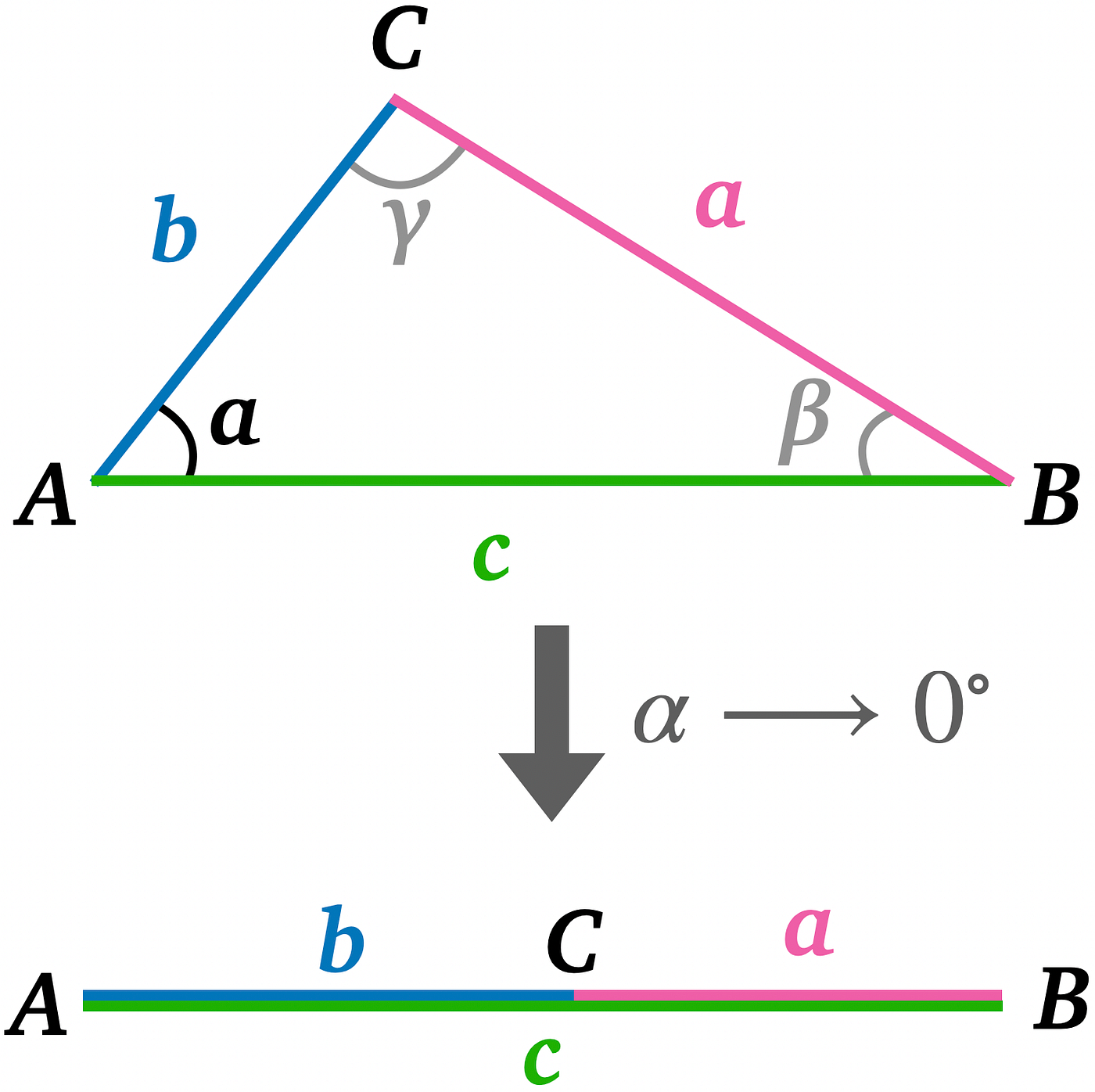
As you see in the figure above, a will be like this: a = c − b (in case of b < c)
By substituting • a = c − b to the left side, and • α = 0° to the right side of the equation
and we get

and

so,

If the correction term was “2bc cosα,” not “bc cosα,” then the equation above was satisfied. And that is the law of cosines.
Again, this is not a rigorous proof, but you can tell the validity of this expression.
α =180°
The same sort of argument goes to this case too.
α goes to 180° with fixing the length of b and c:

When α = 180°,
• a = b + c, and • cos 180° = −1
so,

we can see the law of cosines holds in the case of α = 180°.
Hope you got to be able to have a clearer picture of this equation.
All the images above: Satoshi Higashino
SOCIAL:
- YouTub: https://youtube.com/@satoshihgsn
- Twitter: https://twitter.com/satoshihgsn
- Instagram: https://www.instagram.com/satoshihgsn/
메타데이터
- post_id
- 32ffbc97ad0c
- slug
- intuitive-understanding-of-the-law-of-cosines-32ffbc97ad0c
- url
- https://medium.com/@satoshihgsn/intuitive-understanding-of-the-law-of-cosines-32ffbc97ad0c
- canonical_url
- https://medium.com/@satoshihgsn/intuitive-understanding-of-the-law-of-cosines-32ffbc97ad0c
- author_url
- https://medium.com/@satoshihgsn
- status
- ok
- fetched_at
- 2026-07-13 06:23:13