The Mistakes I See Every Week as an ITAD Provider (And the One That Surprises Everyone)
Published by Integritrade — IT Asset Disposition and Electronics Recycling
The Mistakes I See Every Week as an ITAD Provider (And the One That Surprises Everyone)
Published by Integritrade — IT Asset Disposition and Electronics Recycling
I have been in the IT asset disposition business long enough to know that most data security incidents do not happen because a company was reckless. They happen because a company was uninformed. The gap between what organizations think they need to protect and what they actually need to protect is wider than most IT managers realize — and in our industry, that gap is where the risk lives.
We handle electronics recycling and ITAD for businesses across California. Every week, we see the same patterns. Some are small oversights. Some are the kind of thing that keeps a compliance officer up at night once they realize what almost happened. I am writing this because the best thing I can do for the industry — and for the businesses we serve — is to be honest about what we see.
The Assumption That Only “Obvious” Devices Store Data
The most common mistake I see is also the most understandable one. When a company decides to retire its IT equipment, the mental checklist usually looks something like this: laptops, desktops, servers, phones, tablets. Those get flagged for data destruction. Everything else gets treated as hardware — something to haul away and recycle.
That checklist is incomplete. And the device that falls off it most often is one that sits in nearly every office in America.
The copier.
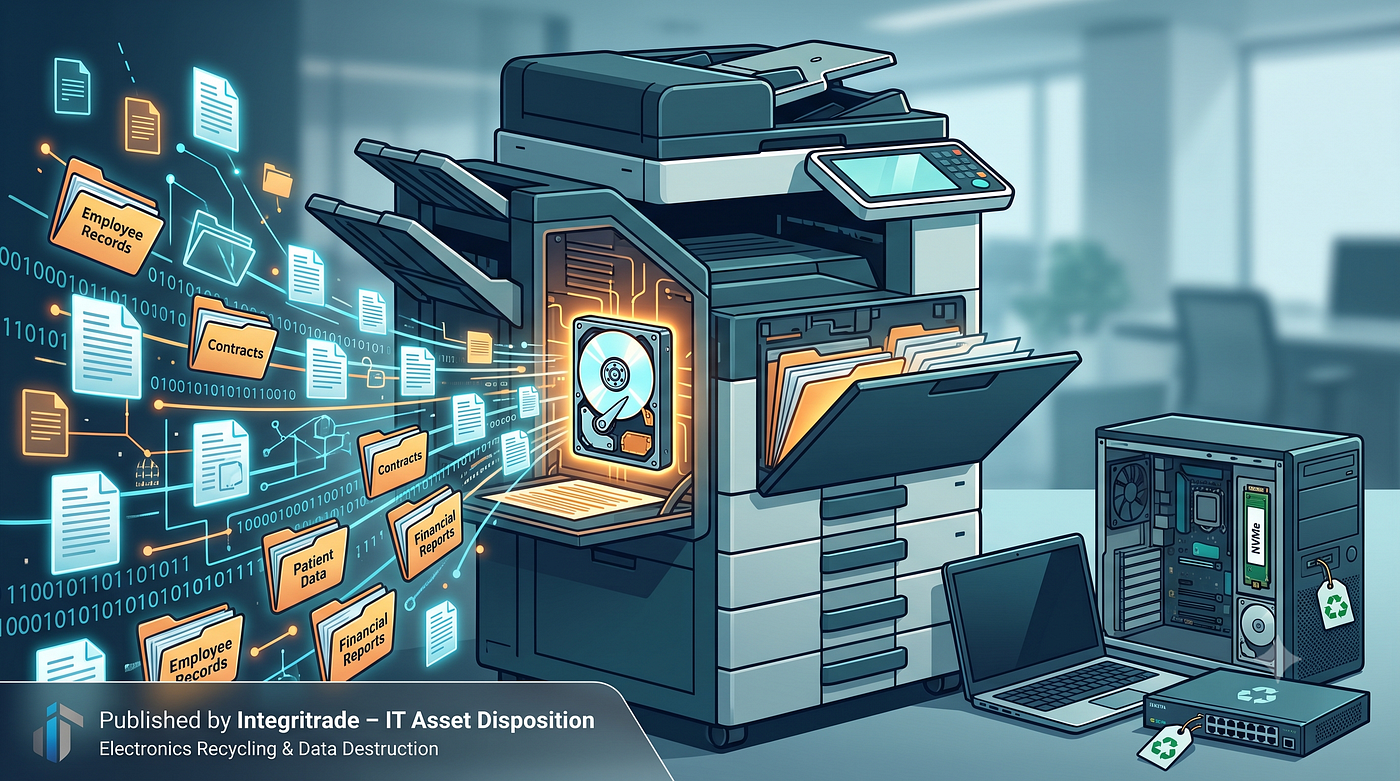
Modern multifunction printers and copiers — the large floor-standing units that scan, print, fax, and copy — contain internal hard drives. These drives store images of every document the machine has ever processed. Scanned HR files. Copied contracts. Faxed financial statements. Printed patient records. Every one of those documents left a trace on the copier’s hard drive, and in most office environments, nobody thinks about it until the machine is being loaded onto a recycling truck.
I have seen copiers leave facilities with user credentials stored in the address book, network configuration data including passwords, and document images that would qualify as protected health information under HIPAA. The people responsible for those facilities were not negligent — they simply did not know the copier was a data-bearing device that required the same treatment as a laptop or server.
Why Copiers Are a Particularly Difficult Problem
Here is where it gets more complicated. Even for ITAD providers who know the risk, copiers are genuinely challenging to handle responsibly — and that challenge is reflected in the cost.
Copiers are large, heavy, and built with high concentrations of brominated flame retardant (BFR) plastics. BFR content is a significant factor in electronics recycling economics because it limits the downstream processing options for the material and increases the cost of responsible handling. Unlike a laptop, where the aluminum chassis and circuit boards carry meaningful commodity value that offsets recycling costs, a copier’s bulk and material composition mean there is very little value to recover from the machine itself.
Before any of that even matters, the hard drive has to come out. That requires a technician to disassemble the unit, locate the drive — which is not always in an obvious location and varies by manufacturer and model — remove it, and route it through the same certified data destruction process as any other storage media. That takes time and labor. It is not a step you can skip, and it is not a step that happens automatically just because a machine ends up at a recycling facility.
The result is that copiers carry a higher disposal fee than most other office electronics. The commodity value is low, the handling cost is high, and the data risk is significant. A provider who quotes you zero cost to take your copiers without asking about the hard drives is possibly not removing them or not telling you the full picture.
The Broader Pattern: Underestimating Where Data Lives
Copiers are the most dramatic example of this problem, but they are not the only one. The same blind spot applies to:
Networking equipment. Managed switches, routers, and firewalls store configuration data, network credentials, and in some cases logs of network activity. A factory reset is not always sufficient — and many organizations retire networking equipment without performing any reset at all.
Printers with onboard storage. Smaller desktop printers increasingly include internal storage for print queuing and job history. The risk is lower than a full copier, but it is not zero.
Badge readers and access control systems. These devices often store employee credential data and access logs. They are almost never included in a standard ITAD scope.
Devices with both magnetic and solid-state storage. This one deserves its own conversation, because it is one of the most consistent oversights we see — even from organizations that believe they have already handled data destruction internally.
Many modern computers contain both a traditional magnetic hard drive and a solid-state NVMe drive. These are two completely separate storage devices inside the same machine. What we regularly see when we receive equipment that was supposedly data-destroyed before it arrived at our facility is this: the magnetic hard drive has been removed, but the NVMe drive is still installed and untouched. Someone opened the machine, pulled the spinning drive, and considered the job done, without realizing there was a second, separate storage device soldered to the motherboard or seated in an M.2 slot that stores the operating system, user profiles, cached credentials, and potentially far more sensitive data than the drive they removed.
This is not negligence. It is an honest oversight that stems from a mental model of computers that predates the widespread adoption of NVMe storage. But the consequence is the same regardless of intent: a device that was believed to be sanitized leaves the facility with live data still on it.
This is precisely why Integritrade performs a full internal inspection and verification on every device we receive before it is evaluated for remarketing, regardless of what we were told about its prior data destruction status. We have caught this specific issue enough times that it is now a standard part of our intake process. Every storage device inside every machine gets accounted for. Every one.
Phones and video conferencing systems. Conference room phones and video units can store dial history, contact directories, and in some cases recorded sessions. They get treated as AV equipment rather than data-bearing devices.
Physical media left inside devices. I will end this section with something that happened to us directly, because it is the kind of story that stays with you.
We received a batch of desktop computers from a local junk removal company that performed an office cleanout for a local healthcare clinic. The hard drives had been removed internally before the machines were handed over, so on the surface, the data destruction box had been checked. During our intake inspection, one of our technicians ejected the optical drive on one of the units. Inside the DVD slot was an X-ray disc. A patient’s medical imaging records, sitting in a machine that was about to be processed for recycling, that everyone assumed had already been sanitized.
The drive had been removed. The disc had been forgotten. And if that machine had moved through a less thorough process, a patient’s protected health information would have left the building on a piece of physical media that nobody thought to look for.
This is not an isolated incident. Physical media — DVDs, CDs, USB drives left in ports, SD cards in card readers — gets overlooked constantly because the mental model for data destruction focuses on internal storage. A thorough intake process checks everything. Ours does.
The pattern is consistent: if a device connects to a network, stores a document, or processes credentials — or has a slot that fits a disc — it is a potential data risk at end of life. A thorough ITAD provider asks about all of it and inspects for all of it. Not just the obvious devices.
You Would Not Hand a Stranger Your Unlocked Phone
Think about it this way. You would never hand your unlocked personal phone to a stranger and walk away. Your phone has your emails, your banking apps, your passwords, your photos, your contacts. The idea of giving that to someone you do not know, without any accountability for what they do with it, feels immediately wrong.
Now consider what is on your company’s computers. Proprietary product designs. Client contracts. Employee records. Financial data. Legal communications. Trade secrets. Credentials to every system your business runs on. Your computers do not just contain sensitive information — they contain the most valuable and irreplaceable information your organization has ever produced. And yet, every day, companies hand that equipment to whoever showed up with the lowest quote and a recycling truck, with no certification, no documentation, and no accountability for what happens next.
The phone analogy breaks down in one important way: your phone is one device. Your IT equipment is dozens, hundreds, or thousands of devices — and the data across all of them, in the wrong hands, can be far more damaging than anything on a personal phone. Choosing an ITAD provider deserves at least as much scrutiny as choosing a bank.
Why Choosing the Right ITAD Provider Is One of the Most Important Decisions You Will Make
The ITAD industry is one where material moves through many hands. A device that leaves your facility may pass through a logistics provider, a primary ITAD vendor, a downstream processor, a materials recovery facility, and eventually a commodity broker — each transition a potential point of failure in the chain of custody.
The difference between a certified, experienced ITAD provider and an uncertified one is not just a piece of paper on the wall. It is the difference between a documented, audited chain of custody and a verbal assurance that your devices were handled responsibly. It is the difference between a serialized Certificate of Destruction tied to a specific asset’s serial number and a generic recycling receipt. It is the difference between a provider who asks about your copiers and one who does not know to ask.
R2v3 certification — the standard recognized by the U.S. Environmental Protection Agency as the benchmark for responsible electronics recycling — requires certified providers to manage their entire downstream chain. Every vendor who touches your material must meet specific standards. That requirement does not exist in the uncertified market. When you hand your equipment to an uncertified recycler, you have no visibility into where it goes after it leaves their dock.
What a Good ITAD Provider Does Differently
A good ITAD provider does not just take your equipment. They evaluate it. They know where the value is, and they use that knowledge to structure a project that works financially for your organization — not just for themselves.
That matters because the economics of ITAD are real. Copiers cost money to handle responsibly. Some older equipment has negative commodity value. A provider who does not understand the value landscape will either charge you for everything, cut corners to avoid the costs, or both.
At Integritrade, we guarantee that qualifying ITAD projects — those with 50 or more devices — will be free or generate revenue for your organization. Pickup is covered. Data destruction is covered. Certificates of Destruction and Certificates of Erasure are included. The value recovered from remarketing and buyback of eligible assets offsets the cost of handling the rest. That is how a properly run ITAD program should work: the provider’s expertise in identifying and recovering value from your assets funds the responsible handling of everything else.
For devices that have no resale value and no commodity recovery — like many copiers — we are transparent about the cost. There is no bait-and-switch, no surprise fee at the end of the project. You know what you are paying for and why before we start.
TraceTech: Because Trust Should Be Verifiable
One of the most common frustrations we hear from organizations that have worked with other ITAD providers is this: once the equipment left the building, they had no idea what happened to it. They received a certificate weeks later — sometimes a generic one that did not even list individual serial numbers — and were expected to take it on faith that everything was handled correctly.
We built TraceTech specifically because faith is not a compliance strategy.
TraceTech is Integritrade’s proprietary AI-integrated asset tracking platform, developed in-house over several years and included at no additional cost for every client. The moment your assets are inventoried and tagged at pickup, they enter the TraceTech system. From that point forward, your team has real-time visibility into exactly where every device is in the processing workflow — whether it is staged for erasure, in the destruction queue, awaiting grading, or completed and documented.
When your Certificates of Destruction or Certificates of Erasure are ready, you do not wait for an email. You log into TraceTech and download them directly. Every certificate is serialized, tied to a specific asset’s serial number, and generated by our processing systems — not typed up after the fact.
TraceTech also minimizes human touchpoints throughout the disposition process. Every hand that touches a device is a potential point of failure in the chain of custody. By automating the tracking, logging, and reporting functions that most ITAD companies handle manually, we reduce those failure points and deliver a level of process integrity that no competitor in this industry currently matches.
The analogy holds here too. You would not leave your unlocked phone with a stranger and just hope for the best. With TraceTech, you never have to hope. You can see exactly what is happening, every step of the way.
The Question Every Organization Should Ask Before Choosing an ITAD Provider
Before you sign an agreement with any ITAD or electronics recycling company, ask them one question: What do you do with a copier?
If they tell you they recycle it, ask how they handle the hard drive. If they cannot answer that question specifically — what drive removal process they use, how the drive is destroyed, and what documentation you receive — that is a signal worth paying attention to.
The copier question is a proxy for a larger question: does this provider actually understand the full scope of data risk in your environment, or are they just picking up boxes? The answer tells you a great deal about whether they are the right partner for the rest of your equipment.
We Serve All of California — From a Facility Built for This
Integritrade is headquartered in Fresno and operates from a dedicated 30,000 square foot facility purpose-built and secured exclusively for ITAD operations. This is not a shared warehouse or a general recycling yard. It is a controlled environment with 24/7 video monitoring, restricted access, and background-checked personnel — designed from the ground up to meet the security, documentation, and chain-of-custody standards that R2v3 and ISO 27001 certification demand.
We provide GPS-tracked pickup and full ITAD services to businesses throughout California. Whether you are in the Bay Area — San Francisco, San Jose, Oakland, Palo Alto, or Fremont — or down in Los Angeles, Irvine, Anaheim, or Long Beach, or further south in San Diego, Chula Vista, or Escondido, or in the Central Valley in Fresno, Bakersfield, Stockton, or Modesto, or up in Sacramento, Elk Grove, or Roseville - we come to you. One call, one provider, one certified chain of custody from your loading dock to our facility and through to final disposition.
No matter where your organization operates in California, you deserve an ITAD partner who asks about the copiers.
Integritrade is an R2v3 certified, ISO 27001, 14001, 9001, and 45001 certified IT Asset Disposition and electronics recycling company based in Fresno, California, serving businesses statewide. Learn more at http://www.integritradeLLC.com.
메타데이터
- post_id
- 330bd3f4a346
- slug
- the-mistakes-i-see-every-week-as-an-itad-provider-and-the-one-that-surprises-everyone-330bd3f4a346
- url
- https://medium.com/@ian_40345/the-mistakes-i-see-every-week-as-an-itad-provider-and-the-one-that-surprises-everyone-330bd3f4a346
- canonical_url
- https://medium.com/@ian_40345/the-mistakes-i-see-every-week-as-an-itad-provider-and-the-one-that-surprises-everyone-330bd3f4a346
- author_url
- https://medium.com/@ian_40345
- status
- ok
- fetched_at
- 2026-08-10 14:12:41