How MCP and RAG transform AI usage from copy-paste process into actual automation infrastructure
This article address why your AI workflow is still manual, and how to actually automate it with right infrastructure.
How MCP and RAG transform AI usage from copy-paste process into actual automation infrastructure
This article address why your AI workflow is still manual, and how to actually automate it with right infrastructure.
Every morning, you open Claude, ChatGPT or Gemini and hunt for relevant documents. You copy-paste the client brief, brand guidelines, previous examples, and strategic frameworks. You get an output, then manually edit it because the context is incomplete or the AI missed nuances. You copy-paste the result into its final destination.
In the afternoon, you repeat this entire process for a different client. You hunt for different docs, copy-paste everything again, edit again, copy-paste again. The next day, it’s the same process, the same manual context gathering, the same wasted time.
This is what Garbage in → Garbage out actually means in practice. It’s not that the AI is bad, it’s that your workflow treats AI like a tool you use manually, not infrastructure that runs automatically.
The Hidden Cost
Let’s do the math on that marketing manager’s workflow: 45 minutes gathering context per prompt, 30 minutes editing output, 75 minutes total per piece of content. She creates 8 pieces of content per week. That’s 10 hours per week just managing AI context — 25% of her work week spent copy-pasting documents.
Not strategizing. Not creating. Not analyzing results.
Just shuttling information between tools manually.
Now multiply this across a team in this equasion 10 people x 100 hours per week = 400 hours per month.
That’s 10 full-time employees worth of time spent copy-pasting.
What Real AI Infrastructure Looks Like
Real AI automation isn’t about finding better prompts or switching to a different AI model. It’s about building infrastructure that connects AI to your knowledge automatically.
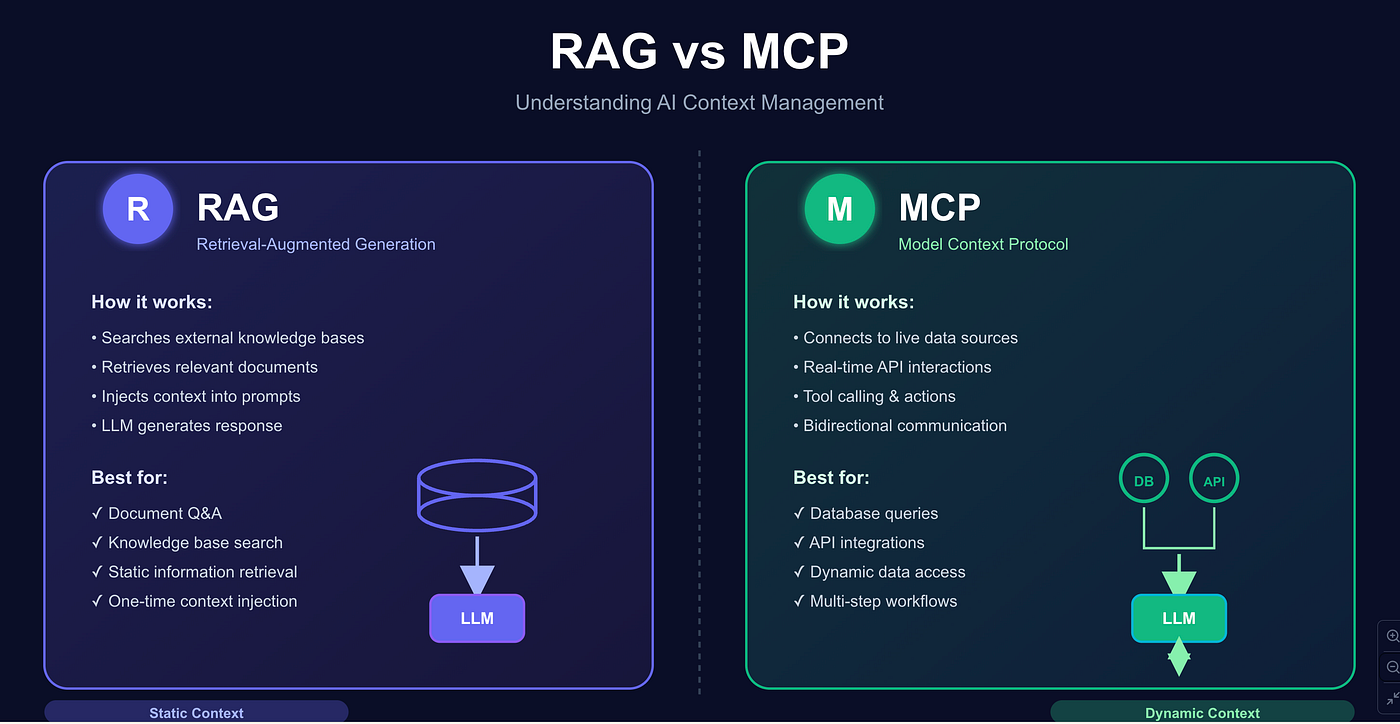
This is where MCP (Model Context Protocol) and RAG (Retrieval-Augmented Generation) come in.
They’re fundamentally different architectures for how AI accesses information.
Understanding MCP: Your AI’s Universal Connector
With MCP, your AI is like a senior employee with access to all company systems. They know where everything is. They can access CRM data, pull documents from Notion, check analytics, and see Slack conversations — all automatically. They don’t stop to ask. They just access what they need and keep working.
MCP connects AI directly to your tools: CRM, databases, document storage, project management, analytics platforms. No copy-paste. No export-import. Direct access to real-time data. AI sees current data, not snapshots you exported last week. When a client updates their info in CRM, AI sees it immediately.
The real power is cross-tool intelligence. AI can pull client data from CRM, brand guidelines from Notion, performance metrics from analytics, and recent conversations from Slack — all in one operation. Configure MCP once, and every team member’s AI interactions now have access to this infrastructure.
MCP in practice
Creating a client proposal without MCP means opening your CRM to find and copy client details, opening Notion to find and copy their brand doc, opening Google Analytics to screenshot performance data, opening Drive to find previous proposals, then pasting everything into ChatGPT to generate a proposal. Total time: 45 minutes of context gathering.
With MCP, you tell AI “Create proposal for [Client Name]” and it automatically accesses client details from CRM, brand guidelines from Notion, performance data from Analytics, and previous proposals from Drive. It generates a proposal with current, accurate data. Total time: 5 minutes.
Understanding RAG: Your AI’s Smart Library
If MCP is about connecting to tools, RAG is about intelligently retrieving knowledge.
Without RAG, you tell AI everything every time. It’s like explaining your company’s entire history, methodology, and context in every single conversation. Or you paste your entire knowledge base into the context window, which hits limits quickly and is expensive.
With RAG, AI has access to your knowledge base and automatically retrieves only the relevant information for each specific task. It’s like having a research assistant who knows where everything is and only brings you exactly what you need for the current task.
When you ask AI something, RAG searches your entire knowledge base for relevant information — not by keywords, but by meaning and context. Instead of loading your entire knowledge base, RAG pulls only relevant documents or sections for the specific task. It works the same whether you have 10 documents or 10,000. Update a document and RAG immediately uses the new version. No re-uploading, no re-training, no version confusion.
RAG in practice
Writing a blog post in brand voice without RAG means finding your brand voice guide, finding successful example posts, finding SEO guidelines, finding your content strategy doc, copy-pasting all of it into AI, hoping you got the right versions, generating content, then editing heavily because AI missed nuances. Total time: 1 hour of prep plus 30 minutes editing.
With RAG, you tell AI “Write blog post about [topic]” and it automatically retrieves your brand voice guidelines in their current version, relevant example posts based on topic similarity, your SEO requirements using your specific framework, and your content strategy reflecting your positioning. AI generates content that already matches your voice, style, and strategy. You do light editing for strategic direction. Total time: 15 minutes total.
The Compound Effect
Here’s where MCP and RAG become transformative. In week one, manual workflow means 10 hours per person per week on context management while you spend 3 days setting up MCP and RAG. By weeks two through four, the manual workflow still requires 10 hours per person per week, while MCP and RAG reduces this to 1 hour per person per week.
Over months two through twelve, manual workflow wastes 480 hours per person per year on context management. With MCP and RAG, you spend 48 hours per person per year on context, reclaiming 432 hours for actual work.
Why Many Companies Still Don’t Doing This
If MCP and RAG save this much time, why isn’t everyone using them?
Most people want plug-and-play solutions. Download app, click buttons, done. But MCP and RAG require infrastructure thinking: structuring your knowledge systematically, connecting systems together, building workflows on top, and maintaining as you grow. This is work. Upfront work. People would rather spend 10 hours per week forever on copy-paste than spend 3 days building infrastructure once.
You can’t just “turn on” MCP and RAG in settings. You need to set up connections to your tools, structure your knowledge base, configure retrieval systems, and test and refine. Most marketers and operators don’t know how. Most developers don’t see it as their job., so it doesn’t happen.
What We Built at n8n Lab
Our infrastructure includes MCP connections to Notion for our knowledge base, Firebase for our website, Slack for communications, and Google Drive for documents.
Our RAG system indexes our frameworks, client examples, brand guidelines, and internal processes. We built n8n workflows that use this infrastructure for blog writing, client proposals, content distribution, and internal documentation.
When we write a blog post now, AI already knows our voice because RAG pulls brand guidelines. AI already knows our methodology because RAG retrieves relevant frameworks. AI already knows our audience because RAG finds similar successful posts. Content publishes automatically to Firebase through MCP connections — then team gets notified in Slack through MCP connections.
If you’re ready to build real AI infrastructure, start by auditing one workflow where you copy-paste a lot of context into AI. Time how long you actually spend on context management.
Don’t try to automate everything at once, instead build infrastructure for one important workflow. Get the benefits → learn the system → expand from there.
If you want to learn more about this check out n8n Lab website or follow me on LinkedIn where I post about this weekly.
The companies building this infrastructure now are creating advantages their competitors can’t match 🚀
메타데이터
- post_id
- 3320a4fed0cf
- slug
- how-mcp-and-rag-transform-ai-usage-from-copy-paste-process-into-actual-automation-infrastructure-3320a4fed0cf
- url
- https://medium.com/@Lochpa/how-mcp-and-rag-transform-ai-usage-from-copy-paste-process-into-actual-automation-infrastructure-3320a4fed0cf
- canonical_url
- https://medium.com/@Lochpa/how-mcp-and-rag-transform-ai-usage-from-copy-paste-process-into-actual-automation-infrastructure-3320a4fed0cf
- author_url
- https://medium.com/@Lochpa
- status
- ok
- fetched_at
- 2026-06-10 12:26:30





