Merchant Account vs. Payment Gateway: Which Payment Solution Is Best for US Businesses?
Accepting online payments has never been more important for businesses in the United States. Whether you run an eCommerce store, a SaaS…
Merchant Account vs. Payment Gateway: Which Payment Solution Is Best for US Businesses?
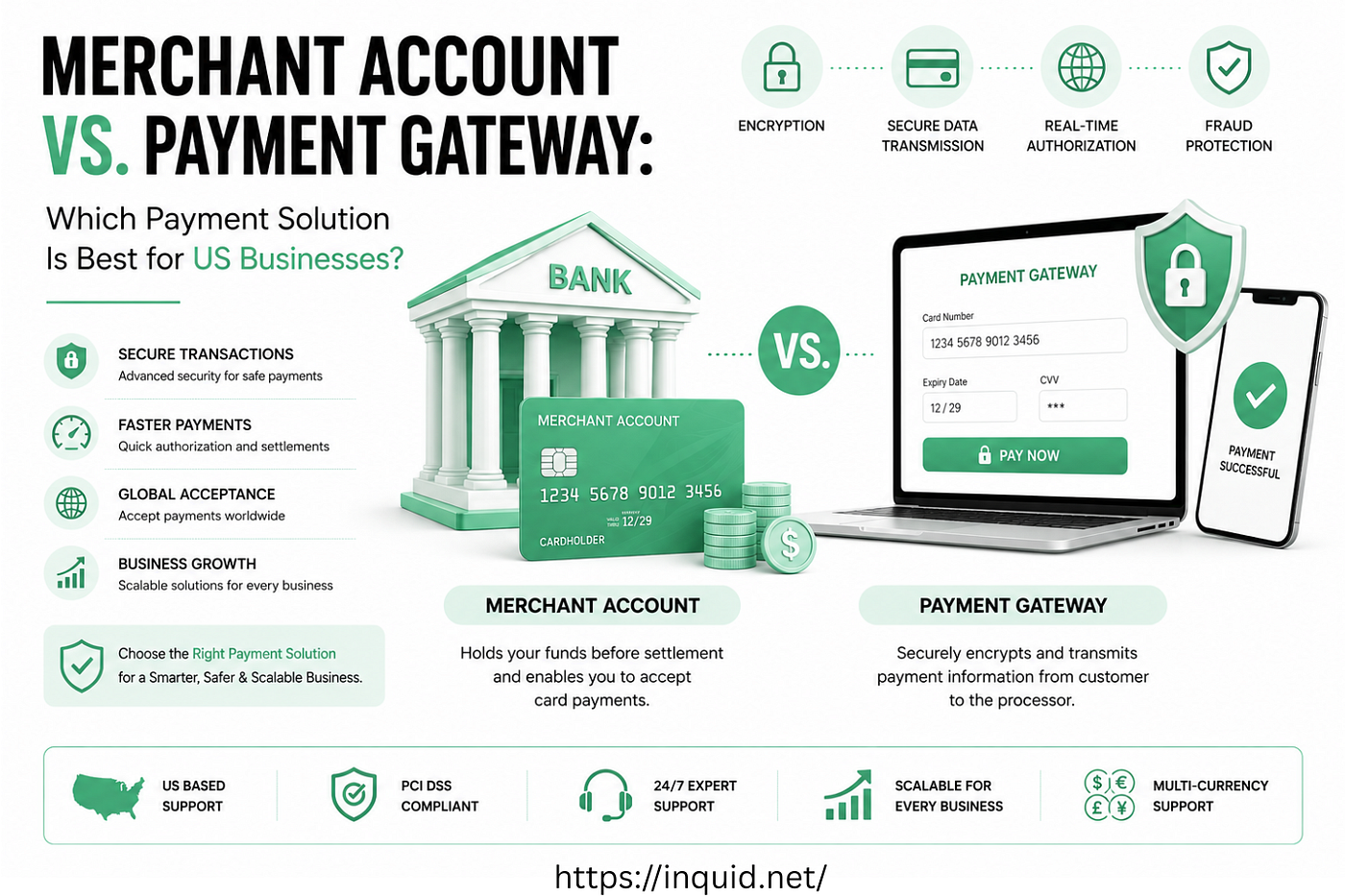
Merchant Account vs Payment Gateway infographic for US businesses with secure online payment solutions
Accepting online payments has never been more important for businesses in the United States. Whether you run an eCommerce store, a SaaS platform, a subscription service, a healthcare practice, a travel agency, or a high-risk business, your customers expect a fast, secure, seamless checkout.
And yet most business owners are still stuck on one basic question: do I need a **merchant account**, a payment gateway, or both?
The two terms get used interchangeably all the time, but they do very different jobs. Get the wrong setup and you end up paying more in fees, waiting longer for settlements, losing sales to declined transactions, or running into compliance headaches you didn’t see coming.
Here’s what this guide covers:
- What a merchant account actually is
- What a **payment gateway** actually does
- How the two work together
- Which setup fits which type of business
- When you actually need a **high-risk merchant account**
- What all of this costs, in real numbers
- How to choose the right setup as you grow
What Is a Merchant Account?
Think of a merchant account as a holding tank. It’s a specialized business account that temporarily holds customer funds after a payment is authorized and before that money lands in your business bank account. It’s not a checking account — it exists purely to process card transactions.
Here’s the sequence every time a customer pays you:
- The card gets authorized.
- Funds land in the merchant account.
- The transaction gets verified.
- Money moves into your business bank account — usually within 1–2 business days for standard accounts, though high-risk or brand-new accounts can take longer.
Without a merchant account, you generally can’t accept Visa, Mastercard, American Express, or Discover directly.
Why a dedicated merchant account is worth it:
- Faster settlement
- Lower per-transaction costs at scale (interchange-plus pricing instead of flat-rate)
- More control over processing and underwriting
- Better approval rates on large transactions
- Stronger fraud monitoring and dispute handling
- Room to grow
Real example: A furniture retailer in Texas doing $400,000+ a month in sales will almost always save real money moving off a flat 2.9% + 30¢ rate onto interchange-plus pricing. When your average ticket is large, even a small percentage-point difference adds up fast.
What Is a Payment Gateway?
If the merchant account is the holding tank, the gateway is the security checkpoint. It’s the technology that captures, encrypts, and transmits payment information from your customer to the processor for approval — basically a digital point-of-sale terminal.
No gateway, no secure online transactions. Full stop.
What a modern gateway should give you:
- PCI DSS compliance
- End-to-end encryption and tokenization
- Fraud detection and 3D Secure authentication
- Real-time authorization
- API integrations
- Mobile payment support
- Subscription billing
- Digital wallet acceptance (Apple Pay, Google Pay, etc.)
Real example: Someone buys running shoes from your site. The gateway encrypts their card details, sends them to the processor, gets an approval or decline back from the issuing bank, and returns the result to your checkout page — all in under two seconds.
Merchant Account vs. Payment Gateway, Side by Side
- What it does: A merchant account holds your funds before settlement. A gateway securely transmits the payment data.
- Does it store money? Merchant account — yes. Gateway — no.
- Does it encrypt data? Merchant account — no. Gateway — yes.
- Fraud protection? Merchant account — limited. Gateway — advanced.
- PCI compliance? Merchant account — partial. Gateway — extensive.
- Handles settlement? Merchant account — yes. Gateway — no.
- Handles authorization? Merchant account — no. Gateway — yes.
How They Work Together
The full payment flow looks like this:
Customer → Payment Gateway → Payment Processor → Merchant Account → Business Bank Account
- The gateway captures and transmits payment data.
- The processor talks to card networks and issuing banks.
- The merchant account holds approved funds temporarily.
- Your bank account gets the final settlement.
Do You Need Both?
For most online businesses — yes. That said, providers like Stripe, Square, and PayPal (Payment Service Providers, or PSPs) bundle a shared merchant account and gateway into one product, which is why they’re so popular with smaller businesses that just want to start accepting payments without the paperwork.
Merchant Account vs. Payment Service Provider (PSP)
A PSP rolls merchant account functionality, a gateway, processing, fraud detection, PCI compliance, reporting, and chargeback management into a single platform. Instead of your own dedicated account, you process through a shared account the provider manages.
- Account ownership: Dedicated account — it’s yours. PSP — shared.
- Approval time: Dedicated — usually slower. PSP — often fast.
- Pricing: Dedicated — interchange-plus, negotiable. PSP — usually flat-rate.
- Risk control: Dedicated — high. PSP — moderate.
- Transaction limits: Dedicated — flexible. PSP — may cap you.
- High-risk support: Dedicated — better suited. PSP — often limited.
What this actually costs you:
PSPs like Stripe and Square generally charge a flat rate around 2.9% + 30¢ for online transactions (Square: 2.9% + 30¢ online, 2.6% + 15¢ in person; Stripe: 2.9% + 30¢ domestic online, plus extra for international cards — roughly 1.5% — and more if you bolt on subscription billing, tax calculation, or currency conversion). Shopify Payments runs roughly 2.5%–2.9% + 30¢ online, with in-person rates closer to 2.4%–2.6% + 10¢ depending on your plan.
A dedicated merchant account on interchange-plus pricing usually adds a much thinner markup on top of the real interchange rate — often somewhere around interchange plus 0.2% and 10¢ per transaction — which is exactly why the savings scale with volume. The average combined Visa/Mastercard interchange rate sits around 2.36% as of 2025, so a business paying a flat 2.9%+ rate at real volume is often quietly giving up half a point or more that a negotiated account would claw back.
The rule of thumb: once you’re clearing somewhere between $30,000–$50,000 a month, it’s worth pricing out interchange-plus through a dedicated account. The math tends to favor it well before you hit enterprise scale.
When Do You Actually Need a High-Risk Merchant Account?
Providers look at your industry, chargeback history, transaction size, and regulatory exposure to decide whether you get labeled “high risk.”
Common triggers:
- High average transaction values
- Recurring subscription billing
- International customers
- Above-average chargeback rates
- Regulatory complexity
- Digital or intangible products
- Card-not-present transactions
Industries that get flagged most often, and why:
- IPTV — high risk, thanks to the subscription model and elevated chargebacks
- Forex — high risk, due to regulatory and financial exposure
- Online gaming — high risk, fraud exposure
- Adult businesses — high risk, card network restrictions
- CBD & nutraceuticals — high risk, regulatory uncertainty
- Travel — high risk, services delivered in the future
- Digital products — medium-high risk, intangible goods
- SaaS — medium risk, recurring billing
What it costs: high-risk merchants typically land somewhere in the 3%–5%+ range, driven by higher interchange categories, bigger processor markups, and extras like rolling reserves (a slice of revenue held back to cover potential chargebacks) and per-chargeback fees.
One thing a lot of US businesses miss: Visa’s Acquirer Monitoring Program (VAMP) and Mastercard’s Excessive Chargeback Program both set hard thresholds — generally a ratio of disputes to transactions — above which you start racking up fines or risk losing the account entirely. If you run recurring billing or ship internationally, ask any provider you’re evaluating exactly how they monitor you against these thresholds and what their early-warning process looks like. Violating them can shut an account down fast, with little notice.
Don’t Forget: You Still Need a Separate Business Bank Account
A merchant account isn’t a replacement for your business bank account — it only holds funds temporarily before settlement. You’ll still want a dedicated bank account for accounting, payroll, and day-to-day operations.
If you also move money via ACH, note that those transactions run through the NACHA network, not the card networks, and come with their own rules around authorization and return timeframes. Worth confirming with your bank or processor if ACH is part of your mix.
Choosing the Right Payment Gateway
Things worth checking before you commit:
- PCI DSS compliance
- Fraud prevention and 3D Secure
- API integrations with your existing stack — Shopify, WooCommerce, Magento, BigCommerce, or custom
- Mobile optimization
- Subscription billing support
- Digital wallet support
- Real-time reporting
- Multi-currency and cross-border support, if you sell internationally
If you’re selling internationally, a domestic-only gateway isn’t going to cut it. Local payment methods, currency conversion, international acquiring, and cross-border fraud tools all directly affect authorization rates and cart abandonment. A US software company selling into 30+ countries while accepting only USD will typically see more declines and more currency-related support tickets than one offering a localized checkout in each major market. It’s a common enough pattern that it’s worth planning for up front rather than fixing later.
Which Setup Fits Your Business?
- Small business: PSP + standard gateway
- Growing eCommerce store: Dedicated merchant account + gateway
- Enterprise: Dedicated merchant account + global gateway
- SaaS: Merchant account + subscription billing gateway
- Travel: International gateway + fraud monitoring
- Forex: High-risk merchant account + compliance tooling
- IPTV: High-risk processing + subscription management
- Adult business: High-risk merchant account + chargeback mitigation
What the Data Actually Shows
Fees are climbing, not falling. US merchants paid a record $198.25 billion in card processing fees in 2025, and the combined Visa/Mastercard interchange rate has climbed from about 2.02% in 2010 to 2.36% in 2025 — largely because more consumers are carrying premium rewards cards, which carry higher interchange.
Checkout friction kills sales. Baymard Institute’s ongoing cart-abandonment research consistently finds that a complicated or untrustworthy checkout is one of the top reasons shoppers bail. That’s a direct argument for investing in gateway UX and fraud tools that don’t over-trigger false declines.
Chargebacks cost more than the refund. Beyond the returned transaction amount, the Merchant Risk Council points out that disputes carry real operational costs — processing time, per-chargeback fees, reserve requirements. High-risk merchants especially should be investing in fraud prevention up front rather than just eating the loss after the fact.
Two Scenarios Worth Recognizing
(These are composite, illustrative scenarios based on common patterns across US businesses — not case studies of any specific company.)
Cross-border eCommerce. A US-based retailer expanding into Europe and Canada while accepting only USD typically runs into two things: more declines (customers’ banks doing unexpected currency conversion) and more support tickets. Moving to a dedicated merchant account with multi-currency and international gateway support tends to fix both — though results vary by market and product.
High-risk subscription business. A subscription-based digital content company getting rejected by standard merchant account providers, with elevated chargeback exposure, generally needs a provider that actually specializes in high-risk underwriting, recurring billing, and active chargeback monitoring — not a generalist PSP that might cap volume or pull the plug after a dispute spike.
How to Actually Choose
- Business type — eCommerce, SaaS, healthcare, travel, and high-risk verticals all have different needs.
- Monthly volume — the crossover point where a dedicated account beats a flat-rate PSP usually sits between $30,000–$50,000/month, depending on your average ticket size and how much of your volume is card-not-present.
- International customers — do you need multi-currency support, **local payment methods**, cross-border compliance?
- Security requirements — PCI DSS, SSL, tokenization, fraud detection, 3D Secure.
- Integrations — does it plug into your existing platform and accounting software?
- Support — 24/7 availability, dispute resolution guidance, a dedicated account manager once you’re at real volume.
Mistakes worth avoiding:
- Picking purely on headline rate and ignoring fraud tools, reporting, and support quality
- Choosing something that can’t scale as volume or international sales grow
- Underestimating security requirements
- Sticking with a domestic-only gateway once you’re already selling internationally
Quick Answers
Do I need both a merchant account and a payment gateway? In most cases, yes — though PSPs bundle both into one product for smaller businesses.
What’s the difference between a gateway and a processor? The gateway captures and transmits payment data from the customer to the processor. The processor talks to banks and card networks to authorize the transaction.
What is a high-risk merchant account? An account built for businesses with elevated fraud, chargeback, or regulatory risk — usually priced at 3%–5%+ with added tools like rolling reserves.
Can a startup get a high-risk merchant account? Yes, though approval depends on your business model, documentation, compliance history, and projected volume.
Is a PSP better than a dedicated merchant account? Depends on your volume and risk profile. PSPs are great for startups that want simplicity. Higher-volume or specialized businesses usually save money and get better risk tools with a dedicated account.
The Bottom Line
There’s no universally “better” option between a merchant account, a payment gateway, and a PSP — it’s about matching the setup to your volume, your industry’s risk profile, and where you’re headed. Most small businesses should start with an all-in-one PSP. Once you’re past $30,000–$50,000/month, a dedicated merchant account on interchange-plus pricing usually starts paying for itself. And if you’re in a regulated or high-risk industry, the underwriting and chargeback tooling matter a lot more than the headline rate.
Ready to Find the Right Fit?
Get a personalized payment processing quote from Inquid — no obligation, just a clear breakdown of what you’d actually pay. Get your free quote →
Sources: Federal Reserve (Interchange Fee Revenue Report) · Baymard Institute (Cart Abandonment Research) · Merchant Risk Council · PCI Security Standards Council · Visa (Acquirer Monitoring Program) · Mastercard (Merchant Chargeback Monitoring) · NACHA (ACH Network Rules) · U.S. Small Business Administration
메타데이터
- post_id
- 333d0f5bcc6e
- slug
- merchant-account-vs-payment-gateway-which-payment-solution-is-best-for-us-businesses-333d0f5bcc6e
- url
- https://medium.com/@inquidinfo/merchant-account-vs-payment-gateway-which-payment-solution-is-best-for-us-businesses-333d0f5bcc6e
- canonical_url
- https://medium.com/@inquidinfo/merchant-account-vs-payment-gateway-which-payment-solution-is-best-for-us-businesses-333d0f5bcc6e
- author_url
- https://medium.com/@inquidinfo
- status
- ok
- fetched_at
- 2026-07-20 18:07:58