2.15 Basics of Digital KYC, eKYC, vKYC, API, and CKYCR by CERSAI: What It Is and How It Works
The concept of Know Your Customer (KYC) has evolved significantly over time, from a manual process of document collection and verification…
2.15 Basics of Digital KYC, eKYC, vKYC, API, and CKYCR by CERSAI: What It Is and How It Works
The concept of Know Your Customer (KYC) has evolved significantly over time, from a manual process of document collection and verification to advanced digital methods, including eKYC, vKYC, and API-based KYC. This evolution has been driven by the need for faster, more secure, and convenient customer onboarding in financial institutions. In this article, we will explore these various forms of KYC, focusing on the digital aspects, the Central KYC Registry (CKYCR), and how they all come together to streamline the KYC process in India.
1. Digital KYC: The Basics
Digital KYC is the overarching term used for processes that use electronic methods to verify customer identity. These methods remove the need for physical document submission and reduce the in-person interaction needed in traditional KYC.
The main advantages of digital KYC are:
- Cost Reduction: It eliminates the need for physical document handling and manual verification.
- Increased Trust: Customers interact directly with authorized representatives in a secure environment.
- Convenience: The process is online, allowing customers to complete the KYC process remotely.
Digital KYC involves several subcategories such as eKYC (Electronic KYC) and vKYC (Video KYC).
2. eKYC: Powered by Aadhaar
eKYC is one of the most popular digital KYC methods, thanks to India’s Aadhaar infrastructure. Through eKYC, an individual’s identity is verified electronically by using their Aadhaar number and registered mobile number for authentication.
- Process: Customers provide their Aadhaar number, and a One-Time Password (OTP) is sent to their registered mobile number. Upon verification, the KYC details (like name, address, and date of birth) are shared with the authorized institution.
- Key Players: The authentication happens through APIs provided by institutions like UIDAI, and only entities authorized by regulators can access this data.
eKYC is especially useful in scenarios like opening a bank account or applying for a mobile SIM card. The use of APIs allows financial institutions to perform KYC checks instantly, reducing onboarding time significantly.
3. Video KYC (vKYC): Personalized and Secure
Video KYC (vKYC), or Video-based Customer Identification Process (V-CIP), was introduced by the Reserve Bank of India (RBI) to offer an alternative to in-person verification. It allows authorized representatives of banks or financial institutions to verify customer identities through a live video interaction.
Key Components:
- Live Video Interaction: Customers must undergo a live interaction with an authorized bank representative.
- Informed Consent: The customer must be informed about the purpose of the video interaction and give explicit consent before any identification details are captured.
- Facial Recognition & Verification: Advanced technologies like facial recognition ensure the customer’s identity matches the documents provided.
- End-to-End Encryption: Data must be transmitted securely between the customer and the institution, ensuring the information cannot be intercepted or altered.
The process enhances security through features like geo-tagging (capturing the customer’s location) and time-stamping the video interaction to prevent fraud or misuse.
4. API-Based KYC: Automation in Action
With the rise of Application Programming Interfaces (APIs), financial institutions have integrated API-based KYC to perform real-time checks for customer verification.
- How it Works: Customers provide details like their PAN card or Aadhaar number. Using APIs, institutions send this data to third-party databases like NSDL (for PAN verification) or UIDAI (for Aadhaar). The system verifies whether the details match the provided identification, and the response is almost instantaneous.
API-based KYC improves the speed of onboarding while ensuring accuracy and security. It reduces the chances of manual errors and minimizes the need for physical document verification.
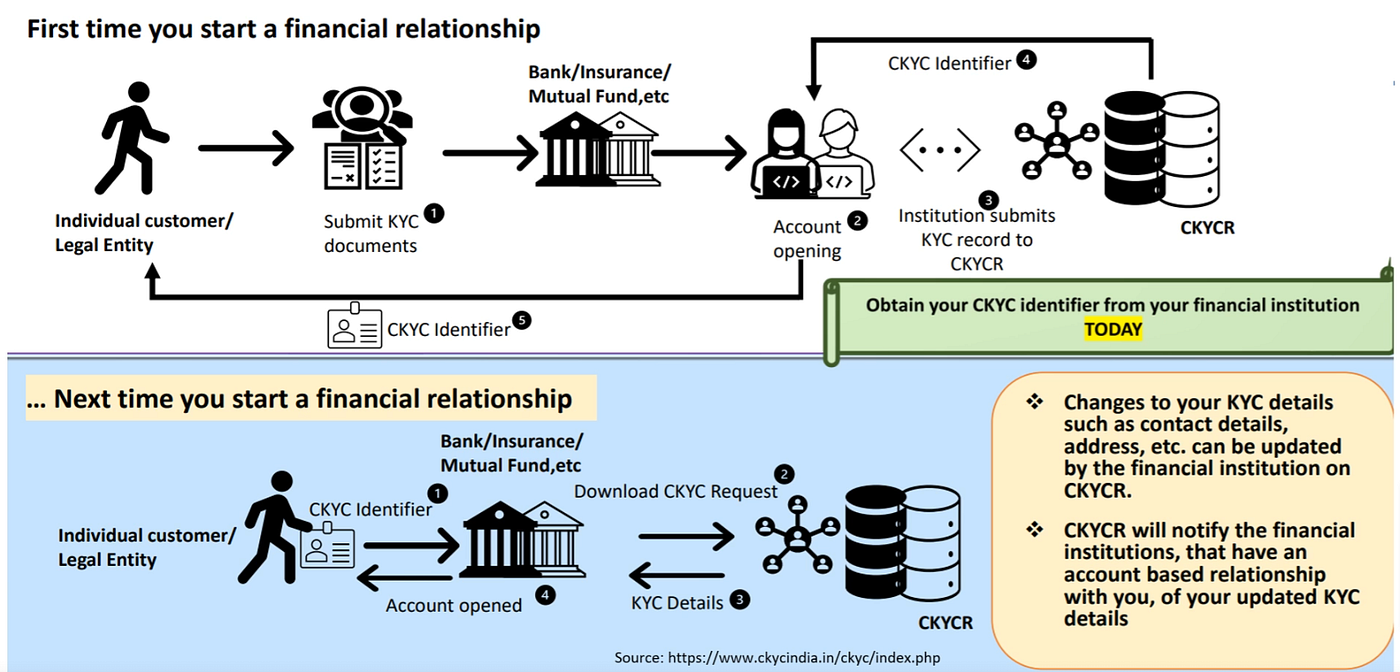
5. Central KYC Registry (CKYCR): Simplifying KYC Across Institutions
The Central KYC Registry (CKYCR) is a centralized repository for KYC data, managed by CERSAI (Central Registry of Securitisation Asset Reconstruction and Security Interest of India). The CKYCR enables customers to complete their KYC process once, and reuse that data across multiple financial institutions, saving time and effort.
How CKYCR Works:
- When a customer submits their KYC information for the first time (at a bank or insurance company, for example), the institution uploads that data to the CKYCR.
- The customer is then assigned a unique KYC Identification Number (KIN), which can be used across other financial entities.
- If the customer updates their details (e.g., changes address or marital status), this information is updated across all linked financial institutions, ensuring consistency.
This system eliminates the redundancy of submitting KYC documents multiple times to different institutions, improving efficiency.
6. Benefits of CKYCR
- Interoperability: The CKYCR database can be accessed by various financial institutions, including banks, insurance companies, and mutual fund providers.
- Unified KYC: Customers don’t have to resubmit their documents repeatedly. Once registered, their KYC data is accessible to any institution they interact with.
- Real-Time Updates: Any changes made to a customer’s KYC data (such as a change in marital status or address) are propagated in real-time to all linked financial institutions.
- Security: CKYCR ensures that KYC data is securely stored and shared only with authorized institutions.
Conclusion
The introduction of digital KYC methods, including eKYC, vKYC, and API-based verification, has transformed how customer identity verification is conducted in India. By leveraging technology, these processes have made KYC faster, more secure, and convenient for both customers and institutions. The CKYCR, managed by CERSAI, adds an extra layer of efficiency, allowing customers to manage their KYC data across multiple institutions with ease. As technology continues to evolve, we can expect further innovations in KYC processes that will enhance security and customer experience even more.
CKYC #CERSAI #EKYC #VKYC #CKYCR #DIGITALKYC #KYC
메타데이터
- post_id
- 335fbbb1970c
- slug
- 2-15-basics-of-digital-kyc-ekyc-vkyc-api-and-ckycr-by-cersai-what-it-is-and-how-it-works-335fbbb1970c
- url
- https://medium.com/@rahul-nain/2-15-basics-of-digital-kyc-ekyc-vkyc-api-and-ckycr-by-cersai-what-it-is-and-how-it-works-335fbbb1970c
- canonical_url
- https://medium.com/@rahul-nain/2-15-basics-of-digital-kyc-ekyc-vkyc-api-and-ckycr-by-cersai-what-it-is-and-how-it-works-335fbbb1970c
- author_url
- https://medium.com/@rahul-nain
- status
- ok
- fetched_at
- 2026-07-22 20:51:11


