Congress Just Dropped a 269-Page AI Bill.
The Great American AI Act looks like safety regulation. It functions as a competitive moat. It freezes state AI laws for three years. It…
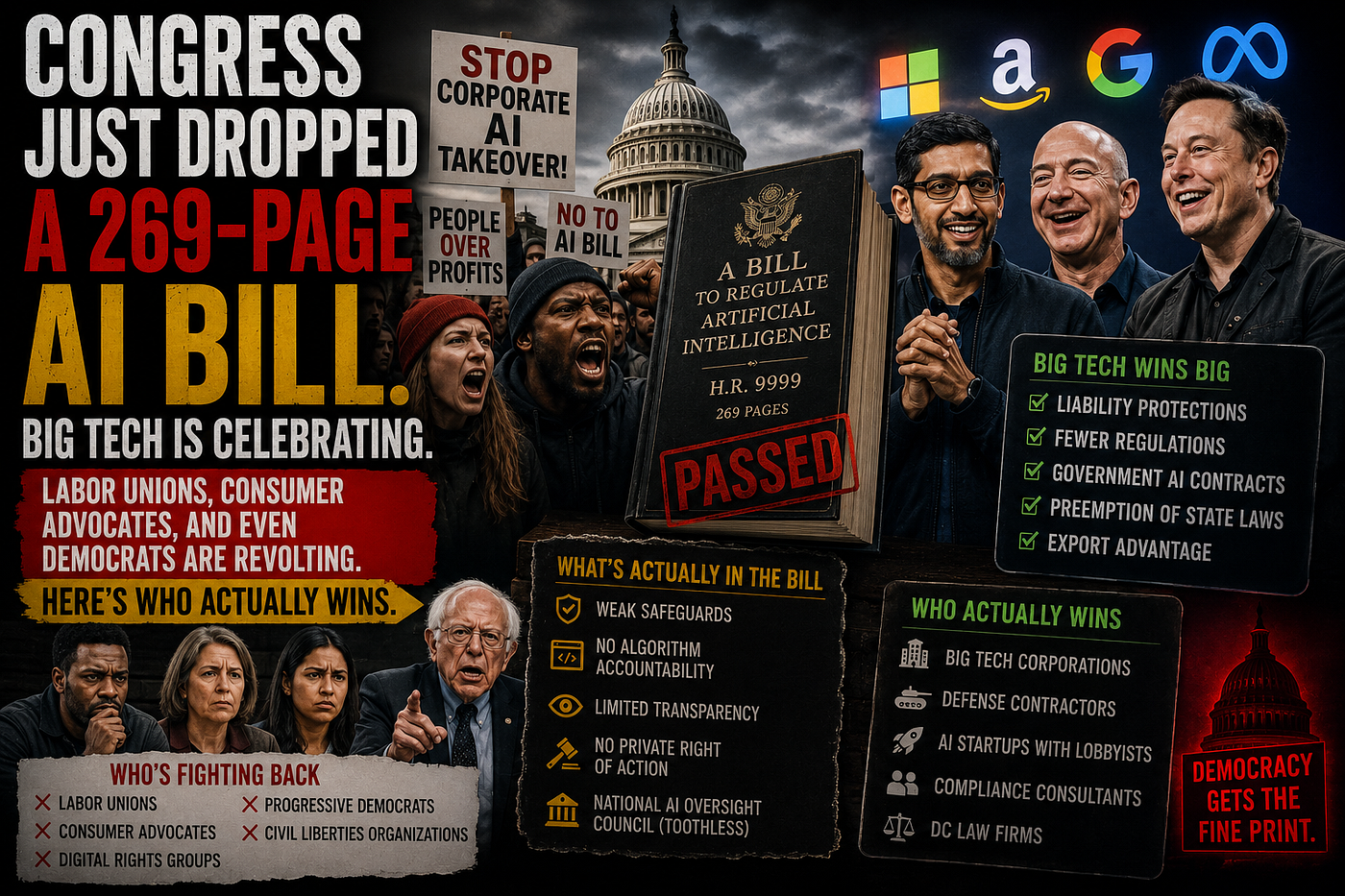
Congress Just Dropped a 269-Page AI Bill. Big Tech Is Celebrating. Labor Unions, Consumer Advocates, and Even Democrats Are Revolting. Here’s Who Actually Wins.
The Great American AI Act looks like safety regulation. It functions as a competitive moat. It freezes state AI laws for three years. It arrives two days after SpaceX’s IPO roadshow and four days after Anthropic’s confidential S-1. And buried in page 47 is the admission that should have been the headline.
On June 4, 2026, two members of Congress — one Republican, one Democrat — dropped a 269-page discussion draft that they called the Great American Artificial Intelligence Act.
The bill landed within hours to near-universal rejection from labor unions, consumer advocates, and even a formal House Democratic commission. SiliconANGLE
Near-universal rejection. From the constituency that one of the bill’s two authors represents.
That response tells you something important about what this bill actually does — as opposed to what it says it does. Because the bill’s stated purpose sounds entirely reasonable. Safety. Transparency. Accountability. A coherent national framework for the most powerful technology in human history.
This 269-page discussion draft targets “frontier” AI models — the most advanced systems trained with enormous computing power. The goal is to reduce serious risks while keeping the U.S. at the forefront of AI innovation. Slashdot
Reduce risks. Keep the US at the forefront. Safety and innovation in the same sentence. Who could object?
Apparently, almost everyone who doesn’t work at one of the five companies who stand to benefit most from its passage.
The Three-Year Freeze That Is the Entire Ballgame
Every major provision in the Great American AI Act is worth examining. But one provision explains the near-universal rejection better than any other.
The bill would freeze state laws on the topic of AI development for three years while requiring the country’s most powerful frontier labs to open up their models. NBC News
The bipartisan bill would bar states from enacting new laws governing how AI systems are built — for at least three years. SiliconANGLE
For three years, no state can pass a new law governing how AI systems are built.
Not how AI is used. States retain that power. But how AI is designed, trained, and deployed — the technical and architectural decisions that determine what harms are possible and what safeguards exist — those decisions would be removed from state legislative authority for a minimum of three years.
That sounds like administrative simplification. One federal standard instead of fifty state standards. Regulatory coherence instead of a patchwork of inconsistent requirements.
Here is what it actually is.
California was ahead. Colorado was ahead. Multiple states had built regulatory frameworks that imposed real requirements on AI developers — requirements that the companies developing these systems had spent significant money lobbying against.
In December 2025, President Trump signed an executive order directing the DOJ to create an AI Litigation Task Force to challenge state AI laws on constitutional grounds. In April 2026, the DOJ filed to block Colorado’s algorithmic discrimination statute — the first federal challenge to a state AI law in US history. SiliconANGLE
The DOJ challenged Colorado’s law in April. Colorado’s legislature then replaced their law with a narrower version before it ever took effect.
The Colorado law, which had been set to take effect June 30, 2026, was replaced by the state legislature with a narrower substitute before it ever took effect. SiliconANGLE
Colorado didn’t wait to be struck down. They preemptively weakened their own law because the federal government signaled it would challenge any state AI regulation that the industry found inconvenient.
That is the regulatory environment the Great American AI Act is arriving into. Not a vacuum. A battlefield where states that tried to regulate AI independently have already been pushed back through DOJ action and legislative self-censorship.
The three-year preemption clause doesn’t create a regulatory framework. It enforces a regulatory ceasefire — and it enforces it on the terms of the parties with the most to lose from state-level regulation.
The Audit Requirement That Sounds Strict and Isn’t
The bill places binding requirements on “large frontier developers” — the big AI companies with more than $500 million in annual revenue that have trained the most powerful AI models. These companies would be required to submit to semi-annual third-party audits. SiliconANGLE
Semi-annual third-party audits. Binding requirements. For the largest AI companies.
This sounds like meaningful oversight. It is the provision that allows the bill’s supporters to say it has teeth.
Here is what the audit requirement actually does when you examine it carefully.
The companies subject to binding audit requirements are the ones with more than $500 million in annual revenue. That threshold was not chosen randomly. It is calibrated to capture the incumbents — OpenAI, Anthropic, Google, Microsoft, Meta — while excluding the emerging competitors who don’t yet have $500 million in revenue but who are building toward the same capabilities.
For the incumbents, a semi-annual audit requirement is an inconvenience they can absorb. They have compliance teams. They have legal departments. They have the resources to navigate a third-party audit framework, shape the standards that govern those audits through industry working groups, and present audit results in the most favorable possible light.
For a challenger — a well-funded startup trying to build a frontier model that competes with GPT-5 or Claude — the same audit requirement is a structural disadvantage. Compliance costs don’t scale proportionally with company size. A $100 million revenue startup subject to the same audit requirements as a $10 billion revenue incumbent faces a proportionally much higher burden.
The audit requirement protects the incumbents it appears to constrain. This is not a novel observation — it is how every major regulatory framework in every major industry has functioned throughout history. Large incumbents write the rules that appear to bind them and actually bind their competitors.
The Provision on Page 47 Nobody Is Covering
The bill focuses primarily on model safety and workforce impacts. Washington Times
Workforce impacts.
The Great American Artificial Intelligence Act looks to create four pillars for AI advancement: establishing frontier AI model governance, collecting insight into changes within the U.S. workforce landscape, fortifying cybersecurity postures, and spurring new AI research and development. CNBC
The second pillar: collecting insight into changes within the U.S. workforce landscape.
Congress is building a federal data collection mechanism to track AI-driven job displacement.
This is the provision that has received the least coverage and carries the most significant signal. Because federal legislation does not create workforce monitoring infrastructure for hypothetical problems. It creates that infrastructure for problems that are real, measurable, and politically consequential enough to require systematic tracking at the national level.
Two weeks ago, Sam Altman told a Sydney conference that he was “delighted to be wrong” about AI job displacement. Three weeks before that, he had been saying AI would take most jobs. Dario Amodei walked back his 50% white-collar job elimination forecast just days before Anthropic filed for a trillion-dollar IPO.
Congress apparently did not get the memo about the revised forecast.
The workforce monitoring provision in the Great American AI Act is the federal government quietly acknowledging what the AI CEOs were saying before their IPO roadshows required them to say something different. The displacement is real enough to require a national data collection system.
That acknowledgment — embedded in bipartisan legislation, endorsed by a Republican and a Democrat — is more credible evidence about what AI is doing to employment than any earnings call reassurance or conference keynote walk-back.
The Timing That Should Be the Lead of Every Story
The Great American AI Act discussion draft dropped on June 4, 2026.
The SpaceX $75 billion IPO roadshow launched in the same week. Anthropic’s confidential S-1 filed four days earlier. OpenAI’s public offering preparation continues in parallel. Mean CEO’s BLOG
Three trillion-dollar AI company IPOs in active preparation. The most significant federal AI regulation bill in US history dropped in the same week.
The three companies preparing trillion-dollar IPOs benefit directly from the three-year state law preemption. They benefit from a federal audit framework they helped shape through industry working groups. They benefit from the elimination of the state-level regulatory variation that creates compliance complexity in the markets where they’re trying to grow enterprise revenue before their public listings.
The bill’s timing is not evidence of corruption. It is evidence of how policy and capital markets interact in practice. When the companies most affected by a regulatory framework are simultaneously preparing the largest public offerings in history, the regulatory environment they’ll operate under is a material fact for investors. A favorable regulatory environment — one that eliminates state-level variation and constrains competitor entry through compliance burden — directly supports the valuations being targeted.
This is how regulatory capture works at scale. Not through explicit deal-making. Through the alignment of interests between the companies that shape regulation and the political incentives of the legislators who write it. Big Tech wants federal preemption. The Trump administration wants to demonstrate that it is managing AI development. Bipartisan legislators want to show voters they are addressing AI without actually constraining the industry that funds their campaigns.
The Great American AI Act satisfies all three sets of interests simultaneously.
What the Opposition Is Actually Arguing
The bill landed within hours to near-universal rejection from labor unions, consumer advocates, and even a formal House Democratic commission — the latest flashpoint in a three-year standoff over who gets to govern artificial intelligence in the United States. SiliconANGLE
The rejection isn’t irrational opposition to AI regulation in principle. It is opposition to this specific regulatory structure because of what it does in practice.
Labor unions are objecting to the workforce monitoring provision being insufficient. Collecting data about AI job displacement is not the same as protecting workers from it. A federal database tracking the industries where AI is eliminating jobs does not require companies to slow down the elimination. It just creates a paper trail.
Consumer advocates are objecting to the three-year preemption. States that had built consumer protection frameworks for AI systems — requirements around transparency, accuracy, and accountability in high-stakes decisions — lose the ability to strengthen those frameworks for three years. During the three years when AI capabilities will develop fastest, the regulatory tools available to protect consumers are frozen at their current level.
The House Democratic commission is objecting to the audit framework’s voluntary elements. The bill creates standards that are voluntary guidance for AI models rather than binding requirements — which means the “accountability” the bill promises is largely accountability to standards that the companies subject to those standards helped write and can meet by self-reporting. NBC News
Between the Information Technology Industry Council describing the bill as “an important step toward building a clear federal framework” and the House Commission on AI and the Innovation Economy describing it as inadequate lies the question the Great American AI Act will spend the summer trying to answer. SiliconANGLE
The IT industry council — the lobbying organization for the largest tech companies — called it an important step. The independent congressional commission called it inadequate.
When the industry being regulated calls the regulation a step forward and the oversight commission calls it insufficient, that is not a close call about whether the regulation serves the public interest.
What This Means for Every Stakeholder in the AI Economy
If you’re a startup trying to build a frontier AI company: The audit requirements for companies above $500 million in revenue don’t apply to you yet. But the preemption of state laws creates a regulatory vacuum that could delay accountability mechanisms that would also constrain your largest competitors. The net effect: a three-year window with weaker overall regulatory pressure on the sector — but also weaker state-level opportunities to build compliance differentiation as a competitive moat.
If you’re an enterprise buyer evaluating AI vendors: The semi-annual audit requirement for large frontier developers gives you a new due diligence tool. Companies subject to those audits will have third-party assessment reports that you can request as part of vendor evaluation. The quality of those reports will vary significantly based on who conducted the audit and what standards they applied — but the existence of the requirement creates a disclosure obligation that doesn’t currently exist.
If you’re an investor evaluating the AI IPOs of 2026: The three-year preemption is material information for your analysis. It removes a category of regulatory risk from OpenAI, Anthropic, and other large frontier developers for a defined period. Regulatory risk that was previously priced into your analysis of these companies is now explicitly frozen at the federal level until 2029. That affects how you model the risk-adjusted returns on trillion-dollar valuations.
If you’re a worker in an industry with AI exposure: The workforce monitoring provision is Congress acknowledging your situation exists. It is not Congress addressing your situation. The gap between acknowledgment and protection is where the actual policy debate needs to happen — and that debate is not in this bill.
If you’re building a compliance or AI governance practice: Even though this is still a draft, smart organizations are already thinking ahead. Closely track updates to the discussion draft and any revisions from stakeholder feedback. Review your current AI risk management practices and identify any gaps compared to the bill’s standards. Strengthen documentation, safety testing, and internal controls around model development. Start building relationships with potential third-party auditors who could perform the required assessments. Slashdot
The audit requirement creates a new professional services market. Third-party auditors certified to evaluate frontier AI systems, compliance officers who understand the GAAIA framework, legal counsel who can navigate the preemption landscape. That market doesn’t fully exist yet. By 2027, it will.
The Three-Year Window and What It Actually Decides
The Stanford HAI 2026 AI Index documents three simultaneous trends that define the current AI moment: AI progress is accelerating faster than any prior measurement period, the cost of training and deploying frontier models is growing exponentially, and public trust in AI companies is declining even as usage grows. TechCrunch
AI progress accelerating. Training costs growing exponentially. Public trust declining.
The Great American AI Act arrives at the precise intersection of those three trends — and it addresses the first two by clearing regulatory barriers to continued acceleration while addressing the third with a framework that offers the appearance of accountability without the substance of constraint.
The three years during which state law preemption prevents stronger regulation are the same three years during which AI progress will be fastest, training costs will most clearly determine market structure, and the public trust deficit will either be addressed or deepen to the point of political crisis.
By the time the preemption expires, the infrastructure will be built. The models will be deployed. The enterprises that signed multi-year contracts will have built workflows around the tools. The switching costs will be established. The incumbents will be public companies with shareholder obligations and lobbying resources and market positions that are far harder to address through legislation than they would have been three years earlier.
The Great American AI Act is not a safety bill.
It is a market structure bill that arrived at exactly the right moment for exactly the right companies — dressed in the language of innovation and accountability and wrapped in 269 pages of bipartisan legitimacy.
The rejection was immediate. Near-universal.
The bill is still moving forward.
If this reframed how you’re reading the AI regulation story — share it with someone who took the bipartisan framing at face value. Drop your take in the comments.
메타데이터
- post_id
- 33844bc2b2b8
- slug
- congress-just-dropped-a-269-page-ai-bill-33844bc2b2b8
- url
- https://journal.messyfounder.com/congress-just-dropped-a-269-page-ai-bill-33844bc2b2b8
- canonical_url
- https://journal.messyfounder.com/congress-just-dropped-a-269-page-ai-bill-33844bc2b2b8
- author_url
- https://medium.com/@sharma.akhil.school
- status
- ok
- fetched_at
- 2026-06-11 21:11:36