The Most Difficult Midjourney Guide I’ve Created
A few months ago, I thought I was writing a small guide about architecture.
The Most Difficult Midjourney Guide I’ve Created
A few months ago, I thought I was writing a small guide about architecture.
I was wrong.
What started as a simple idea slowly turned into one of the largest research projects I have ever undertaken for Midjourney.
At first, I believed the topic would be straightforward.
Find a few architectural techniques.
Collect some examples.
Write a PDF.
Move on to the next project.
Instead, I found myself asking questions I couldn’t easily answer.
Why do some architectural images feel enormous while others feel miniature?
Why do some spaces feel immersive while others feel like stage sets?
Why can two images contain the same building and yet produce completely different emotional reactions?
The deeper I looked, the more complex the subject became.
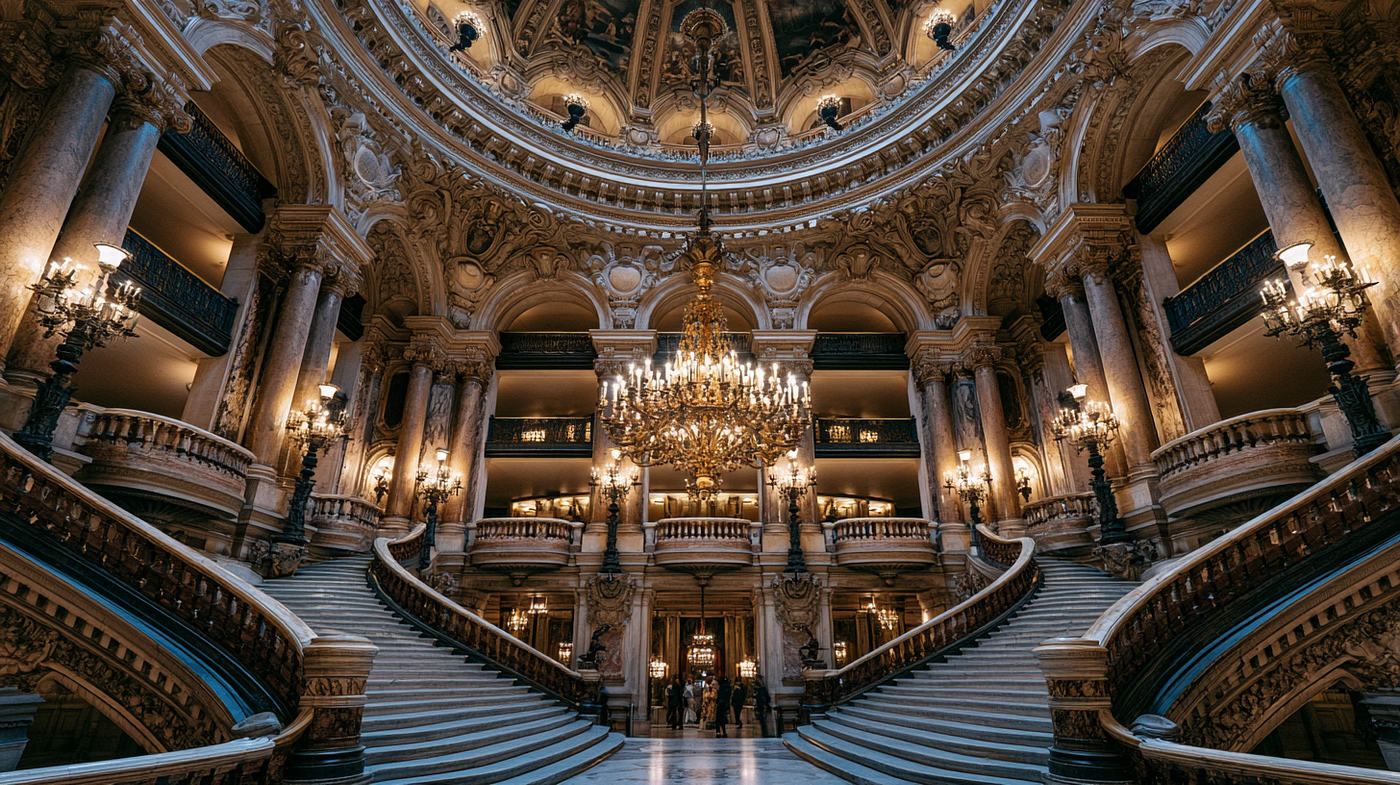
looking upward from the center of an opulent opera house foyer, three-point perspective architecture, staircases extending toward opposite vanishing points while balconies climb toward an immense chandelier dome, elegantly dressed visitors proving scale, Leica SL3, 15mm lens — ar 16:9 — raw — v 8.1
A narrow medieval stone street captured from a corner intersection where two facades diverge, two-point perspective, the strongest corner formed by a timber-framed house with a chamfered edge, left and right rows of irregular buildings receding through uneven rooflines, shutters, window boxes, arcades, cobblestones, and hanging signs, a distant figure near the vanishing point, early morning mist, soft side light, rich occlusion and scale reduction, highly believable old-town geometry, cinematic depth, — ar 3:2 — raw — v 8.1

The Rabbit Hole
The problem with architecture is that it is invisible when it works.
Most people see walls.
Architects see relationships.
Most people see columns.
Architects see rhythm.
Most people see a staircase.
Architects see movement.
I quickly realized that architectural depth was not a single technique.
It was an ecosystem.
Perspective.
Framing.
Occlusion.
Scale.
Compression.
Light.
Materials.
Transitions.
Emotion.
Every answer created new questions.
safe circular gathering hall beneath a warm wooden dome, intimate proportions creating emotional security, cinematic architecture photography, Hasselblad X2D, 55mm lens — ar 16:9 — v 8.1

Hundreds of Experiments
I generated image after image, Sometimes changing a single word, Sometimes changing only the position of an opening, Sometimes removing half of the visible architecture.
The surprising discovery was that more architecture often created less depth.
Showing everything frequently made an image feel smaller.
Hiding information often made it feel larger.
Organizing Chaos
Research is exciting, Organization is not.
The hardest part was not writing.
The hardest part was transforming hundreds of notes, observations, prompt experiments, image comparisons, and visual principles into something another person could actually use.
I rewrote sections repeatedly.
I merged chapters.
I deleted entire pages.
I rebuilt the structure from scratch more than once.
The final guide became far larger than originally planned.
luxury alpine lodge corner overlooking a valley, two-point perspective architecture, timber facades stretching along both mountain ridges, distant balconies fading into atmospheric depth, tiny hikers proving scale, Leica SL3, 35mm lens — ar 16:9 — raw — v 8.1

minimalist contemporary museum viewed from a sharp architectural corner, two-point perspective, long concrete galleries extending left and right toward distant vanishing points, visitors appearing smaller with distance, subtle atmospheric separation, architectural photography masterpiece, Sony A7R V, 24mm lens — ar 16:9 — raw — v 8.1

More Than a PDF
At some point, I realized I wasn’t creating a prompt pack.
I was creating a framework.
Something that could help people understand why architectural images work.
Not just what to type, But what to see.
That distinction became the foundation of the entire project.
The Final Result
The completed guide contains more than 200 pages dedicated entirely to architectural depth.
Why I Created It
Because architectural depth is one of the most overlooked subjects in AI image generation.
People spend endless hours searching for styles, For parameters, For secret prompt formulas.
Yet depth is often the single factor that separates an image that feels ordinary from one that feels cinematic.
I wanted to understand that difference.
And now I finally have a way to share what I learned.
The guide is finished.
But I suspect the research is only beginning.
Libée Lune
메타데이터
- post_id
- 339776aa134b
- slug
- the-most-difficult-midjourney-guide-ive-created-339776aa134b
- url
- https://medium.com/@libelune/the-most-difficult-midjourney-guide-ive-created-339776aa134b
- canonical_url
- https://medium.com/@libelune/the-most-difficult-midjourney-guide-ive-created-339776aa134b
- author_url
- https://medium.com/@libelune
- status
- ok
- fetched_at
- 2026-06-22 17:31:34