How On-Chain Commerce Could Create New Growth Opportunities for Global Brands
Author: Xinyue, Fu Rao Tony Editor: Avrum
How On-Chain Commerce Could Create New Growth Opportunities for Global Brands

Author: Xinyue, Fu Rao Tony Editor: Avrum
China’s Export Landscape: Growth, Resilience, and Structural Change
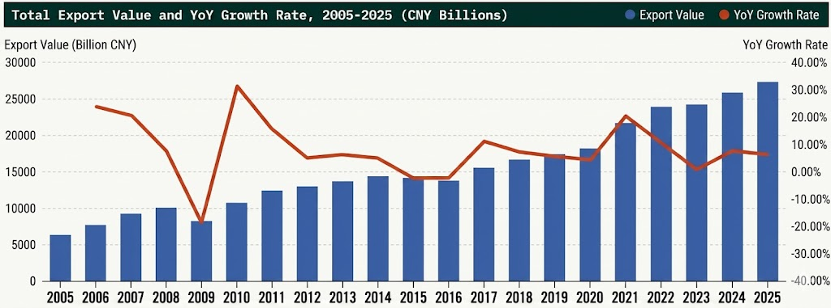
Over the past two decades, China’s export sector has experienced remarkable expansion, although the pace of growth has gradually moderated. Between 2005 and 2007, China’s exports increased from approximately RMB 6.3 trillion to nearly RMB 10 trillion, maintaining annual growth rates above 20%. Benefiting from the globalisation wave that followed China’s accession to the WTO, the country rapidly emerged as the world’s manufacturing centre and entered a period of accelerated trade expansion.
The global financial crisis of 2008–2009 marked the first major disruption to this trend. In 2009, China’s exports declined to approximately RMB 8.2 trillion, with year-on-year growth falling to around -16%, representing one of the most significant contractions in decades. As the global economy recovered and domestic industrial upgrading accelerated, exports rebounded strongly between 2010 and 2014. Total exports rose from RMB 10.7 trillion to RMB 14.4 trillion, although annual growth rates gradually normalised from the post-crisis peak of 32% in 2010 to approximately 5%.
Between 2015 and 2016, global trade weakness, declining commodity prices, exchange rate adjustments, and softer international demand contributed to a period of stagnation. Export volumes remained relatively flat at around RMB 14 trillion, with growth rates approaching zero. Another major turning point arrived in 2018, when trade tensions between China and the United States escalated significantly. The United States imposed tariffs on approximately US$360 billion worth of Chinese goods, while China responded with corresponding measures. Despite these challenges, China’s exports remained relatively resilient. Export values remained within the RMB 16–17 trillion range during 2018 and 2019, with no dramatic collapse.
Several factors contributed to this resilience. Some exporters accelerated shipments ahead of tariff implementation, creating a temporary front-loading effect. At the same time, China’s export markets became increasingly diversified. In addition, portions of trade flows were redirected through third-party economies such as Vietnam and Mexico, reducing the apparent impact reflected in official trade statistics.
The COVID-19 pandemic created another unexpected shift. China was among the first major economies to restore manufacturing capacity, benefiting from surging global demand for medical supplies, consumer electronics, and remote-working equipment. Exports continued to expand rapidly through 2021 and 2022, surpassing RMB 23 trillion.
In recent years, ongoing trade frictions with the United States have encouraged China to accelerate industrial upgrading and pursue broader market diversification. Strong export growth to ASEAN and European markets has partially offset weaker demand from the United States. In 2025, China’s total goods exports reached RMB 26.99 trillion, representing year-on-year growth of 6.1%.
Source: National Bureau of Statistics of China, RWA.LTD Research Department
Shifting Export Dynamics
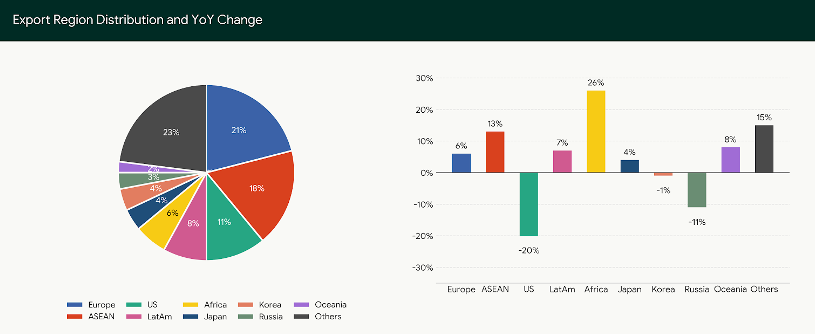
China’s export structure has also undergone meaningful changes. Europe and ASEAN accounted for approximately 21% and 18% of total exports, respectively, making them China’s two largest regional export markets.
European exports continued to grow by roughly 6%, highlighting the competitiveness of Chinese manufacturers across industrial equipment, consumer products, and new energy supply chains. ASEAN, meanwhile, expanded even faster, recording growth of approximately 13%. Supported by deeper regional integration through RCEP, supply-chain regionalisation, and the increasing overseas expansion of Chinese enterprises, ASEAN has become one of the most important drivers of China’s export growth.
The United States, by contrast, represented approximately 11% of China’s exports and experienced a decline of roughly 20%. This decline reflects the ongoing impact of trade tensions, supply chain restructuring, and production relocation to third countries.
Emerging markets have become increasingly important sources of growth. Exports to Africa accounted for approximately 6% of total exports while growing by 26%, making it one of the fastest-growing regions. Latin America represented approximately 8% of exports and recorded a growth of 7%. Northeast Asian markets remained relatively stable, with Japan and South Korea each accounting for roughly 4% of exports. Exports to Japan increased by 4%, while exports to South Korea declined slightly by 1%.
Taken together, these trends suggest that China’s export growth is entering a new phase. While Europe, ASEAN, and the United States continue to form the foundation of China’s export economy, much of the incremental growth is increasingly coming from ASEAN, Africa, Latin America, and other emerging markets.
Source: General Administration of Customs of the People’s Republic of China, RWA.LTD Research Department
What PDD’s Earnings Reveal About the Future of Chinese Cross-Border E-Commerce
PDD’s first-quarter 2025 earnings release triggered significant market volatility. The company reported total revenue of RMB 106.2 billion, representing year-on-year growth of 11%, slightly below the Bloomberg consensus. Non-GAAP net income attributable to shareholders reached RMB 14.1 billion, down 17% year-on-year and significantly below market forecasts. While the results disappointed investors in the short term, the earnings report may reflect something more important: PDD’s transition from a phase of rapid expansion to one focused on long-term, sustainable growth.
By examining PDD’s recent performance and strategic initiatives, we can gain valuable insights into the broader evolution of China’s cross-border e-commerce industry.
Seasonal Headwinds and Strategic Investment
Part of the pressure on first-quarter results can be explained by the seasonal nature of the e-commerce business. Both domestic and international markets typically experience weaker consumer demand following year-end shopping seasons and major holiday periods. After events such as Singles’ Day, Double 12, and the Lunar New Year shopping cycle, consumer spending often enters a temporary slowdown.
From a management perspective, slower periods also provide an opportunity to test new initiatives and adjust business strategy. Compared with peak shopping seasons, increased investment during the off-season generally has a more limited impact on annual performance, making it a suitable period for experimentation and long-term investment. However, seasonality alone does not fully explain the softer year-on-year performance.
The Challenge of Low Switching Costs
PDD’s international success was initially built on China’s manufacturing advantages and an aggressive subsidy-driven growth strategy. Supported by a highly efficient manufacturing ecosystem and industrial supply chain, Temu rapidly expanded across Europe and North America through highly competitive pricing. The platform further strengthened its cost advantage by continuously identifying and supporting high-quality manufacturers.
Yet the e-commerce industry faces a structural challenge that is difficult to overcome: consumers can switch platforms with very little friction.
Whether shopping on Amazon, Walmart, TikTok Shop, or Temu, consumers are often willing to switch between platforms when they find better prices, promotions, or product selections. As a result, user acquisition strategies based primarily on subsidies and marketing campaigns can drive rapid growth, but they rarely create lasting competitive advantages.
Recognising this challenge, PDD has increasingly shifted its focus towards supply chain development. In 2026, the company launched its self-operated overseas brand initiative, Xinpinmu, and established a dedicated subsidiary in Shanghai with an initial investment of RMB 15 billion. PDD has announced plans to invest a cumulative RMB 100 billion over the next three years to strengthen supply-chain capabilities and support merchants through shared-risk initiatives. The objective is not simply to increase sales, but to help businesses move beyond prolonged price competition and build more sustainable advantages.
At its core, this strategic shift reflects a response to one of the defining characteristics of modern e-commerce: when user loyalty alone cannot create a durable moat, superior products and supply chain efficiency become increasingly important sources of long-term competitiveness.
Marketing Costs and the Economics of E-Commerce
A closer look at PDD’s revenue composition provides additional insights. In the first quarter, transaction service revenue grew to RMB 56.3 billion, while online marketing revenue reached RMB 49.9 billion, increasing by only 2.5% year-on-year.
Over recent years, transaction revenue has consistently grown faster than advertising revenue. While this trend partly reflects Temu’s rapid overseas expansion, it also highlights important differences between Temu’s business model and those of more mature e-commerce platforms.
During its early growth stage, Temu relied heavily on a fully managed operating model. The platform handled product selection, pricing, marketing, and fulfilment, while merchants functioned primarily as suppliers rather than independent store operators. As a result, increasing transaction volume did not necessarily translate into greater advertising demand.
In addition, Temu remains in a market-expansion phase. A significant portion of its traffic originates from subsidies, referral programmes, social sharing, and paid user acquisition campaigns rather than high-intent searches initiated by consumers. Consequently, the monetisation maturity of its advertising ecosystem naturally lags behind the growth of gross merchandise volume (GMV).

Source: PDD, RWA.LTD Research Department
Why High Revenue Does Not Always Mean High Profitability
From the perspective of merchants, cross-border e-commerce presents another often-overlooked challenge. Many overseas brands generate attractive gross margins yet struggle to achieve equally strong net profitability.
It is common for cross-border brands to report gross margins exceeding 40%, with some niche categories surpassing 60%. However, net profit margins frequently remain below 10%. The primary reason is not manufacturing cost, but customer acquisition expense.
During early-stage expansion, sales and marketing expenses can exceed 40% of revenue. Even for more mature brands, marketing costs often remain above 20%. This does not necessarily indicate operational inefficiency. Rather, it reflects the concentration of the global digital advertising market.
Today, the majority of online consumer traffic is controlled by a small number of platforms, including Google, Meta, TikTok, and Amazon. Whether merchants operate through marketplaces or independent websites, they must typically rely on these platforms to reach customers. Consumer attention is increasingly concentrated, forcing brands to compete aggressively for visibility.
Public financial data illustrates the strength of these platforms. Google has consistently maintained gross margins between 50% and 70%, while Meta’s gross margins have often exceeded 70%. Such profitability reflects the significant bargaining power these platforms possess within the digital traffic distribution ecosystem.

Source: UBS, RWA.LTD Research Department
PDD’s Alternative Approach
The success of PDD in both China and international markets is rooted in a relatively simple idea: redistributing a portion of platform profits and marketing costs back to consumers.
Traditional e-commerce platforms often rely on advertising-driven traffic allocation systems. On search-based platforms such as Taobao, merchants compete for visibility through keyword bidding, meaning traffic acquisition is frequently determined by advertising budgets rather than product competitiveness. While this model generates substantial advertising revenue for platforms, it also raises merchant acquisition costs, which are ultimately passed on to consumers through higher prices.
PDD adopted a different approach. Through price comparison mechanisms and algorithmic recommendations, traffic is more heavily allocated to products that offer greater value and competitiveness, rather than simply rewarding the highest advertising spenders. This reduces merchants’ dependence on paid traffic while allowing part of the savings to be transferred directly to consumers.
The same principle underlies Temu’s international expansion. Rather than competing solely on price, Temu is attempting to reshape how value is distributed across the e-commerce ecosystem. By reducing platform take rates, minimising advertising inefficiencies, and improving supply-chain efficiency, more value can flow directly to end consumers. This redistribution model helps explain how Temu achieved rapid user growth in a relatively short period.
How On-Chain Commerce Could Support Global Brand Expansion
Industry Challenges and Emerging Responses
The analysis above highlights two persistent challenges facing the cross-border e-commerce industry: low user switching costs and rising customer acquisition costs.
From the consumer’s perspective, platforms such as Amazon, Temu, TikTok Shop, SHEIN, and independent e-commerce websites are largely interchangeable. Users rarely develop deep loyalty to a particular platform and often move between marketplaces based on pricing, promotions, or product availability. This low switching cost makes it difficult for platforms and merchants to create the kind of network effects commonly seen in social media or software businesses.
At the same time, the cost of acquiring users continues to rise. Global e-commerce traffic is increasingly concentrated within a small group of platforms, including Google, Meta, TikTok, and Amazon. Merchants must continually spend on advertising to generate visibility and sales, leaving many cross-border brands trapped in a cycle of high gross margins but relatively low net profitability. When consumers can leave at any time while merchants must continuously purchase traffic, the industry becomes locked in a cycle of competition, advertising expenditure, and margin compression.
Recognising these challenges, major e-commerce platforms have begun exploring different strategies to strengthen their competitive positioning.
Temu is gradually evolving beyond its early reliance on low prices and fully managed operations, investing more heavily in supply-chain capabilities while continuing to pass value back to consumers. SHEIN is expanding beyond its fast-fashion roots by building a broader brand ecosystem. Through initiatives such as SHEIN Xcelerator, the company supports emerging designers and brands while simultaneously strengthening consumer engagement through offline retail experiences. AliExpress, meanwhile, is leveraging Alibaba’s ecosystem through its Brand+ strategy, helping established Chinese brands expand internationally through integrated logistics, traffic acquisition, and digital operating capabilities.
Logistics infrastructure is also undergoing a transformation. The industry’s focus is shifting from broad global coverage toward deeper regional penetration. Rather than serving every market equally, platforms are increasingly concentrating resources in key markets through local warehouses, regional inventory networks, and localised supply chains. Delivery expectations have evolved accordingly, moving from one- to two-week international shipping toward increasingly localised fulfilment standards measured in days rather than weeks.
The Potential Advantages of On-Chain Commerce
Against this backdrop, on-chain commerce presents an alternative approach to addressing some of the structural challenges facing modern e-commerce.
The value of on-chain commerce does not simply lie in selling products on a blockchain. Rather, its significance lies in redefining ownership of user relationships and user-generated value.
In traditional e-commerce ecosystems, browsing history, purchasing behaviour, and consumer preferences ultimately become platform-owned assets. These data assets are then monetised through advertising systems and traffic allocation mechanisms. Although merchants create products and services, they rarely gain direct ownership of customer relationships and must repeatedly pay to reacquire the same consumers.
On-chain commerce introduces a different possibility. Consumer identities, transaction histories, and digital credentials can be owned and controlled by users themselves while being selectively shared with merchants. This allows businesses to distribute rewards, memberships, loyalty benefits, or exclusive offers directly to users based on verified on-chain activity.
Such a model may reduce dependence on third-party advertising platforms and create opportunities for more efficient customer engagement. More importantly, it enables user value to accumulate over time. When purchase histories, memberships, loyalty benefits, and digital assets remain linked to a persistent identity within a broader ecosystem, switching platforms may entail more than just choosing a different storefront. It may also involve leaving behind accumulated privileges, reputation, and digital ownership, thereby creating new possibilities to improve customer retention and lifetime value.
From Transaction Platforms to User Networks
On-chain commerce may also help address another long-standing challenge within traditional e-commerce ecosystems: low user engagement outside of shopping periods.
Many traditional platforms exhibit a familiar pattern of high Monthly Active Users (MAU) but relatively low Daily Active Users (DAU). Consumer activity often surges during major promotional events such as Singles’ Day or Black Friday, only to decline sharply once campaigns end. While this dynamic can support short-term GMV growth, it is less effective at building long-term user communities. As a result, platforms frequently need to spend additional marketing budgets to reactivate users.
On-chain commerce introduces additional layers of interaction beyond purchasing. Secondary marketplaces, loyalty systems, digital memberships, and reward mechanisms can encourage users to remain engaged even when they are not actively shopping. Users may continue participating by collecting, trading, staking for benefits, or engaging in community activities associated with their digital assets and memberships.
This creates the potential for a more sustainable cycle of engagement: consumption, ownership, interaction, and repeat participation. Compared with promotion-driven traffic models, such ecosystems may be better positioned to develop long-term user communities and stronger network effects.
From a broader perspective, on-chain commerce represents one of the most practical application areas for both Consumer RWA and the emerging On-Chain Commerce ecosystem. Its long-term potential extends beyond transaction efficiency. By combining digital ownership, tokenised rights, on-chain identity systems, and user-owned data, on-chain commerce may create new ways for brands and consumers to build deeper, more enduring relationships.
Disclaimer
This article is intended solely for industry research, educational, and informational purposes. It does not constitute investment advice, a solicitation, or recommendation to buy or sell any securities, digital assets, or financial products, nor should it be construed as legal, financial, tax, or other professional advice.
The information, data, examples, analyses, and opinions presented in this article are derived from publicly available sources and the authors’ own research and judgment. While reasonable efforts have been made to ensure accuracy, no representation or warranty is made regarding the completeness, accuracy, or timeliness of the information provided.
The views expressed herein are those of the authors and do not necessarily reflect the official position of RWA.LTD or any affiliated organisations. Readers should conduct their own independent research and exercise their own judgment before making any decisions based on the information contained in this article.
About RWA.LTD
RWA.LTD explores consumer RWAs, tokenised commerce infrastructure, and the integration of real-world products and services with blockchain technology.
Website: rwa.ltd LinkedIn: https://linkedin.com/company/rwaltd X: https://x.com/RWA_LTD Instagram: https://instagram.com/rwa.ltd_ Spotify: https://open.spotify.com/show/033vjlvag1CJrPicLy9aYC
메타데이터
- post_id
- 339b42e53e78
- slug
- how-on-chain-commerce-could-create-new-growth-opportunities-for-global-brands-339b42e53e78
- url
- https://medium.com/@rwa-ltd/how-on-chain-commerce-could-create-new-growth-opportunities-for-global-brands-339b42e53e78
- canonical_url
- https://medium.com/@rwa-ltd/how-on-chain-commerce-could-create-new-growth-opportunities-for-global-brands-339b42e53e78
- author_url
- https://medium.com/@rwa-ltd
- status
- ok
- fetched_at
- 2026-06-15 20:49:13




