The Symphony of Gravity: One Motif, Two Movements🎶 The Symphony of Gravity: One Motif, Two…
Series: A New Geometry of the Universe (Part IV)
The Symphony of Gravity: One Motif, Two Movements🎶 The Symphony of Gravity: One Motif, Two Movements
Series: A New Geometry of the Universe (Part IV)
Dear physics explorer,
In the previous chapters, we watched “awakened spacetime” reinterpret the Hubble tension using a time-evolving effective rhythm, ε(t). We stopped treating 67 and 73 km/s/Mpc as mortal enemies — and started reading them as two geometric snapshots of one living, dynamic tempo taken at different cosmic ages.
But a truly great symphony never consists of a single melody.
A composer takes one motif and moves it across movements — changing instruments, tempo, and harmony — until the same idea reveals entirely different faces.
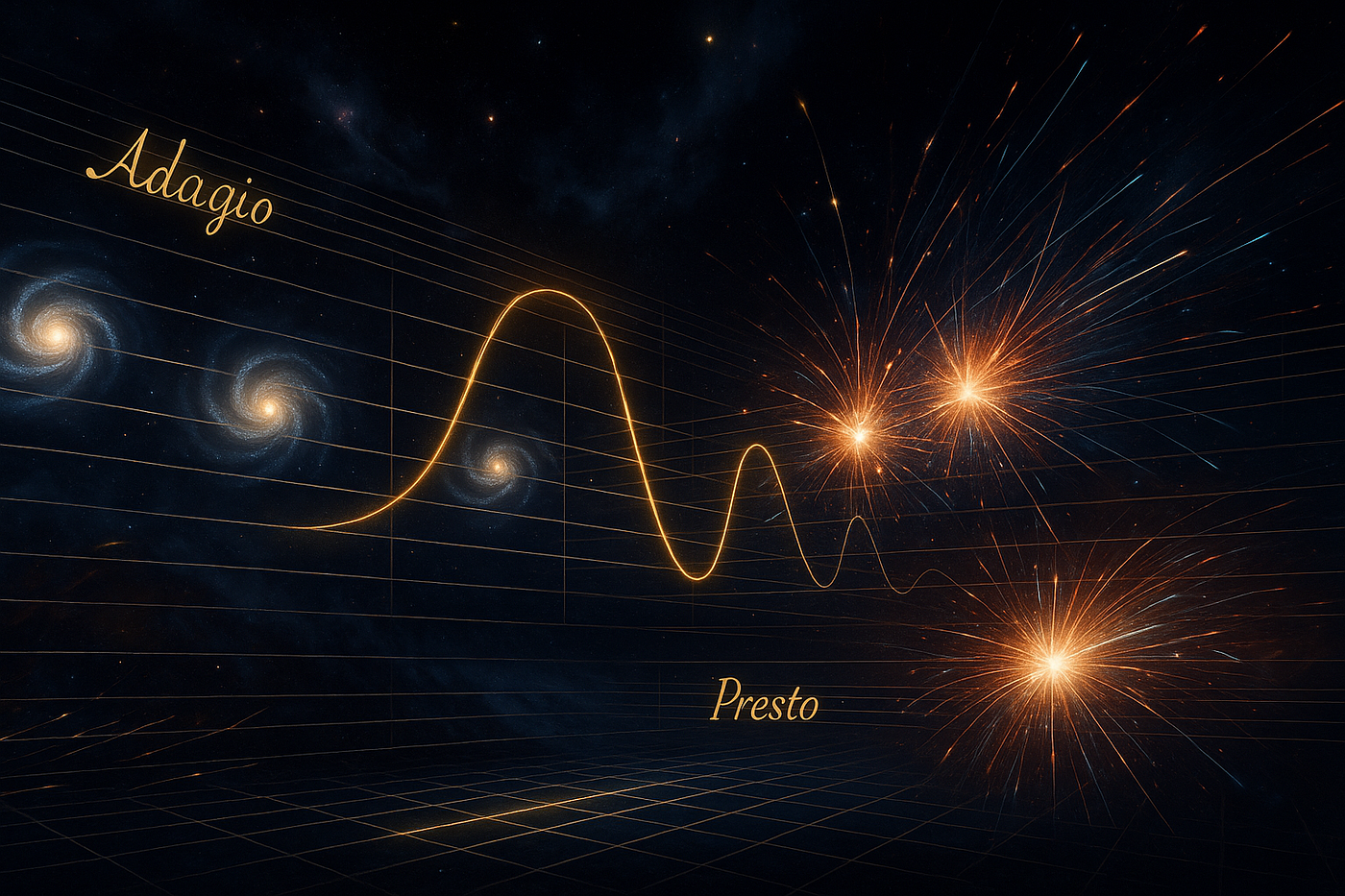
Today, let’s listen to two new movements in the Symphony of Gravity:
How the same geometric motif can resurface at galactic scales and high-energy scales, producing radically different styles.
⚠️ A crucial reminder (PTQ consistency)
In PTQ theory, we allow the underlying geometric description to be richer — sometimes even carrying quaternionic structure. But every physical observable must first pass through the PT projection operator Π_PT.
That means the data we ultimately measure is always real-valued.
So in this essay, ε is a “geometric participation dial” — not an imaginary color your instruments directly see.
First Movement — 🎻 Adagio: The Galactic Gravity Waltz, ε(r)
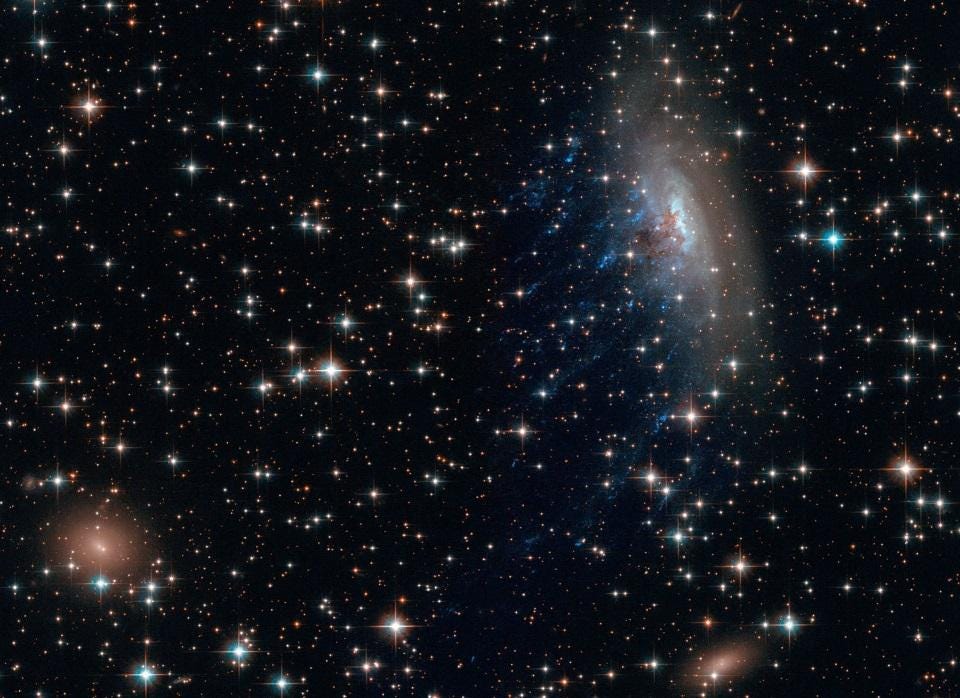
Out in the outskirts of galaxies, intuition says stars should orbit more slowly. Matter becomes sparse, gravity weakens, and rotation should drop.
Yet the famous flat rotation curves show something else: stars near the edges keep dancing — fast, steady, elegant.
The traditional fix is to add invisible “dark matter ghosts” everywhere.
But in the awakened-spacetime view, the stage itself can lay down hidden tracks.
We describe this with a radial geometric profile:
ε(r) = 2 · tanh(r / r_s)
This melody expresses a simple saturation story from center to edge:
- Galactic core: ε(r) is tiny, and dynamics return to familiar Newtonian gravity.
- Galactic outskirts: ε(r) approaches saturation. Through a geometric efficiency factor κ, orbital dynamics are modified so stars naturally maintain high rotation speeds.
The chorus of data
When this “geometric profile” is compared against the SPARC database of 175 galaxies, the model shows competitive fit quality — reproducing rotation curves at a level comparable to traditional halo-based ΛCDM fits.
Same galaxy. Same stars. A different role for geometry.

Second Movement — 🔥 Presto: Quantum Tremors in High-Energy Events, ε(E_T)
If the first movement is a slow waltz, the second is percussion — played inside a particle collider.
In high-energy experiments (like the LHC), energy spectra typically fall smoothly. But if the tail region shows tiny ripples or shoulder-like structures, it may hint at something deeper:
spacetime itself could be resonating.
When you strike the stage hard enough, it can respond with specific tones.
We describe the high-energy variation motif as:
ε(E_T) = α · (E_T / E₁) · sin²(E_T / E₁)
Here:
- E₁ is the resonance “pitch,” setting the frequency scale of the ripples.
- sin²(·) shapes the oscillatory pattern, predicting regular modulations in the distribution.
- α is the “volume knob,” controlling how visible the geometric resonance becomes in the data.

The resonance with data
When compared to CMS public missing transverse energy (MET) spectra, this oscillatory template can provide a better shape fit than a purely exponential model — capturing subtle high-energy features more precisely.
This is not merely “adding a bump.”
It is a claim that geometry can leave a fingerprint.

Coda — 🎼 One Motif, Two Movements: The Beauty of Unity
Now step back and view the full symphony:
- Cosmic scale ε(t): a time pacemaker describing how expansion rhythm evolves across epochs.
- Galactic scale ε(r): a spatial profile that makes outer orbits naturally flatten.
- High-energy ε(E_T): a resonant variation that imprints geometric signatures in energetic tails.
Different stages. Different instruments. A single underlying rulebook — rooted in a unified PT-symmetric Palatini framework.
And to keep this symphony from collapsing into chaos, two backstage heroes quietly do their work:
- The geometric scale φ: a calibration parameter tied to ε through ε = 2φ / M_pl
- The light-speed guardian (C3 locking): a hardware-like safety bolt that locks key coefficients so gravitational waves must propagate at light speed, c_T = 1
Dr. Q’s Reflection Moment
If the universe is a composer, its greatest magic may not lie in inventing infinitely many new notes.
It may lie in taking one geometric theme and writing multiple movements that echo one another across scale.
What we hear is not three unrelated songs, but one melody played on different instruments — each passage passing through the strict audit of PT projection before it becomes observable, reportable physics.
🚀 Explore More with Dr. Q
Curious about the mathematics, derivations, and observational links behind this story?
- Academic paper: *A Unified PT-Even Torsion Framework for the Dark Sector: Cosmology, Galaxies, and Collider Signatures*
- Follow the Medium series: *More stories from Dr. Q’s New Geometry of the Universe*
Next Series Preview
We’ve heard the Symphony of Gravity.
Now comes a more ambitious question:
Can we become not just listeners — but conductors?
If humanity learns an engineering method to control ε, could we unlock a vault of vacuum energy?
Coming next: “Beyond the Boundary: Engineering Fantasies of Geometric Flux.”
PTSymmetry #GalaxyRotationCurves #LHC #DarkMatter #GeometricEfficiency #PTQ #DrQPhysics
메타데이터
- post_id
- 33abe1eebbd1
- slug
- the-symphony-of-gravity-one-motif-two-movements-the-symphony-of-gravity-one-motif-two-33abe1eebbd1
- url
- https://medium.com/@dr.q.universe/the-symphony-of-gravity-one-motif-two-movements-the-symphony-of-gravity-one-motif-two-33abe1eebbd1
- canonical_url
- https://medium.com/@dr.q.universe/the-symphony-of-gravity-one-motif-two-movements-the-symphony-of-gravity-one-motif-two-33abe1eebbd1
- author_url
- https://medium.com/@dr.q.universe
- status
- ok
- fetched_at
- 2026-06-20 20:29:01