The Age of Knowing Is Here. The Age of Doing Is What Defines You.
Artificial intelligence has collapsed the distance between ignorance and information. The question facing the next generation of…
The Age of Knowing Is Here. The Age of Doing Is What Defines You.
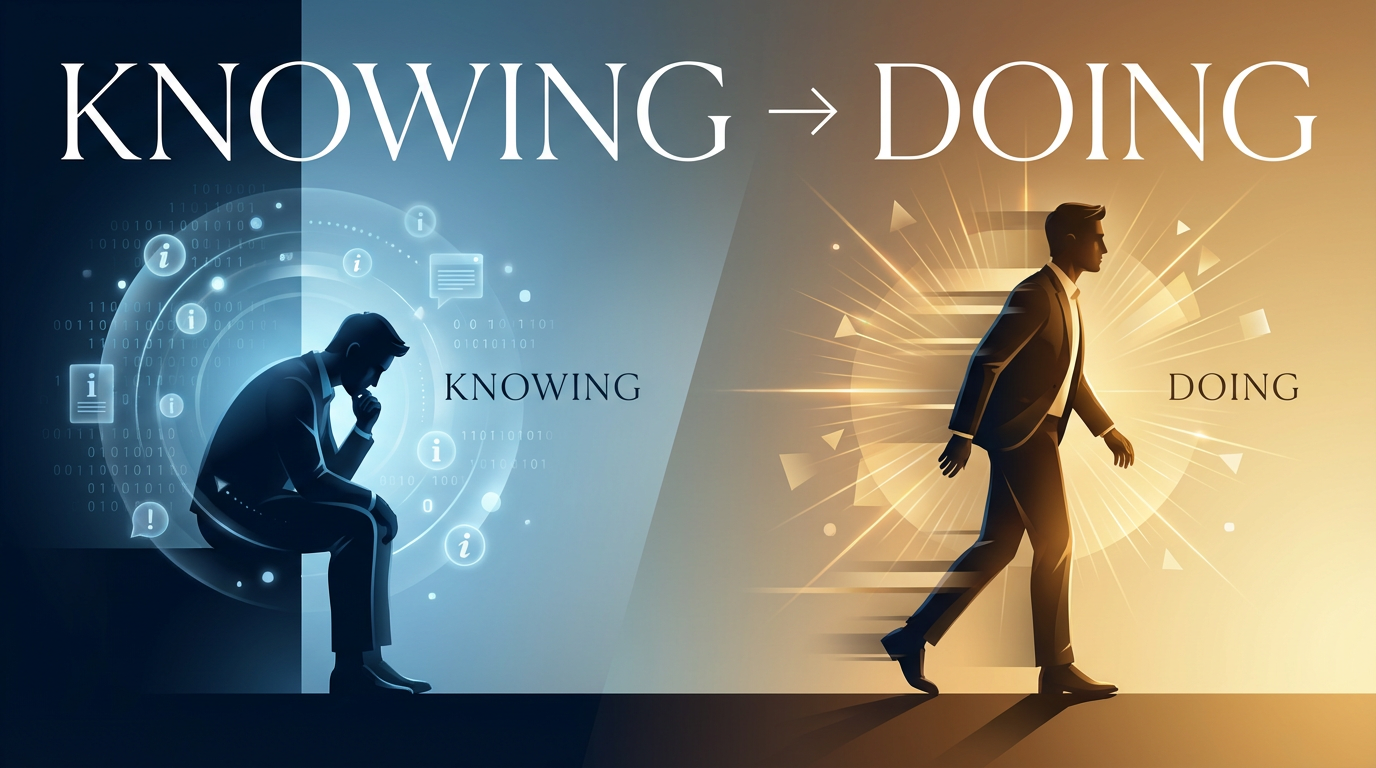
Artificial intelligence has collapsed the distance between ignorance and information. The question facing the next generation of professionals is not what they know — it is what they choose to do with it.
There is a philosophical threshold every generation crosses — a moment when the gatekeepers of knowledge either collapse or transform. The printing press democratized the written word. The internet democratized access to information. Now, artificial intelligence has done something far more profound: it has democratized the synthesis of knowledge itself. And with that shift comes an uncomfortable truth that every ambitious professional must reckon with. Knowing is no longer the differentiator. Doing is.
For the generation that came before us, expertise was scarce and therefore valuable. To know something deeply — the mechanics of law, the intricacies of medicine, the architecture of software — required years of deliberate study, expensive mentorship, and exclusive institutional access. Knowledge was a moat. It protected careers. It justified hierarchies. It conferred authority.
That moat has been drained. Not slowly, and not gently.
“Every previous generation competed on what they knew. Your generation must compete on what you do — and more precisely, on the speed, judgment, and creativity with which you act.”
I. The Philosophical Shift: From Epistemology to Action
The ancient Greeks distinguished between episteme — theoretical knowledge — and techne — the knowledge of how to make and do things. For millennia, the accumulation of episteme was the pinnacle of intellectual aspiration. To know was to be educated. To be educated was to be valuable.
AI has fundamentally rebalanced this equation. Today, episteme is abundant and nearly free. Ask any large language model to explain the capital structure of a leveraged buyout, draft a legal brief on contract breach, or produce a working machine learning pipeline — and it will, in seconds, with startling competence. The edifice of knowing has been democratized beyond what any prior revolution achieved.
What remains scarce — what AI cannot simply generate on command — is techne at its highest form: the disciplined, directed, creative application of knowledge to real, resistant, ambiguous problems. The doing. This is not a small caveat. It is the entire game.
The philosopher John Dewey argued that knowledge divorced from action is mere abstraction. In the AI era, his pragmatism becomes not a philosophical school but a professional survival strategy. Information without execution is decoration.
II. What AI Actually Gives the Ambitious Professional
Let us be precise about what artificial intelligence provides, because the conversation is too often distorted by either breathless enthusiasm or paralytic fear. AI, used deliberately, offers the working professional something extraordinary: the compression of the learning curve.
Tasks that required days of reading now yield structured synthesis in minutes. The professional who masters AI-augmented research operates at a pace that previous generations simply could not match. AI removes the boundary between what you studied and what you can engage with competently — a marketer can now dialogue intelligently with engineers; a lawyer can interrogate financial models. Early-career professionals, armed with AI, can produce outputs that rival those of seasoned veterans, compressing years of experience into months of deliberate practice.
But here is where the philosophical nuance sharpens into something critical: these advantages are available to everyone. The professional who merely uses AI to know more is not building a durable advantage. They are running on a treadmill. The professional who uses AI to do more — to ship more, build more, iterate more, create more — is building something that compounds.
III. Knowing Is Table Stakes. Doing Is the Career.
Consider what this means in practice. Two analysts sit down to solve the same strategic problem. Both use AI to research the market, synthesize the competitive landscape, and draft a preliminary framework. At the end of that process, they both know roughly the same things. The divergence begins immediately after.
One stops. They have the knowledge. They feel informed. They wait for direction. The other acts. They take the draft, apply their own judgment, stress-test the assumptions, present it to a stakeholder, absorb the feedback, and iterate. Within a week, they have moved from information to insight to impact. That gap — between knowing and doing — is where careers are built or surrendered.
The previous generation competed on who had accumulated more knowledge over time. Time was the raw material. The next generation competes on who can translate knowledge into action most effectively. Velocity of execution, quality of judgment, and courage to commit — these are the new career currencies.
“AI has made information free and abundant. It has made wisdom — the earned, applied, experiential kind — more scarce and more valuable than ever before.”
IV. The Compounding Advantage of the AI-Native Professional
There is a second-order effect that most professionals are not yet thinking about carefully. AI does not merely accelerate individual tasks. It changes the rate of compounding for those who act on its outputs.
In previous generations, a professional might complete one significant project per quarter. With AI-augmented productivity, a disciplined professional can complete three. Each project is not just a deliverable — it is a unit of experience, a data point of feedback, a building block of judgment. The professional who does more, learns faster. The professional who learns faster, compounds their capability at a rate that was structurally impossible for any prior generation.
The four domains of doing that AI cannot replace:
① Judgment under genuine uncertainty — when the data is ambiguous and someone must decide anyway, with real consequences on the line.
② Relationship capital — the trust, credibility, and social intelligence built through sustained human interaction over time.
③ Creative synthesis — the ability to connect disparate ideas in ways that are not merely recombinant but genuinely novel.
④ Execution persistence — the unglamorous, irreplaceable discipline of seeing difficult work through to completion when motivation is absent.
V. The Discipline of Standing Out in the Age of AI
If knowing is no longer scarce, and if AI democratizes access to information for everyone, the question becomes: how does an individual professional genuinely distinguish themselves? The answer is uncomfortable because it demands something AI cannot provide: character expressed through sustained action.
The professionals who will stand out in this era share a specific profile. They are not the ones who know how to use AI most cleverly — though that is a necessary baseline. They are the ones who have developed an insatiable bias toward action. They ship imperfect work and improve it. They raise their hand before they feel fully ready. They embrace the discomfort of doing hard things in public, in real time, with genuine stakes.
They treat AI as a force multiplier on their agency, not a substitute for it. And in doing so, they accumulate something that no model can train: a track record. A body of real work. A reputation earned through delivery.
The professional who consistently produces visible output in their field — who is known not just for what they understand but for what they have built, solved, and delivered — becomes, in time, irreplaceable. AI raises the floor for everyone. It does not raise the ceiling for those who act.
VI. A Note to the Next Generation
If you are early in your career, you are entering a world of extraordinary advantage and extraordinary noise. The advantage: you can access, learn, and synthesize at a pace your predecessors could not imagine. The noise: so can everyone else. Knowing is no longer what makes you exceptional.
What makes you exceptional, in 2026 and beyond, is the same thing that made the great professionals of every prior era exceptional: the willingness to do the difficult work, to take the uncomfortable action, to commit to the imperfect first step. The willingness to be seen doing, not merely knowing.
AI is your most powerful ally. But allies do not win for you. They multiply what you are willing to bring.
“The previous generation had to earn the right to act by first accumulating knowledge. You have been given the knowledge. Now earn the right to lead by acting on it — relentlessly, visibly, and without waiting for permission.”
ArtificialIntelligence #CareerDevelopment #FutureOfWork #Leadership #ProfessionalGrowth #AIInTheWorkplace
메타데이터
- post_id
- 33f86c0c201b
- slug
- the-age-of-knowing-is-here-the-age-of-doing-is-what-defines-you-33f86c0c201b
- url
- https://medium.com/@hafidhaneefa/the-age-of-knowing-is-here-the-age-of-doing-is-what-defines-you-33f86c0c201b
- canonical_url
- https://medium.com/@hafidhaneefa/the-age-of-knowing-is-here-the-age-of-doing-is-what-defines-you-33f86c0c201b
- author_url
- https://medium.com/@hafidhaneefa
- status
- ok
- fetched_at
- 2026-06-09 15:37:30