The Era Of Cheap Everything Is Ending
The Era Of Cheap Everything Is Ending
The Era Of Cheap Everything Is Ending

Image made with DALL-E
The Era Of Cheap Everything Is Ending
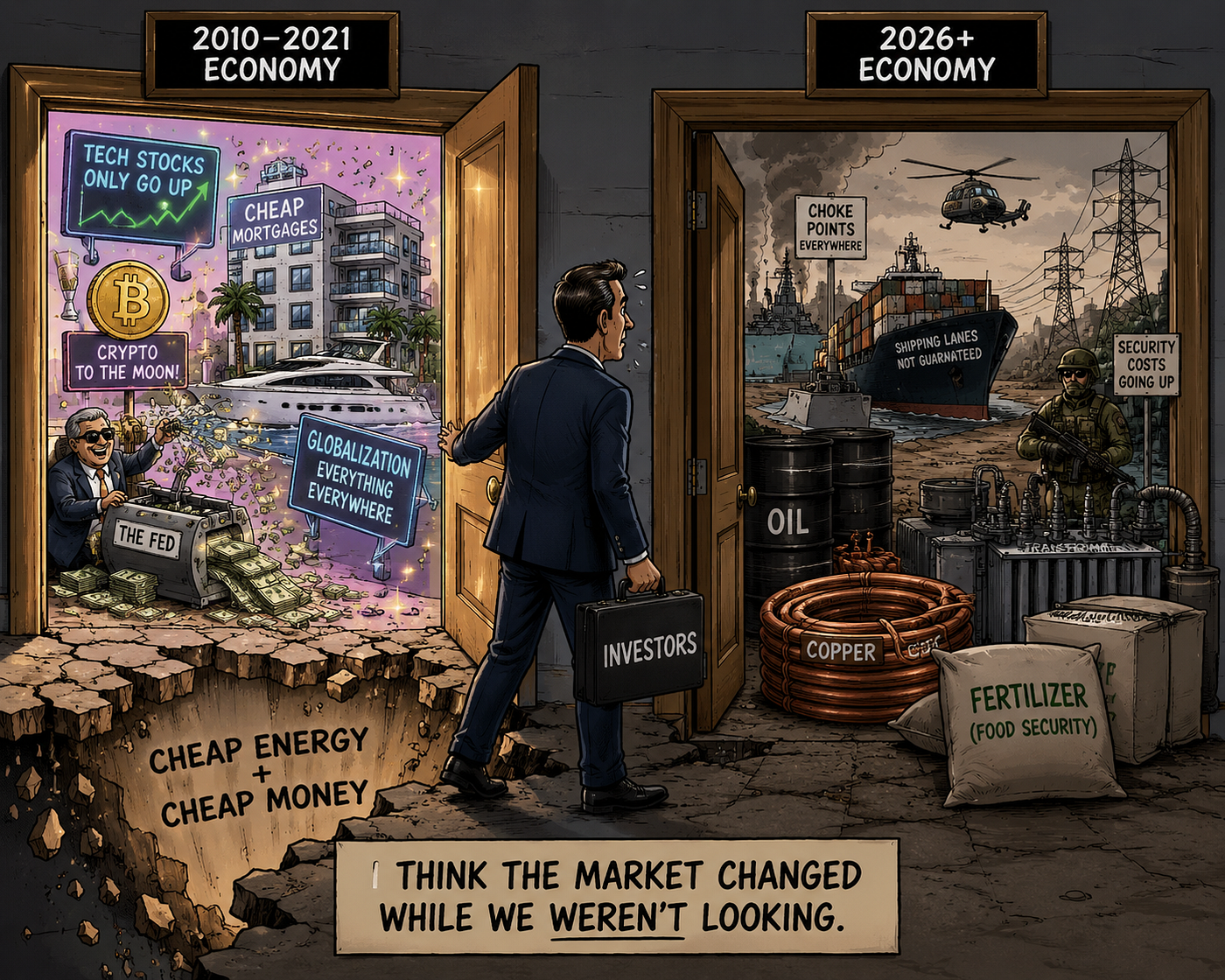
Cheap energy, cheap money and globalization created one kind of global economy. Expensive energy, tariffs, geopolitical conflict and supply-chain instability are creating another.
But you do not have to take my word for it. Look at what governments and corporations are already doing.
The United States passed the CHIPS Act after realizing how dependent modern technology had become on overseas semiconductor production. Europe scrambled to replace Russian natural gas after the Ukraine war shattered decades of energy assumptions. Countries that spent years preaching free trade now openly subsidize domestic manufacturing, impose tariffs and restrict exports of strategic technologies and industrial materials.[1]
Apparently the new master plan is tariffs, war and hoping oil markets stay calm anyway.
Even global shipping routes suddenly matter again. Disruptions in the Red Sea and fears surrounding the Strait of Hormuz repeatedly send energy markets into panic because the modern economy still depends on a handful of fragile physical chokepoints.[2]
We have been here before.
The closest historical parallel is probably the oil-shock economy of the 1970s. Energy prices surged, inflation became difficult to control, geopolitical conflict spread through global markets and confidence in economic leadership began to weaken. The economy that emerged after World War II suddenly stopped behaving the way people expected.[3]
During the Carter administration, inflation stopped behaving the way economists expected. Oil-producing nations suddenly gained enormous geopolitical leverage. Entire industries built around cheap energy and stable growth models struggled to adapt.[4]
The similarities are becoming difficult to ignore. Oil prices are once again reacting violently to instability in the Middle East. Governments are intervening more aggressively in trade and industrial policy. Supply chains that people seemed to ignore now dominate national-security discussions. Inflation remains more stubborn than many economists expected.[5]
Today’s economy may actually be more fragile than the economy during the Carter administration.
Modern supply chains are vastly more interconnected. Entire industries depend on semiconductors manufactured through highly specialized international production networks. Data centers and artificial intelligence systems are driving enormous increases in electricity demand at the same time electrical infrastructure is already aging. Governments, corporations and consumers also carry far more debt than they did during the 1970s.[6]
It turns out you cannot run an industrial civilization entirely on apps and optimism.
This matters because debt changes how economies react to stress.
For most of the post-2008 period, low interest rates helped stabilize the system. Cheap borrowing supported housing, technology investment, government spending and financial markets. But expensive energy, persistent inflation and geopolitical instability make cheap money much harder to maintain.[7]
This may be where the deeper transition begins. If these trends continue, the biggest change may not be a dramatic collapse. It may be the slow return of scarcity.
Not scarcity in the sense that stores suddenly become empty, but scarcity in the sense that the world becomes more expensive, less reliable and harder to maintain.
Energy shocks become more common. Insurance costs rise. Infrastructure becomes more expensive to repair. Supply disruptions last longer. Governments spend more money stabilizing systems that once seemed self-sustaining. Consumers discover that decades of cheap goods, cheap credit and cheap energy may have been temporary conditions rather than permanent features of the global economy.
This new kind of economy behaves differently.
It rewards companies that produce fuel, maintain electrical grids, secure shipping routes, build infrastructure and control strategic materials. It also rewards owning property with real assets. Homes with hard-to-replace fixtures and fittings. Properties that earn their keep as Airbnbs.
Personally I might invest in Magic: The Gathering dual land cards. Some of the original dual lands are up thousands of percent over the last twenty years because they are scarce, globally recognized inside their niche and protected from reprinting by the Reserved List.[8]
I cannot afford a Black Lotus. The last PSA 10 Alpha Black Lotus sold at auction for around $540,000.[9]
If you live in America, do not expect the era of endlessly cheap imported goods to continue forever.
For years companies like Temu thrived because the global economy was optimized around cheap manufacturing, cheap shipping and stable trade relationships. That environment allowed consumers to buy products from the other side of the planet at prices that often seemed absurdly low.
That model is now under pressure from multiple directions at once.
Tariffs raise import costs. Rising diesel and energy prices make global shipping more expensive. Supply-chain disruptions create delays and instability. At the same time, companies like Amazon are already moving aggressively to undercut foreign competitors and lock consumers back into domestic logistics networks.
The result may be a gradual reversal of one of the defining assumptions of the post-1990 economy: that consumer goods would keep becoming cheaper, faster and easier to obtain over time.
That assumption helped shape an entire generation of consumer behavior. It may not survive the next decade intact.
Now is the time to own something real and of value.
Because in an economy where inflation keeps returning and governments keep printing and borrowing to stabilize increasingly fragile systems, ownership of real assets may become one of the only ways ordinary people can keep up.
The market still seems convinced somebody else will deal with the physical part of civilization.
So does all of this mean economic collapse is inevitable? No, it’s not likely.
Civilizations are remarkably adaptive. The global economy is not simply going to vanish because energy prices rise, supply chains become unstable or governments make bad decisions. People adjust. Businesses adapt. Technologies change. Entire industries reorganize themselves around new realities.
But adaptation is not the same thing as returning to the world people became accustomed to after the Cold War. The economy now emerging may be organized around something very different.
Now seems a good time for keeping the lights on. Keeping ports operating. Keeping semiconductor factories running. Repairing aging infrastructure. Holding supply chains together while energy prices, climate pressure and geopolitical conflict keep hitting the system from different directions.
That changes what economies reward.
The winners of the last era often promised to reinvent civilization. The winners of the next era may increasingly be the companies preventing civilization from becoming falling apart.
That is not necessarily a story of collapse. It is more of a story about limits.
Cheap energy is no longer guaranteed. Globalization is becoming more fragile. Debt keeps piling up. The old assumption that technology alone could outrun physical limits is starting to look a lot less convincing.
And once an economy begins running into limits, maintenance starts mattering more than expansion. That may be the real transition now taking place beneath the global economy.
Afterword
This article is a personal opinion piece based on my own observations of current economic and geopolitical trends. I am not an economist, financial advisor or investment professional. Nothing here should be considered financial advice or used as the sole basis for investment decisions.
I may be completely wrong.
If you are making important financial decisions, consult a qualified financial professional before acting on anything discussed here.
Endnotes
[1] Reuters, “Europe rushes to secure energy supplies after Russian gas disruptions,” Reuters, accessed May 22, 2026. https://www.reuters.com/
[2] Reuters, “Red Sea shipping disruptions raise fears over global trade routes,” Reuters, accessed May 22, 2026. https://www.reuters.com/
[3] Encyclopaedia Britannica, “Stagflation,” Britannica, accessed May 22, 2026. https://www.britannica.com/money/what-is-stagflation
[4] Federal Reserve History, “The Great Inflation,” Federal Reserve History, accessed May 22, 2026. https://www.federalreservehistory.org/essays/great-inflation
[5] International Monetary Fund, “World Economic Outlook,” IMF, accessed May 22, 2026. https://www.imf.org/en/Publications/WEO
[6] Reuters, “AI and data centers driving power demand growth,” Reuters, accessed May 22, 2026. https://www.reuters.com/
[7] Federal Reserve Bank of St. Louis, “Federal Funds Effective Rate,” FRED Economic Data, accessed May 22, 2026. https://fred.stlouisfed.org/series/FEDFUNDS ; International Monetary Fund, “World Economic Outlook,” IMF, accessed May 22, 2026. https://www.imf.org/en/Publications/WEO
[8] TCGPlayer, “What the Bleep Is Going on with Dual Lands?” TCGPlayer, accessed May 22, 2026. https://www.tcgplayer.com/content/article/What-the-Bleep-Is-Going-on-with-Dual-Lands/97745033-67cc-4215-b3d6-15ef6999d174/
[9] Star City Games, “PSA 10 Gem Mint Alpha Black Lotus Sells for $540,000,” Star City Games, accessed May 22, 2026. https://articles.starcitygames.com/magic-the-gathering/psa-10-gem-mint-alpha-black-lotus-sells-for-540000-breaks-record-for-highest-selling-mtg-card/
What More?
This is the second in series of articles about the current economic regime change. The first article in the series is, “The World Economy May Have Just Flipped Upside Down.” The third article in the series is, “ The Social Stress of Current Economic Regime Change.”
You might also enjoy my articles: The Collapse Is Here. You Are Already Inside It. The Future Of Collapse (2025–2050) The Collapse Is Already Here America’s Biggest Risks in the Next Four Years Mass Extinctions: Warnings From The Past And Present To The Future
🔔 Follow me, David Speakman at https://medium.com/@2davidspeakman
📬 Subscribe to join my mailing list to receive updates and book release information.
All personal statements were written by me and edited for spelling and grammar by ChatGPT. Sections of this article have been refined by AI to enhance comprehensibility and provide facts that only online search engines would know.
© David Speakman 2026
메타데이터
- post_id
- 342099ed9233
- slug
- the-era-of-cheap-everything-is-ending-342099ed9233
- url
- https://medium.com/@2davidspeakman/the-era-of-cheap-everything-is-ending-342099ed9233
- canonical_url
- https://medium.com/@2davidspeakman/the-era-of-cheap-everything-is-ending-342099ed9233
- author_url
- https://medium.com/@2davidspeakman
- status
- ok
- fetched_at
- 2026-06-09 15:37:30