Books I’d Press Into Every Writer’s Hands
Why I keep the book that refuses to make people simple.
A WEEKLY WRITING CHALLENGE BY HEARTLINE PUBLICATIONS
Books I’d Press Into Every Writer’s Hands
Why I keep the book that refuses to make people simple.
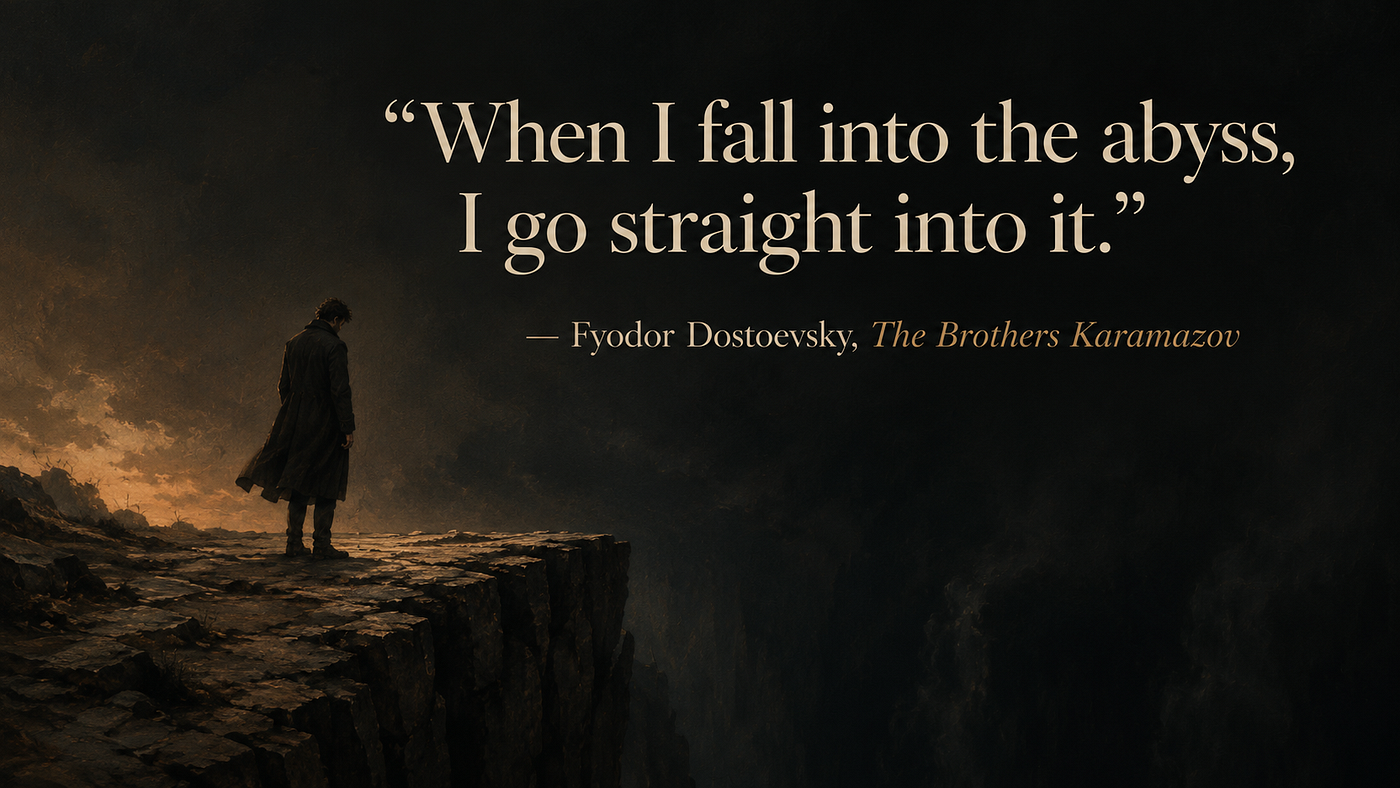
Image generated by AI. Quote from Fyodor Dostoevsky, The Brothers Karamazov.
The Brothers Karamazov is not a book I’d give to a writer because it reads easily. I’d give it to them because it won’t let the soul lie.
I wouldn’t hand this book to anyone lightly.
I wouldn’t say, “Read it; it’s lovely.”
It isn’t lovely in that tidy, pleasant way. It isn’t a book you open to rest from yourself. It isn’t a book that pats you on the shoulder and tells you everything will make sense if you just wait patiently enough.
The Brothers Karamazov asks more of the reader.
It asks you to walk into a house where no one is only good, only bad, only guilty, only clean, only clever, only lost. It asks you to sit among people who talk too much, stay quiet at the wrong moments, love clumsily, sin deeply, want the things they’re ashamed of, and carry far more inside than they can explain.
That’s why I’d put this book in every writer’s hands.
Not because it teaches you how to build a plot, or how to construct a great novel, or because Dostoevsky looks good in a literature essay. But because it reminds you that a person is never one sentence.
And writers forget that often.
It’s easier to write a good man. It’s easier to write a bad man. It’s easier to give someone one wound, one trait, one reason, one mask. It’s easier to say: he’s like this, she’s like that, this is trauma, this is love, this is guilt, this is faith, this is betrayal.
But a person doesn’t behave that neatly.
A person can love and wound in the same sentence. Can believe and doubt with the same heart. Can want forgiveness and not know what they’d do with it once they had it. Can look for the truth, then take fright the moment they get close to it.
That’s what The Brothers Karamazov does so mercilessly well.
It won’t let you slip away into a simple reading.
Every time you think you know who’s who, the book moves your chair. Someone who seems weak suddenly shows depth. Someone who sounds certain cracks in front of their own emptiness. Someone who looks lost says something that stays in the room long after they’ve left it.
For me, that’s the great lesson of writing. Not style, not technique. The capacity to hold complexity.
Not to run the moment a character turns unpleasant. Not to punish him too soon. Not to wash him clean too soon. Not to rush to explain what he doesn’t understand himself.
A writer has to have the stomach for contradiction.
Has to be able to look at a person full of weakness and not turn him into a caricature. To look at pain and not turn it straight into wisdom. To look at guilt without making a courtroom of every page.
Dostoevsky doesn’t write people as examples. He writes them as abysses.
And that’s exactly why they’re alive.
With him, no one is a decoration for someone’s message. No one exists just to prove a point. Even when a character carries an idea, he never stops being a body, a voice, hunger, shame, fear, want.
That’s what I’d want every writer to feel at least once. How dangerous is it to shrink a person so the text comes out clearer?
Because clearer isn’t always truer. Sometimes it’s just poorer.
The writing that interests me most doesn’t try to sort everything out. It doesn’t turn life into a clean table. It doesn’t wipe away the crumbs, the stains, the handprints. It lets a person be contradictory, say something ugly and then do something tender, be funny at the moment he ought to be serious, be large and petty in the same breath.
The Brothers Karamazov is a book that doesn’t believe in flat people.
That’s why I trust it.
Not because it’s easy. Not because I’d recommend it to anyone for the beach, the train, the dentist’s waiting room, or a weekend away from reality.
This book isn’t an escape.
It’s an entrance.
Into a family. Into guilt. Into faith. Into rebellion. Into the hunger to be loved. Into that place where a person most wants to be seen, and is most afraid of what will show if someone really looks.
For a writer that’s precious.
Because writing doesn’t begin where we have a clever answer. Writing often begins where something in a person unsettles us.
Why is someone we love able to hurt us? Why can someone who talks about goodness fail to be kind on an ordinary day? Why is guilt sometimes passed down like an inheritance? Why is it easier to want punishment than to accept mercy? Why can a family be both a root and a wound?
Dostoevsky doesn’t close those questions.
He keeps them open long enough that they start to look like life.
That’s why I’d put this book in the hands of every writer who’s in too much of a hurry to write something beautiful.
Read this, I’d say. Not to learn how to sound cleverer, or to decorate your style with big thoughts. Read it to see how much a person can carry and still walk across a room as if everything were ordinary.
Read it to remember that a character isn’t a function. That pain isn’t an ornament. That faith isn’t a pose. That doubt isn’t weakness. That a family isn’t only the place we come from, but often the first room where we learn how to stay silent, how to love, how to wound, how to ask for forgiveness.
The greatest books don’t just give us a story. They change our measure.
After them, you can’t easily write a person as a single trait, or guilt as a point, or love as a clean thing.
And it’s good that you can’t.
A writer shouldn’t make a person easier so the reader can bear him. He should write him truly enough that the reader recognises what they’re trying to hide themselves.
That’s why The Brothers Karamazov is a book I’d put in every writer’s hands.
Not as an obligation. Not as proof of education. But as a warning.
Don’t shrink the person.
Not even if the text were lovelier that way. Not even if it were easier for you. Not even if the reader understood faster.
Because a person isn’t here to be quickly understood.
A person is here to be written honestly.
Written for Heartline Publications’ Weekly Writing Challenge Season Two Week 2 prompt: Books I’d Press Into Every Writer’s Hands.
Thank you, Manya Sachdeva and Annaya Mahale, for a prompt that brings us back to the books that shaped us before we fully knew they were shaping us. Some books are not only read. They stay inside us, change our measure, and become part of the way we write, think, and look at people.
I’m tagging a few writers whose work I’m always happy to meet on the page: WordsInWilderness, Arpita Srivastava, Pari Sharma, fatehana and Kateryna Fedotova.
Become a writer at Heartline Publications 🤍
[embed]Welcome to Heartline Publications A Home for True Storytellingmedium.com
메타데이터
- post_id
- 342ead98e0ab
- slug
- books-id-press-into-every-writer-s-hands-342ead98e0ab
- url
- https://medium.com/heartline-publications/books-id-press-into-every-writer-s-hands-342ead98e0ab
- canonical_url
- https://medium.com/heartline-publications/books-id-press-into-every-writer-s-hands-342ead98e0ab
- author_url
- https://medium.com/@katarinab
- status
- ok
- fetched_at
- 2026-07-13 06:23:13