Escaping the Data Landfill: Right-Tooling Cloudera
In my last post, we looked at how unmanaged data lakes degenerate into an accidental data landfill due to a lack of deterministic…
Escaping the Data Landfill: Right-Tooling Cloudera
In my last post, we looked at how unmanaged data lakes degenerate into an accidental data landfill due to a lack of deterministic guardrails.
As shown in the snippet below, the four structural bottlenecks destroying your platform are: 1️⃣𝗧𝗵𝗲 𝗦𝗺𝗮𝗹𝗹 𝗙𝗶𝗹𝗲 𝗔𝘃𝗮𝗹𝗮𝗻𝗰𝗵𝗲 (𝗦𝘁𝗼𝗿𝗮𝗴𝗲 𝗟𝗮𝘆𝗲𝗿): Replication micro-batches drop millions of tiny files. 2️⃣𝗢𝘃𝗲𝗿-𝗣𝗮𝗿𝘁𝗶𝘁𝗶𝗼𝗻𝗶𝗻𝗴 (𝗠𝗲𝘁𝗮𝗱𝗮𝘁𝗮 𝗟𝗮𝘆𝗲𝗿): High-cardinality paths force query planners to waste time traversing directories rather than scanning records. 3️⃣𝗛𝗶𝘃𝗲 𝗠𝗲𝘁𝗮𝘀𝘁𝗼𝗿𝗲 𝗥𝗲𝗮𝗱/𝗪𝗿𝗶𝘁𝗲 𝗟𝗼𝗰𝗸 𝗖𝗼𝗻𝘁𝗲𝗻𝘁𝗶𝗼𝗻 (𝗧𝗵𝗲 𝗖𝗵𝗼𝗸𝗲𝗽𝗼𝗶𝗻𝘁): Concurrent write-locks and analyst read-locks freeze the HMS database in a transactional deadlock. 4️⃣𝗬𝗔𝗥𝗡 𝗦𝘁𝗮𝗿𝘃𝗮𝘁𝗶𝗼𝗻: Unisolated background data movement hogs cluster capacity, starving analytical queries.
We previously established a four-step remediation blueprint to rescue platforms by locking raw data with encryption zones, compacting small files, shielding the metastore, and segregating YARN queues.
But how do you execute this strategy on modern infrastructure? If you are in the Cloudera Data Platform (CDP) ecosystem, you aren’t stuck with a legacy HDFS/Hive landfill. The modern toolkit provides four specialized weapons to restore order: Apache Iceberg, Apache Ozone, Apache Hudi, and Apache Kudu.
Let’s look at how to right-tool Cloudera architecture to execute this blueprint seamlessly.
The Co-Located Architectural Blueprint
Modern data engineering has forced organizations into a frustrating compromise: sacrificing the scale needed for massive analytics just to keep up with the real-time speed required by operational dashboards. Attempting to force a single storage layer to handle both workloads leads to an infrastructure that is slow, expensive, and fragile.
The way out of this trap is not to force one format to handle every stage of your data lifecycle. Instead, you co-locate two distinct, highly specialized tracks within the same Cloudera cluster to separate your large-scale analytics from fast operational traffic.
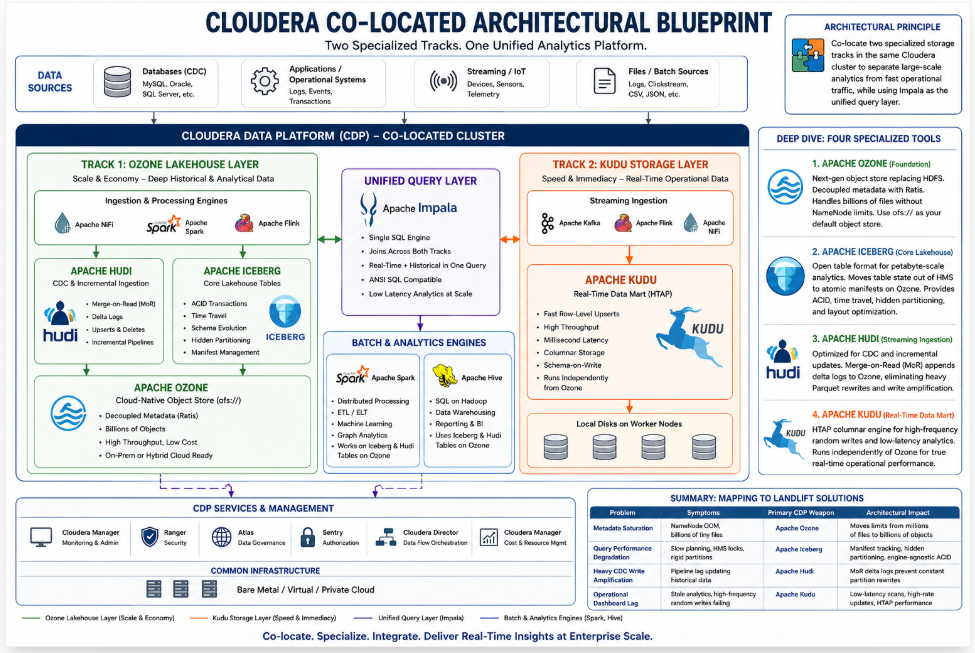
The Ozone Lakehouse Layer (Scale & Economy): Apache Ozone serves as your deep, cost-effective object storage foundation layer. On top of it sit Apache Iceberg (for core, petabyte-scale batch data warehouse analytics) and Apache Hudi (for incoming change data capture database mirrors).
The Kudu Storage Layer (Speed & Immediacy): Running completely independent of Ozone, Apache Kudu acts as its own specialized storage engine directly on the worker nodes. It bypasses object storage entirely to capture high-frequency, row-by-row live streaming updates.
Because both tracks are co-located in CDP, you can use Apache Impala as a unified query layer to seamlessly join real-time operational data from Kudu with historical data from your Ozone Lakehouse in a single query. Meanwhile, your engineering and data science teams can use Apache Spark and Apache Hive to run heavy batch transformations and machine learning models directly across the massive Iceberg and Hudi datasets on Ozone.
Deep Dive: The Four Specialized Tools

🌌 Foundation: Apache Ozone
The root cause of many data landfills is HDFS NameNode saturation, caused by millions of tiny, raw files eating up active memory.
The Blueprint Role: Next-gen, cloud-native object store replacing traditional HDFS.
The Fix: Apache Ozone decouples metadata management from physical storage using the Raft-based Apache Ratis consensus protocol. It natively handles billions of small and large files alike without hitting a centralized metadata memory wall.
The Takeaway: Use Ozone (ofs://) as your default object store container for cloud-native performance on-prem or in hybrid setups.
🧊 Core Lakehouse: Apache Iceberg
When raw data dumps directly into standard Hive tables, metadata lock contention hangs analytical read queries, while hidden high-cardinality paths degrade partition pruning.
The Blueprint Role: The default open table format for high-performance, petabyte-scale batch analytics (Hive, Impala, Spark). The Fix: Iceberg moves table states entirely away from the Hive Metastore (HMS) and into atomic manifest files stored directly on Ozone. It eliminates multi-nested directory swamps via native layout optimization tools and hidden partitioning.
🔄 Streaming Ingestion: Apache Hudi
When handling heavy Change Data Capture (CDC) streams from transactional upstream databases, rewriting entire Parquet files to update a few rows causes massive write amplification.
The Blueprint Role: Heavy-duty pipeline optimization for continuous, incremental record updates and deletes. The Fix: Hudi utilizes optimized Merge-on-Read (MoR) storage strategies on top of Ozone. It appends updates to compact delta log files instantly, preventing your ingestion engine from constantly rewriting giant chunks of Parquet data just because a few upstream transactions occurred.
🐆 Real-Time Data Mart: Apache Kudu
If business analysts require millisecond-level dashboards or real-time event monitoring, querying cold object-store files won’t cut it — no matter how optimized the table format is.
The Blueprint Role: True Hybrid Transactional/Analytical Processing (HTAP) columnar storage engine for high-frequency random inserts and updates. The Fix: Kudu acts as its own managed, structured storage layer separate from Ozone. It easily absorbs thousands of concurrent random modifications per second from live streaming IoT or telemetry data while supplying immediate, sub-second execution times for downstream business intelligence (BI) consumption.
Architect’s Takeaway: Modernizing the Data Lake
Ultimately, modernizing the data lake requires organizations to break down the traditional monolith and implement a deliberate, multi-format strategy across Iceberg, Hudi, Kudu, and Ozone. As outlined, this approach stops data sprawl directly at the ingestion point by intercepting and organizing data before it can accumulate uncontrollably. By leveraging this specialized multi-format ecosystem instead of relying on a rigid, one-size-fits-all framework, teams can seamlessly handle highly diverse workload requirements. The final business outcome is a self-healing, deterministic architecture that successfully turns your biggest operational liability back into your most valuable enterprise asset.
메타데이터
- post_id
- 345d47fe4b09
- slug
- escaping-the-data-landfill-right-tooling-cloudera-345d47fe4b09
- url
- https://medium.com/@bdhar/escaping-the-data-landfill-right-tooling-cloudera-345d47fe4b09
- canonical_url
- https://medium.com/@bdhar/escaping-the-data-landfill-right-tooling-cloudera-345d47fe4b09
- author_url
- https://medium.com/@bdhar
- status
- ok
- fetched_at
- 2026-07-09 23:31:43






