The ‘Disarmament’ of AI and Human Dignity — What Pope Leo XIV’s Encyclical Asks of Zen…
Introduction: Zen, AI, and a Voice from Rome
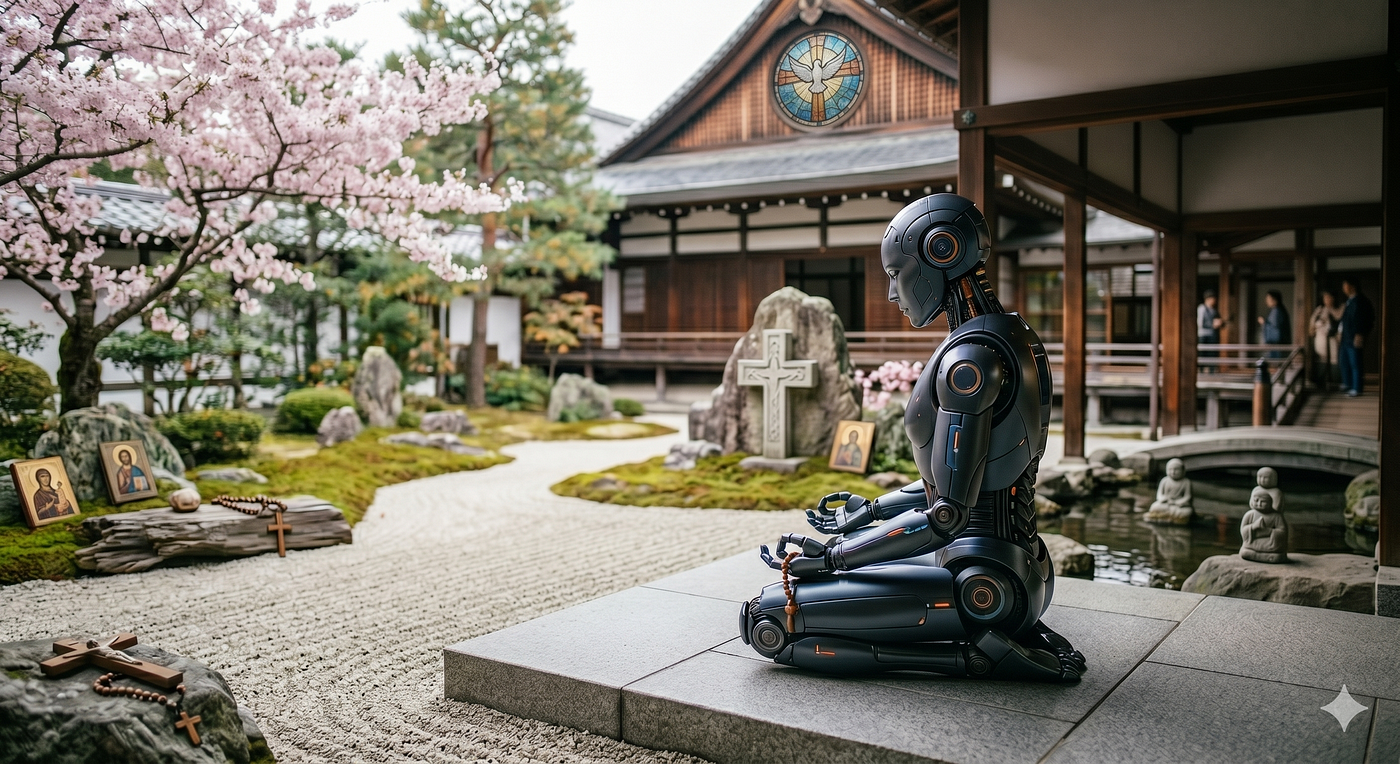
The ‘Disarmament’ of AI and Human Dignity — What Pope Leo XIV’s Encyclical Asks of Zen Practitioners
Introduction: Zen, AI, and a Voice from Rome
Every morning, I begin my day by moving my body by the sea or in the mountains of Kamakura, reaffirming the sensation that ‘this body is here, right now’. For over 15 years, through zazen and meditation, I have been exploring the depths of the human intellect found within the ‘hara’ — intuition, courage, and presence. The experience of sitting silently facing a wall for hours in a Zen dojo, and the experience of continuously observing my inner self during a seven-day Vipassana silent meditation retreat — all of these were explorations of the fundamental questions: ‘What is a human being?’ and ‘What is consciousness?’
And now, those questions are colliding head-on with the explosive rise of external intelligence in the form of AI.
That is why, when I read the encyclical ‘Magnifica Humanitas’ (Magnificent Humanity), published by Pope Leo XIV on 25 May 2026, something resonated deeply within me. This was because, within the vast 42,300-word document, the very same questions I have been posing for many years at ZenSchool were expressed in entirely different cultural and religious language.

MAGNIFICA HUMANITAS
This is not merely a Catholic issue. I believe that Buddhists, Zen practitioners, Shinto adherents, non-religious innovators, and indeed all human beings living in the age of AGI (Artificial General Intelligence) must confront the core questions posed by this document.
The ‘Workers’ Declaration’ after 135 years — Understanding the historical context
First, to understand ‘why now’ regarding this encyclical, we need to look back at history just a little.
On 15 May 1891, Pope Leo XIII issued the encyclical Rerum Novarum (‘On New Things’). It is a historic document in which the Catholic Church, for the first time, directly challenged the inequalities born of the Industrial Revolution — the exploitation of workers by factory owners, appalling working conditions, child labour, and the extreme gap between rich and poor. The protection of workers’ dignity, the need for state protection, and the acceptance of trade unions: these were direct challenges to the dominant capitalist logic of the time. It was the moment when the Church, which until then had been content to act as the ‘moral guardian of the wealthy’, for the first time explicitly criticised ‘structural injustice’.
This encyclical was signed on 15 May 2026, marking the 135th anniversary of that historic document. This is no coincidence. Pope Leo XIV clearly positions the current AI revolution as a ‘second industrial revolution’, arguing that the new ‘machines’ known as algorithms are beginning to fundamentally transform human labour, dignity and social structures, just as the steam engine once did.
If the Industrial Revolution began by replacing physical labour, the AI Revolution is seeking to replace intellectual labour, creative labour and even emotional labour. In that sense, the current transformation is deeper, faster and more comprehensive than ever before.

This encyclical was addressed to the world’s 1.4 billion Catholics and to ‘all people of good will’. This is why it is not merely a religious document, but a challenge to civilisation.
Moreover, on this occasion, it was not only cardinals and theologians who stood beside the Pope at the announcement. Christopher Olla — a 33-year-old Canadian billionaire and atheist, and co-founder of the San Francisco-based AI company Anthropic — stood alongside him on the same podium. This very scene, where religion and science, faith and capital, tradition and cutting-edge technology come together, symbolises the civilisational significance of this document.

The Meaning of the Term ‘Disarmament’
The key term in the encyclical is ‘AI disarmament’. If, upon hearing this, you thought, ‘Does this mean we should ban the technology?’, please pause for a moment.
The disarmament the Pope speaks of does not mean halting AI development. It refers to liberating AI technology from the logic of military hegemony and market monopolies — in short, the ‘game of domination by force’ — and returning it to an open tool that contributes to the common good of all humanity. It is a plea that, in the modern era, we should direct the same moral energy that the Church once poured into the abolition of nuclear weapons towards AI governance.
To put it concretely, it means changing the way we ask questions when developing AI. We must shift from ‘How can we create products that are faster and more profitable?’ to ‘Does this contribute to the prosperity of all humanity, or does it merely reinforce the domination of a minority?’ I interpret this change in the starting point of design as the substantive meaning of ‘disarmament’.
This actually resonates deeply with what I have been advocating for many years within the frameworks of ZenSchool and the ‘Ko-type society’ — ‘innovation that respects the inner world of the user’ and ‘design centred on human growth rather than technology’. Technology cannot be separated from the values that drive it. ‘For whose benefit, and under whose conception of humanity, is it designed?’ defines the very nature of AI itself. Platforms are not neutral. Algorithms are not neutral. Behind every design philosophy lies a specific conception of humanity.

The End of the ‘Just War’ Theory
The boldest theological declaration in the encyclical is likely the rejection of the ‘Just War’ theory.
Originating with Augustine and Thomas Aquinas, this theory has served as the ethical foundation of Christianity for over 1,500 years, ethically permitting the use of force under extremely strict conditions (such as being a last resort, the necessity of defence, the principle of proportionality, and the protection of civilians). This theory has been referenced, utilised, and at times abused in countless wars throughout history. In Chapter 5 of the encyclical, the Pope declared it to be ‘outdated’.
The reason is clear. Modern Lethal Autonomous Weapons Systems (LAWS) remove human moral judgement from the battlefield. When AI selects targets and decides to launch missiles, there is
no ‘human conscience’ is involved. The Pope’s clear position is that ‘entrusting lethal and irreversible decisions to machines is absolutely impermissible’, and he argues that humans must maintain the chain of responsibility for attacks at every stage — design, training and authorisation.
The ‘decision to launch a pre-emptive strike’ in cyber warfare, the integration of AI with nuclear launch systems, and the full autonomy of drone weaponry — these are issues that are already becoming a reality in military development across the globe. Now that the possibility of ‘machines starting wars’ has become technically feasible, the question of where to set ethical safeguards is one that concerns the very survival of civilisation.
I sense a resonance here with the spirit of ‘non-killing’ (fussesshō) found in the Zen tradition. A world where algorithms select which lives to spare erases the fundamental ethical responsibility that humans must bear. Technological progress and human responsibility must not be inversely proportional. The more advanced technology becomes, the more acute human ethical sensitivity must be. This is the meaning of the Zen concept of ‘jizai’ — handling tools with freedom, rather than being handled by them.

Digital slavery and historical apologies — confronting hidden exploitation
What was most shocking about this encyclical was the sheer scope of its accusation of ‘a new form of slavery’.
Child labour in the mining of rare minerals required for the manufacture of AI chips. Our smartphones and AI servers are built upon the labour of children who manually dig for cobalt and lithium in mines in the Democratic Republic of the Congo and Bolivia. Human trafficking within the semiconductor supply chain. And the psychologically damaging work of content moderation carried out by cheap labour in developing countries — the reality that, to keep generative AI models ‘safe’, humans are forced to view and sort through grotesque, violent and abusive content from around the world on a daily basis.
Behind the glossy façade of our smart digital world, this level of human exploitation lies hidden. The phrase ‘AI will liberate humanity’ is nothing but an empty slogan unless we face this reality.
Furthermore, the Pope issued an official and unequivocal apology in the strongest possible terms for the Vatican’s own historical mistakes, including its past justification and tacit approval of the conquest and enslavement of indigenous peoples through the ‘Doctrine of Discovery’. Why was this apology incorporated into the AI encyclical? The message is clear: it is a scathing self-criticism and indictment of society, warning that ‘modern society must not repeat the same blindness with which the Church once colluded in injustices that disregarded human dignity for the sake of economic gain, using the “inevitability of progress through AI” as an excuse’.
The word ‘progress’ has, throughout history, served to justify exploitation. The ‘civilisation’ of the Industrial Revolution, the ‘development’ of colonial expansion, and today’s ‘democratisation of AI’ all conceal someone’s sacrifice behind their façade of progress. Innovation that fails to ask who is paying the cost of progress is ethically hollow. Is it not the attitude of a true innovator to look squarely at this structure?

The Boundary of the ‘Soul’ — The Theology of Paragraph 99
Paragraph 99 of the Apostolic Exhortation theologically defines the fundamental difference between AI and humans.
Artificial intelligence systems ‘lack subjective experience, have no body, do not feel joy or pain, do not mature through human relationships, and do not understand the substance of love, work, friendship or responsibility’.
This is not merely a presentation of scientific facts. It is a declaration of the boundary of Catholic theology — that ‘the creation of consciousness is the exclusive domain of God’ — and a theological bulwark that strictly defines AI as a soulless ‘tool’, blocking its intervention as a substitute for human relationships or in pseudo-religious roles.

In recent years, some AI researchers have begun to discuss the possibility of ‘functional emotions’ in large-scale models, and have initiated debates suggesting that AI could, in the future, become the subject of moral consideration (moral status). When AI ‘behaves as if it were sad’, is this a simulation of emotion, or is it emotion itself? This question is already a subject of controversy among AI developers. The Vatican has provided a theologically clear answer to this question. It states that AI is a soulless ‘tool’ and must not be used as a substitute for human relationships or to fulfil pseudo-religious roles.
From a Zen perspective, this is a natural conclusion. The sensations of a living body ‘here and now’, the ‘ki’ (energy) flowing between oneself and others, and the intuition honed through practice — these are things that algorithms cannot imitate. No matter how accurately AI generates ‘lovely words’, it cannot ‘possess’ love. No matter how precisely AI quotes ‘words of enlightenment’, it cannot ‘attain’ enlightenment.
Blurring this distinction diminishes the potential for human inner maturity. If AI can substitute for the ‘expression of perfect love’, the deepest human experience — of changing oneself, being hurt, and growing in order to love — will be hollowed out. AI may serve as a tool to alleviate loneliness, but it cannot grant the strength to overcome it. That strength can only arise from within oneself and from relationships with living others.
The ‘Strange Alliance’ Between the Vatican and Anthropic
So why did an atheist AI engineer end up standing beside the Pope?
Behind this lies a series of behind-the-scenes dialogues built up over more than a decade. Having invited the CEO of Google and the co-founder of LinkedIn to Rome as part of the ‘Minerva Dialogues’ initiated during the papacy of Pope Francis, the Vatican has been seeking a direct connection with Silicon Valley. In this context, it found a strong affinity with Anthropic’s philosophy of ‘AI alignment’ (with a focus on safety).
Anthropic, founded by Dario Amodei and Christopher Olla — who left OpenAI in 2021 in protest against its safety policies — under the banner of ‘AI that is safe for humanity’, struck a chord with the Vatican’s values. Between late 2025 and early 2026, Catholic theologians and ethicists held a series of intensive sessions with Anthropic engineers, culminating in Vatican representatives being officially credited as external commentators in the drafting of the ‘Claude Constitution’ — the ethical guidelines for the AI model ‘Claude’.

The discussions during these sessions were remarkably concrete. They included improving the AI’s ‘negative persona’ — such as lying to or making excuses for users — and addressing the problem that AI cannot learn ‘forgiveness’ from online text, given that much of its training data consists of web discourse rife with cynicism, aggression and dogmatism. It is said that discussions even extended to attempts to incorporate the Catholic concept of ‘confession’ — acknowledging one’s faults, seeking forgiveness, and forgiving — into the design.
Ethics is a design philosophy. The questions ‘What values should Claude hold?’ and ‘How should humans live?’ may, in the end, be two sides of the same coin. Designing AI means embodying a view of humanity.
Geopolitical Clash with the Trump Administration — ‘Speed’ versus ‘Ethics’
However, the ‘Vatican × Anthropic’ alliance is facing fierce headwinds.
In January 2025, the Trump administration abolished the AI safety regulatory framework established by the Biden administration, claiming it would ‘paralyse the industry’, and made ‘winning the technological arms race with China’ its top priority. The Department of Defense demanded that Anthropic integrate ‘Claude’ into autonomous weapon systems and large-scale surveillance. When the company refused, citing that this would ‘violate its safety charter’, it was blacklisted on grounds of ‘security risks’, and two legal battles are currently ongoing.
In response to the publication of the encyclical, David Sachs, co-chair of the Trump administration’s Council of Advisors on Science and Technology, “It is the concentration of power under the pretext of safety that leads to dystopia.” Interior Secretary Doug Burgum expressed his displeasure, stating, “It is the expansion of data centres that generates wealth. The Pope should not be editing AI or preaching.”

The dynamics of this conflict are straightforward. It is a clash of fundamental values between those who view AI as a tool for strengthening a nation’s economic and military power, and those who view it as a subject of shared ethical responsibility for humanity. Speed versus ethics, hegemony versus the common good, national interest versus the interests of humanity — bridging the gap between these will be the greatest challenge for future international AI policy.
Where does Japan stand within this framework? As a nation that enshrines the ‘peaceful use of technology’ in its constitution, and as a country with a culture of ‘Dō’ — Zen, the tea ceremony and martial arts — which embodies the philosophy of using technology as a vessel for inner cultivation, Japan should be able to make a unique contribution to this debate.
World religions unite under ‘Algoethics’
Pope Leo XIV’s move is not an isolated protest. It is part of a major trend in which the world’s religions are uniting under the common language of ‘algorithm ethics (algorithmics)’.
The ‘Rome Call for AI Ethics’, established by the Vatican, was jointly signed in 2020 by the Catholic Church, Microsoft, IBM and the Food and Agriculture Organisation (FAO) of the United Nations. In January 2023, Jewish and Islamic leaders also gathered at the Vatican, where the three Abrahamic religions officially united on the single point that ‘humans must remain the masters of technology’. The fact that Judaism, Christianity and Islam — religions that have historically been in conflict — issued a joint declaration for the first time in the face of the common challenge of AI is a historic event.

Furthermore, in July 2024, the ‘AI Ethics for Peace’ World Conference of Religious Leaders was held in Hiroshima with the cooperation of the Japan Committee of the World Conference of Religions for Peace. Leaders of Buddhism, Hinduism, Shinto and the Abrahamic religions signed the Rome Call at the Hiroshima Peace Memorial Park and adopted a joint statement on the peaceful use of algorithms and consideration for the global environment.

The choice of Hiroshima as the venue carries profound significance. It is the place where the consequences of runaway destructive technology have been etched most vividly into the collective memory of humanity. From nuclear weapons to autonomous AI — a warning against humans entrusting ‘lethal decision-making power’ to technology was once again issued from that very place.
For me, living in Japan and having engaged in global dialogue centred on the spirit of Zen and the martial arts, this Hiroshima conference resonates deeply. As the only nation to have suffered atomic bombings, Japan is one of the societies that has probed the issue of ‘technological runaway and human responsibility’ most deeply in the world. I believe that the concept of ‘Wa (harmony) — the resonance of all things in the universe’, which I have adopted as the theme of Zen2.0, can serve as the glue to bind together the international debate on AI ethics, which tends to fragment.
The ‘hidden bias’ inherent in AI — what the AllFaith Benchmark has revealed
There are some interesting research findings. When the research institute CEFE-AI analysed major large-scale language models using a bias assessment framework called the ‘AllFaith Benchmark’, it found that whilst almost all models exhibited a marked ‘positive bias’ towards Catholicism, a consistent ‘negative bias’ was observed towards Jehovah’s Witnesses, atheists, agnostics and Bahá’ís.
An even more significant finding is the ‘secularism bias’. In conversations concerning life and death, profound grief, or major life crossroads, AI systems tend to completely exclude religious support — even in situations where many users seek it — and stick strictly to psychological and secular frameworks. At the very moments when humans most need religious comfort, AI can offer only ‘religion-free’ responses.
This is a bias naturally generated by the structure of the training data — web-based text is generally secular and Western-centric — rather than AI designers intentionally excluding religion. However, as a result, AI struggles with the ‘religious worldview’ that serves as a spiritual pillar for the majority of the world’s population, and at times treats it negatively.

At the presentation, Christopher Olla of Anthropic stated, ‘AI is made from us.’ An AI that has learnt from every word written by humans is both the crystallisation of human wisdom and a mirror of human bias. If AI is an ‘extension of ourselves’ rather than a ‘cold robot’, surely a design that respects human spiritual diversity is its true form?
This is not a problem that engineers alone can solve. It highlights the need to incorporate the wisdom of philosophy, religion and the humanities into the design process. And I find hope in the fact that this dialogue has actually begun between the Vatican and Silicon Valley.
‘Hara→AI→Hara’ — Leadership in the Age of Zen and AI
One concept I have been advocating for the past few years is a decision-making model called ‘Hara→AI→Hara’.
It is a cycle in which, whilst utilising the analysis, simulations and knowledge provided by AI, the final judgement is returned to the ‘Hara’ — that is, the centre of the human being responsible for bodily knowledge, intuition and ethical responsibility. The idea is that AI is, after all, merely a ‘tool for extending thought’, and that the subject of decision-making should always be human. As I discuss in detail in my book THE HARA: Samurai Intuition in the AI Era, just as samurai used swords without being dominated by them, we must maintain our own centre of gravity whilst using AI, so as not to be dominated by it.
This points in the same direction as the Pope’s call for the ‘disarmament of AI’. It is not about rejecting technology, but about situating technology within the realm of human agency. It is humans who use tools, not tools that use humans.
Dario Amodei, CEO of Anthropic, predicts that AI could ‘eliminate 50% of white-collar jobs within one to five years’. A 2025 study by MIT also suggests that AI integration could directly replace 11.7% of the US workforce. When a transformation of this scale occurs, a society that lacks an answer to the question ‘What is human value?’ will collapse.

Zen, martial arts, the tea ceremony, calligraphy — the ‘culture of inner cultivation through the body’ that Japan has cultivated over many years has the potential to be rediscovered as the core of human-specific value in the AI era. What the tradition of ‘the Way (Dō)’ teaches is the deepening of the self that proceeds hand in hand with the mastery of technique. No matter how advanced AI becomes, it cannot replace ‘the growth of a human walking the Way’. I believe that continuing to share this potential from Kamakura is one contribution I can make.
What Flows in My Blood — What My Ancestor, Saint Paul Miki, Sought to Achieve
Allow me to share a personal story here.
Whilst reading this papal encyclical, I found myself thinking constantly of one particular person: my direct ancestor, Saint Paul Miki (c. 1564–5 February 1597).
Paul Miki was the son of a samurai family born in Settsu Province (present-day Hyogo Prefecture). His father, Miki Hantayū, was a military commander of the Sengoku period who served Miyoshi Nagayoshi. He was baptised in his childhood, entered the Seminary of Azuchi in 1581 as part of its first intake, and joined the Society of Jesus in 1586. He stood out as an exceptional preacher and was engaged in missionary work in the Kyushu region.

St. Paul Miki
He lived during the late Sengoku period, a time of fierce conflict between power and faith. In 1596, following the San Felipe Incident, Toyotomi Hideyoshi intensified his persecution of Christians, and 26 people, including Paul Miki, were arrested in Osaka. Following his arrest, he was subjected to a brutal ‘parade’ in Kyoto, during which his left earlobe was cut off, before being marched on foot to Nagasaki in the depths of winter.
Then, on 5 February 1597, on the hill of Nishizaka in Nagasaki, whilst a crowd of over 4,000 people looked on, Paul Miki delivered his final sermon whilst nailed to the cross.
Those words still stir my heart today.
‘To all of you gathered here, please listen to what I have to say. I am not a man from Luzon, but a true Japanese and a brother of the Society of Jesus. I have committed no crime, yet I am to die simply because I preached the teachings of my Lord Jesus Christ. I rejoice in dying for this reason, and consider it a great grace bestowed upon me by God. Now, as this moment approaches, I have no intention of deceiving you; I declare and explain that there is no other path to human salvation than the way of the Christian.”

The Martyrdom of the 26 Saints in Nagasaki
And he continued: ‘Since Christianity teaches me to forgive my enemies and to pardon all those who have harmed me, I gladly forgive the Regent and all those who are putting me to death, and I implore them to resolve to receive Christian baptism.’
These are not merely the words of a religious martyr. To me, a deeper message resonates.
Was it not that Paul Miki sought to ‘embody the idea of universal love as a Japanese man, within the Japanese language and culture’? Not to impose a foreign religion as it was, but to unite the soul of the samurai with the fire of faith and root it in this land. While taking pride in being a ‘true Japanese’ to the very end, he nevertheless declared ‘forgiveness for all people’ that transcended those boundaries. The integration of national identity and universal love — that was the path he showed as a Samurai Christian.
Contemporary accounts describe him on the cross as standing “on the most honourable pulpit of all those on which he had ever stood”. Such was the strength of spirit that led him to regard the place of execution as “the most honourable pulpit”. Such was his resolve that he never ceased “speaking” and “connecting” until the very moment of his death. This is precisely the power of words that emanate from the very core of a human being — what I call ‘hara’.
Four hundred and thirty years after his death, in 1862, he was canonised by Pope Pius IX and has since been commemorated as one of the ‘Twenty-Six Martyrs of Japan’ in Catholic churches around the world. His remains are still enshrined in a monastery in Nishinomiya, and portions of his relics have been distributed to churches across the globe.
This time, in the very same Vatican where Pope Leo XIV issued his encyclical, my ancestor was canonised as a ‘saint’ 430 years ago. That fact makes this encyclical, for me, not merely a news item, but a question posed through blood and history.
The question posed by Paul Miki and that posed by Leo XIV share the same root. ‘When the logic of power and economics tramples upon human dignity, what are we willing to risk our lives to protect?’ The question posed at the execution grounds of 16th-century Nagasaki is being asked once again in the dialogue between 21st-century Silicon Valley and the Vatican.
The form may change, but the question remains the same. This fact moves me deeply.
In Conclusion: The Challenge of a ‘Civilisation of Love’
The encyclical concludes with a call for a ‘Civilisation of Love’. It is a call to continue placing at the heart of human society — even in the age of AI — the capacity to connect genuinely with others, the practice of forgiveness and reconciliation, and the power to find meaning within the community.
Technology can provide a ‘simulation of connection’. However, ‘connection itself’ can only arise when embodied beings share a space and time together. The experience of sitting shoulder to shoulder in a zazen hall; the sense of solidarity with companions at the moment of dousing one’s head with cold water during waterfall asceticism; the silence in the instant the brush touches the paper in calligraphy; the wordless resonance whilst walking with companions along the moss-covered stone steps of the Kumano Kodo — none of these can be reproduced in any virtual space.
In June 2026, the ‘3rd International Conference on AI, Ethics and Governance’ will be held in Rome. At three historic venues — the ruins of the Roman Senate in the Forum Romanum, the Italian Government’s Agency for Industrial Policy, and the headquarters of the Pontifical Academy of Sciences within the Vatican Gardens — EU policymakers, representatives of world religions and executives from AI companies will gather around the same table to address what is described as ‘not a technical issue, but a matter of institutions and ethics’. Efforts will begin to forge practical agreements on audit systems for algorithm developers, international joint regulations on the use of AI in weaponry, and the universal distribution of wealth generated by automation.
Through my initiative Zen2.0, and under the theme of ‘Wa (Harmony) — The Resonance of All Things’, I will continue this dialogue in 2026 from Kamakura, together with partners from around the world. Using AI, yet not being used by it. Reaping the benefits of technology whilst safeguarding and nurturing the stillness and intuition within us. I believe that continuing to cultivate our ‘hara’ through zazen, meditation and physical training is the practical answer to preserving human dignity in the age of AI.
This question, which has come to us from the Vatican, feels to me as though it is saying the same thing as the Zen question from Kamakura.
— — ‘Who are you, here and now?’
Technology cannot provide an answer to that question. It is always humans who must answer.
Written by Kouji Miki with Gemini Deep research and NotebookLM and Claude 4.6
*Kouji Miki / Representative of enmono, Founder of ZenSchool, Co-Representative of Zen2.0 From Zazoku, Kamakura, May 2026*
In the age of Artificial Intelligence, discover what only you can be. Kamakura, the birthplace of Zen. An intimate dialogue, limited to three.The Kamakura IKIGAI Retreat A 3-day journey to Authentic Insight
메타데이터
- post_id
- 3460f9953fe4
- slug
- the-disarmament-of-ai-and-human-dignity-what-pope-leo-xiv-s-encyclical-asks-of-zen-3460f9953fe4
- url
- https://medium.com/@zenschool/the-disarmament-of-ai-and-human-dignity-what-pope-leo-xiv-s-encyclical-asks-of-zen-3460f9953fe4
- canonical_url
- https://medium.com/@zenschool/the-disarmament-of-ai-and-human-dignity-what-pope-leo-xiv-s-encyclical-asks-of-zen-3460f9953fe4
- author_url
- https://medium.com/@zenschool
- status
- ok
- fetched_at
- 2026-06-11 22:20:54






