The People’s CTMP
The Solved Equation
The People’s CTMP
The Solved Equation
This is not a proposal. It is a solved equation.
The Earth already produces this energy every second. The ocean exerts pressure. Gravity pulls water downward. Rock provides structure. The only question is whether we route that energy through steel and concrete, or let it dissipate unused.
The governing equation is simple: P = ρgQHη. Power equals fluid density times gravitational acceleration times volumetric flow times head times efficiency. This is not theory. This is the same equation that has governed every hydroelectric plant ever built. We are applying it at a scale that matches the problem.
At 150 metres of head, generating 1 gigawatt requires approximately 737 cubic metres per second of flow. At 300 metres of head, that drops to 368 cubic metres per second. The ocean provides effectively unconstrained flow at our design velocities. The rock provides the head. Gravity does the work. The math is done.
CTMP is not an invention. It is an assembly. Every component exists. Every equation is textbook. Every material is proven. We are simply building the most powerful jigsaw puzzle ever constructed.
The Energy Crisis
We are in the middle of an energy crisis. The world keeps applying incremental fixes: 5 GW here, 10 GW there, a few hundred MW someplace else. No one has addressed the issue head on. No one has proposed a single source of energy capable of supplying roughly six to seven times the world’s global power output, which is what we truly need.
Humanity generated about 30,000 TWh of electricity in 2024. Our energy demand is growing exponentially. Data centers alone already consume roughly 3% of U.S. electricity and could double or triple in a few years. Yet our power grids remain dangerously fragile, often one failure away from cascading into widespread blackouts. In an interconnected grid, a failure at a single node can spread like dominos through the system. The 2003 Northeast Blackout started with a single line trip and cascaded into an outage for 55 million people.
What happens when there is not enough power? Society shuts down. You cannot heat your home. Your phone does not work. Many cars do not run. None of your appliances turn on. Modern food production grinds to a halt because agriculture depends on industrial fertilizer from the Haber Bosch process, which requires massive energy. Without power, we cannot produce fertilizer, and global food output crashes to roughly half of today’s levels. Our entire society breaks down.
This is the stark reality: skyrocketing demand, insufficient supply, and a fragile grid teetering on the edge. We are on the verge of catastrophic failures. Millions of people die each year from dirty air and energy poverty. Incremental solutions will not cut it. We need a solution at the scale of the problem.
The 300 GW Module
We have designed something called the hydro module: a single unit engineered to deliver 300 GW of electrical power, baseload, with a capacity factor of 95%. That is 300,000 megawatts running continuously.
One module could power roughly 200 million homes. It is roughly 13 times the nameplate capacity of the world’s largest power plant, China’s 22.5 GW Three Gorges Dam. But nameplate capacity is the wrong comparison. Three Gorges runs at something like 45 to 50 percent capacity factor, so in baseload terms it delivers maybe 10 to 11 GW. One 300 GW CTMP module at 95 percent capacity factor delivers about 285 GW of firm output. In real, capacity factor adjusted terms, that is more like 25 to 30 Three Gorges Dams, not 13.
A single 300 GW module produces roughly 2,500 TWh per year, which is on the order of one tenth of all the electricity the world uses in a year. Scale to 80 modules and you are now at roughly six times today’s global electricity generation, with almost all of it as firm baseload.
This is not scaling turbines up. It is scaling the number of turbines. Francis runners at 8 to 12 metres diameter. Flow rates around 1,000 cubic metres per second per unit. Rotational speeds of 60 to 75 rpm, slow and cavitation safe. Direct drive generators with many poles. Full power converters isolating the mechanical world from the grid. Between 205 and 210 turbines per module, all proven technology, all textbook engineering.
How It Works
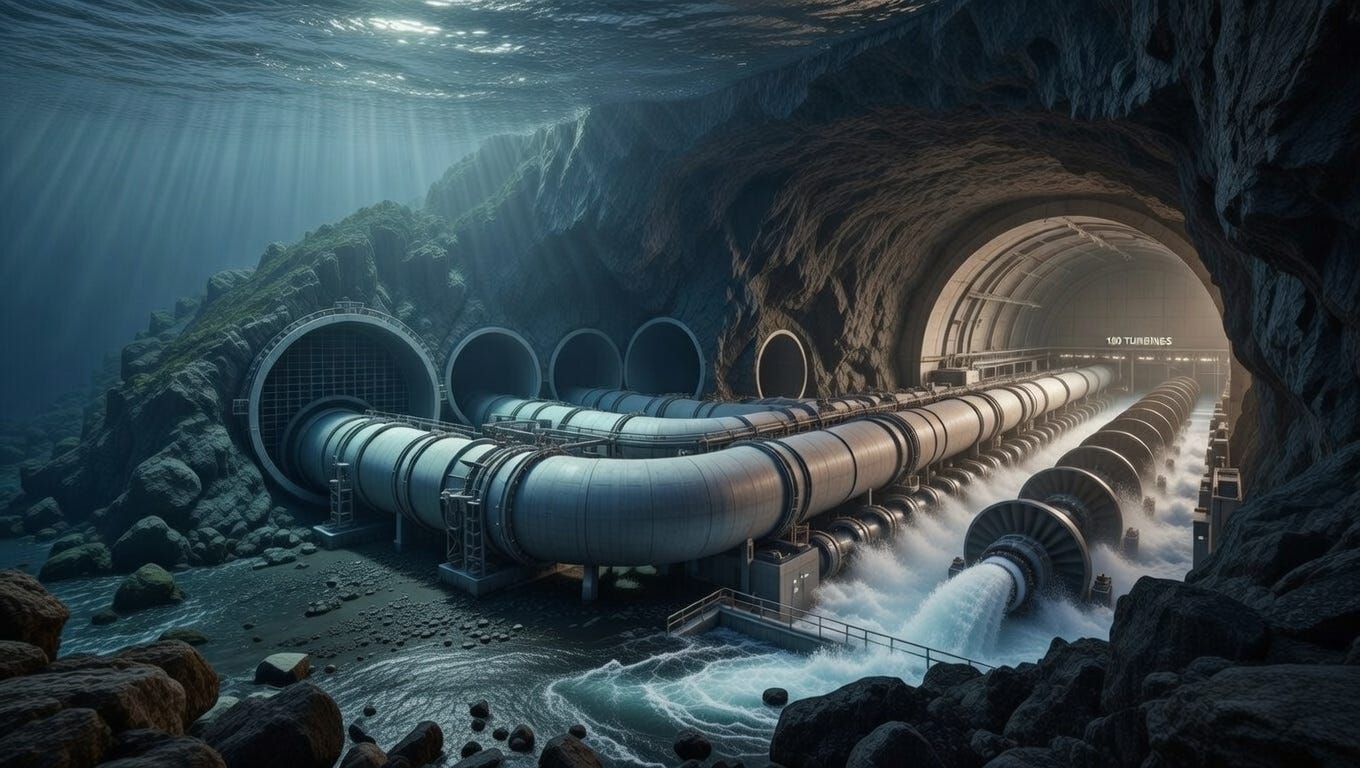
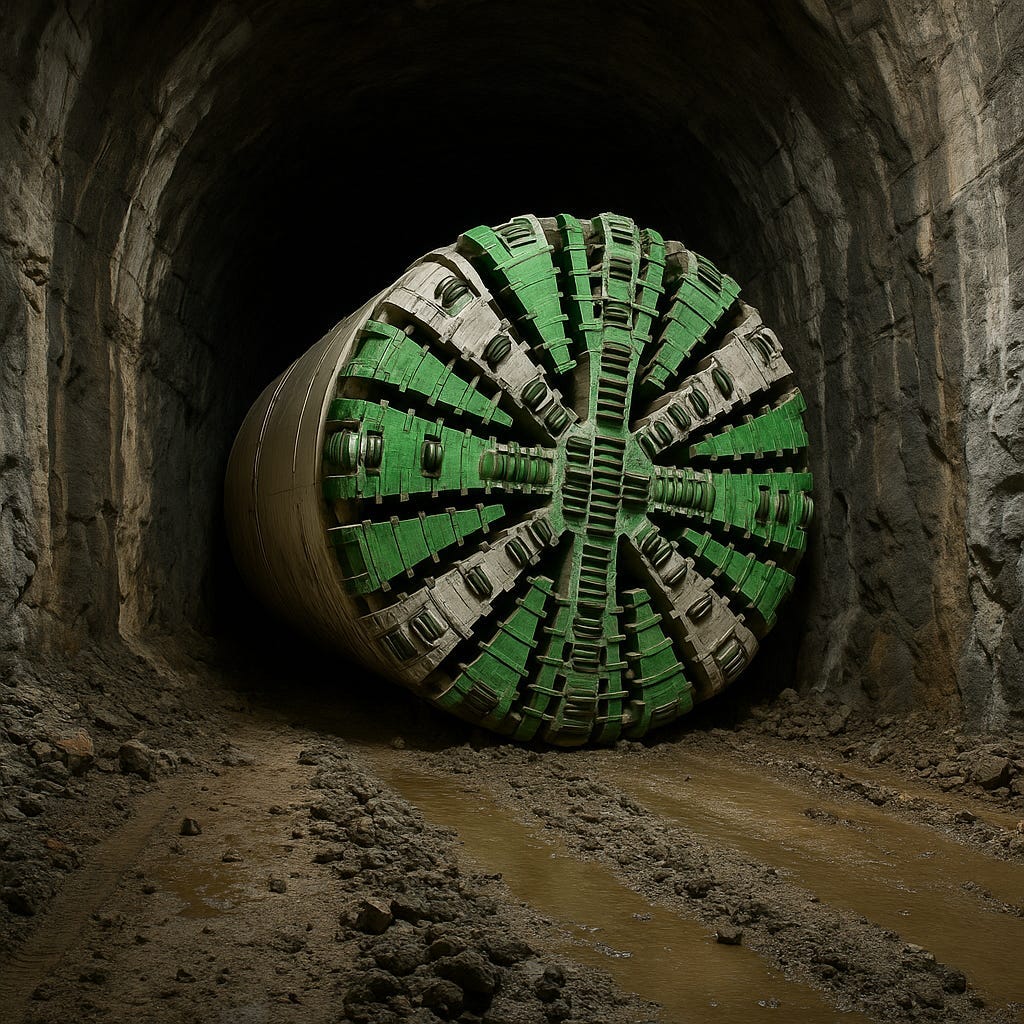
It is a subsurface, underground hydro system. Think of it as an invisible dam. Dozens of tunnel boring machines chew into the rock starting a few metres below sea level, cutting gently sloped intake tunnels and lining them with green concrete as they go. Water from the ocean enters those intake galleries at less than 0.3 metres per second, slow enough to protect marine ecology.
As the tunnels step down in elevation, we reach the level where the penstocks branch off. Each penstock is fabricated from green steel and feeds into caissons that sit roughly 120 metres below sea level. As water drops through the penstocks it accelerates to around 3 to 5 metres per second, the sweet spot for Francis turbines. The turbines sit at depth, converting the head into about 300 GW of baseload power.
The water then exits through buried tailrace tunnels and is discharged back into the ocean at depth. The same TBMs that cut the intake galleries also cut the tailrace galleries and manifolds. There is no hydraulic loop and no recirculation. Water enters from the ocean at near sea level, falls through engineered head inside rock, spins the turbines, and is returned to the ocean at depth. There is no loop, no perpetual motion trick, just gravity acting on seawater inside rock.
The engineering package contains a full Hydraulic Grade Line and Energy Grade Line proof showing energy loss, friction accounting via Darcy Weisbach, and neutral discharge. The system obeys Bernoulli. The plume exits at zero residual head. This is textbook hydraulics at unprecedented scale.
Unkillable Power
CTMP is not just huge power. It is huge and unkillable power.
The protection architecture includes surge tanks to absorb flow oscillations, bypass and relief valves to provide emergency spill paths during rapid shutdowns, air admission valves to prevent vacuum collapse in long tunnels, isolated turbine converter pairs so a single failure cannot cascade, and HVDC breakers that clear faults in milliseconds.
If one turbine fails, it isolates. The others keep running. If the grid fails, CTMP restarts it. Local storage or seed sets energize control systems. One turbine spins up, converters build the DC bus, then the rest of the fleet joins seamlessly. If everything fails, CTMP still has internal reserves and can black start entire continents.
A CTMP world is designed so that a 2003-style cascade blackout never needs to happen again.The system stays within safe pressure limits, experiences no cascade failures, and can restart independently from a dead grid. This is the existential differentiator in a world of grid fragility.
Zero Disturbance
CTMP is the first terawatt-scale zero-disturbance energy architecture we actually know how to build.
Solar destroys land. Wind destroys sky. Traditional hydro destroys rivers. Fossil fuels destroy air. Nuclear destroys politics. CTMP destroys nothing.
Discharge water is pressure balanced and temperature neutral. It re-enters the ocean without creating thermal or chemical impact. Flow is dispersed and diluted immediately upon exit, ensuring compliance with all regulatory mixing zone criteria. Outfalls are positioned and oriented to avoid seabed scour, resuspension, or disruption of marine habitats. Real time ocean sensors, remote surveys, and third party audits provide transparent proof of ecological safety.
CTMP is the only terawatt scale system that leaves the surface of the Earth untouched.
Record Low Cost
Our Levelized Cost of Energy for the CTMP module is around 0.2 cents per kWh using a Lazard-style LCOE methodology applied to our own numbers. Every other form of energy on the planet is 70 to 300 times more expensive. Utility scale solar today averages around 4 to 5 cents per kWh, onshore wind around 5 cents, natural gas around 7 cents, coal around 10 cents, nuclear around 18 cents. Nothing else comes close.
How do we get costs that low? Three architectural decisions.
No debt, ever. We will never take on a single dollar of debt to finance this. Debt financing and the required interest payments and investor returns massively inflate the cost of energy. In the corporate world, the cost of capital can make up half or more of a power project’s LCOE. By eliminating debt and keeping financing internal at effectively 0% interest, we slash the cost. For an offshore wind farm, cutting the weighted cost of capital from 10% to 0% can more than halve the LCOE. Traditional power companies are often paying more to banks and bondholders than to actually produce electricity. We refuse to play that game.
Vertical integration at city scale. Our footprint is organized into 17 co-dependent verticals: turbine manufacturing, tunnel boring machine factory, green steel plant, green concrete plant, 3D fabrication plant, and so on. By building everything in house and in parallel, we collapse deployment timelines from decades to years. We are not at the mercy of external supply chains. We are the supply chain. And we sell everything internally at cost. No profit markups between verticals. The steel we make is provided to the project at cost. The TBMs we manufacture are used at cost. The concrete, at cost. This eradicates vendor profit margins and drives down the final cost of energy.
50% reinvestment. All revenue gets reinvested back into future modules. We hard wire continuous growth and efficiency gains into the model. The platform keeps getting bigger and cheaper over time, rather than extracting dividends or paying down interest. With 10% annual growth, capacity roughly doubles every seven years. We are building an energy behemoth that feeds itself to grow even larger. Under SLE, 50% or more of net free cash is permanently locked to expansion.
Verticals Are Physics
The 17 verticals are not a business strategy. They are a physical necessity.
The module requires hundreds of kilometres of double digit metre diameter tunnels. That requires dozens of TBMs running in parallel. The global TBM market cannot supply that. So we build our own TBM factory.
The module requires over 200 Francis turbines at double digit metre runner scale. The global turbine market cannot supply that on our timeline. So we build our own turbine factory.
The module requires millions of tonnes of green steel for penstocks and structural elements. The global green steel market does not exist at that scale. So we build our own green steel plant.
The module requires millions of cubic metres of low permeability, sulfate resistant concrete. So we build our own green concrete plant. Concrete which actively absorbs or sequesters carbon.
The module requires HVDC converter stations and hundreds of kilometres of subsea cable. So we build our own HVDC vertical.
CTMP verticals are not ideas. They are factories whose outputs are structurally required by the physics of the system. The verticals exist because the module exists. Not the other way around.
Responsible Pricing
We will sell the energy initially at 2.5 cents per kWh, allowing local utilities to mark it up to about 5 cents per kWh for end consumers. We could charge actual cost and make electricity basically free. Physics allows it. But that is not abundance, that is chaos.
Dropping the cost of energy too fast would be extremely disruptive. Imagine your electricity bill plunging from 16 cents to 1 cent per kWh overnight. Coal, oil, and gas would become instantly uncompetitive. Existing assets would become stranded. Jobs in those sectors would vanish. Companies and petrodollar states could hit the wall hard.
The whole point of CTMP is that we are not doing this blind. A very large share of that workforce is exactly who we need next. The people who run rigs, refineries, pipelines, grids and ports today are the same people who can run TBMs, turbines, HVDC yards and port bunkering tomorrow. We are not just killing fossil jobs. We are offering them better ones, at higher pay, on infrastructure that does not poison their kids.
If you dropped global power prices to 1 cent overnight with no preparation, demand would spike hard. Grids that were never designed for that kind of load could get hammered. The HVDC vertical exists to build the transmission spine that can carry CTMP power where it needs to go, on terms we control. We phase the price descent and the buildout together. We upgrade and extend the grid with our own cables and converter stations as we ramp. That is how you avoid frying the system while you are trying to save it.
We chose 2.5 cents to balance urgent relief with a graceful transition. This is not compromise. This is responsibility. Your $150 per month power bill could become roughly $19 with CTMP, an 87% reduction, which is life changing, yet it gives existing energy workers and companies a window to adapt.
The SLE, our Sovereign Logic Engine, is an air gapped constitutional enforcement mechanism embedded in the platform’s governance. It enforces the 5 cent per kWh resale price cap. No matter where our power is delivered, utilities cannot sell it for more than 5 cents. The SLE makes it impossible for middlemen to introduce hidden fees or price gouging. No arbitrary hikes. No Wall Street whims. Energy by the people, for the people, at a people’s price.
Transformative Implications
Lives saved from clean air: Fossil fuel air pollution currently kills about 8 million people every year. That is over 20,000 lives lost per day from dirty air. By deploying one module, we estimate we would save roughly 1,382 lives per day just from cleaner air, on the order of 500,000 lives a year. Every minute our module runs, another human life is spared from pollution related death.
Clean water for millions: Roughly 1 million people die each year from unsafe water and sanitation related diseases. With CTMP’s abundant energy, we make large scale desalination dirt cheap. Each module provides about 2 billion cubic metres of potable water per year, enough for 40 to 50 million people. Deserts could bloom. Drought stricken regions could have reliable water for drinking and agriculture.
Industrial transformation: We will produce green hydrogen, green ammonia, green methanol, synthetic fuels, green steel, green cement, and more, all at massive scale and at cost. With 10% annual growth, by year 20 our output of each product is transformative. We are bootstrapping a new industrial revolution, powered by surplus electrons.
Millions of jobs: First year of full deployment: about 0.45 million operations jobs and 9 million construction jobs, roughly 9.4 million people all-in, with a conservative ±10% corridor. As we scale out over 20 years, the labor force required balloons to roughly 65 million. With each module funded internally, each with their own independent verticals, all growing by 10% per annum, that 65 million figure looks trivial in comparison. The real figure that we are looking at is 100’s of millions of full-time jobs across multiple modules. These are not gig economy poverty jobs. These are careers building the future of humanity.
End of grid fragility: End of legacy grid fragility: CTMP is engineered to remove the structural causes of cascade risk. The world has never had that. A CTMP world is built so that a 2003-style blackout should never happen again.
The Inevitability
Nothing about CTMP is speculative. All components exist.
Standard hydraulics. Standard TBM engineering. Standard turbine engineering. Standard HVDC. Standard metallurgy. Standard O&M. We are not inventing new physics. We are assembling proven components at a scale that matches the problem.
They have been charging you 70 to 300 times more than physics requires for electricity, not because it is expensive to make, but because they could get away with it. That era is over.
This happens the moment enough people know it is possible.
Gravity is the power plant. The math is done. The Earth already produces this energy every second. We are simply routing it through steel and rock.
The era of artificial scarcity is over. The era of engineered abundance begins now.
Chris Coode
Founder & CEO, Hutchison Lea ConneXions Inc.
References
Global electricity ~30,000 TWh in 2024
- Ember, Global Electricity Review 2025 — reports that global electricity demand grew 4% in 2024, “crossing 30,000 TWh total demand for the first time.” Ember Energy
Grid fragility / 2003 Northeast blackout (~55 million people)
- Wikipedia, “Northeast blackout of 2003” — wide-area cascade, ~55 million people affected across US and Ontario. Wikipedia
- IESO retrospective, “Looking Back at Blackout 2003” — confirms more than 50 million people impacted and ~61.8 GW of load lost. IESO
Data centres as a growing share of power demand
- IEA, Energy and AI — Energy demand from AI — estimates data centres consumed around 415 TWh in 2024, about 1.5% of global electricity, with rapid growth expected; regionally this is already a few percent of national demand in some systems. IEA
Air pollution deaths (~8 million per year from fossil fuels)
- Harvard T.H. Chan School of Public Health summary of Vohra et al. (2021) — estimates >8 million deaths in 2018 attributable specifically to fossil fuel air pollution, about 1 in 5 global deaths. Harvard Public Health
- WHO, Health impacts of air pollution — confirms that air pollution causes millions of premature deaths annually worldwide. World Health Organization
Unsafe water and sanitation (~1 million deaths per year)
- WHO fact sheet, Drinking-water — estimates around 1 million deaths per year from diarrhoea due to unsafe drinking water, sanitation and hygiene. World Health Organization
- WHO Global Health Observatory, Water, sanitation and hygiene: burden of disease — gives >1 million deaths from unsafe WASH in 2019. World Health Organization
LCOE ranges for solar, wind, gas, coal, nuclear
- Lazard, Levelized Cost of Energy Analysis, Version 16.0 (2023) — gives utility-scale solar PV and onshore wind in the ~US$24–96/MWh range (~2.4–9.6 ¢/kWh) with best-in-class around 3–5 ¢/kWh; gas, coal and nuclear in higher ranges consistent with your 7–18 ¢ bands.
- Lazard, LCOE+ June 2025 update — updated ranges for thermal and nuclear that still land in the single- to high-teens ¢/kWh, preserving your “4–5¢ solar, ~5¢ wind, ~7¢ gas, ~10¢ coal, ~18¢ nuclear” order-of-magnitude.
Global electricity growth / “crossing 30,000 TWh” context
- IEA, Electricity 2024 and Global Energy Review 2025 — show global electricity generation growing by ~1,200 TWh in 2024 (about 4% growth), consistent with the Ember figure that total demand passed 30,000 TWh. IEA+2IEA+2
메타데이터
- post_id
- 346700a9824b
- slug
- the-peoples-ctmp-346700a9824b
- url
- https://medium.com/@chris_16327/the-peoples-ctmp-346700a9824b
- canonical_url
- https://medium.com/@chris_16327/the-peoples-ctmp-346700a9824b
- author_url
- https://medium.com/@chris_16327
- status
- ok
- fetched_at
- 2026-07-14 08:23:42