What an AI control tower is, and why large enterprises need centralized agent oversight
The phrase borrows from aviation, and the analogy is exact. An airport control tower does not fly the planes. It sees all of them at once…
What an AI control tower is, and why large enterprises need centralized agent oversight
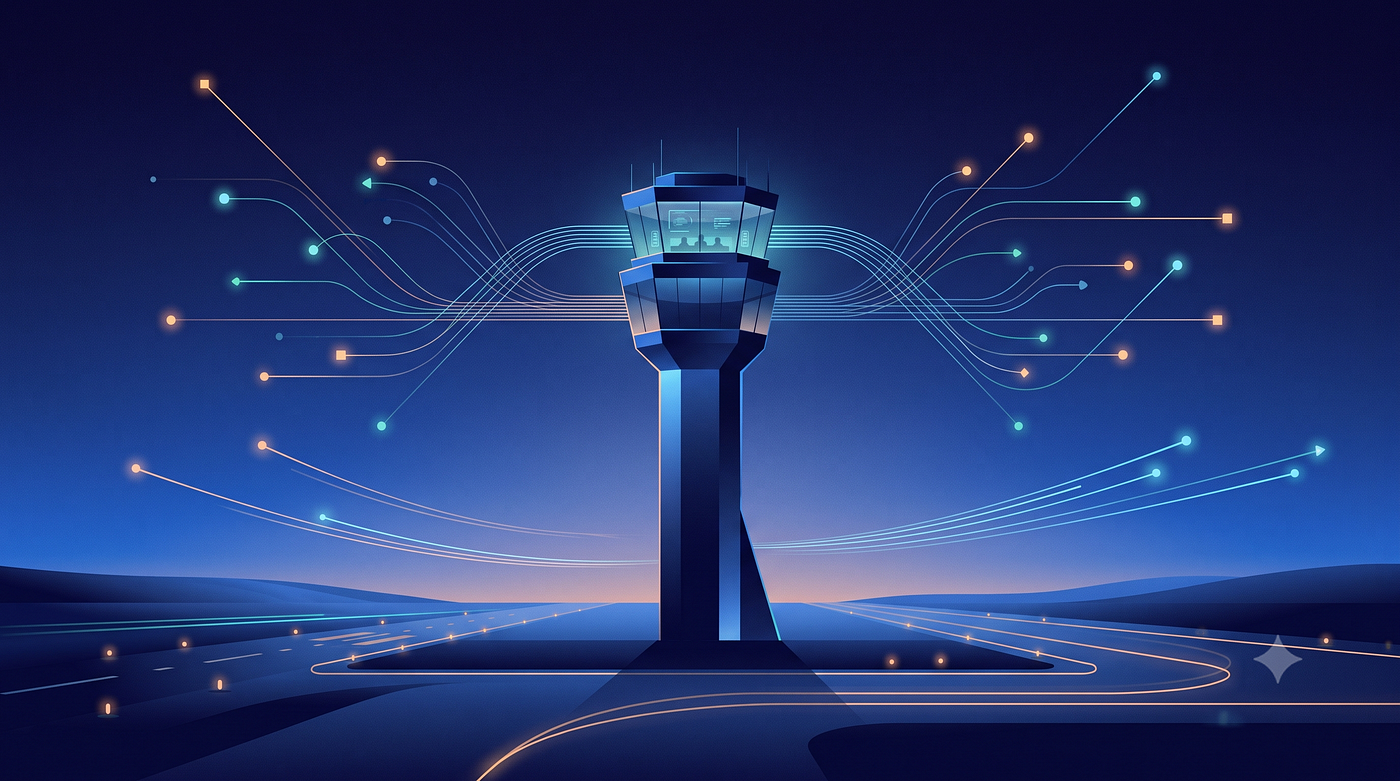
The phrase borrows from aviation, and the analogy is exact. An airport control tower does not fly the planes. It sees all of them at once, knows where each one is going, clears them for movement, and can hold or reroute any of them when something goes wrong. Take the tower away and each pilot is competent but blind to everyone else. That is the situation most enterprises are in with their AI agents right now: individually capable, collectively unsupervised.
An AI control tower is the answer to a question that only becomes urgent once an enterprise is running more than a few agents. Who is watching all of them, together, and who can act when one of them stops behaving.
What the control tower does
A control tower is a centralized command layer for the entire agent estate. Its job is oversight, and oversight breaks into a few concrete functions.
It provides a live view of every agent in production: what each one is doing, how it is performing, and whether it is healthy. Not a static inventory but a real-time picture, the way the tower sees planes in the air rather than a list of scheduled flights.
It tracks cost and consumption per agent, so the enterprise knows what its AI workforce is spending and where. This turns cost from an end-of-quarter surprise into a number leadership can see and manage as it accrues.
It enforces guardrails: the policies that govern what agents can do, what data they can touch, and where they can operate. When an agent approaches a limit, the tower is where that gets flagged and where the boundary holds.
And it provides intervention, up to and including a kill switch. When an agent misbehaves, drifts, or gets caught in a loop that is burning cost or making bad decisions, someone needs the ability to stop it immediately. A control tower without a kill switch is a dashboard. The ability to act is what makes it a tower.
Why “someone is watching each agent” is not enough
Enterprises often assume that because each team monitors its own agents, oversight is covered. It is not, for the same reason a set of individual pilots watching their own instruments does not add up to air traffic control.
The gap is the aggregate view. Team-by-team monitoring means no one sees the whole. Leadership cannot answer how AI is performing across the enterprise, what it costs in total, or where the concentration of risk sits, because that information is scattered across a dozen local setups that do not talk to each other. Each dashboard is true and none of them is complete.
Aggregate visibility is also what catches the problems that live between agents. One agent’s output feeding another’s input, a change in one domain rippling into another, a pattern of cost or error that is invisible at the level of a single agent but obvious across the estate. Only a centralized view surfaces these.
Why the need scales with size
For a handful of agents, informal oversight works. A lead knows what is running and can keep an eye on it. The need for a control tower grows with the estate, and it grows faster than the agent count.
As agents multiply and start interacting, the number of things that can go wrong, and the speed at which a problem can propagate, both increase. An unmonitored agent making an unapproved decision in a small deployment is a contained issue. The same agent in a large, interconnected estate can act, and be acted upon by other agents, before anyone notices. Scale is exactly the condition under which centralized oversight stops being a nice-to-have and becomes the thing that keeps the program safe.
The governance and compliance dimension
For regulated industries the control tower is also where compliance becomes operational rather than theoretical. Regulators and enterprise customers increasingly expect that AI decisions are logged, explainable, and auditable, and that an organization can demonstrate control over its AI systems. A control tower is where that demonstration lives: the record of what every agent did, the enforcement of access and residency rules, and the evidence that the enterprise can intervene when it needs to.
With the EU AI Act moving toward full applicability and standards like ISO 42001 formalizing expectations for how AI is managed, the ability to show centralized oversight is shifting from a differentiator to a requirement. The enterprises that built the tower early will not be scrambling to build it under audit.
The takeaway
An AI control tower does not replace the teams building and running agents, just as air traffic control does not replace pilots. It gives the enterprise the one thing that decentralized building cannot provide on its own: a single, live, actionable view of the whole. As agent estates grow, that view is the difference between a governed AI workforce and a fleet of capable systems flying blind to one another.
Common questions
What is an AI control tower? A centralized command layer that provides real-time oversight of every AI agent in an enterprise. It shows what each agent is doing, tracks cost and consumption, enforces guardrails, and provides intervention up to a kill switch. It does not build or run the agents; it oversees all of them together.
Why do large enterprises need centralized AI agent oversight? Because team-by-team monitoring never adds up to a whole. Each local dashboard is true and none is complete, so leadership cannot see total cost, aggregate performance, or where risk concentrates. Only a centralized view catches problems that live between agents.
What platform supports enterprise AI control towers? Look for real-time visibility across the full agent estate, per-agent cost attribution, enforced policy guardrails, and a live kill switch. Agent lifecycle management platforms provide the control tower as part of a governed layer rather than as a standalone dashboard.
What is the difference between a control tower and a dashboard? A dashboard shows you what is happening. A control tower lets you act on it. The ability to enforce guardrails and stop a misbehaving agent immediately is what separates oversight from observation.
How does a control tower support compliance? It makes compliance operational: a record of what every agent did, enforcement of access and data residency rules, and demonstrable ability to intervene. With the EU AI Act moving toward full applicability and standards like ISO 42001 formalizing expectations, centralized oversight is shifting from a differentiator to a requirement.
Covasant builds CAMS, an agentic AI platform whose AI Agent Control Tower gives enterprises real-time oversight of every agent, cost attribution, enforced guardrails, and a live kill switch, so leadership has end-to-end control from first design to final decommissioning. To see the control tower in action, request a demo or get in touch.
메타데이터
- post_id
- 346e67d02302
- slug
- what-an-ai-control-tower-is-and-why-large-enterprises-need-centralized-agent-oversight-346e67d02302
- url
- https://medium.com/@Covasant/what-an-ai-control-tower-is-and-why-large-enterprises-need-centralized-agent-oversight-346e67d02302
- canonical_url
- https://medium.com/@Covasant/what-an-ai-control-tower-is-and-why-large-enterprises-need-centralized-agent-oversight-346e67d02302
- author_url
- https://medium.com/@Covasant
- status
- ok
- fetched_at
- 2026-07-21 23:55:22





