AI Lawyer Software — Zipprr: A Practical Review of the Source-Code Legal AI Platform
Ask any attorney where their week goes, and you’ll rarely hear “arguing cases.” You’ll hear about the drafting, the intake calls, the…
AI Lawyer Software — Zipprr: A Practical Review of the Source-Code Legal AI Platform
Ask any attorney where their week goes, and you’ll rarely hear “arguing cases.” You’ll hear about the drafting, the intake calls, the billing entries logged from memory at midnight, and the deadlines scattered across three calendars.
Talk to enough practitioners and a pattern shows up fast: big chunks of the working day quietly slip by without ever landing on a client invoice. Closing that leak is the whole reason a new wave of legal AI tools exists.
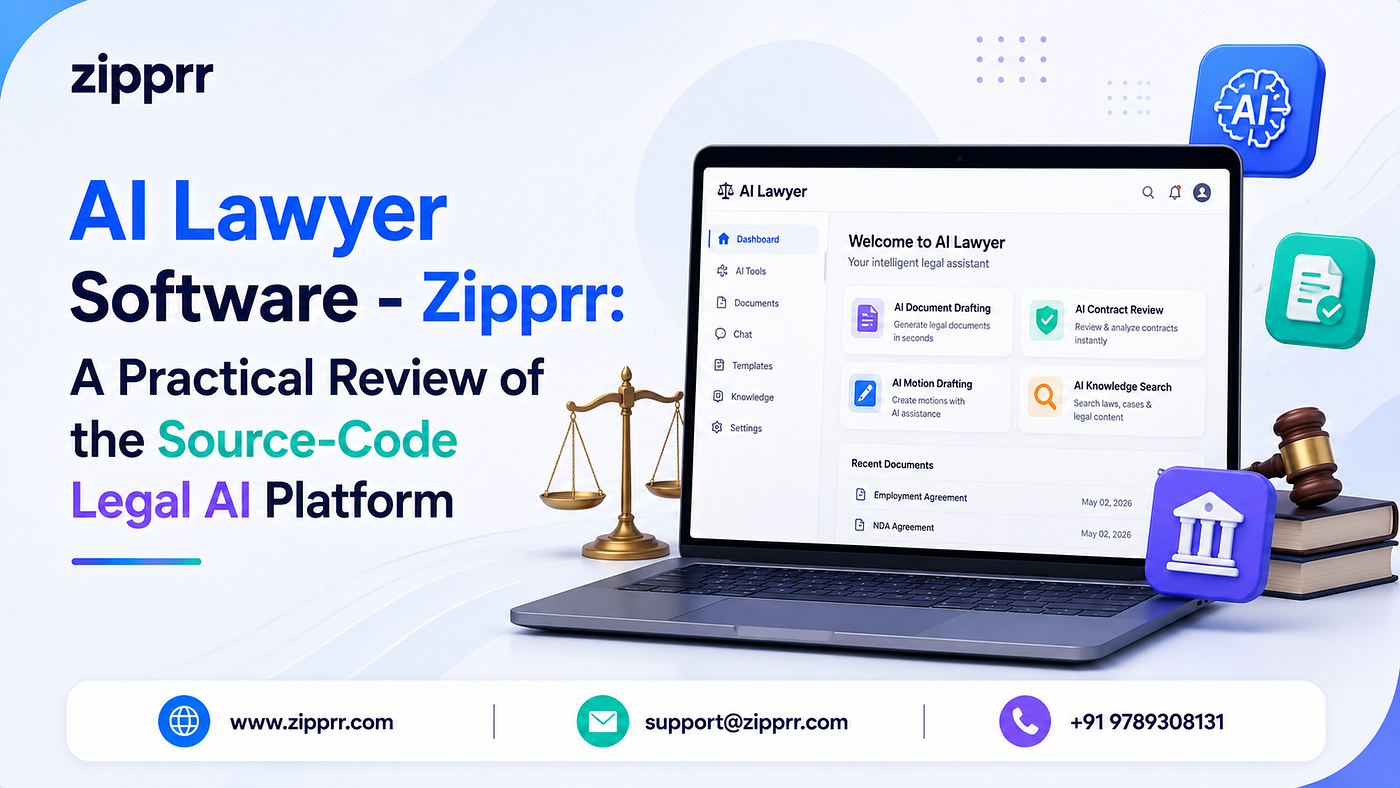
**AI Lawyer Software** Zipprr takes an unusual route through that space. It isn’t a monthly app you rent — it’s a legal practice platform you pay for once and keep, with the source code handed over too. Here’s what that really adds up to in practice.
What Is AI Lawyer?
AI Lawyer is an AI-native legal practice management platform built by Zipprr, a company that sells ready-made software products with full source code.
Instead of renting access month to month, you pay once and receive the complete codebase. That lets a firm self-host the platform, or lets an entrepreneur rebrand it and launch a legal-tech product of their own.
Functionally, it bundles the daily jobs of a small legal operation into one system: drafting documents, reviewing contracts, handling client intake, generating LEDES invoices, running IOLTA trust accounting, and tracking court deadlines.
The pitch is that these aren’t bolt-on modules. Drafting and contract review are built into the core and connected to your case records, so outputs land directly in the matter file rather than in a separate tool you copy from.
That single design decision — AI that reads the case file — is what separates it from a generic chatbot pointed at legal text.
Why AI Is Changing the Legal Industry
Legal work is document-heavy, deadline-driven, and repetitive at the edges. That combination is unusually well-suited to automation, and it’s why AI for lawyers has moved from novelty to normal budget line in a few short years.
Here’s where the shift is landing hardest.
Legal Research
AI legal research tools now summarize case law, surface relevant precedent, and answer plain-English questions against a firm’s own document library — turning hours of manual reading into minutes of review.
Contract Review
AI contract review flags risky clauses, maps who owes what, and spots missing standard language before a client signs. First-pass review that used to eat an afternoon can run in the background.
Document Drafting
Generative drafting produces jurisdiction-aware first drafts of motions, letters, and agreements. The lawyer edits rather than starts from a blank page.
Compliance
Deadline mapping and audit logging reduce the quiet risk that sinks firms — a missed statute date or a trust-accounting slip.
Productivity
Time captured automatically, invoices generated in a click, intake handled by adaptive forms. Less admin, more billable work.
Client Support
Portals, status updates, and multilingual intake keep clients informed without a paralegal fielding every call.
None of this replaces legal judgment. It removes the scaffolding around it. If you want a broader view of how automation is reshaping software categories, the Zipprr blog covers adjacent SaaS and marketplace trends worth a read.
Key Features
Zipprr describes AI Lawyer as 19 integrated modules. These are the ones that matter most in daily practice.
AI Document Drafting
Pick the client, the type of matter, and the jurisdiction, hit draft, and the tool reads the underlying case file before handing back a formatted first version — with the caption and citation style already matched to the court.
Zipprr puts the range at more than 500 document types spanning every US state and federal circuit, and says the system picks up a firm’s house style once it’s approved a few documents.
Example: Instead of digging for an old template, a litigation associate asks for a motion to dismiss and gets a jurisdiction-checked draft dropped straight into the matter file.
AI Contract Review
Drop in an agreement as long as 200 pages and the system grades each clause on a risk ladder that runs from Standard up to Critical, then maps out who is obligated to do what and boils the whole thing down to a summary a non-lawyer could follow. Feed it two versions and it returns the redline between them.
Example: In-house counsel drops a vendor MSA into the tool and spots within seconds that one section leaves liability uncapped — caught well before anyone signs.
AI Timeline (Deadline Tracking)
Give it the case type, the jurisdiction, and the dates that start the clock, and it works out the response windows, limitation periods, and contract milestones on its own. Reminders escalate as the date nears — thirty days out, then fourteen, seven, three, and one — and the calendar talks to both Google Calendar and Outlook in both directions.
LEDES Billing and IOLTA Accounting
Invoices come out in LEDES 1998B and XML with UTBMS codes attached, no separate module required, and the trust side runs IOLTA reconciliation on a three-way match. Contingency work, flat fees, blended rates — each billing shape is supported out of the box.
24/7 AI Legal Assistant
Rather than a generic chatbot, this is a chat window wired into your firm’s knowledge base and live matter records. Ask it to dig up research, condense a document, or rough out a first draft, and it answers with your own files in view.
Security Architecture
The stack leans on SOC 2 Type II certification, AES-256 encryption, and TLS 1.3, with the AI itself running in walled-off sessions. Per Zipprr, that means client files are never parked with the model providers or recycled into training data.
Benefits
Different users get different wins from the same platform.
Solo attorneys gain what functions like an operations team — intake, billing, and drafting handled without hiring.
Corporate and commercial teams get faster contract review as a standard first pass and LEDES billing that doesn’t require reformatting.
Immigration practices benefit from visa-category intake and USCIS deadline mapping, with client portals in 40+ languages.
Founders and agencies get something the others don’t: full source code and white-label rights, so they can launch a branded legal-tech product without building from scratch.
Pros
- One-time payment with no recurring subscription fees
- 100% source code included — full ownership and self-hosting
- White-label rights for rebranding and commercial use
- AI drafting and contract review built in, not sold as add-ons
- Broad US jurisdiction coverage (all 50 states plus federal)
- Native LEDES billing and IOLTA trust accounting
- SOC 2 Type II with zero-knowledge AI processing
- Free installation, 90 days of support, and lifetime updates
Cons
No tool is a perfect fit, and it’s worth being clear about the trade-offs.
- Self-hosting means responsibility. Owning the source code also means you (or your dev team) manage hosting, updates, and any customization beyond the base build.
- Performance claims are vendor-stated. Figures like “4.2x faster drafting” and “99.4% billing accuracy” come from Zipprr and should be validated during your own trial.
- Not a substitute for legal judgment. AI drafts and risk flags still require attorney review before anything is filed or signed.
- Best suited to US practice. Jurisdiction coverage centers on US states and federal courts, so firms outside that scope should confirm fit.
- Support is time-boxed. The included support window is 90 days; longer-term needs may require a separate arrangement.
Pricing
There’s no monthly bill here — you pay once and the license is yours. Whichever tier you choose bundles in the complete source code, a free install on your site, three months of support, and updates for the life of the product. Standard — $490, one-time. You get 100% of the source code, a single-site license, website installation, 90 days of support, and ongoing updates. Pro — $890, one-time. Everything in the Standard tier, plus a multiple-site license, native iOS and Android apps, and full app-store submission. Both plans carry a 7-day money-back guarantee. Pricing shown here reflects the current public listing; for the latest figures or licensing questions, contact Zipprr directly.Use Cases
Law firms consolidate drafting, billing, and deadline tracking into one platform, cutting the tool-switching that eats hours.
Solo lawyers take on more matters without hiring, using AI for the intake and paperwork a paralegal would otherwise handle.
Businesses run incoming agreements through AI contract review before signing, catching risky terms early.
Startups absorb routine legal drafting and review in-house instead of routing everything to outside counsel.
Enterprises standardize LEDES billing and audit-ready trust accounting across larger teams.
In-house counsel move at the speed of the business, handling more contracts per attorney with a first-pass AI review.
Getting Started

Zipprr says most firms are live in under two hours. The setup runs in four steps.
1. Configure your firm. Add your name, logo, time zone, practice areas, and billing format, then connect your calendar. (~15 minutes)
2. Import your cases. Use the guided wizard to migrate from Clio, MyCase, or PracticePanther. The AI Timeline begins mapping deadlines immediately. (~1–3 hours)
3. Activate the AI tools. Toggle on drafting, contract review, and intake automation, then upload two or three reference documents to calibrate style. (~5 minutes per tool)
4. Launch and invite your team. Set role-based access, activate client portals, and open your first matter. (~30 minutes)
If you’d rather see it before committing, Zipprr offers a free demo on the product page.
Competitor Comparison
The well-known names in this space — call them the three leading cloud practice-management suites — are capable systems that layered AI onto software designed before AI was central. Zipprr’s pitch is different on two fronts: it was built AI-first, and it’s sold as owned code rather than a monthly seat. Here’s how they stack up on the points that tend to matter. Pricing model. AI Lawyer is a one-time purchase with the source code included. The three established suites all run on recurring subscriptions. Native AI drafting. With AI Lawyer, drafting is built in and aware of your case file. On the legacy platforms it’s typically an add-on that’s still maturing, or limited in scope. AI contract review. AI Lawyer offers full clause-level risk scoring; the comparison suites generally provide limited review, if any. LEDES and IOLTA. Both are native in AI Lawyer. Among the older platforms, LEDES support ranges from available to basic, and trust accounting is often an add-on. White-label rights. Included with AI Lawyer, and absent from the subscription suites. Self-hosting. AI Lawyer can run on your own infrastructure. The established options are cloud-only. The honest read: the incumbent suites bring mature ecosystems, large integration marketplaces, and support organizations built for scale. AI Lawyer trades some of that maturity for ownership, no recurring fees, and AI at the core. Which side wins comes down to whether you’d rather lease a managed cloud service or hold full control of the software.
Why Choose AI Lawyer Software?
The strongest case for **AI Lawyer is ownership**. A one-time purchase with source code changes the math for anyone tired of per-seat subscriptions that scale with headcount.
For a solo or small firm, that means predictable cost. For a founder, it means a shippable product foundation with white-label rights already included.
The second draw is that the AI is built into the workflow rather than sitting beside it. Because drafting and review read the case file, outputs move without copy-paste — a small thing that compounds across a busy week.
That said, the right choice is the one you’ve tested. Use the demo, run your own documents through it, and confirm the numbers against your practice before you decide.
Final Verdict
**AI Lawyer Software** Zipprr is a genuinely different proposition in a subscription-dominated market. You buy it once, you own the code, and the AI features that competitors treat as premium add-ons are part of the core.
For solo attorneys, cost-conscious small firms, and legal-tech founders who want a foundation to build on, that model is compelling — especially at a one-time cost of $490 to $890.
The caveats are equally real: self-hosting carries responsibility, vendor performance figures deserve independent verification, and AI output always needs a lawyer’s review. Treat the free demo and 7-day guarantee as your due diligence window.
If you want practice-management software you control rather than rent, AI Lawyer earns a serious look. If you prefer a fully managed cloud service backed by a large support organization, the established subscription players may suit you better.
FAQ
What is AI Lawyer software?
Think of it as a full back office for a law practice, run by AI. It handles the drafting, contract checks, intake, billing, and deadline work — and instead of a monthly login, you buy the whole thing once and receive the code behind it.
How much does AI Lawyer cost?
Two prices, both paid a single time: $490 gets you the Standard license, $890 gets the Pro bundle. There’s no recurring fee, and the source code ships with either one.
Is the source code included?
It is. You get the entire codebase, which is what makes self-hosting possible and ownership real. Standard covers one installation; Pro widens that to multiple sites.
Can I rebrand AI Lawyer for my own business?
That’s a core use case. White-label rights let you swap in your own branding and domain and run it as a commercial product. The one line you can’t cross: reselling or sublicensing the raw code as a product in its own right.
How is AI Lawyer different from Clio or MyCase?
The older platforms are subscription tools that grafted AI onto systems designed years earlier. This one started with AI at the center, so writing documents and scanning contracts are native abilities tied to your case data — not premium extras.
Is it secure, and does it protect attorney-client privilege?
According to Zipprr, the platform carries SOC 2 Type II certification, encrypts data with AES-256 over TLS 1.3, and runs its AI in sealed sessions — nothing is retained by the model providers or fed into training.
Does it support LEDES billing and trust accounting?
Yes on both. It produces LEDES 1998B and XML invoices without extra tooling, and its trust-accounting side handles IOLTA with a three-way match.
Which US states and courts does it cover?
Zipprr lists every US state and all federal circuits, with the right caption and citation style dropped in per jurisdiction across more than 500 document types.
How long does setup take?
Figure on under two hours. The path is four steps — set up the firm, pull in your matters, switch on the AI features, then bring your team aboard.
Can I migrate from Clio, MyCase, or PracticePanther?
Yes. Migration is one click, hands-on onboarding comes at no charge, and deadline mapping kicks in the moment your cases land.
Does AI Lawyer have a mobile app?
The Pro bundle ships native iOS and Android apps plus store submission, and working offline costs nothing extra.
How much time can a firm save?
Zipprr aims at the 15-plus billable hours a typical attorney burns on admin weekly. Treat that as the goal and measure it against your own numbers during the trial.
Is there a free trial or money-back guarantee?
A free demo is available before you commit, and once you buy, a 7-day refund window backs the purchase.
Who is AI Lawyer for?
Solo practitioners, corporate and immigration shops, real estate and consulting firms, in-house departments — and founders who want a code-included base to build a legal-tech product on.
How do I get started?
Book a demo from the Zipprr AI Lawyer page, pick Standard or Pro, and the team sets it up on your site at no cost.
메타데이터
- post_id
- 34c019d4c047
- slug
- ai-lawyer-software-zipprr-a-practical-review-of-the-source-code-legal-ai-platform-34c019d4c047
- url
- https://medium.com/@zipprr/ai-lawyer-software-zipprr-a-practical-review-of-the-source-code-legal-ai-platform-34c019d4c047
- canonical_url
- https://medium.com/@zipprr/ai-lawyer-software-zipprr-a-practical-review-of-the-source-code-legal-ai-platform-34c019d4c047
- author_url
- https://medium.com/@zipprr
- status
- ok
- fetched_at
- 2026-07-16 04:05:14




