The Quiet Alliance: Inside China’s Drone-Training Pact With Russia’s Army
As Berlin summons Beijing’s ambassador over reports of joint military drills, Trump authorizes Ukraine to build its own Patriot missiles —…
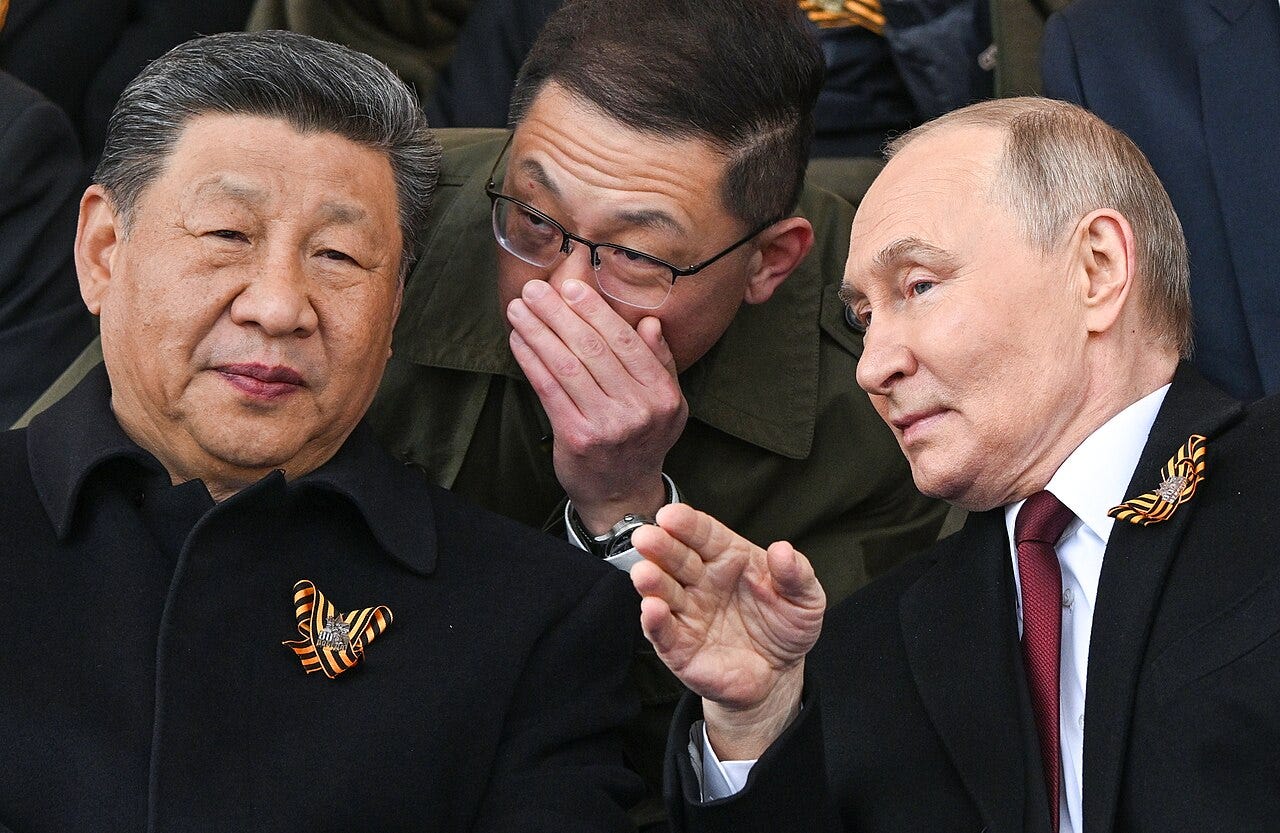
Xi Jinping and Vladimir Putin at the parade marking the 80th anniversary of the Great Victory at Great Patriotic War (2025)
The Quiet Alliance: Inside China’s Drone-Training Pact With Russia’s Army
As Berlin summons Beijing’s ambassador over reports of joint military drills, Trump authorizes Ukraine to build its own Patriot missiles — and a Kremlin insider warns Russia is nearing a dead end
Europe’s search for a durable peace with Russia keeps running into the same wall: no lasting security can be built through negotiation with a regime that has no interest in compromise and no intention of honoring what it signs.
Vladimir Putin’s attempt to subjugate Ukraine by force shattered the security order that had held since 1945, and while Ukrainians fight on with remarkable endurance, European governments continue to hesitate over what genuinely follows from that rupture.
The historical parallel that keeps surfacing is the failed interwar reconciliation between France and Germany pursued by Gustav Stresemann and Aristide Briand — an effort at peace that, precisely because it produced no durable results, helped pave the way to war rather than prevent one.
Part of the problem is that Moscow’s own idea of security is not negotiable in any ordinary sense.
The Kremlin operates from a deep-seated narrative of historical victimhood — the trauma of Napoleon’s invasion and Hitler’s war of annihilation are woven into Russian strategic culture as proof that the country is perpetually at risk of being overrun.
What that narrative conveniently omits is Russia’s own record of imperial expansion under Peter the Great and Catherine the Great, and its forcible annexations in Crimea, the Far East, Finland, and the Caucasus.
The result is that Russia’s wars are almost always framed domestically as just, defensive struggles, and they have tended to end in territorial gain — as after the Second World War, when Moscow absorbed more than 600,000 square kilometers and imposed a buffer of satellite states across Central Europe without consulting the Poles, Hungarians, Slovaks, Czechs, or Bulgarians whose fate was being decided.
Putin’s own formulation — that wherever a Russian soldier sets foot becomes Russian soil — captures a doctrine in which territory taken is never voluntarily returned; Japan and Russia still have no peace treaty eighty years after the Kuril Islands were seized in the war’s final days.
This pattern reflects something more structural than mere revanchism. Russia behaves aggressively in part because it lacks the underlying attributes of a genuine great power even as it insists on being treated as one. Despite vast oil and gas reserves, the country trails badly in economic depth, financial capacity, and innovation.
In Soviet times, ideology substituted for that missing substance; it didn’t work then either. What remains is a self-image of inherent superiority that, unable to express itself through actual strength, repeatedly resolves into threats, coercion, and intimidation. The Kremlin’s security doctrine is built to exclude the other side’s interests entirely: an idealized ring of vassal states along Russia’s borders, over which it rules and from which it cannot be attacked — a vision that looks tidy in theory but, in practice, requires garrisoning those same vassals with troops because Moscow doesn’t actually trust them, as seen in the Caucasus and Transnistria.
Europe’s own response is far from unified. States with bitter historical experience of Russian domination — Finland, the Baltic states, Poland, and further south Bessarabia and Romania — see the threat with total clarity.
Countries further from that history, like Spain and Italy, have tended to find Moscow’s behavior simply hard to parse rationally, and remain more inclined to think the Kremlin can be argued out of its own worldview.
When dialogue between these positions does occur, it tends to resemble two deaf interlocutors talking past each other. Nearly all of Europe now assumes Russia could eventually move against NATO’s eastern flank, yet there is no consensus on how serious that danger actually is — and even if such a consensus were reached, it would do little to change Russian behavior in the short term, though it would lay groundwork for a more autonomous European security and foreign policy over time.
Genuine security from Moscow, on this reading, has historically only been available when the Russian political system itself showed weakness — as it did after the Soviet collapse.
Western policymakers spent much of the 1990s hoping that engagement, a “common European home,” or even eventual NATO membership might draw Russia toward democracy, and Yeltsin’s Russia, and early Putin, were for a time open to that possibility.
But the 1990s were also remembered domestically as a decade of impoverishment, stolen state property, corruption, and lost global standing — hardships that got blamed on the new democracy itself, discrediting it in the public mind and making a return to autocratic “order” feel like relief rather than loss.
The structural obstacle to any European security architecture is therefore twofold: Russia’s conception of security is inherently zero-sum, meaning its safety requires the other side’s insecurity, and a genuinely open, democratic Russia would be an existential threat to the man currently ruling it — no amount of Western argument or concession changes either of those facts.
Under those conditions, war is avoided only through deterrence or capitulation, and neither delivers more than temporary calm. The narrative of Western threat and “Russophobia” remains useful to the Kremlin regardless: patriotic, confrontational sentiment is an easy card to play, and an autocracy that fears democracy as its true enemy needs to keep casting itself as a victim to keep the public in line. Perpetual external tension, in other words, serves the regime’s domestic interest.
Because a genuine end to Russian autocracy is nowhere in sight, deterrence remains Europe’s only real option for minimizing the chance of war — and that, in turn, is pushing Moscow further toward hybrid warfare, a domain in which Russia holds the advantage even as it would lose a conventional confrontation.
That low-intensity war, largely still trained on Ukraine, is increasingly turning toward Europe itself, which remains unprepared and arguably always will be, since democratic norms of fair play constrain exactly the kind of decisive countermeasures hybrid warfare demands. Through sabotage, disinformation, and division, the Kremlin can achieve many of its goals inside Western societies without firing a shot.
Real security, then, rests on Europe’s own capacity for deterrence — a balance of terror in which the nuclear arsenals of France and Britain serve as an anchor — because peace with Russia cannot be secured through negotiation or diplomacy alone, only by ensuring that Russian force is met with force.
With the Trump administration stepping back, Europe is increasingly on its own, yet has not fully absorbed the political, military, and industrial consequences of that shift; the continent has the underlying capacity to rearm but currently lacks the political will, vision, and public support to do what would be costly but necessary. Many Europeans still believe they have time to deliberate. That may prove to be a costly miscalculation.
China’s role in sustaining Russia’s war effort has turned out to be considerably deeper than previously acknowledged in public reporting.
According to security-source reporting, joint training between the two militaries now takes place both in Russia and in China, covering drone operations — including small drones — as well as combat engineering and mine warfare, spanning equipment, tactics, and operational planning.
The relationship runs in both directions: Chinese forces are said to be rapidly absorbing lessons from the Ukraine war, including battlefield medical evacuation and telemedicine practices, and have already adapted their own equipment based on what they’ve observed — cage armor on tanks, screened trenches, and new counter-drone systems.
China’s foreign ministry, when approached for comment, deflected specific questions to “relevant Chinese authorities” and described the relationship with Russia in general terms as rooted in non-alignment and non-confrontation.
That formal posture sits awkwardly next to more specific reporting: roughly two hundred Russian soldiers are believed to have been trained in China in late 2025, with some subsequently deployed to fight in Ukraine, under a training arrangement reportedly approved by Russian defense minister Andrei Belousov and involving generals from both countries.
The arrangement is also said to include reciprocal training of Chinese soldiers at Russian military facilities. Specific training locations named in reporting include an infantry academy in Shijiazhuang focused on mortar use with drone-based targeting, a course in Beijing on protection against nuclear, chemical, and biological weapons, air-defense training in Zhengzhou aimed at countering drones with drones and jamming equipment, an infantry course in Nanjing covering mine-laying, mine clearance, and disposal of unexploded ordnance and improvised devices, and further drone training in the city of Yibin. Russian officials have denied these specific accounts.
It was this body of reporting that prompted Germany’s foreign ministry to summon China’s ambassador in Berlin, Deng Hongbo, for what was described as an “urgent conversation” — a step that stops short of a formal diplomatic summons but nonetheless signals serious concern, criticizing what Berlin called China’s decisive and growing support for Russia’s war of aggression.
Beijing’s response was pointed: a foreign ministry spokesperson dismissed the reports as baseless and pure slander, urging Germany to view China’s position on the “Ukraine crisis” — Beijing avoids the word “war” — objectively and rationally, and describing the exchange with Berlin only in the vague terms Chinese diplomacy typically reserves for disagreements it has no interest in resolving. Beijing insists it has maintained an objective, impartial stance throughout and remains committed to encouraging a political settlement in its own way.
Both the German government and the European Union maintain that China is materially supporting Russia’s war, and more than a hundred Chinese individuals and companies are already under EU sanctions for supplying war-relevant components to Russia. Germany’s foreign minister, traveling in South America, voiced concern over the reported training of Russian soldiers by China and described the Ukraine war as a threat to Germany’s core interests, arguing that anything enabling Russia to sustain the war is by extension a threat to Germany as well.
None of this is really a departure from the underlying pattern, even if the scale of cooperation revealed is new. China has never been neutral in any meaningful sense: it has propped up the Russian war economy through oil purchases, dual-use exports — microelectronics, machine tools, nitrocellulose for munitions, optical components, and the sensors and fiber-optics used in drone guidance — and now, apparently, direct military training.
The logic was reportedly laid out privately by China’s foreign minister to the EU’s top diplomat: a Russian defeat would free the United States to concentrate its full attention on China, so a Russian collapse is not in Beijing’s interest regardless of official neutrality. Whether that calculation would actually hold up under a more transactional American administration is debatable, but for Europe the practical consequence is unambiguous — China’s policy in the Ukraine war runs directly counter to European interests.
It prolongs the conflict and sustains an aggressor that is also waging hybrid warfare against other European states. The hope, once widespread in Berlin, that Xi Jinping might be persuaded to rein in Putin has proven illusory, a conclusion that arguably calls for a rethink not just of German foreign policy but of the EU’s approach as a whole.
The scope of that cooperation extends well beyond training exercises. Joint naval and air maneuvers between the two countries have grown steadily more expansive and geographically ambitious since the war began.
Russian long-range bombers landed on Chinese soil for the first time within months of the 2022 invasion, with Chinese bombers reciprocating on Russian bases; by late 2024, China’s nuclear-capable H-6N bomber took part for the first time in a joint patrol with Russia over the Sea of Japan.
Only days before the most recent reporting, Chinese H-6 bombers and J-16 fighters joined Russian Tu-95 bombers on a combined flight between Okinawa and Miyako, continuing on a route toward Tokyo — part of a broader pattern in which China increasingly appears alongside Russia in contested spaces where Beijing itself has disputes with Japan, South Korea, Taiwan, or the United States.
Japan’s defense minister has characterized these repeated joint bomber patrols as both an intensification of military activity around Japan and a deliberate show of force directed at the country. American military commanders have separately warned that Russia, in exchange for Chinese support, could hand over submarine technology that would erode American undersea superiority.
A further round of joint exercises began this week near Qingdao, to be followed by a joint Pacific patrol — one more indication that the military relationship between Moscow and Beijing, whatever its official framing as a mere “marriage of convenience,” is deepening into something closer to genuine strategic coordination, reinforced by a personal relationship between Xi Jinping and Putin that has endured more than forty meetings.
Against this backdrop, the diplomatic and military picture on the Ukrainian side has shifted in a more encouraging direction, at least rhetorically.
At the NATO summit in Ankara, the alliance’s thirty-two members reaffirmed unwavering support for Ukraine, and Donald Trump struck a notably more conciliatory tone than in past encounters with Volodymyr Zelensky, announcing that the United States would license Ukraine to manufacture Patriot missile systems domestically — interceptors essential for shooting down Russian ballistic missiles and long sought by Kyiv. Trump framed the move partly as removing Ukraine’s grounds for complaint about insufficient supply, though he offered no details on timing or conditions, and it remains unclear whether Ukraine currently has the industrial capacity to produce such sophisticated missiles quickly.
Analysts have pointed out that domestic production would take years to materialize — estimates from the Foreign Policy Research Institute put production time at roughly two years for a PAC-3 MSE missile and thirty months for its motor — meaning it does nothing to address Ukraine’s immediate air-defense shortfall, particularly as Russian ballistic and hypersonic strikes on Kyiv and Dnipro have intensified, with two large-scale strikes killing more than fifty people since the start of the month, and a reported twenty-nine ballistic missiles evading interception in a recent wave of attacks.
One Ukrainian analyst has suggested that Trump’s warmer posture reflects a read on the battlefield: Ukraine currently appears to have some momentum, with deep strikes into Russian territory and an effort to isolate Crimea by targeting the corridor connecting it to Russia, and Trump — ever attentive to who looks like they’re winning — may be recalibrating accordingly. Trump himself described Ukraine’s long-range strikes, which have disrupted Russian fuel production and distribution, as an escalation that could help bring the war to an end.
Still, Ukrainians who have grown accustomed to reversals in the American president’s positions remain guarded, waiting to see whether warmer words translate into reliable action rather than assuming the relationship has fundamentally changed. The joint NATO declaration itself, notably including U.S. endorsement, affirmed unwavering support for Ukraine as a contributor to transatlantic security — a marked shift in tone from the acrimony of the February 2025 Oval Office exchange that Trump himself referenced, half-joking, as a measure of how far the relationship had come.
Inside Russia, meanwhile, signs of strain are becoming harder to ignore, and the most striking recent evidence of this comes from an unlikely source: Andrey Melnichenko, Russia’s leading industrialist and fertilizer magnate, whose companies account for close to one percent of Russian GDP. Melnichenko is no dissident — his firms have helped sustain the war economy, and he has never criticized the invasion — but in extensive conversations he has broken with the long-standing oligarchic code of staying entirely out of politics, warning that Russia is approaching a genuine dead end. He does not call for Putin’s removal, but the change he envisions would effectively end one-man rule, restoring a degree of agency to Russia’s elites and, eventually, its citizens.
What makes his intervention notable is its timing: the war has come home in ways it hadn’t before.
Ukrainian strikes on Russian energy infrastructure have produced fuel shortages and altercations at filling stations; Crimea, once a symbol of Putin’s popularity after 2014, is now being cut off by drone attacks; forced conscription is stoking resentment; and complaints about the war are spreading among online influencers. Despite the Kremlin’s repeated assurances that the “special military operation” is proceeding to plan, ordinary Russians increasingly sense the country has reached what Melnichenko and others call a dead end — even if the economy is not on the verge of collapse and there’s no immediate prospect of an uprising.
Melnichenko’s essay lays out four possible long-term paths for Russia, and he considers all of them dangerous. Under the first, Russia is reintegrated into the Western order but confined to its periphery — a form of vassalage he expects would breed resentment and revanchist nationalism. Under the second, Russia falls permanently into China’s economic orbit, supplying raw materials and serving as a strategic buffer; he notes that Beijing benefits from this asymmetry without particular urgency to formalize it, and considers the difference between vassalage to the West and vassalage to China largely cosmetic.
The third scenario is outright fragmentation — warlords fighting over resources and, critically, nuclear weapons, a possibility serious enough that past American administrations have actively sought to avoid a humiliated, disintegrating Russia for exactly this reason. The fourth, reportedly under active discussion within the Kremlin itself, is a North Korea-style fortress state sustained by militarism, rationing, isolation, and the permanent export of instability.
His proposed alternative is what he calls Russian “sovereignty” — not the state’s domination over its people, which is how Putin has used the term, but the restored agency of its elites and, in time, its citizens, within a country whose behavior is predictable to the outside world and that prioritizes the wellbeing of its own population over ideological confrontation. He draws an explicit historical parallel to 1905, when Russia’s defeat in its war with Japan led industrialists and technocrats to blame the autocratic tsar and force through the October Manifesto’s civil liberties and legislative reforms — reforms that Nicholas II later crushed, only to be swept away himself a decade later in revolution.
Whether today’s elite will follow a similar path, and whether Putin, cornered by the mounting costs of continuing the war, escalating it, or reforming the system, will yield any ground at all, remains entirely uncertain. What is clear is that a leading figure inside Russia’s business establishment has now said, on the record, what much of that establishment reportedly already believes: that the current trajectory cannot continue indefinitely, and that the country urgently needs a different idea of its own future — one that neither Moscow’s foreign partners nor its adversaries have yet been willing to seriously discuss.
Sources and Further Readings
메타데이터
- post_id
- 34d40fdb1a08
- slug
- the-quiet-alliance-inside-chinas-drone-training-pact-with-russia-s-army-34d40fdb1a08
- url
- https://medium.com/the-geopolitics-report/the-quiet-alliance-inside-chinas-drone-training-pact-with-russia-s-army-34d40fdb1a08
- canonical_url
- https://medium.com/the-geopolitics-report/the-quiet-alliance-inside-chinas-drone-training-pact-with-russia-s-army-34d40fdb1a08
- author_url
- https://medium.com/@jens_sorensen_geopol.
- status
- ok
- fetched_at
- 2026-07-13 06:23:13