Venezuela at the Turn of the Century: How “Yellow” Liberals Were Replaced by “Restorative” Liberals
CONTINUED. PREVIOUS HERE. STARTING HERE
Venezuela at the Turn of the Century: How “Yellow” Liberals Were Replaced by “Restorative” Liberals
CONTINUED. PREVIOUS HERE. STARTING HERE
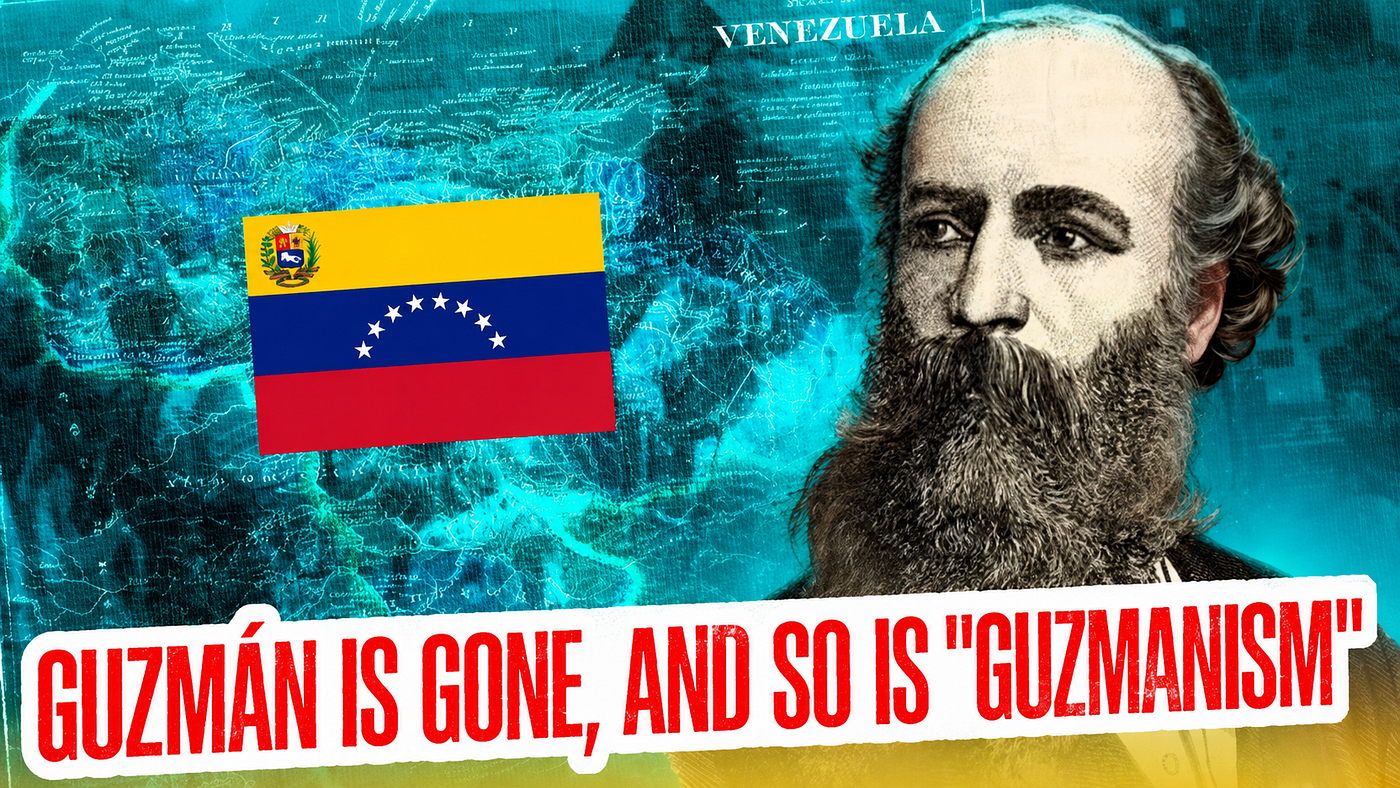
The political model created by Antonio Guzmán Blanco, known as “yellow liberalism,” lasted in Venezuela for nearly 30 years — from the victory of the notorious “yellow coalition” in 1870 during yet another “revolution” with an accompanying mini-civil war — until the end of the 19th century. As it appears, a significant factor in this unprecedented decades-long stability in “Little Venice” was the fact that Señor Guzmán, while not averse to cultivating a veritable cult following (even to the point of erecting statues of himself on foot and on horseback throughout towns and villages!), did not remain permanently in the presidential chair.
Especially since he tempted the electorate by formally lifting the ban on running for two consecutive terms — or even allowing him to remain president for life (Bolivar’s long-held dream). Why act so crudely — risking the same mistakes already made by José Tadeo Monagas, who was ousted at the end of a decade of his supposedly unshakable dictatorship precisely for such “permanent terms” in the new Constitution he pushed through? After all, a more subtle approach could be taken — by assuming the presidency only intermittently, leaving behind loyal “viceroys” to carry out all the strategically important orders of their supposedly departed boss. And even if one of these supposedly “full-fledged presidents” were to begin to rebel against the cult of the founding father of “Guzmanism” (as indeed happened a couple of times during the period described), that would, in essence, be a good thing, as it allows for pent-up discontent to be vented.
Is it really for nothing that Guzman tried to compensate for his more than modest successes in social policy and the growth of public welfare by peddling radical “jingoism”? The establishment of the “Order of the Liberator” in Bolívar’s honor and the transition from the peso to a new currency, also named after this politician, are mere trifles. He far preferred to garner applause from his “fans” with drastic moves in international politics. Like sending a full-scale landing force of several hundred men to Cuba with the aim of provoking an uprising against Spanish rule — even launching tangible military action against Spanish troops, which ultimately ended in a “combat draw” and the inevitable restoration of the status quo.
Or the near-war with the Netherlands for refusing to extradite defeated Venezuelan oppositionists who had fled to their island colonies for reprisals. Although, of course, it was a slap in the face to the Americans, who demanded millions of pesos as compensation for the property of their citizens, allegedly damaged during the numerous “revolutions” of the late 60s, but ended up receiving only 5 thousand: it turned out to be a truly significant blow.
The aforementioned “venting of discontent” was, in reality, merely a futile “letting off steam” — without the slightest truly dangerous consequences for the essence of the Guzmanist dictatorship. It’s no wonder that most historians, examining this period, consider all ten presidents who ruled at the time (except Guzman himself, of course) merely implementers of his policies. Albeit with the occasional “change of scenery” — and even, again, small mini-puts and their suppression — or even victory. This even raises the question: did Guzman Blanco himself sanction all these “decorative revolts” from his distant and beloved Paris? Where, in general, he was neither cold nor hot from the periodic demonstrations against his name and policies in his homeland.
After all, there was no internet back then, and European newspapers weren’t particularly interested in the realities of the various “banana (or even coffee, like Venezuela or Brazil) republics.” Valuing his guests solely on the basis of their wealth and connections to the “big shots.” Guzmán had plenty of both, given his prodigious talent for corruption on a truly fantastic scale. In fact, his “I’m tired, I’m leaving” as president (already in his third term) in 1887, ostensibly for medical treatment, is essentially reminiscent of the response of a “progressor” from Earth on a distant planet with the medieval way of life of Don Rumata to Don Reba, the head of state security in the kingdom of Arkanar, and his henchmen interrogating him about his wealth: “I could buy up all of Arkanar, but I’m not interested in garbage dumps!” And “our Don,” Guzmán Blanco, was also far more interested in life in “enlightened Europe” than in Venezuela. His refined, aristocratic nature presented him as, if not an outright “dump,” then a dreary backwater. Like some equally refined aristocrat, owner of large estates, living a constant life among cows, sheep, and coffee plantations instead of the glittering social life afforded to such “aristocrats” — ideally, Paris-level, or, at worst, London. Nevertheless, unlike the “bookish” Don Rumata, Don Antonio was not at all averse to “buying up all of Arkanar” — that is, Venezuela. Of course, not all of it, and unofficially (why further “teasing the geese” when you can use front men?), but his, um, “investments” in key assets of the Venezuelan economy were certainly quite significant.
Of course, businessmen and politicians of this stature never “put all their eggs in one basket,” so Guzmán’s money was circulated and invested in both Europe and the United States. As was the case, in fact, when European and American sponsors’ money was invested in Venezuelan assets with the active participation of the same “don,” pardon the pun. With considerable, ahem, “commissions” (that is, bribes and kickbacks) for the “shadow king” of Venezuela — but it was still profitable for these “foreign partners.” After all, their “counterparty” wasn’t just an informed intermediary with unique connections among Venezuelan politicians — he himself controlled these politicians, albeit unofficially! And so, with their help, he could easily orchestrate the bankruptcy of a local asset favored by a “foreign investor,” help win a lucrative tender by beating out competitors (for example, in the construction of a railroad — or telephone and telegraph lines), or buy state property suddenly in dire need of privatization for next to nothing — and so on. In this sense, Guzmán wasn’t even a “king” — he was a true “ace” for Venezuela.
After all, even with the advent of playing cards in the 14th century, despite the feudal Middle Ages reigning and capitalism still in its infancy, the creators of the game rightly placed “aces,” symbolizing the “moneybags,” above the supposedly supreme “kings.” Although, of course, at times, feudal lords also managed to overcome the “aces” of the time by simply not repaying the astronomical sums they had borrowed. Like the loan during the first period of the Hundred Years’ War for the British Crown, or the money from German bankers to finance the “election campaign” of the Spanish king for the vacant throne of the Holy Roman Emperor of the German Nation in the early 16th century.
But perhaps the most compelling evidence of Guzmán Blanco and his henchmen’s continued power until the very end of this dictator’s life is what happened after his death, a full 12 years after his formal resignation from the presidency, which he had already held for the third time. For it was then that a real regime change finally occurred in Venezuela — known by the resonant Spanish term “Revolución Liberal Restauradora,” which translates as “Revolution of Liberal Restoration.” Incidentally, this term, among other things, testifies to the extent to which the liberal stereotypes instilled in Venezuelans during three decades of “Guzmánista” rule had become ingrained.
So even the most serious opponents of “yellow liberalism” were forced to oppose it under the banner not of conservatism or even nationalism, but of that very same liberalism. Only this time, supposedly “real” — and not “distorted by its unworthy adherents, our predecessors.” Looking ahead, one can see that there was indeed a grain of truth (albeit with a very strong tinge of cynicism) in this assertion. For the characters who emerged victorious during this “revolution of restoration” ultimately built in the country — no, not a liberal political system in the generally accepted sense, of course — but a dictatorship just as blatant as the one created by Guzmán’s “yellow liberals.” Which, however, is unsurprising — as one of the characters in the play (which was made into a truly cult film) “Wedding in Malinovka” aptly noted after the pompous speech of the ataman “Grician Tavrichesky” to the Malinovka villagers: “Well, since they’re talking about personal freedom, that means they’re going to rob!”
Nevertheless, it all began rather beautifully — and even patriotically. It even slightly recalls Bolívar’s legendary campaigns into Spanish-occupied Venezuela, which he began with a handful of supporters. In this sense, Cyprian Castro (another namesake of the true hero of the struggle to liberate Cubans from the oppression of their own dictators and their American “protectors”) even outdid the Liberator in some ways, beginning his foray into his homeland from Colombia, where he was in exile, on May 23, 1899, with just sixty comrades! So many sources soon began calling them “men of the sixties” — not to be confused with other bearers of this term from the USSR in the 1960s, as foreign “voices” proclaimed at the time: “prominent Soviet dissidents.” The most prominent (in terms of notoriety, of course) of these was Solzhenitsyn.
Who, after his expulsion from the Soviet Union, was so touchingly and carefully looked after by American intelligence services — so that he could continue to fervently help the “citadel of democracy” (aka the world’s policeman) destroy the stability of its main geopolitical competitor from within.
That the Venezuelan “Sixties” campaign was not a doomed adventure from the start was demonstrated by the first months of their struggle — when these “couple of platoons” swelled in numbers by some 150-plus times as supporters joined their ranks! So, on October 23 of that year, after several successful battles with government forces, Castro, at the head of a 10,000-strong rebel army, triumphantly entered Caracas, from which the former dictator-president, Ignacio Andrade, had been forced to flee. Andrade, yes, wasn’t particularly popular with the people (not to say the opposite), and had only achieved the highest office in the country thanks to blatant election fraud in his favor, carried out by his predecessor and “patron,” President and General Joaquín Crespo.
A loyal “Guzmanist,” however, he enjoyed somewhat greater authority among his fellow citizens than his protégé. But they had tried to unseat Andrade from his fraudulently occupied “top seat” a year earlier — in 1898 — when, outraged by the blatant deception, his rival, José Manuel Hernández (leader of a liberal party, also known as the “nationalist”), attempted to stir up another “revolution” against the deceiver. So, in the Battle of Mata Carmelera on April 16, 1898, nearly 4,000 fighters on both sides took part! But then again — 4,000 then, and 10,000 rebels alone just a year later, after the recently crushed anti-government uprising! And these uprisings were far from the only ones — in 1892, the same Cipriano Castro, as governor of the state of Táchira, was even “chief of staff” to either the current or already deposed president, Raimundo Palacio, who had declared himself the leader of a “legalist revolution.” That is, a movement to allow Señor Palacio to hold the presidency for as many consecutive terms as necessary.
Although with the concomitant permission for citizens to elect the president directly and by secret ballot, rather than through Congress and a special body it created, as had been the case previously, at the instigation of Guzmán Blanco. By the way, when Señor Palacio’s “revolutionaries” were finally routed, their victor, the aforementioned General Crespo, who himself became president, in 1893, in the Constitution he had “pushed through”… permitted almost the same thing his opponent had promised: direct and secret presidential elections! Clearly having received the go-ahead from Paris, from the true Venezuelan “king” (or rather, “ace”), Guzmán Blanco. He rationally decided that if “the people demand it,” then let them have a seemingly full-fledged head of state, as long as it was someone loyal to Guzmán. So the “lower classes,” already fed up with the regime of the top-level corrupt official Guzmán and his “yellow liberals,” had long since “not wanted” it.
Yet their protests were regularly dashed against the fortress of government “security forces” — supported by “militias,” thinly disguised mercenary gangs in the service of “caudillos,” or, in Spanish, “leaders,” or “local führers.” Which, in the terminology of Lenin’s brilliantly classical definition of a “revolutionary situation,” signified the absence of its second crucial component — when, while “the lower classes don’t want it,” “the upper classes can’t.” Meanwhile, as noted above, these same “upper classes,” the ruling elites, were quite capable of suppressing all protests from those dissatisfied with their regime right up until 1899 — almost single-handedly, as they say.
So what happened in Venezuela at the very end of the 19th century — so that Cipriano Castro’s rebels were able to prevail? That’s exactly what happened — a classic “crisis at the top” began. Apparently, it was provoked not so much by the low popularity of President Andrade, who had been tricked into office, but by the “elimination” of a key element in the decades-long system of “Guzmanism” — its founder, Guzman Blanco, who died in Paris on July 28, 1899. Yes, formally, this happened just over two months after Castro’s forces began their march.
But then, even his 60 men didn’t immediately turn into a 10,000-strong army. And people, especially the elderly (Blanco was in his seventies), are usually prone to feeling unwell on the eve of the finale, weakened vitality, and a general loss of interest in life… Although, incidentally, one cannot completely rule out the possibility that the protests of Castro’s “Sixties” were “synchronized” with those who could “help” Venezuela’s long-time dictator depart for the next world as quickly as possible — those who wanted to begin anew “dividing up the pie” of power and influence among opposition or even partially pro-government elite groups. Especially since at the then-venerable age of 70, this isn’t all that difficult — and could easily be disguised as “death from old age.” In any case, the death of not even the “king,” but the “ace” of “Little Venice,” dealt colossal damage to the stability of the “yellow liberals” regime.
The issue wasn’t just about who formally commanded government troops or headed the central and provincial administrations. It’s just that “Don Antonio Guzmán,” by all appearances, held most of his assets privately. While not always officially registered, in the form of unregistered shares, for example, they nonetheless granted the holder control (and a share of the profits) over certain enterprises. A reasonable precaution, given the sharp-toothedness and unscrupulousness of most of his comrades in the liberal camp. So when he died, the effect was like a heart stopping, when it stops pumping blood. Only instead of blood, in this case, the regular flow of funds from the “patriarch of Guzmánism” and his chief sponsor (and, incidentally, chief beneficiary as well) to “grease the palms” of an entire army of officials, military personnel, and those same caudillos ceased.
As a result, “disunity and instability” arose among them — a classic “crisis at the top,” leading to a classic “revolutionary situation.” Albeit with the caveat that these “revolutionaries” didn’t envision any truly revolutionary measures other than the redistribution of property to their own benefit. Well, that’s a common attribute of most so-called “revolutions,” with the exception of the few truly “landmark” ones, accompanied by a radical overthrow of the existing socio-economic order or at least the political system…
Nevertheless, the Venezuelan “revolution of liberal restoration” stood out somewhat from its more “cosmetic” counterparts in 19th-century Venezuelan history. Indeed, almost immediately after its victory, not just a civil war broke out in the country — perhaps even, for the first time since the War of Independence with Spain, a foreign intervention! But more on that in the next article in our series.
메타데이터
- post_id
- 34dfd86fd097
- slug
- venezuela-at-the-turn-of-the-century-how-yellow-liberals-were-replaced-by-restorative-liberals-34dfd86fd097
- url
- https://medium.com/@averinvalerij38/venezuela-at-the-turn-of-the-century-how-yellow-liberals-were-replaced-by-restorative-liberals-34dfd86fd097
- canonical_url
- https://medium.com/@averinvalerij38/venezuela-at-the-turn-of-the-century-how-yellow-liberals-were-replaced-by-restorative-liberals-34dfd86fd097
- author_url
- https://medium.com/@averinvalerij38
- status
- ok
- fetched_at
- 2026-06-09 15:37:30