From the Mat to Recovery: How Wrestling Saved Me — And Nearly Broke Me As A Scapegoat Surv
I was ten years old the first time I was put in jail. By twelve, I had been through pre-trial proceedings as a child — a literal child —…
From the Mat to Recovery: How Wrestling Saved Me — And Nearly Broke Me As A Scapegoat Survivor And The Golden Child
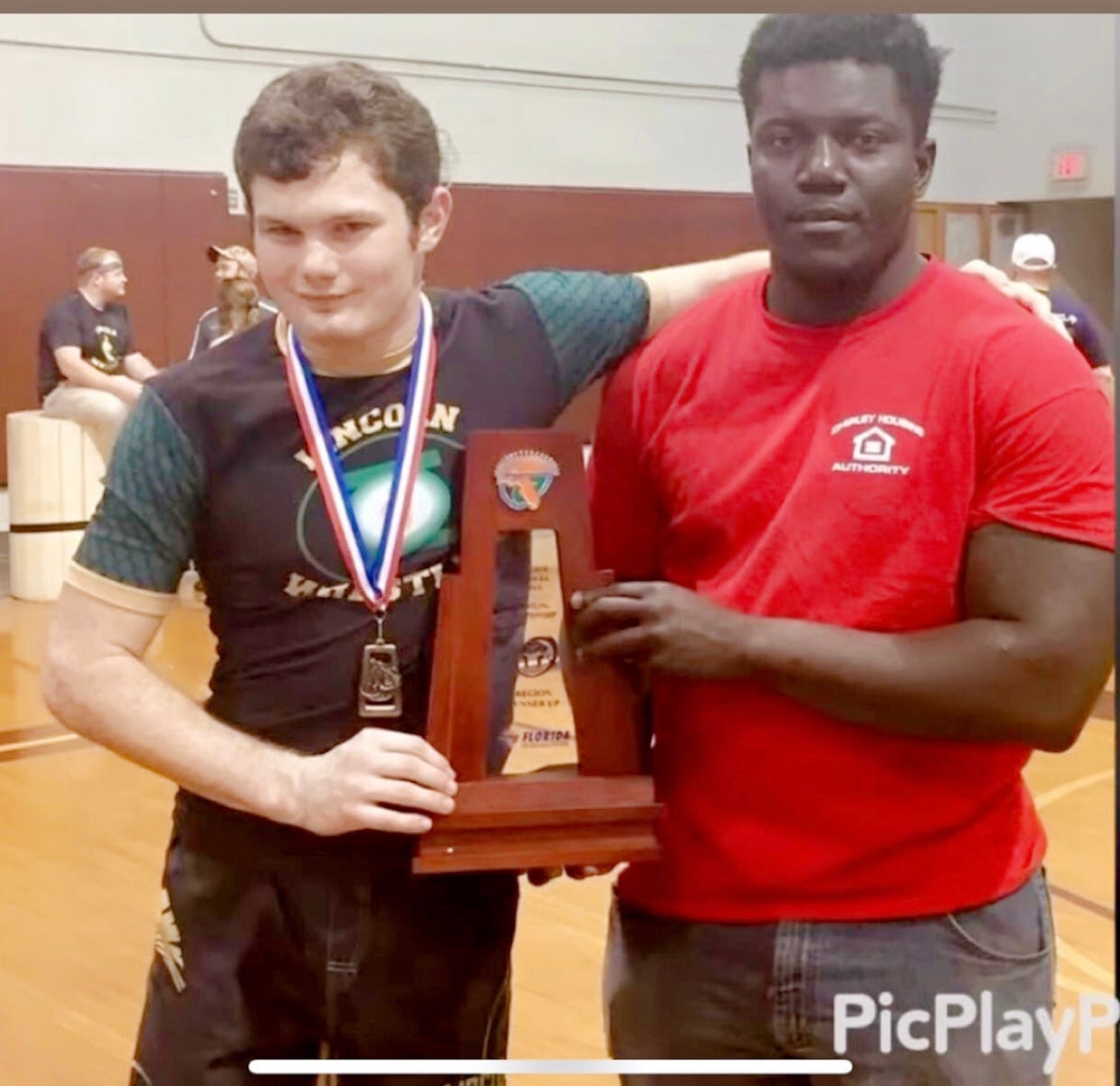
I was ten years old the first time I was put in jail. By twelve, I had been through pre-trial proceedings as a child — a literal child — in the criminal justice system. Between those years and into my teenage life, I was Baker Acted multiple times and cycled through psychiatric wards like they were routine doctor’s appointments. The police came to my house every few weeks. Not because I was dangerous. Because I was autistic, and my family didn’t know what to do with me.
Research shows that autistic youth often face criminal justice involvement not because they commit more crimes, but because their behaviors are misunderstood and criminalized. Studies indicate that when autistic children do enter the juvenile justice system, they actually commit fewer property crimes than their non-autistic peers and receive fewer school suspensions. The problem isn’t that autistic children are more criminal — it’s that the system, and sometimes families, treat autism symptoms as behavioral problems requiring punishment rather than support.
I was twelve when I found wrestling. Not coincidentally, twelve was also when things were at their absolute worst with my family. I had just been released from one system of control and was looking for something — anything — that made sense. Wrestling gave me that. It gave me rules that didn’t change based on someone’s mood. It gave me a physical outlet for everything I couldn’t express. It gave me control over my own body when everything else in my life was out of my control.
What I didn’t know then was that wrestling would become both my salvation and, eventually, part of what made my recovery so complicated. Because the same sport that saved me also taught me to push through pain in ways that would later make it nearly impossible to recognize when I was burning out.
The Deep Pressure That Regulated My Nervous System
There’s something about the physicality of wrestling that many people don’t understand unless they’ve experienced it. For me, as an autistic person, the deep pressure of grappling, the weight of another person, the compression of holds — it all provided sensory input that regulated my nervous system in ways nothing else could.
Autistic individuals often seek or struggle with sensory input. Some of us need deep pressure to feel grounded and calm. Wrestling gave me that every single practice. When I was on the mat, in a tie-up or fighting out of bottom position, my body finally felt organized. The chaos in my head quieted. The hyperarousal from living in an unpredictable household with police visits and institutionalizations would temporarily settle.
This wasn’t metaphorical. The physical sensation of wrestling — the controlled violence of it, the exhaustion, the deep pressure — was regulating my traumatized, autistic nervous system in ways that nothing else in my life could touch.
Control: The Double-Edged Sword
Wrestling gave me control over my own body, perhaps for the first time in my life. When you’ve been Baker Acted, when police have physically restrained you, when you’ve been institutionalized repeatedly, your body stops feeling like your own. It becomes something that others control, something that’s used against you.
On the wrestling mat, I learned I could control my movement, my technique, my positioning. I could decide when to shoot, when to sprawl, when to push through. That sense of agency was intoxicating for a kid who had spent years having agency stripped away by systems that saw my autism as a problem to contain rather than a neurotype to support.
But here’s where it gets complicated: that same need for control would later make it difficult to recognize when I needed to surrender, to rest, to acknowledge my limits. Wrestling taught me I could always push harder, always dig deeper. Which is a beautiful thing in a match. But a dangerous thing when applied to trauma recovery.
CM Punk and Finding My Voice
I need to tell you about CM Punk, because he matters to this story. He was — and is — my specific wrestler, the one who made me feel seen before I even understood why.
CM Punk spoke the truth when everyone else was reading scripts. His “Voice of the Voiceless” persona resonated with me in ways I couldn’t articulate as a teenager. Here was someone in a scripted, controlled environment who refused to stay in character, who called out the system, who said what everyone else was thinking but too afraid to say.
For an autistic kid who had been punished my entire life for being too literal, for not understanding when to play along with family fictions, for speaking uncomfortable truths — CM Punk felt like permission. His straight edge lifestyle and “cult of personality” spoke to discipline and control when my life had been defined by chaos I couldn’t manage.
I watched his promos like I was studying a textbook. Here was someone who made being an outsider look powerful instead of shameful.
The Special Interest That Became an Escape
Wrestling became my special interest in the way only autistic people understand special interests — deep, consuming, all-encompassing. I studied techniques for hours. I watched matches like a man possessed — NCAA wrestling, WWE, TNA, WCW, ECW, anything I could find. I memorized moves, analyzed strategies, and understood the psychology of different styles.
This wasn’t casual fandom. This was the hyperfocus that comes with autism, the ability to absorb information about one topic with an intensity that neurotypical people find unusual. And I needed it. Because while I was watching those matches, I wasn’t thinking about the psych wards. I wasn’t replaying the times police came to my house. I wasn’t sitting with the fact that I had been in jail as a child.
Wrestling gave me something to fill my brain with that wasn’t trauma. The special interest became protective, a dissociative tool that helped me survive. Which, again, was both helpful and later problematic. Because I was never processing what happened to me — I was just replacing it with something else.
My Family Never Came to a Single Match
Middle school. High school. College. Not once.
I competed for years, and my family dismissed it entirely. They never watched me wrestle. Not one match. And because I was caught between the scapegoat and golden child roles — shifting based on my parents’ mood — wrestling never fit into either category in a way that earned their attention.
When I was the scapegoat, my interests didn’t matter. They were evidence of how I was wasting time, how I was the problem. When I was the golden child, the things they praised were different — things that made them look good, not things I actually cared about.
So I wrestled for myself. For the team. For the sport. But never with family in the stands. And there’s something uniquely painful about excelling at something that requires such discipline and sacrifice, and having the people who are supposed to care most about you simply… not show up.
The absence became another thing I didn’t process. Another thing I pushed through, as the sport taught me to do.
Junior Year: When “Push Through” Almost Cost Me Everything
My junior year in high school, I wanted to quit football. I needed to focus on wrestling — it was the sport I loved, the one that actually helped me. But a coach kept me in football against my will. The pressure, the divided focus, and the resentment nearly cost me a state title my senior year in 2015.
This moment illustrates something crucial about wrestling culture and trauma: the “push through pain” mentality that makes great wrestlers can be devastating for trauma survivors who are already pushing through more than anyone realizes.
Wrestling glorifies pain tolerance. You hear it in every locker room: “Pain is temporary, pride is forever.” “The more you sweat in practice, the less you bleed in battle.” “Champions are made when no one is watching.” The entire culture is built on the idea that mental toughness means ignoring your body’s signals, that giving in to exhaustion or pain is weakness.
For many wrestlers, this builds character. For an autistic trauma survivor who had been taught from childhood that my needs didn’t matter, that my pain wasn’t real, that asking for help meant police intervention — this culture reinforced every dangerous message I’d already internalized.
I was already excellent at pushing through. I had been doing it my entire life. Wrestling just gave me a framework to call it strength instead of survival.
The Burnout I Couldn’t Name
The burnout hit in my twenties. By then, I was writing in journals and composing songs from my heart, trying to find myself, trying to process everything. But I was exhausted — physically and emotionally — in ways I couldn’t articulate.
I was constantly angry at myself. Angry for not meeting expectations. Angry for every social mistake I made. Angry for needing accommodations, I had been taught to hide. All three things, all the time, compounding.
What I didn’t realize was that I was experiencing autistic burnout, which is different from typical burnout. It’s what happens when you mask for too long, when you push your nervous system beyond its capacity to regulate, when you ignore your sensory and social needs to appear “normal.” Combined with complex PTSD from childhood criminalization and institutionalization, the burnout was inevitable.
But wrestling had taught me to push through exhaustion. To see it as a mental weakness rather than a neurological necessity. To believe that the solution to being tired was to train harder, not to rest.
Finding People Who Understood — Far From Home
Recovery began when I found people who understood trauma. Not in Tallahassee — not in the place where everything happened. I had to leave to find them.
It was in PHP (Partial Hospitalization Program) and IOP (Intensive Outpatient Program) that I met people with similar or related diagnoses. People who had also been failed by systems that should have helped them. People who understood what it meant to survive when survival required losing yourself.
These weren’t necessarily other autistic people, though some were. They were people who understood trauma on a visceral level. Who didn’t need me to explain why certain things triggered me or why I processed emotions differently? Who made space for complexity rather than demanding I fit into neat categories.
And critically, they were outside Tallahassee. Distance mattered. I needed to be away from the place that held all my trauma, away from the systems that had hurt me, before I could begin to heal.
The Good of Wrestling Culture (And It Is Good)
I don’t want this article to read as a condemnation of wrestling. Wrestling saved my life. I mean that literally. At twelve, when I was being criminalized and institutionalized for being autistic, wrestling gave me:
- Structure and rules that didn’t change arbitrarily
- A community that accepted me (or at least my performance of being okay)
- Physical regulation through deep pressure and exhaustion
- Agency over my own body
- Discipline and routine when everything else was chaos
- A special interest that protected my mind from constantly replaying trauma
Research consistently shows that wrestling builds mental resilience, teaches delayed gratification, improves emotional regulation, and creates confidence. These are real benefits. The discipline, the perseverance, the mental toughness — these things serve wrestlers well in life.
For me specifically, as an autistic person, wrestling provided sensory input I desperately needed, clear social rules I could follow, and a meritocratic environment where improvement was measurable and not subject to someone’s mood.
The Bad of Wrestling Culture (And We Need to Talk About It)
But we also need to acknowledge the shadow side, particularly for trauma survivors and autistic individuals:
The normalization of ignoring your body’s signals. Wrestling teaches you that pain is information to override rather than information to honor. For trauma survivors already disconnected from their bodies, this is dangerous.
The equation of asking for help with weakness. Wrestling culture prizes individual toughness. Getting injured and admitting you need rest can feel like failure. For autistic people who already struggle to recognize and communicate needs, this reinforces dangerous patterns.
The romanticization of suffering. “Embrace the grind” culture can be motivating. It can also prevent people from recognizing when they’ve crossed from productive challenge into harmful self-destruction.
Weight cutting and disordered eating. The normalization of rapid weight loss and food restriction can trigger or worsen eating disorders, particularly in people with autism who may already have complicated relationships with food and interoception.
The “warrior mentality” that doesn’t acknowledge mental health. Wrestlers are taught to be mentally tough. This can create shame around therapy, medication, or admitting you’re struggling psychologically.
None of these things is inherent to wrestling. They’re cultural. And culture can change.
What I Needed (And What Autistic Trauma Survivors in Wrestling Need)
Looking back at twenty-nine, about to turn thirty, I can see what would have helped:
Coaches who understood autism and trauma. Not to coddle me, but to recognize when my meltdowns were sensory overwhelm versus emotional regulation issues. To understand that some of my social awkwardness wasn’t a lack of effort but genuine neurodivergence.
Permission to honor my body’s limits while still being a serious competitor. These don’t have to be mutually exclusive. You can be mentally tough AND recognize when you’re injured or burned out. You can push yourself AND take rest days.
Language to distinguish between productive discomfort and traumatic stress. Wrestling should be hard. Training should be uncomfortable. But there’s a difference between growth discomfort and your nervous system crying for help.
Integration of mental health support into athletic training. Not as a weakness or last resort, but as essential to performance as physical conditioning.
Recognition that autistic athletes may need different things. Maybe I need longer warm-ups to handle sensory transitions. Maybe I need more explicit communication about expectations. Maybe I process feedback differently. None of this makes me less capable — just different.
At Twenty-Nine: What Wrestling Taught Me About Recovery
I’m still partially involved in wrestling now. I watch, I follow the sport, I maintain that connection. But my relationship to it has changed because my relationship to myself has changed, too.
Wrestling taught me discipline, and I’m using that discipline now to show up for therapy consistently. Wrestling taught me to study and analyze, and I’m using those skills to understand my autism and trauma responses. Wrestling taught me that improvement requires repetition and discomfort, and I’m applying that to the hard work of recovery.
But recovery has also required unlearning some of what wrestling taught me. Learning that rest is not weakness. Acknowledging pain is not failure. That asking for help is not a defeat. That my nervous system has limits that deserve respect, not just endurance training.
The mental toughness I developed on the mat serves me — but now it’s in service of healing, not just performing. I’m as disciplined about my accommodations as I once was about my technique. I’m as committed to understanding my autism as I was to studying matches.
Moving Forward: A Letter to Young Autistic Wrestlers
If you’re an autistic kid who found wrestling, who feels like the mat is the only place that makes sense — I see you. If wrestling is your escape from a home environment that doesn’t understand you, I understand that, too.
Use what wrestling gives you. The discipline, the structure, the physical regulation, the clear rules, the community. Let it be the refuge it needs to be right now.
But also know this: if you’re pushing through more than just physical exhaustion, if you’re using the “warrior mentality” to avoid processing trauma, if “mental toughness” has become your excuse for not asking for help — that’s not sustainable. I know because I tried for seventeen years.
You can be a serious wrestler AND honor your autistic needs. You can be mentally tough AND go to therapy. You can love the grind AND recognize when you’re burned out.
And if your family doesn’t come to your matches — if they dismiss what matters to you, if they treat your special interests like inconveniences — that says nothing about your worth and everything about their limitations.
Find your people. Maybe they’re on your team. Maybe they’re in other autistic communities. Maybe they’re in treatment programs far from your hometown. But find people who see you as you are, who understand that your brain works differently, and that’s not a flaw.
Wrestling saved me when I needed saving. But recovery required me to expand my definition of strength beyond what the mat taught me. Both can be true. Both are true.
At twenty-nine, turning thirty in five months and four days, I’m still unraveling the complex relationship between wrestling, autism, trauma, and healing. I’m still figuring out which pieces of wrestling culture serve me and which I need to leave behind. I’m still practicing the hardest thing of all: being as compassionate with myself as I would be with a teammate.
The mat gave me somewhere to belong when I had nowhere else. That gift was real. And the work I have to do now — learning to belong in my own body, in my own life, with my own needs acknowledged — is also real.
If you’re on that same journey, know that you’re not alone. The discipline you learned on the mat? You can use it for your healing. The mental toughness you developed? It works for recovery, too, once you redefine what “tough” actually means.
We’re not broken. We’re not problems to be solved. We’re autistic trauma survivors who found a sport that spoke to something deep in us, and we’re learning — slowly, imperfectly — how to integrate all the parts of ourselves that wrestling both saved and couldn’t quite reach.
Keep wrestling if it serves you. But also keep healing. You deserve both.
메타데이터
- post_id
- 34ee4ad91625
- slug
- from-the-mat-to-recovery-how-wrestling-saved-me-and-nearly-broke-me-as-a-scapegoat-surv-34ee4ad91625
- url
- https://medium.com/the-unexpected-autistic-life/from-the-mat-to-recovery-how-wrestling-saved-me-and-nearly-broke-me-as-a-scapegoat-surv-34ee4ad91625
- canonical_url
- https://medium.com/the-unexpected-autistic-life/from-the-mat-to-recovery-how-wrestling-saved-me-and-nearly-broke-me-as-a-scapegoat-surv-34ee4ad91625
- author_url
- https://medium.com/@jasonosagieisbad
- status
- ok
- fetched_at
- 2026-06-15 20:49:13