Tax Incentives: What Business Leaders Must Know
If your company earns over €750 million a year globally, a new international tax rule called the Global Minimum Tax now applies to you. The…
Tax Incentives: What Business Leaders Must Know
If your company earns over €750 million a year globally, a new international tax rule called the Global Minimum Tax now applies to you. The rule sets a floor: you must pay at least 15% tax in every country where you operate.
The old approach — negotiating tax holidays or low-rate deals with governments — no longer works the way it used to. If a government cuts your tax rate below 15%, another government (usually where your parent company is based) will simply collect the difference.
That said, certain incentives still work very well under the new rules — specifically those linked to real investment and jobs. This article explains which incentives are protected, which are not, and what you should do about it.
1. The Old Playbook No Longer Works
For decades, large companies followed a straightforward logic when deciding where to invest: find a country with low taxes, negotiate a good deal with the government, and lock in those savings. Governments, meanwhile, competed for investment by offering tax holidays, reduced rates, and income exemptions.
That approach has been fundamentally disrupted. More than 40 countries — including Turkey — have now passed laws to implement what is known as the Global Minimum Tax, or Pillar Two. The rules were developed by the OECD, the international economic organisation, and agreed upon by over 140 countries.
The core principle is simple: no matter what deal a company has with a local government, it must pay an effective tax rate of at least 15% in every country where it operates. If it does not, a top-up charge is applied to make up the difference.
Who collects that top-up charge? Usually the country where the parent company is headquartered — not the country that gave the incentive. In other words, the host government has reduced its own tax revenue without any benefit to the company. The savings have gone to a foreign tax authority instead.
2. How the 15% Floor Works
The Global Minimum Tax works by calculating an Effective Tax Rate (ETR) for each country where a company operates. The ETR is simply the taxes paid divided by the profits earned in that country.
If a tax incentive — say, a reduced corporate rate or an income exemption — brings that ratio below 15%, a top-up tax is automatically triggered to restore it to exactly 15%.
A Simple Example
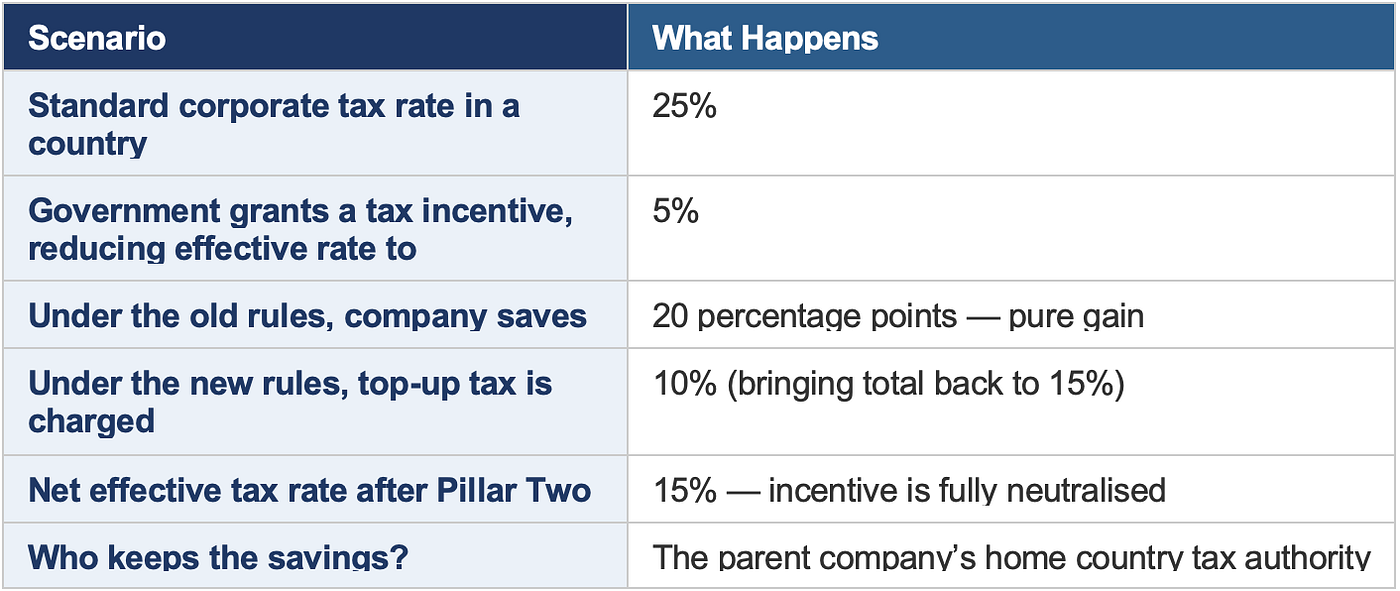
The host government tried to help the company. Instead, it ended up transferring its own revenue to another country’s treasury. This is why governments around the world are redesigning their incentive systems — and why companies need to reassess their assumptions.
3. The January 2026 OECD Package: Four Key Changes
On 5 January 2026, the OECD released what it calls the Side-by-Side Package — a set of updates and clarifications to the Global Minimum Tax rules. For companies, there are four developments that matter.
3.1 A Simpler Compliance Test for Low-Risk Countries
In many countries, a company’s effective tax rate is well above 15% already. In those cases, going through the full Global Minimum Tax calculation every year is expensive and time-consuming for no real purpose.
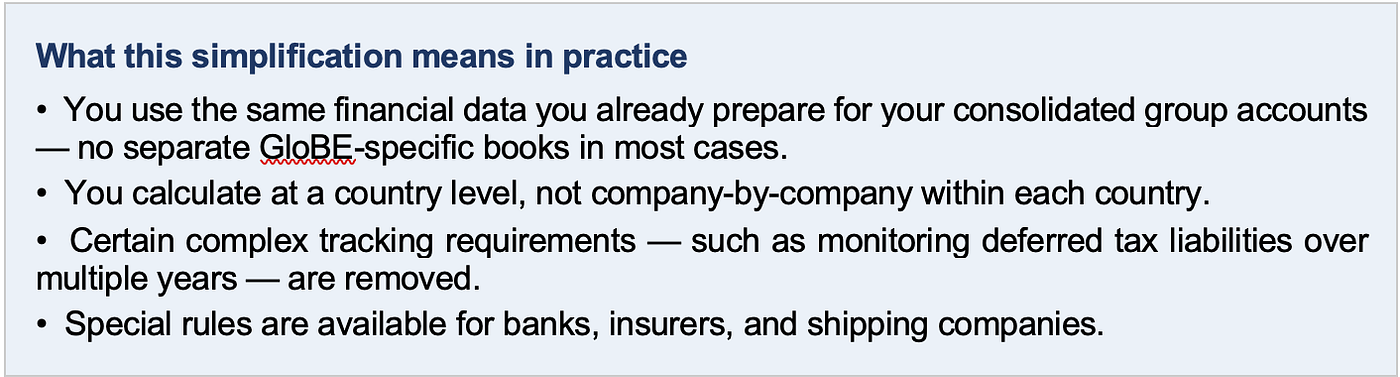
The new Simplified ETR Safe Harbour addresses this. If your effective tax rate in a country is clearly above 15%, you can use a much shorter calculation based on your existing financial accounts. You do not need to run the full, detailed GloBE computation. This applies from January 2027, with an earlier start available in some cases.
3.2 The Transitional Rules Are Extended
A temporary set of rules introduced in 2022 — called the Transitional CbCR Safe Harbour — has been extended by one more year. It now covers fiscal years up to and including those beginning before 1 January 2028. The applicable test rate is 17% for both 2026 and 2027.
This extension gives companies more time to prepare their systems for the permanent Simplified ETR Safe Harbour that takes over from 2027.
3.3 Protected Incentives: The SBTI Safe Harbour
This is the most important development for companies that invest in physical operations. The OECD has created a formal safe harbour — the Substance-Based Tax Incentive Safe Harbour — to protect certain incentives from being neutralised by the top-up tax.
The underlying logic is this: the Global Minimum Tax was designed to stop companies from shifting paper profits to low-tax countries. It was not designed to penalise companies for investing in factories, hiring workers, or manufacturing goods. The SBTI Safe Harbour recognises that distinction.
Under this safe harbour, qualifying incentives are treated as though the company actually paid the tax, preventing the ETR from falling below 15% in the calculation. The company keeps the financial benefit of the incentive.
3.4 A Parallel Track for Countries with Their Own Minimum Tax Systems
Some countries — the United States being the most significant — already have their own minimum taxation systems that did not follow the OECD model directly. The Side-by-Side System creates a parallel track for multinational groups headquartered in those countries, recognising their domestic regimes rather than forcing a full double-compliance burden. The OECD will assess which countries qualify by mid-2026.
4. Which Incentives Are Protected — and Which Are Not
The SBTI Safe Harbour only covers incentives that meet a specific definition: a Qualified Tax Incentive (QTI). The classification is straightforward once you understand the principle.
Protected incentives are those calculated by reference to what a company actually does in a country — how much it spends on investment or how much it produces. Unprotected incentives are those calculated by reference to how much profit the company makes.
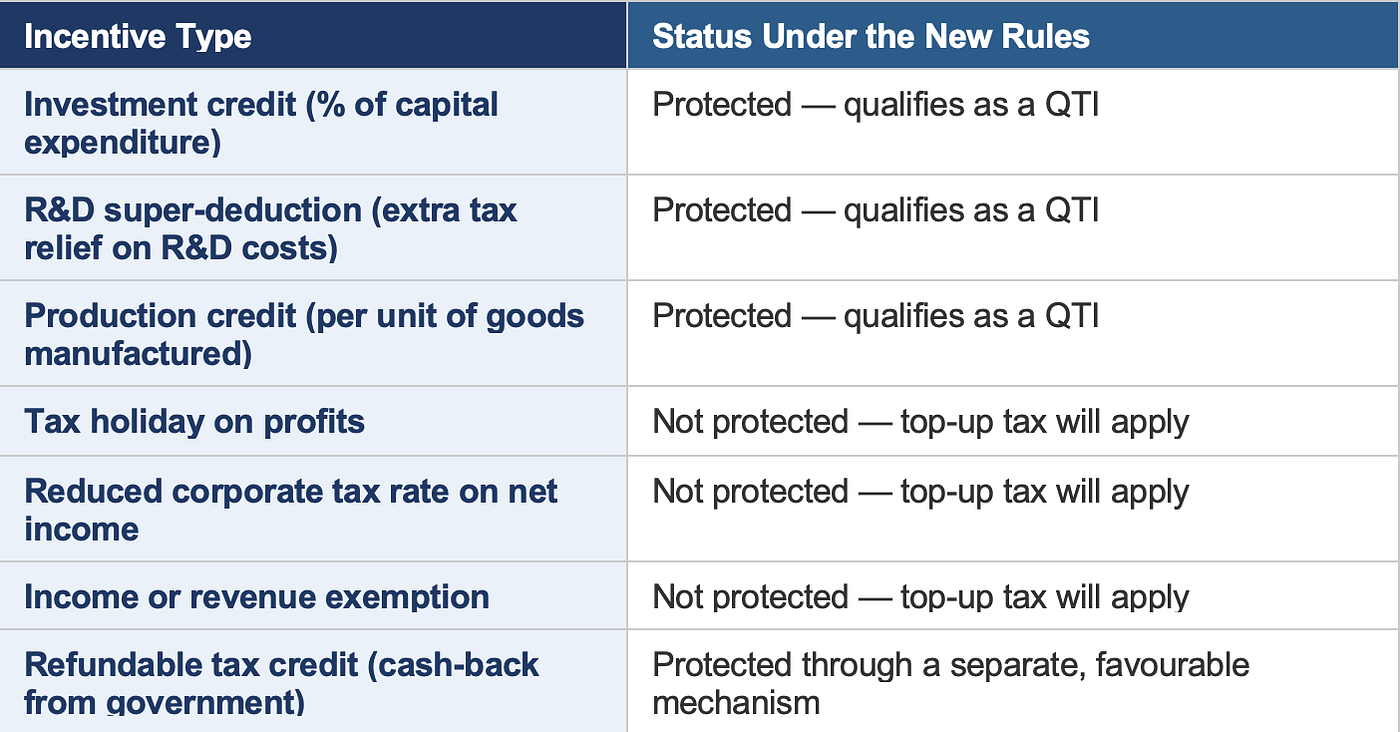
One important limit: an expenditure-based incentive only qualifies if the total tax saving it generates does not exceed the amount of expenditure it is based on. If the incentive is so generous that its value exceeds the underlying investment, the excess portion loses its protected status.
5. The Substance Cap: How Much Protection You Can Get
Even when an incentive qualifies, there is a ceiling on how much protection the company receives. This ceiling is called the Substance Cap, and it is calculated directly from the company’s physical presence in the country.
The logic is consistent: the bigger your real footprint — more employees, more machinery, more infrastructure — the larger your cap, and the more protection you can claim.
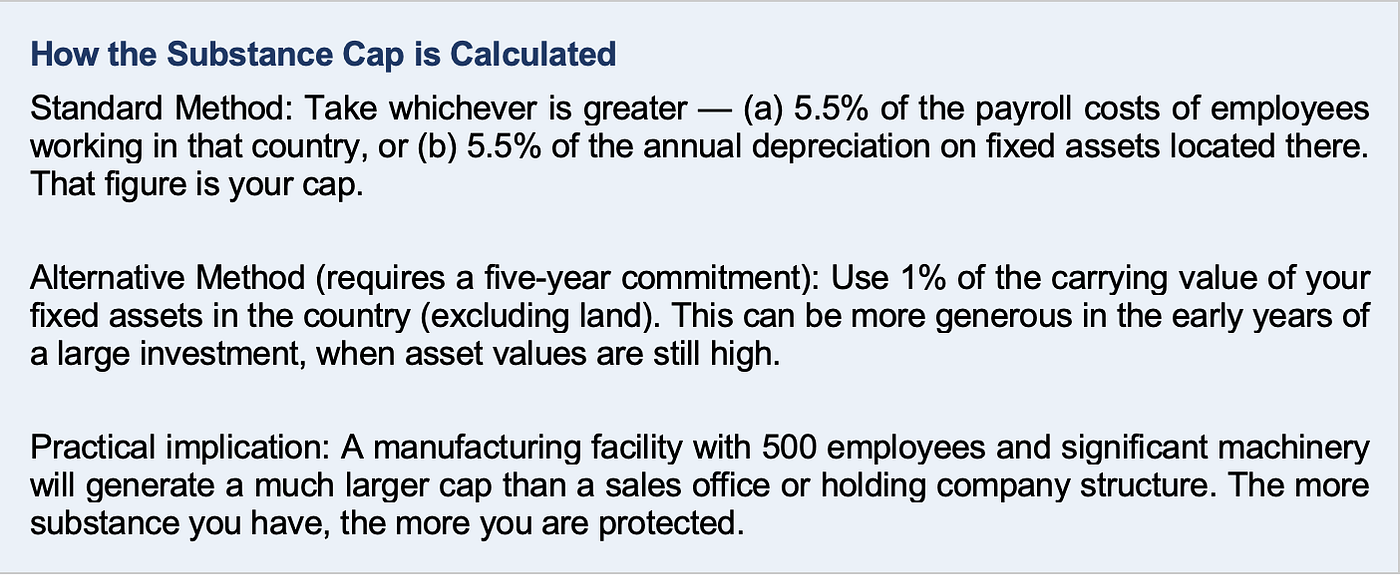
If you elect the alternative method and later switch back to the standard method, the assets previously covered cannot simply re-enter the standard calculation. This prevents companies from cherry-picking the most favourable method year by year.
6. Refundable Tax Credits: The Best Incentive Under the New Rules
Separate from the QTI framework, one category of incentive stands out as particularly well-suited to the Global Minimum Tax era: the Qualified Refundable Tax Credit, or QRTC.
A refundable tax credit is one where the government will pay the credit to the company in cash if the company’s tax bill is too small to absorb it. The government’s commitment to pay within four years is what makes it “refundable.”
Under the Global Minimum Tax rules, refundable credits are treated as income rather than as a reduction in taxes. This is a crucial distinction.
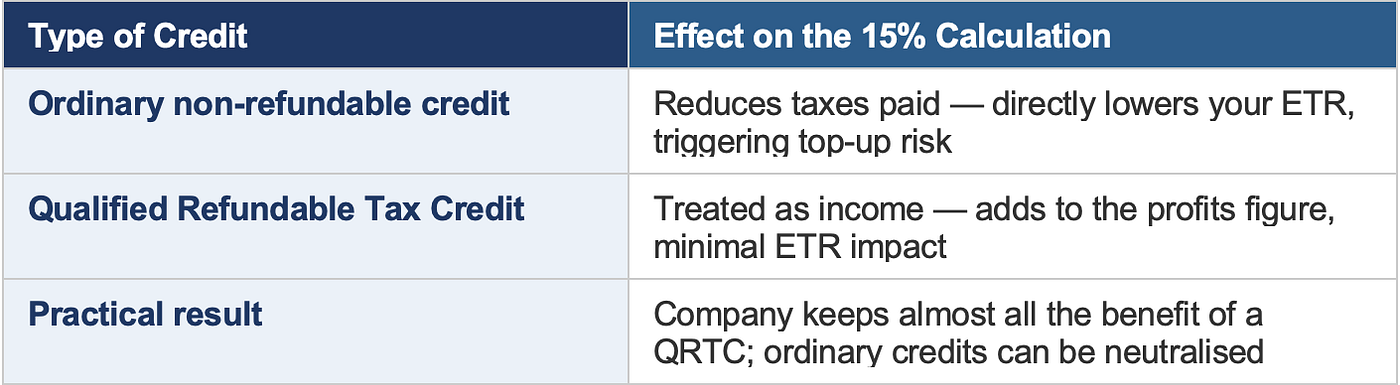
The strategic implication is clear: companies should actively seek to convert existing non-refundable credits into refundable form wherever possible. A government that is willing to restructure an existing incentive as a refundable credit is offering materially better value under the new rules.
7. Turkey’s Position: What the Local Rules Mean for You
Turkey enacted its Global Minimum Tax legislation in July 2024 as part of a broader corporate tax reform. The Turkish Revenue Administration has since issued detailed implementing regulations setting out how the rules operate domestically.
7.1 Turkey Keeps the Revenue
Turkey has implemented what is called a Qualified Domestic Minimum Top-Up Tax (QDMTT), known in Turkish as the Yerel Asgari Tamamlayıcı Vergi. This is an important design choice. It means that if a company operating in Turkey falls below the 15% threshold, the top-up tax is collected by the Turkish Revenue Administration — not by the tax authority of the parent company’s home country.
From a government revenue perspective, Turkey retains the tax that might otherwise flow abroad. From a company perspective, the result is the same: the total tax burden is brought up to 15%.
7.2 The REF Deduction (Turkey’s Substance Carve-Out)
Turkey’s implementing rules include a domestic substance-based carve-out, called the REF Kazanç İndirimi. It works similarly to the OECD’s Substance-Based Income Exclusion: a portion of income linked to physical assets and payroll is excluded from the minimum tax calculation.
During the transition period currently in effect, the rates are 10% for payroll costs and 8% for tangible assets, declining over time to 5% for each. This carve-out operates independently of any specific incentive regime — it applies automatically to all qualifying operations in Turkey.
7.3 Turkey’s Investment Incentives: A Direct Assessment
Turkey’s investment incentive system includes several tools, each of which needs to be assessed individually under the new rules.
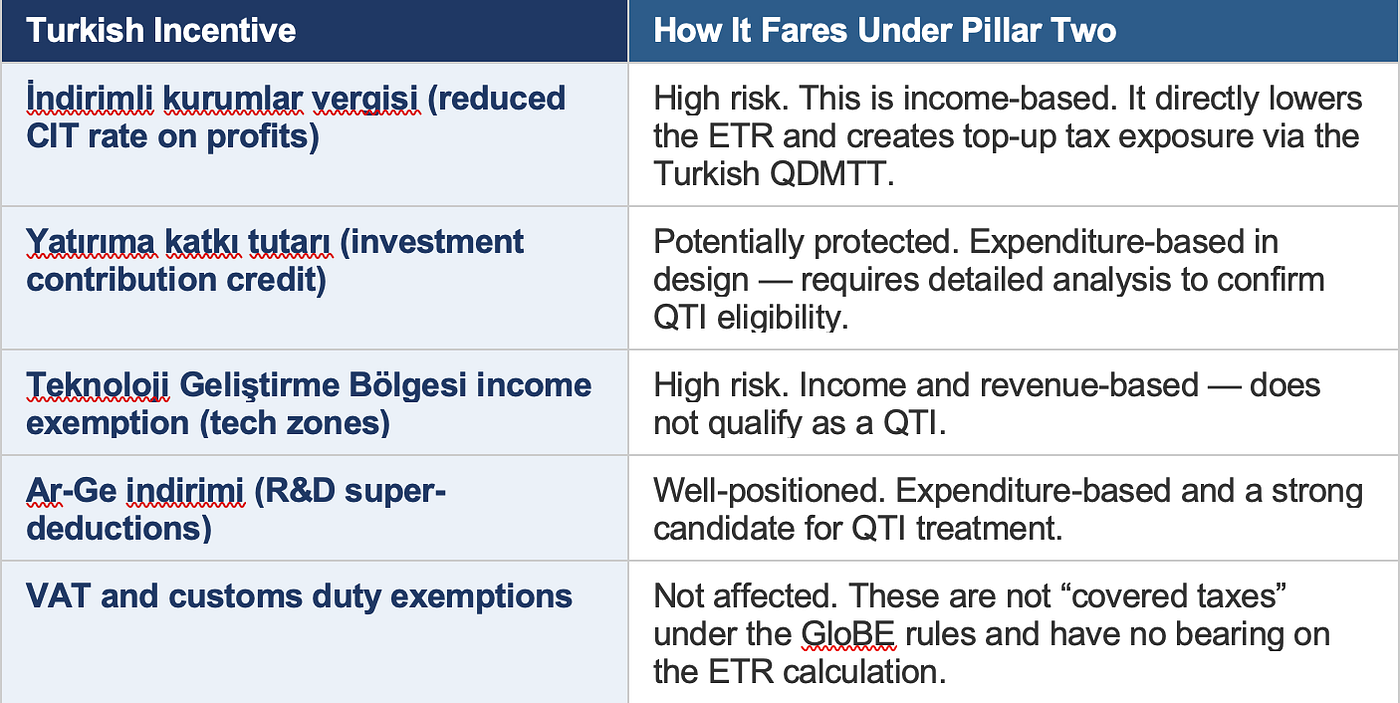
The indirimli kurumlar vergisi deserves particular attention. It is Turkey’s most widely used investment incentive, but it is also the one most directly exposed to the Global Minimum Tax. Companies relying heavily on this mechanism should model their ETR position under the Turkish QDMTT without delay.
8. Three Actions to Take Now
The rules are in force. The time for theoretical assessment has passed. The following three steps represent the most urgent priorities.
Step 1: Map and Classify Your Incentives
Produce a complete inventory of every tax incentive your organisation currently benefits from, in every country. For each one, answer a single question: is this incentive calculated by reference to what we spend or produce, or by reference to what we earn?
• Expenditure-based and production-based incentives: Assess whether they meet the QTI definition. Confirm that the total tax benefit does not exceed the qualifying expenditure. These are your protected incentives.
• Income-based and profit-based incentives: Quantify your top-up tax exposure. For Turkish operations, model the impact of the indirimli kurumlar vergisi on your consolidated ETR position and calculate the expected QDMTT liability.
• Credits with cash settlement: Confirm whether they meet the four-year payment test for QRTC treatment. If yes, ensure they are being correctly treated as income in your GloBE calculations.
Step 2: Change How You Negotiate with Governments
When approaching governments for support on future investments, the terms of the conversation need to change. Asking for a reduced profit tax rate or a tax holiday is largely ineffective for in-scope groups. The discussion should instead focus on:
• Converting existing non-refundable credits into refundable form, so they qualify as QRTCs.
• Structuring new incentive packages around capital investment and employment, so they meet the QTI definition and benefit from the SBTI Safe Harbour.
• For Turkey: engaging with the Ministry of Industry and Technology to explore whether investment incentive certificates can be rebalanced toward expenditure-based mechanisms.
Step 3: Know Your Substance Cap
Your finance team should calculate the Substance Cap for every jurisdiction where you receive qualified incentives. The inputs are straightforward: eligible payroll costs and the depreciation on fixed assets in that country.
This figure tells you the maximum amount of top-up tax protection you can claim. For a large manufacturing operation, the cap may comfortably cover all existing incentives. For lighter operations, it may fall short. Knowing the number now allows you to plan future investments in a way that maximises the available protection.
9. A Note on Compliance Costs
One practical benefit of the January 2026 package that is easy to overlook: for many jurisdictions, compliance costs are going down.
In countries where your effective tax rate is consistently well above 15% — most major OECD economies — you will likely qualify permanently for the Simplified ETR Safe Harbour. That means no full GloBE computation, no multi-year tracking of deferred tax items, and no entity-by-entity income allocation. For a group with operations in 30 or 40 countries, the cumulative saving in time and professional fees is meaningful.
The sensible approach is to identify, country by country, which jurisdictions will qualify for the simplified test on a permanent or near-permanent basis. For those, compliance infrastructure can be scaled back significantly.
Conclusion
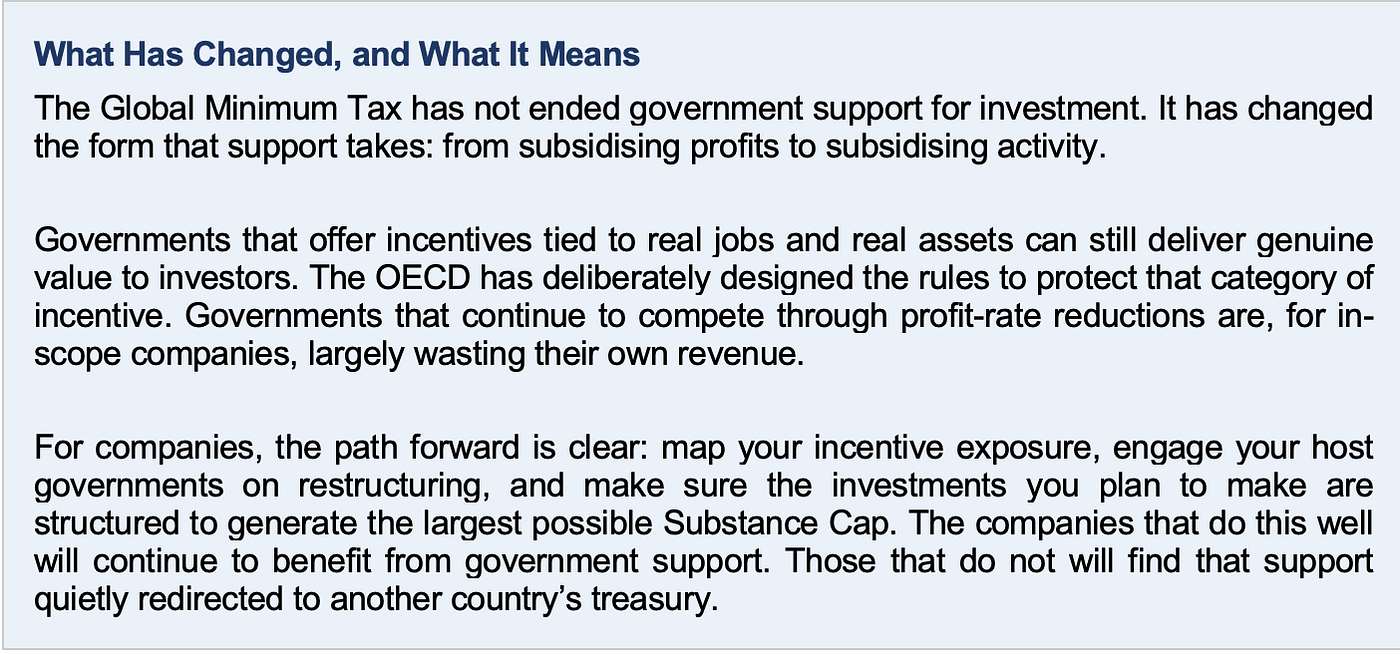
These rules are not temporary. The Pillar Two framework is now law in over 40 countries, and the January 2026 OECD package reflects a consolidation and maturation of that framework, not a weakening of it. Planning should proceed on the assumption that the 15% floor is permanent.
References
OECD (2026), Global Anti-Base Erosion Model Rules (Pillar Two), Side-by-Side Package: Inclusive Framework on BEPS, January 2026.
Turkish Revenue Administration (2024–2025), Implementing Communiqués on the Global Minimum Tax (Yerel ve Küresel Asgari Tamamlayıcı KVUGT).
OECD GloBE Model Rules (2021) and Commentary (2022), as updated through 2025 Administrative Guidance.

메타데이터
- post_id
- 34f7ccfa4e53
- slug
- tax-incentives-what-business-leaders-must-know-34f7ccfa4e53
- url
- https://medium.com/@gressibenveniste/tax-incentives-what-business-leaders-must-know-34f7ccfa4e53
- canonical_url
- https://medium.com/@gressibenveniste/tax-incentives-what-business-leaders-must-know-34f7ccfa4e53
- author_url
- https://medium.com/@gressibenveniste
- status
- ok
- fetched_at
- 2026-07-13 06:23:13