your vote can be gambled.
The 2026 Midterm elections are coming up, and there isn’t a single candidate not on edge worrying about the election. Right now, the GOP…
your vote can be gambled.
The 2026 Midterm elections are coming up, and there isn’t a single candidate not on edge worrying about the election. Right now, the GOP has a majority in the House and Senate — but in 2026, the Democrats are looking to change that. Each candidate leads their constituents to believe they have something to gain by electing them. Citizens are torn. Social Media platforms are being weaponized. Inevitably, voters decide who they vote for based on what they can gain personally.
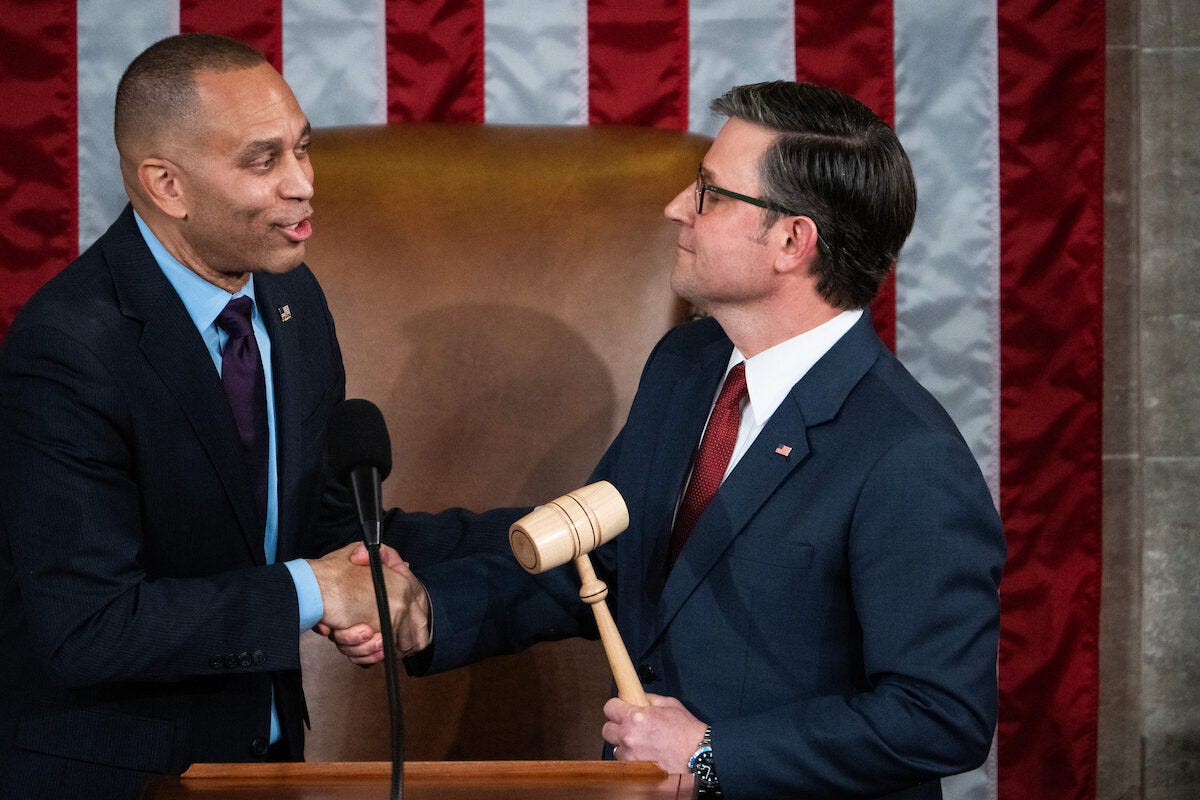
House Speaker Mike Johnson (R-LA-04) and House Democratic Leader Hakeem Jeffries (D-NY-08) shaking hands.
But it’s not just Democrats/Republicans and their constituents who have something to gain.
Sports betting, as the name implies, was something that was only limited to sports. You could put money on your favorite team or player — if your team was going against a team they haven’t lost to, you wouldn’t make that much money betting them to win. But if you predict a major upset, you win big if it happens.
Same principle for these prediction markets.
Prediction markets are essentially Stock Markets for real life. Instead of buying shares in a specific company, you’re buying a prediction tied to real life outcomes. You’re buying a contract that pays out if you’re right, and pays $0 if you’re wrong. Nowadays, the media quotes companies like Kalshi and Polymarket for probabilities of events happening.
This is not without reason.
Unlike a poll where people just share their opinion for free, prediction markets make people put money where their mouth is. Since participants are actually paying for an “opinion”, it makes it significantly more calculated and rational. In a poll, you can say whatever you want and not face a single consequence. Not the same for a prediction market — the minute you bet money, you care way more about the truth.
This psychology makes these traders focus way more on calculations, because if they don’t calculate correctly, they lose money. As a whole, their collective opinion is more calculated and reliable than responses you’d get from a typical survey.
These markets are facing significant pushback. Individuals believe that at its core, the practice of putting money in a prediction market is gambling.
They’re not entirely wrong.

Polymarket and Kalshi: The two major platforms at the center of the prediction market explosion.”
Companies like Kalshi register as a Designated Contract Market (DCMs) under federal law. They argue that they’re offering a legit way for individuals to “hedge” a risk for uncertain events. Because they are federally regulated, they say states should not be allowed to ban them. However, states like New York and New Jersey believe these platforms are unregulated gambling, which historically has been a state level issue. They say that these prediction markets can incentivize misinformation, which is a pillar to undermining our very democracy.
In April 2026, a federal appeals court (3rd Circuit) ruled in favor of Kalshi. Kalshi was to be governed under federal law, which should override state gambling restrictions. This decision didn’t go without consequence, however. On July 8th, a federal judge in New York ruled that the State does have the power to enforce its own gambling laws against these Prediction Markets. Honestly, it’s starting to feel like different parts of the country have different rules.
Why does this all matter?
Refer back to when I talked about how certain people believe that Prediction Markets are bad for democracy. Let’s expand on that.
With these Prediction Markets, you can bet on an election. Which means, an election turns into a “share” that you can buy or sell. Voting is universally recognized as a civic duty in a democracy — the whole prediction market encourages citizens to look for “profit” in the political world instead of solutions that can genuinely bring change to their everyday life.
If I bet $10 million that a candidate will lose, I inevitably have something to gain by spreading misinformation about the opposing candidate. Misinformation, in the age of social media, has become very easy to spread. Coupled with a large capital, people could be delivered massive amounts of misinformation very quickly. This is undeniably a huge threat to our democracy. Prediction markets can become generators of propaganda.
The presence of these unregulated prediction markets really boil down to a single question about our democracy. Do we want our concrete, stable, age-old democracy to be in a voting booth in which equality for each vote is guaranteed, or do we want democracy to be in the hands of the trading booth, where the people with the most capital have the most influence over us?
I feel the answer is obvious to the patriotic citizen.

Picture I took of the July 4th fireworks.
메타데이터
- post_id
- 34ff93d0b0e7
- slug
- everything-is-for-sale-how-political-betting-is-gamifying-democracy-34ff93d0b0e7
- url
- https://medium.com/@adityanerkar746/everything-is-for-sale-how-political-betting-is-gamifying-democracy-34ff93d0b0e7
- canonical_url
- https://medium.com/@adityanerkar746/everything-is-for-sale-how-political-betting-is-gamifying-democracy-34ff93d0b0e7
- author_url
- https://medium.com/@adityanerkar746
- status
- ok
- fetched_at
- 2026-07-10 16:46:54