Sacred Waters Across Time

Inside the Thirunavayya Navamukunda Temple, photo by Jamstechs, CC BY-SA 4.0, https://commons.wikimedia.org/w/index.php?curid=66234045
Sacred Waters Across Time
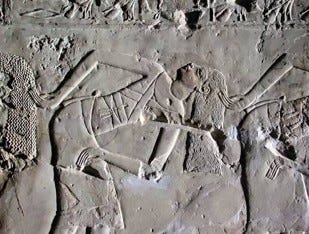
In the tomb of Tutankhamun (ca. 1332–1323 BCE), a wall mural depicts a woman ready to pour water on the young pharaoh’s feet. A similar mural in his successor pharaoh Ay’s tomb also shows the same ritual, suggesting that this was a formal ritual rather than an isolated artistic motif. In both depictions, the woman bears the hieroglyph 𓈖 n on her hands, denoting the word nnw meaning “water” in ancient Egyptian.¹

The tomb of Tutankhamun, photo by ولاء, Public Domain, https://commons.wikimedia.org/w/index.php?curid=175875912

The tomb of Ay, photo by Fabio Achilli, CC BY 2.0, https://commons.wikimedia.org/w/index.php?curid=170091535
Sprinkling or pouring water on the feet of a venerated individual is a tradition not unique to ancient Egypt. Remarkably, it continues to be practiced even today in India as a gesture of reverence and ritual purification. What is especially striking is that only in South Indian languages does the verb describing this “wetting” closely resemble the ancient Egyptian term. Malayalam നന nana and Tamil நனை nanai, both meaning “to become wet,” are linguistically akin to nnw, a similarity that warrants closer attention.²
The Egyptian word nnw stems from the root 𓏌𓏌𓏌𓇯𓈗 nw meaning “water” generally, and more particularly, “ocean,” attested as early as 1939 BCE in Egypt.³ This word is very similar to Sanskrit नाविक naavika meaning “boat,” “sailor,” and even more so to Malayalam നാവായി naavayi meaning “ship.”⁴ Taken together, these parallels suggest a shared symbolic and linguistic complex between India and Egypt centered on water, navigation, and the sea.

Thirunavaya and surrounding region, from Google Maps
Indeed, this maritime connection is embodied in Kerala’s geography and ritual landscape, in the name of a town called തിരുനാവായ thirunaavaaya in Malappuram district, near the mouth of Kerala’s second-longest river, the erstwhile Peraar, now called Bharatapuzha.⁵ Intriguingly, when transposed into ancient Egyptian phonology, the name of this town can be rendered as 𓏏𓅨𓂋-𓈖𓍇𓏌𓅱𓇋𓇋𓈗 twr-nwy, meaning “sacred waters.”⁶ This interpretation resonates with local religious practice: the Navamukunda Temple on the riverbank lacks a traditional temple pond because the river itself is considered sufficiently pure for all ritual ablutions.⁷

Navamukunda Temple, photo by Ssriram mt, CC BY-SA 4.0, https://commons.wikimedia.org/w/index.php?curid=62056562
The Navamukunda Temple is dedicated to Vishnu, who in Hindu cosmology, rests upon cosmic waters, sustaining creation by divine equilibrium. According to temple lore, the idol worshiped here is the only survivor of a set of nine, the other eight having disappeared into the ocean. Another interesting belief is that of a bottomless unexplored pit behind the idol in the sanctum.⁸ This temple is especially revered for pitr tarpanam, in which various funerary offerings are made to departed ancestors.⁹ It is also the site of mamankam, an erstwhile festival held once every twelve years that featured ritual combat and martial displays.¹⁰

Miniature Hindu shrine with the deity Vishnu sleeping on the cosmic ocean, Asian Art Museum of San Francisco, photo by Marshall Astor, CC BY-SA 2.0, https://commons.wikimedia.org/w/index.php?curid=15785364
These themes of water, creation, dissolution, ancestral rites, and ritual combat find close parallels in the figure of the ancient Egyptian god 𓏌𓏌𓏌𓇯𓈗 Nww.¹¹ Nww personified the primordial watery abyss from which the cosmos emerged. Interestingly, in artwork created for the Book of the Dead, ca. 1050 BCE, he is shown holding up a bark with eight deities, evocative of the eight idols that disappeared under the ocean in the Navamukunda tradition.¹²

Nww holding up the solar bark with eight deities, by Original author unknown — Scanned from The Complete Gods and Goddesses of Ancient Egypt by Richard H. Wilkinson, p. 117; artwork from the Book of the Dead of Anhai, Public Domain, https://commons.wikimedia.org/w/index.php?curid=17699180
At the Osireion, constructed by pharaoh Seti I (ca. 1290–1279 BCE) at Abydos in Egypt, Nww was represented by a subterranean water chamber associated with the realm of the dead, remarkably reminiscent of the bottomless unexplored pit behind the Navamukunda idol and the ancestral rites performed at the temple.¹³ During the Late Period (ca. 664 BCE-332 BCE) in Egypt, Nww came to be associated more with chaos than creation, a duality that recalls the violent ritual of the mamankam festival.¹⁴

Ruins of the Oseirion at Abydos, photo by Olaf Tausch, CC BY 3.0, https://commons.wikimedia.org/w/index.php?curid=14690552
The Thirunavaya Navamukunda Temple, a beautiful example of Kerala’s distinctive temple architecture, continues to occupy a central place in the religious life of the region. Like several other temples in Kerala, it appears to preserve echoes of ancient Egyptian religious ideas, possibly transmitted through long-distance trade networks, or perhaps through deeper currents of human migration. That this site may embody a religious lineage stretching back thousands of years, interweaving some of humanity’s oldest reflections on water, creation, death, and renewal, is indeed striking.
Notes
[1] https://app.vega-lexique.fr/?entries=w3508
[2] https://dsal.uchicago.edu/cgi-bin/app/gundert_query.py?page=530; https://dsal.uchicago.edu/cgi-bin/app/burrow_query.py?page=320
[3] https://thesaurus-linguae-aegyptiae.de/lemma/84930
[4] https://www.learnsanskrit.cc/translate?search=navika&dir=se; https://dsal.uchicago.edu/cgi-bin/app/gundert_query.py?page=546
[5] https://en.wikipedia.org/wiki/Bharathappuzha
[6] https://thesaurus-linguae-aegyptiae.de/lemma/81240; https://thesaurus-linguae-aegyptiae.de/lemma/856122
[7] https://en.wikipedia.org/wiki/Thirunavaya_Navamukunda_Temple
[8] See note, supra.
[9] https://www.malappuramonline.in/guide/thirunavaya-temple-in-malappuram
[10] https://en.wikipedia.org/wiki/Mamankam
[11] https://en.wikipedia.org/wiki/Nun_(mythology). He is popularly known as Nun.
[12] Nww is also part of the Ogdoad, a set of eight primordial deities worshiped in ancient Egypt, who represented chaos before the creation of the universe.
[13] https://en.wikipedia.org/wiki/Osireion; https://www.memphis.edu/egypt/resources/colortour/abydos.php
[14] mamankam — maha ankam “great fight”, likely from 𓏠𓈖𓂝 “fighting sport” https://app.vega-lexique.fr/?entries=w3195
메타데이터
- post_id
- 34ffaed1b52f
- slug
- sacred-waters-across-time-34ffaed1b52f
- url
- https://medium.com/@variyam-2021/sacred-waters-across-time-34ffaed1b52f
- canonical_url
- https://medium.com/@variyam-2021/sacred-waters-across-time-34ffaed1b52f
- author_url
- https://medium.com/@variyam-2021
- status
- ok
- fetched_at
- 2026-06-09 15:37:30