The Troubling Moral Hierarchy Beneath ‘The Minpins’ by Roald Dahl
A story of childhood wonder that promotes exploiting vulnerability.
The Troubling Moral Hierarchy Beneath ‘The Minpins’ by Roald Dahl
A story of childhood wonder that promotes exploiting vulnerability.
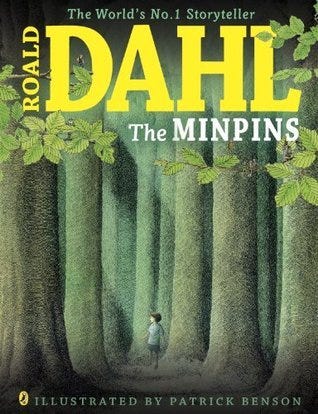
The Minpins authored by Roald Dahl and illustrated by Patrick Benson. First published in 1991, United Kingdom.
Dahl immediately connects to the blithe curiosity of children:
“All the things he was allowed to do were boring. All the things he was not allowed to do were interesting.”
Little Billy’s disregard for his mother’s warning about the “Forest of Sin” is spurred on by “the Devil” whispering in his ears — Dahl’s peculiar personification of childhood curiosity emerging from boredom.
His mother’s warning is revealed to be true; a hulking murderous monster stalks Billy through the imposing forest. Dahl builds tension and panic as the child’s adventure becomes a struggle for survival.
“…the Thing, the Beast, the Monster, or whatever it was, was hidden from his sight by the smoke it shot out as it galloped forward.”
Escaping up a seemingly endless tree, Billy finds a hidden society of human-like creatures the size of ladybugs, and unknown to the rest of humanity — the Minpins.
“On his feet he was wearing tiny green boots rather like miniature wellies. His clothes were curiously old fashioned, mostly brown and black, the sort of thing people wore two or three hundred years ago.”
Inhabiting the trees, the Minpins are described as a self-sufficient society, living alongside birds. The Minpin describes these birds as their friends, yet the friendship described is at best transactional, and even cruel.
“The birds are our friends. We use them all the time…” “We can summon them any time we want…” “They’ll do anything for us. [because] We store food for them inside the trees so they don’t starve when the icy-cold winter comes along.”
This raises the question of why the birds’ winter survival must depend on their being “used” at “any time” for “anything”. What of the birds’ autonomy when their survival is contingent upon servitude to the Minpins? Of course the reality of wild animals’ lives is that brutal on average, but the Minpins are distinguished by Dahl as industrious beings. Beings with capacity for understanding the needs of others, like us. Can we admire those who manufacture famine as punishment for refusing bondage?
In planning an escape from the ravenous beast still in wait, the once frightened child suddenly adopts “a new authority in his voice”, and demands a bird for himself in order to lead the beast to its death. Having just entered a world new to him, he proposes a solution to a generations-old problem. A Minpin, and Swan summoned to be his steed readily accept, nervous only for Billy’s safety during the flight.
The pair are successful in extinguishing the fiery beast and upon their return, it is Billy alone who receives a hero’s accolade. Here, Dahl reinforces the primacy of the individual hero above the collective effort; where other beings are a tool or backdrop for the triumph of one’s own. As a final insult, for Swan’s bravery and comradery, the self-proclaimed friend gifts Swan to Billy to use as a “personal private aeroplane”.
“Another time, Swan flew through the night for what seemed like hours and hours…”
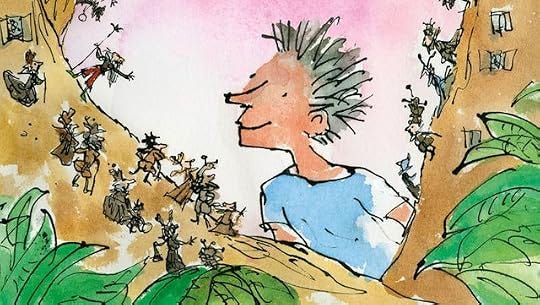
Illustration: Little Billy and the Minpins by Quentin Blake
Summary
The birds are described as friends and simultaneously as tools; their survival bound to serving the Minpins. The Minpins themselves are subordinated by Billy’s authority; centring his choices and heroism. Swan’s loyalty and bravery are absorbed into Billy’s triumph; Swan’s efforts repaid by being transferred as an object of ownership.
Through these choices, Dahl frames exploitative relationships as natural and rewarding. He reinforces, to his youth audience, a view in which the value of another’s life is measured by its usefulness to oneself; where virtue is found not in coexistence, but in the domination of beings more vulnerable.
Author context
Roald Dahl (1916–1990) was a British-born author of Norwegian immigrants. Dahl served as a Royal Air Force (RAF) pilot during WWII and later become a prominent children’s author. His works continue to have a formative influence on youth readers across the Anglosphere.
Originally written for Walt Disney Productions, he published his first children’s book in 1943. He has also published short stories for adults; known for their dark and taboo content involving cruelty, sexuality, and child abuse.
Following his literary success and fame, in 1983 he was awarded Commander of the Order of the British Empire.
메타데이터
- post_id
- 3513d2cdf807
- slug
- the-troubling-moral-hierarchy-beneath-the-minpins-by-roald-dahl-3513d2cdf807
- url
- https://medium.com/@literaryatlas/the-troubling-moral-hierarchy-beneath-the-minpins-by-roald-dahl-3513d2cdf807
- canonical_url
- https://medium.com/@literaryatlas/the-troubling-moral-hierarchy-beneath-the-minpins-by-roald-dahl-3513d2cdf807
- author_url
- https://medium.com/@literaryatlas
- status
- ok
- fetched_at
- 2026-07-31 06:51:58