Le Cercle Rouge: The Circle Has Already Been Drawn
How Melville turns a French heist movie into a discussion of fate, masculinity, and human freedom.
Le Cercle Rouge: The Circle Has Already Been Drawn
How Melville turns a French heist movie into a discussion of fate, masculinity, and human freedom.
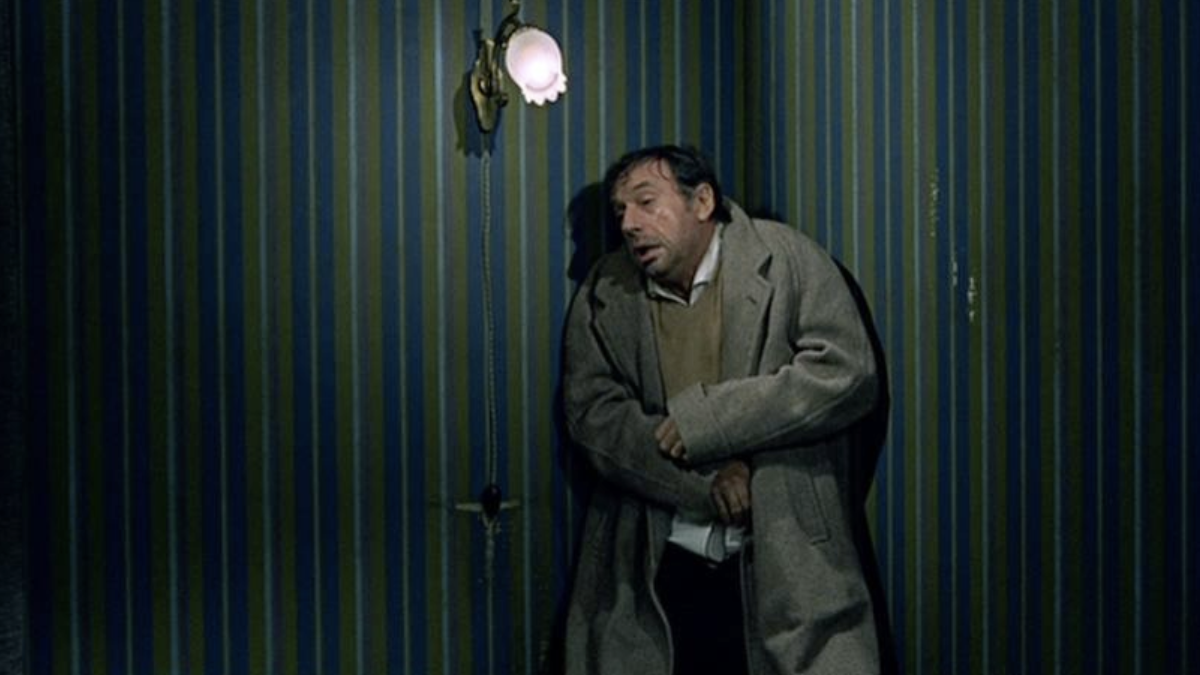
Image: Le Cercle Rouge (1970), Les Films Corona / Selenia Cinematografica.
It’s hard to overstate how Le Cercle Rouge (Melville, 1970) exceeds the usual gangster movie. On one level it’s a classic heist flick, chalked cue balls, slick suits, a lengthy silent jewelry store robbery, but underneath it all it’s really a meditation on fate, discipline, and the lonely codes that men live by (Fujiwara, 2011; Nixon, 2017). But Melville made a philosophical crime film. The movie opens with a pseudo-Buddhist epigraph about destiny, and then proceeds to test it.
Importantly, the epigraph is generally understood to be Melville’s invention rather than an authentic Buddhist quotation (Scott, 2008).
Are Corey, Vogel, and Jansen free agents who choose to rob a jewelry shop, or were they always going to collide in this way? The film invites exactly that question, with its protagonists’ divergent paths gradually converging through chance, circumstance, and their own decisions (Fujiwara, 2011). It’s like a French noir remix of existentialism: our protagonists act according to their own codes and skills, but the results feel eerily predestined.
“When men are meant to meet again, even if they don’t know it, anything may happen to each of them… inevitably they will meet again in the red circle.”
Melville himself invented this “Buddhist” aphorism, so he’s playing at philosophy, but that doesn’t mean it’s fluff. The “red circle” is a metaphor for karma and mortality. As one critic puts it, “The men in this film make their own fates. True, the red circle denotes their shared bloody destiny. But it also conjures a bullet through the heart” (Sragow, 2011, para. 4). In other words, fate in Le Cercle Rouge feels like a trapdoor or a gunshot, not a comforting cycle.
We, the audience, see every tight shot of trigger pulls and safe combinations, and the unease builds until it seems almost absurd that this calm professionalism could end any way but badly.
This ties into the existential threads running through the film. Melville doesn’t hand out easy moral judgments. The characters live by a code, but the world around them is indifferent. You could say the film is about men trying to find meaning in a meaningless universe.
Sartre (2007) argued that “existence precedes essence,” meaning that a predetermined essence does not define human beings but continually create themselves through their choices and actions.
In Le Cercle Rouge, Corey and his crew repeatedly choose to act, to make the heist happen, and yet their choices always feel overridden by fate. Even Captain Mattei, the good cop, embodies this conflict. After finally cornering the thieves, he shrugs and mutters the film’s bleak refrain: they’re all guilty; “they’re born innocent, but it doesn’t last” (Sragow, 2011). It’s the opposite of cosmic justice: the detective ends up playing judge, jury, and executioner, blurring the line between right and wrong. In the end, Melville seems to ask (in the words of John Huston’s Captain Ahab):
“Where do murderers go, man? Who’s to doom, when the judge himself is dragged to the bar?” (Sragow, 2011).
Alongside the existential questions, there’s the whole “Buddhist circle” motif. Melville literally starts with a Buddha statue and a chalk circle and never lets go of that image. Buddha here is almost mocking: he’s laughing, as Vincendeau (2003) notes, “the contrast between the laughing figure… and the morbid text is chilling,” while we read about inexorable doom. Later, Corey himself draws a red circle on a billiard cue, a wink to that idea.
But don’t mistake this for a sincere Eastern philosophy. The circle here is the impossible trap of destiny. Every step the characters take, the roads they drive, the men they shoot, just tightens the circle. Even the film’s color scheme and composition enforce a kind of karmic symmetry. Nothing is arbitrary. It’s as if the movie is saying: you think you’re free, but you’re dancing inside the circle we’ve drawn for you.
For all its talk of fate, Le Cercle Rouge is also absolutely masculine to its core. It’s a story almost entirely about men, by men, for men (or at least about our idea of men). Women barely exist here, and when they do, they’re on the periphery (Fujiwara, 2011). What matters are the codes these guys live by: professionalism, honor (among thieves), and self-discipline (Nixon, 2017). Each man is defined by his routine and tools: the way Corey polishes his guns, the custom bullets Jansen designs, Vogel’s ritualistic killing impulses. They’re craftsmen of crime. According to Nixon:
“Their backgrounds remain as mysterious as their closely guarded emotions; we learn about them through their actions. Every move they make tells us something about who they are.”
Melville’s interest in masculinity isn’t political so much as anthropological: he studies these men like creatures, noting how they betray loyalty or kick vanishingly small hints of tenderness. The film can feel alien to the feminine universe, because Melville’s built a world where relationships are forged in silence and glances.
Here’s a great example of how the film’s focus on action over words plays out: early on, Corey confronts Rico (an underworld boss) about stealing his girlfriend. In any other movie, that might be a big shouting scene. Instead, Melville plays it cool. Corey reaches into Rico’s safe and pulls out two items: a gun and Rico’s cash. Then, without a word, he exchanges those for a photograph of his ex (that Rico had taken) and walks out. Just a poker-faced swap of objects (Healey, 2006).
Michael Sragow summed it up nicely: “It’s the mark of a man in Melville’s cinema to act on his own terms and only when he’s damn well ready” (Sragow, 2011, para. 5). In other words, these guys show who they are, they don’t talk about it. That’s a very old-school, macho style, think Hawks, think Earnhardt, that kind of straightforward bravado. Healey even quipped the movie is like “Hawks without the wisecracks (or the dames).”
This emphasis on visual storytelling ties into another lens: semiotics and structuralism. Instead of spelling out the heroes’ psyches, Melville piles up meaningful signs. The camera lingers on hats, coats, gloves, watches, the way Corey lights his cigarette, or the position of a chess piece. Even the location details matter: the dingy train car, the gleaming Place Vendôme by day, the dark hotel room.
For example, notice how Corey’s new car is a big, clunky American Cadillac, a sort of armor, while Mattei, the cop, drives no-nonsense French cars. Or how Jansen, the sharpshooter, meticulously polishes the guns and bullets for the heist.
The film assumes we understand what these objects mean: a polished gun says “professional,” a dangling cigarette says “nervous or unfazed,” a hallway lit in half-shadow says “we’re in someone’s shadowy moral world.” Vincendeau (2003) argues that Melville’s style depends heavily on framing, lighting, mise-en-scène, color, and the careful observation of gestures and objects. Every frame is like a piece of that language, the “structural” grammar of the movie.
The result is that Le Cercle Rouge feels almost phenomenological: it makes us live the experience. Melville always throws out the conventional narrative momentum. Instead of dialogue, we get real time. Think of the heist sequence: around twenty minutes of near-wordless tension. We hear every groan of metal, measured footstep. Time slows down to the characters’ clock. This is pure spectator-embodiment.
You could invoke philosopher Maurice Merleau-Ponty (2012) here: the film is about bodies moving through space, and we sense every inch and second with them; how he “uses music minimally” and fills scenes with ambient noise such as wind, rain, doors, radios, so you’re hyper-aware of the environment. After watching you feel there, adrenaline pulsing. As Sragow says of that part:
“One emerges from this film with senses primed” (Sragow, 2011, para. 2).
The famous Place Vendôme scene (the jewelry heist) is always compared to Rififi or The Asphalt Jungle: it’s so precise and long that it practically hypnotizes you. It’s all very concrete with clamp, drill, click, pause, breathe, etc.
Of course, this still wears the trappings of film noir like moody lighting, trench coats, bars and nightclubs, fatalism. But Melville’s noir is stripped to its bones. Everyone moves with purpose. There is only men in action. Melville’s camera sometimes holds the men head-on in a way that feels intimate. We literally look them in the eyes. In one pivotal scene, Corey and Vogel finally meet face-to-face and plan the heist. We see them from the front, framed in symmetry. That shot, so simple, says so much about equality of power and shared destiny.
Now, when you map these ideas onto the actual story, a richer picture emerges. The plot in broad strokes is simple: ex-con Corey hooks up with escaped killer Vogel, and together they recruit ex-cop Jansen to rob a jewelry store; the diligent inspector Mattei chases after them; in the end, literally everyone gets shot. On paper it’s a straight line of crime and punishment.
But with our lenses, it unfolds on deeper layers. We see existential irony in how these men want freedom but are bound by their natures. Corey has served time and now tries to walk a straight line, almost saying “I’m a professional, I deserve my payday,” yet he’s immediately dragged back into violence. Vogel is a loose cannon who insists he’s not a terrorist, yet his very unpredictability dooms them. And Jansen, sobering up and pouring himself into the job to feel like a man again, is on a desperate search for meaning in an empty routine.
Melville pays homage to America (like Moby-Dick) in how he frames it, but the soul of the film is surprisingly French. In fact, the American influence runs deeper than just the director’s adopted surname. Melville was obsessed with American crime cinema, especially John Huston’s The Asphalt Jungle (1950), which he regarded as a kind of master text for the cops-and-crooks genre. He later explained that he had wanted to make a heist film even before seeing The Asphalt Jungle, but the film nevertheless became an important reference point for his own work.
Le Cercle rouge also carries the unmistakable DNA of Jules Dassin’s Rififi (1955), particularly in its extended, nearly silent jewelry-store robbery.
Melville had actually been involved in the aborted attempt to make Rififi himself before Dassin directed it, making the relationship between the two films more complicated than simple imitation. The result is a strange hybrid: an American-style crime mythology filtered through French ideas about honor, fate, and masculine codes.
The script never preaches, and indeed, as Sragow puts it, “the film proves rigorously moral in its evaluation of five men” even as it seems amoral. When Rico skims Corey’s girlfriend and Santi’s loyalty is put under pressure, or when Mattei’s own boss sneers that “all men are guilty,” the movie isn’t endorsing corruption so much as showing us how every person here is caught by compromise.
This is where the film’s debt to Moby-Dick becomes especially interesting. Like Ahab and his crew, Corey, Vogel, and Jansen pursue a single objective with obsessive professionalism, and that pursuit becomes a test of character, hubris, and fallibility.
There is also a distinctly Cocteau-like element in the film’s underworld: Santi functions as a corrupted version of the intermediary figure Heurtebise from Orphée (1950), while the elegant masks worn during the robbery echo Cocteau’s fascination with the boundary between the living world and an underworld of shadows. Mattei’s gentle ruefulness suggests even the police are trapped by the same rules of honor. In Le Cercle rouge, cops and criminals may stand on opposite sides of the law, but Melville keeps asking whether they are really operating under different moral systems at all.
Melville’s style underlines every theme. He barely uses music. When he does, it’s for doom. Instead, we get Henri Decaë’s crystal-clear compositions: street and sky, sharp blacks and grays (Axmaker, 2003). Scenes always unfold in long, still shots. Corey’s arrival at prison in Marseille, for instance, is almost pure silence. It’s like the film itself is breathing in. And so are we (Lemaire, 2024).
Early on, Melville’s characters may appear objective and cool, but they’re anything but “unfeeling.” The contemplation becomes almost painful: Corey sits at a dining car table beside the handcuffed Vogel, offering coffee but barely speaking. Every glance has weight (Healey, 2006). The young Montand quietly assembling the gun in a kitchen, the detective slowly prepping his traps in the barn. These visual details are as much dialogue as any line could be.
Let’s talk about a couple of scenes concretely. One powerful sequence is that morning after Corey’s jail release, when he confronts Rico. We don’t see the fistfight the script might promise. Instead, Melville cuts around it. We hear muffled noises from the bedroom, flashes of a fist, and then, quiet again. When Corey re-emerges, he’s standing beside Rico’s terrified ex (Corey’s old flame), as bloodied men lie on the floor. No words are exchanged. Corey simply says, “You take care,” implying he’s burned that bridge.
Then: the pool hall. Corey, dark shirt and his trademark hat, casually walks in, buys an American car, tips the bartender, and leaves. Every gesture is controlled (Gonzalez, 2006). It’s a minor scene, but it sets the tone: Le Cercle Rouge is made of these small, meaningful acts, not big monologues.
Contrast that with the climax in Mattei’s farmhouse. After the flashy heist, tension turns into pure shock. Melville breaks all his long takes into staccato movement. The soundtrack, which had been silences and ambient noise, slams to foreboding percussion. Mattei has tricked Corey and Jansen with a fake fence. Vogel arrives with the truck full of loot. Mattei, hat in hand, stands there calmly. Then it’s over in a heartbeat. There are bangs, men fall, Mattei staggers.
Suddenly, the helicopter above (another choice of sound, the very symbol of state power) starts shining its light. Mattei looks up, anguished, and you see it on his face: horror and remorse (Woo, 2011). Melville also compared this to Bertolucci’s sudden killings in The Conformist (1970), equally brutal and anti-climactic.
After it’s over, the cops pile out of their vehicles. The last shot lingers on Mattei, sweating and broken, removing jewels from a tray. Over this, the movie says “All guilty”. A chapter of the story book closes, but the final card (the Internal Affairs chief) flips up. He repeats, with weary certainty:
“They’re born innocent, but it doesn’t last.”
Then that chilling line, drawn from Melville’s Moby-Dick, “All right, Messieurs les Juges, where do murderers go?” It’s as if the movie throws the question right at the audience: no matter what side these men were on, who really has the moral high ground in this story?
“All men are guilty… We all change — for the worse.”
This quote might be the truest line in the movie. By then, we’ve seen everyone “change — for the worse.” The once-honest cop has turned cold, the ex-con has wrestled with loyalty and failure, and the killer is drunk on blood. Style, professionalism, even brotherhood couldn’t keep that darkness hidden. Le Cercle Rouge leaves you right there in the storm, unsettled.
Writing about Le Cercle Rouge is like aiming at a moving target with a single bullet; the film itself defies easy labels. But the lenses give us useful tools. Melville’s gangsters are symbols. And through them, he asks us, over and over, to gaze into the abyss of freedom and responsibility. The job itself is almost secondary; what it really grabs hold of is how these men cope with, or fail under, the weight of their fates.
It’s a kind of blasphemy, a great one, in that it won’t let us off the hook. Just life in all its noise and silence, forcing us to ask: when the judge and criminal are both human, who’s truly innocent?
Bibliography
- Axmaker, S. (2003, June 19). Restored Cercle Rouge is an austere beauty. Seattle Post-Intelligencer.
- Bertolucci, B. (Director). (1970). The conformist [Film]. Mars Film Produzione; Marianne Productions; Maran Film.
- Cocteau, J. (Director). (1950). Orphée [Film]. André Paulvé Films.
- Dassin, J. (Director). (1955). Du rififi chez les hommes [Film]. Pathé Consortium Cinéma.
- Fujiwara, C. (2011). Le cercle rouge: What is the red circle? The Criterion Collection.
- Gonzalez, P. B. (2006). Jean-Pierre Melville: Encounters with conscience. Senses of Cinema, (40).
- Healey, M. (2006). Le cercle rouge. Senses of Cinema, (39).
- Huston, J. (Director). (1950). The asphalt jungle [Film]. Metro-Goldwyn-Mayer.
- Lemaire, S. (Ed.). (2024). Silence(s) dans le cinéma contemporain. Presses universitaires du Septentrion.
- Melville, H. (1851). Moby-Dick; or, The whale. Harper & Brothers.
- Melville, J.-P. (2011). Melville on Le cercle rouge. The Criterion Collection. (Original interview published 1970).
- Melville, J.-P. (Director). (1970). Le cercle rouge [Film]. Les Films Corona.
- Merleau-Ponty, M. (2012). Phenomenology of perception (D. A. Landes, Trans.). Routledge. (Original work published 1945).
- Nixon, R. (2017). Le cercle rouge. Turner Classic Movies.
- Sartre, J.-P. (2007). Existentialism is a humanism (C. Macomber, Trans.; A. Cohen-Solal, Intro.). Yale University Press.
- Scott, J. M. (2008). “When men, even unknowingly, …”: Quién sabe?, Love is colder than death, Le cercle rouge: The buddy movie becomes romance. Senses of Cinema.
- Sragow, M. (2011). Le cercle rouge: Great blasphemies. The Criterion Collection.
- Vincendeau, G. (2003). Jean-Pierre Melville: An American in Paris. British Film Institute.
- Woo, J. (2011). Honor, loyalty, and friendship: John Woo on Le cercle rouge. The Criterion Collection.
메타데이터
- post_id
- 352d2f47d0e7
- slug
- le-cercle-rouge-the-circle-has-already-been-drawn-352d2f47d0e7
- url
- https://medium.com/@salmanalfarisi590/le-cercle-rouge-the-circle-has-already-been-drawn-352d2f47d0e7
- canonical_url
- https://medium.com/@salmanalfarisi590/le-cercle-rouge-the-circle-has-already-been-drawn-352d2f47d0e7
- author_url
- https://medium.com/@salmanalfarisi590
- status
- ok
- fetched_at
- 2026-08-18 20:16:12