Why Green Dashboards Don’t Make Me Feel Safe Anymore
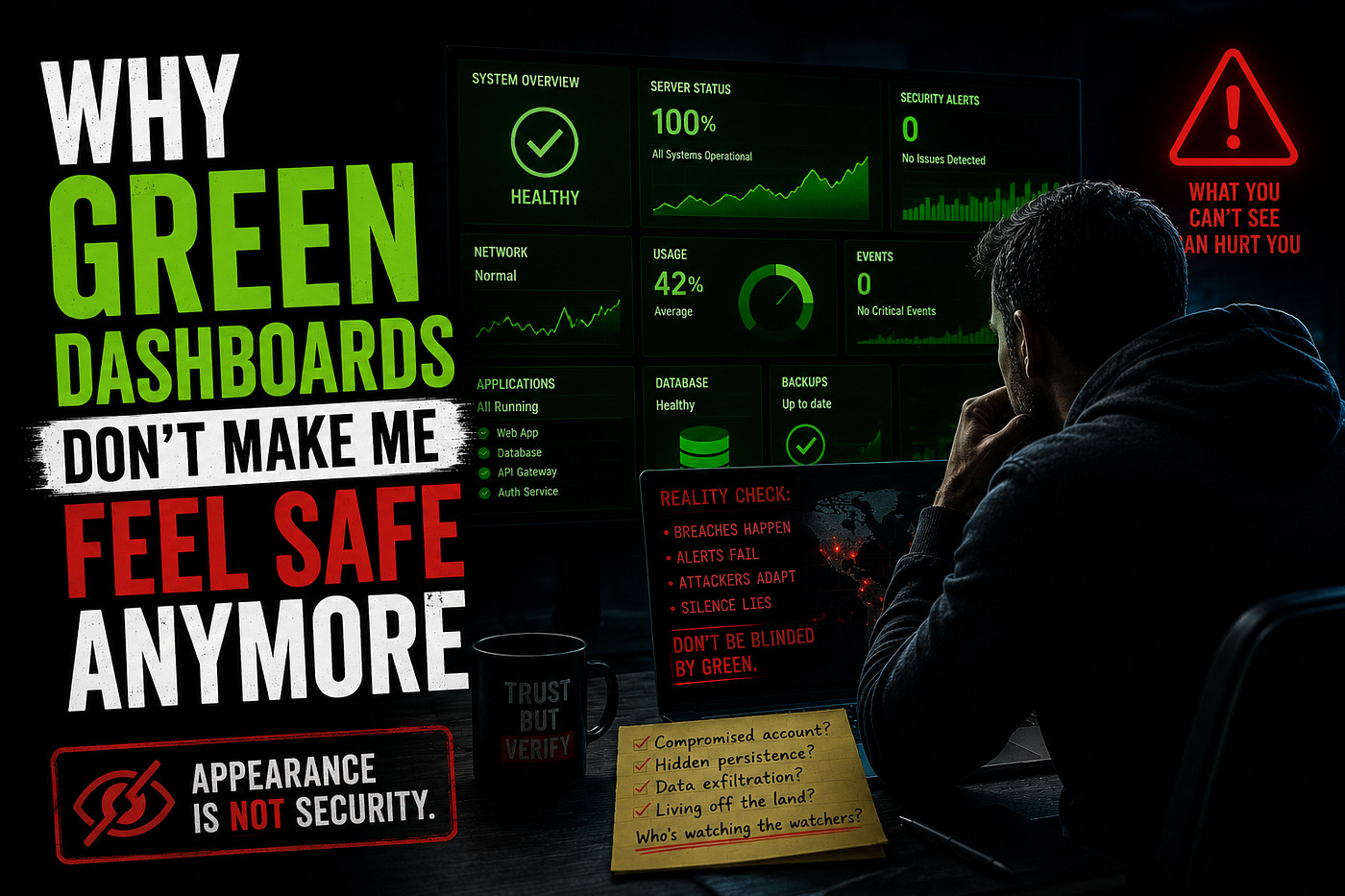
There was a time when green dashboards made me feel comfortable.
Why Green Dashboards Don’t Make Me Feel Safe Anymore
There was a time when green dashboards made me feel comfortable.
No alerts.
No failed checks.
No service outages.
Everything looked healthy.
Now?
Sometimes green dashboards make me more cautious.
Because some of the quietest Linux systems I’ve investigated later turned out to be compromised.
And honestly, that realization changes the way you look at monitoring forever.
The Problem With “Everything Looks Fine”
Modern environments generate massive amounts of telemetry.
Dashboards track:
- CPU usage
- memory utilization
- service availability
- disk space
- application uptime
- network traffic
All of that matters.
But here’s the uncomfortable part:
Attackers learned a long time ago that noisy compromises get detected quickly.
So many modern compromises avoid creating obvious operational disruption.
No ransomware.
No massive CPU spikes.
No loud malware activity.
Just careful, low-noise persistence.
And from a dashboard perspective?
The system can still look completely healthy.
Some of the Most Dangerous Systems Look Calm
One of the strangest things about incident response is realizing how normal compromised systems can appear.
Applications still work.
Users still log in.
Monitoring still shows green.
Meanwhile:
- credentials are being collected
- persistence is being established
- outbound communication is quietly happening
- attackers are mapping internal systems
And operationally?
Almost nobody notices.
That’s what makes subtle compromises dangerous.
Not what they break immediately.
What they quietly become over time.
One Investigation Changed the Way I Look at Monitoring
One Linux server I investigated looked healthier than usual.
CPU usage was stable for days.
Memory usage barely moved.
No suspicious spikes anywhere.
But one thing bothered me.
Outbound traffic started occurring at nearly identical intervals every single hour.
Not enough to trigger alerts.
Not enough to break anything.
Just enough consistency to feel unnatural.
That small behavioral change eventually mattered more than every green dashboard on the screen.
And honestly?
That’s when I fully realized something important:
Monitoring shows activity.
Not intent.
Dashboards Only Show What You Measure
This is something many teams underestimate.
Monitoring platforms are excellent at detecting:
- outages
- instability
- performance failures
- service interruption
But behavioral drift is much harder to measure.
For example:
- successful SSH logins at unusual times
- quiet outbound connections
- processes that look almost legitimate
- systems becoming “too quiet”
- operational patterns slowly changing
Those things rarely appear as bright red alerts.
And attackers know this very well.
That’s why many compromises focus on blending into expected behavior instead of fighting against it.
Healthy-Looking Systems Can Still Be Dangerous
One thing I’ve learned after years around Linux environments:
A calm system is not automatically a safe system.
In fact, some compromised systems become quieter after attackers settle in.
Less noise.
Less experimentation.
Less obvious activity.
Once attackers understand the environment, many intentionally reduce operational visibility.
That’s when traditional monitoring becomes less reliable.
Because the environment still appears operationally stable.
The Most Important Signals Are Sometimes Psychological
This is difficult to explain to people outside incident response.
Sometimes the first warning sign isn’t a tool.
It’s instinct.
A system suddenly feels different.
Not broken.
Different.
Maybe:
- authentication patterns changed slightly
- outbound traffic timing shifted
- cron behavior became unusually consistent
- logs looked cleaner than normal
Nothing individually alarming.
But together?
Something feels operationally wrong.
And honestly, that instinct has saved investigations more than once.
Attackers Understand Operational Fatigue
Most security teams are overwhelmed.
Too many systems.
Too many logs.
Too many alerts.
Attackers understand this very well.
So instead of creating chaos, many modern compromises are designed to survive quietly inside operational noise.
The quieter they remain:
- the longer they stay
- the more credentials they gather
- the more systems they map
- the harder investigations become later
That’s why subtle behavioral drift matters so much.
Especially on Linux systems where legitimate administration activity already creates complex patterns.
Final Thought
I still use dashboards every day.
They’re extremely valuable.
But I no longer assume:
Green means safe.
Because some of the most dangerous Linux systems I’ve investigated looked completely healthy operationally.
No alerts.
No failures.
No visible panic.
Just quiet compromise hiding inside normal behavior.
The most dangerous systems I’ve investigated rarely looked broken.
They looked normal.
And honestly?
That’s exactly why they survived unnoticed for so long.
Follow NextGenThreat Publication for more real-world Linux security stories, SSH investigations, behavioral drift analysis, and practical defensive security content.
메타데이터
- post_id
- 352f8ee860d9
- slug
- why-green-dashboards-dont-make-me-feel-safe-anymore-352f8ee860d9
- url
- https://medium.com/nextgenthreat/why-green-dashboards-dont-make-me-feel-safe-anymore-352f8ee860d9
- canonical_url
- https://medium.com/nextgenthreat/why-green-dashboards-dont-make-me-feel-safe-anymore-352f8ee860d9
- author_url
- https://medium.com/@bornaly
- status
- ok
- fetched_at
- 2026-06-09 15:37:30