The Trillion-Dollar Rush: AI Is Not One Bet. It Is a Stack.
In June 2026, something strange happened. A rocket company’s share price moved, and on paper, its founder became richer than anyone in…
The Trillion-Dollar Rush: AI Is Not One Bet. It Is a Stack.

In June 2026, something strange happened. A rocket company’s share price moved, and on paper, its founder became richer than anyone in modern history, worth roughly $866 billion. Nothing physical changed that day. He didn’t sell a product. No factory opened. The number simply moved because investors decided his company was worth more.
That one fact tells you almost everything about the moment we are in, and almost nothing about what you should actually do about it.
Here is the bigger picture. SpaceX, the rocket company, just sold shares to the public for the first time, raising close to $75 billion at a valuation of nearly $1.77 trillion, the largest such sale in history. Its two most famous neighbours in the AI world are close behind. Anthropic filed confidentially for its own listing on June 1, after private investors valued it at roughly $965 billion, and OpenAI filed days later, last valued at about $852 billion. Add the three together, and you get close to $4 trillion in value, sitting inside just three companies, all reaching for the public markets in the same season.
If you are in Lagos, Accra, or Nairobi and feel like you are missing out on something big, that feeling is understandable. But before you decide whether it is an opportunity or noise, it helps to understand what is actually being priced underneath the big numbers. Because the mistake almost everyone makes is treating “AI” as one thing to bet on. It isn’t. It is a stack of very different businesses, layered on top of each other, with very different risks, and the whole world is busy repricing every layer at once. The layer you buy determines what you actually own.
Three Companies, One Story? Not Quite
People tend to lump SpaceX, OpenAI and Anthropic together as “the AI boom.” But they are not the same kind of business, and that difference matters more than most people realise.
SpaceX builds rockets, satellites, and now, after absorbing Elon Musk’s AI company xAI, it is also building the physical computing power that AI needs to run. Think data centres, chips, and the electricity to power them. OpenAI and Anthropic, on the other hand, do not build physical things. Their product is the AI itself, the software that companies and developers pay to use.
Why does this distinction matter? Not because one kind of business is safe and the other risky. Neither is safe at these prices. It matters because the two are held up by different assumptions, and different things break them. A software company’s value rests almost entirely on growth continuing and its technology staying ahead of everyone else’s. An infrastructure company’s value rests on its buildings and machines staying more valuable than the debt raised to construct them, and on the demand for them not going quiet. Those are different risks, and they fail in different ways. The bet on SpaceX and the bet on Anthropic are not really the same bet, even though the news treats them as one story. And once you start pulling on that thread, you find it goes much further down than the three famous names.
The Stack, Floor by Floor
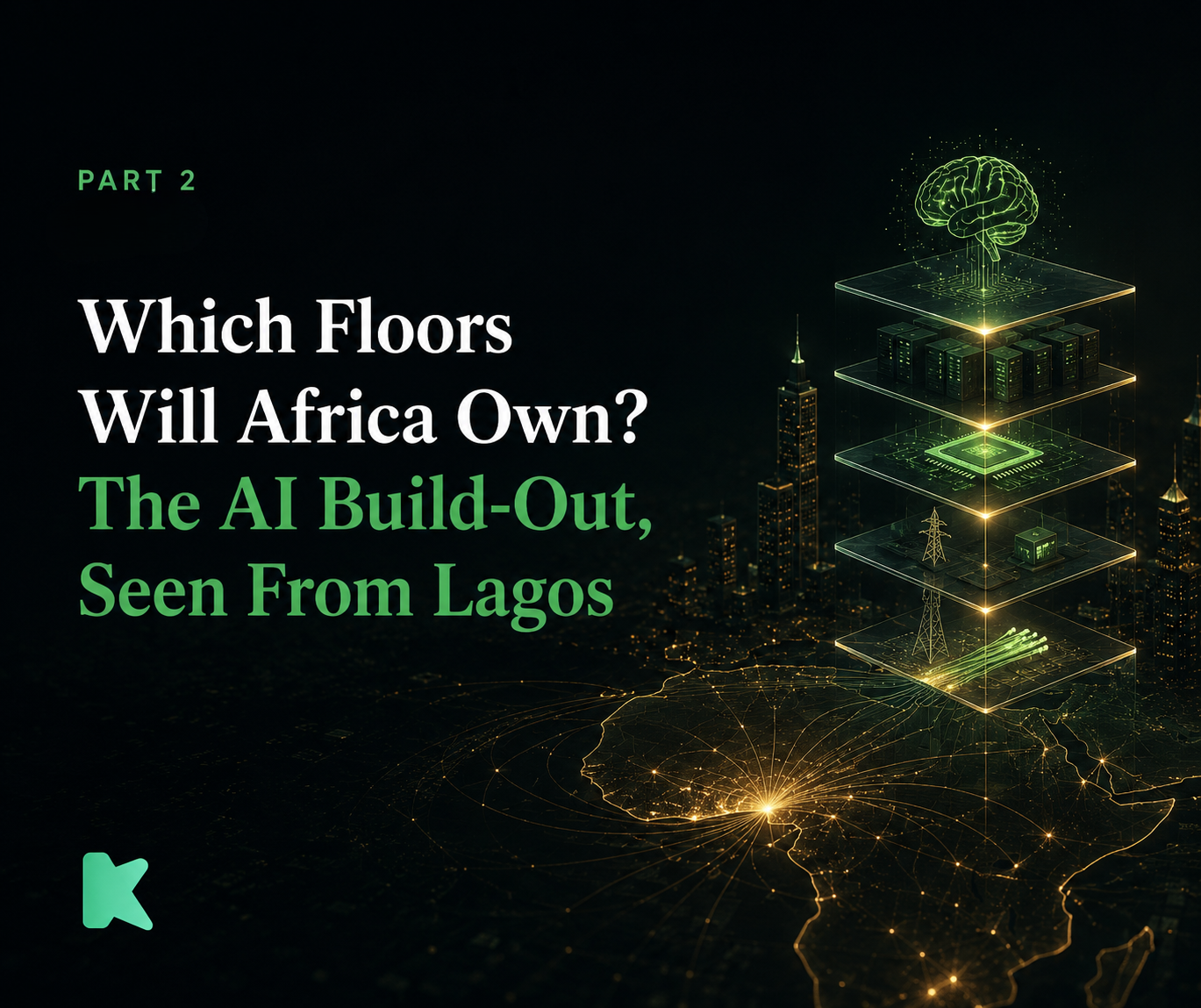
Picture the AI economy as a tower with several floors. At the very top sit the labs whose software you can actually talk to. But that software cannot run on nothing. It needs a floor below it, and another below that, all the way down to the ground.
Start at the top and look down. Anthropic and OpenAI make the models. But to train and run those models, they need enormous amounts of computing power, more than they own themselves. So they rent it. In May, Anthropic agreed to pay SpaceX $1.25 billion a month through 2029 to rent the full capacity of a data centre SpaceX had originally built for its own AI work. Weeks later, Google signed on at $920 million a month for access to around 110,000 Nvidia chips in SpaceX’s facilities. That is over $26 billion a year in contracted computing rent, flowing to a company whose entire revenue in 2025 was under $19 billion. Read that again. The rocket company is now a landlord, and two of the biggest names in AI are its tenants. It is the clearest possible sign that these floors are separate businesses that trade with each other, not one single thing. One honest footnote: both contracts can be cancelled on 90 days’ notice after this year, a reminder that even landlord income in this economy is less fixed than it looks.
Go down a floor. Those data centres are filled with specialised chips, and the chips need a particular kind of memory to feed them. This is where a company most ordinary investors have never heard of quietly became one of the most important in the world. Micron makes the high-bandwidth memory that sits inside AI accelerators. Its stock has risen roughly 300 per cent this year, and its market value crossed $1 trillion for the first time in May. The company says its entire 2026 production of that memory is already sold out under long-term contracts, and in June it announced a strategic supply agreement directly with Anthropic. So there is a second trillion-dollar story here, created by the exact same boom, one floor down from the labs. Nvidia, whose chips every one of those data centres is ultimately built to hold, sits on the same floor and needs no introduction.
Go down again, to the floor almost nobody talks about until the lights flicker. All of this runs on electricity, and the amounts are staggering. Data centres consumed more than 448 terawatt-hours of power globally in 2025, with forecasts climbing past 1,000 terawatt-hours, which is more electricity than entire countries use in a year. That demand is why some of the year’s more surprising AI beneficiaries were not chip or software companies at all. They were power companies. Utilities like Constellation Energy and Vistra have signed long-term contracts to supply electricity to the technology giants building these data centres. When a boom this large runs into a hard physical limit, the thing supplying the limit gets repriced too.
There is a catch to this neat picture, and it is worth being honest about. The floors are a useful way to understand how each company gets valued, but the companies themselves refuse to stay on their floor. Days after its listing, SpaceX agreed to buy Cursor, a popular AI coding tool that competes directly with Anthropic’s and OpenAI’s own products, for $60 billion in stock. Whatever the company’s intent, the effect is plain: the infrastructure business at the bottom used freshly minted shares to buy its way onto the software floor at the top. The stack is real. The boundaries between its floors are not fixed.
What One Month of Trading Just Taught Everyone
Here is where this stops being theory, because the market has spent the past month running the experiment in public. SpaceX jumped 19 per cent on its first day, kept climbing to a peak of $225.64 within three sessions, and has since given most of that back, trading around a third below its peak by mid-July. Nobody can tell you the single reason why. Analysts have pointed to ordinary profit-taking after a frenzied retail-driven run, to a broader sell-off in technology shares, to the heavy losses inside the company’s AI unit, and to disagreement about the valuation itself. That disagreement is real: professional price targets on the stock currently range from $62 to $401, which tells you serious people looking at the same company see completely different futures. One structural feature made every one of those moves bigger than it would otherwise have been. Only about 4 to 5 per cent of the company’s shares trade publicly, and when so few shares are available, modest buying or selling swings the price violently in both directions. The float did not cause the fall any more than it caused the rise. It amplified both.
The ripples were felt beyond one stock. OpenAI, which filed confidentially for its own listing in June, has said publicly that its timing is undecided and that some things are simply easier to do as a private company, while some market commentary has read its reported hesitation as a response to SpaceX’s turbulent first month. Anthropic is still reported to be tracking a late-2026 debut, helped by something rarer than hype: its first profitable quarter, on roughly $10.9 billion of quarterly revenue.
So is this a bubble? Here is the honest answer: informed people are looking at the same numbers and reaching opposite conclusions, and both sides have real evidence. The believers point to revenue that is not imaginary. Anthropic’s annualised revenue grew from about $9 billion at the end of 2025 to over $44 billion by May, and OpenAI reports around $2 billion in revenue every month, with businesses, not just curious individuals, doing most of the paying. The sceptics point to the prices being paid for that growth. NYU valuation expert Aswath Damodaran examined SpaceX’s own filings and valued the company at roughly $1.3 trillion, about a quarter below its listing price, and it is worth noticing what that number is and is not. Even the most-quoted sceptic of this boom thinks the company is worth more than a trillion dollars. The argument is not about whether these businesses are real. It is about whether today’s prices already assume a future so perfect that there is no room left to be paid for taking the risk. Damodaran has also pointed out one way this cycle differs from the dot-com era: this time, trillions are going into physical buildings, chips and power stations, much of it funded by debt, which means a bad unwinding would not stay contained to people who chose to buy AI shares. We are not going to tell you which side is right. We do not know, and neither does anyone selling you certainty. What we can tell you is what the stack does: it turns “is AI a bubble?” into a sharper question, which floor’s price assumes perfection, and which floor is being paid for real, present demand? Those can have different answers at the same time.
Seeing the Building Before You Buy a Floor
So what should you take from all of this, sitting in Lagos or Abuja with the headlines rolling past?
First, stop asking whether to “invest in AI” and start asking which floor you would actually be buying. A chip maker, a power utility, a data-centre landlord and a software lab are four different businesses with four different risks, even when the same boom is lifting all of them. The floor being repriced hardest is not always the one that is easiest or safest to reach.
Second, let SpaceX’s first month teach the lesson it actually taught, which is about timing, not about listings being good or bad. Consider three investors in the same company, in the same month. One bought at the $135 listing price and, even after the fall, is still above water. One bought at the listing price and sold near the peak, making over 60 per cent in days. One bought near $225 in the excitement of the run and is now sitting on a loss of roughly a third. Same company, same month, same information available to everyone. The only difference between them is when they acted, and none of them could have known in advance which one they would turn out to be. That is the point. Over a single month, your outcome is dominated by entry and exit luck that nobody can reliably time, which is why the questions that actually stay in your control are the boring ones: how much of your money belongs in something this volatile, and how long can you genuinely afford to leave it there.
Third, be careful of anyone selling you early access. Anthropic has formally warned that pre-listing share offerings circulating on secondary platforms are unauthorised and will be treated as invalid. If someone offers you a piece of a famous AI company before it lists, the most likely thing you are buying is a story.
None of this tells you whether the boom will end well. Honest people disagree, and the uncertainty itself, not some hidden answer, is the right starting point for any decision about your own money. What the stack gives you is not an answer. It is a better set of questions, and the vocabulary to tell one floor from another before you put money on any of them. There is one more question the stack raises, and it is the biggest one for anyone reading this from an African city: which floors of this building does Africa itself stand on, and on whose terms? That question deserves its own article, and it is where we go next.
메타데이터
- post_id
- 352fbec8bcfd
- slug
- the-trillion-dollar-rush-ai-is-not-one-bet-it-is-a-stack-352fbec8bcfd
- url
- https://medium.com/@kudyfinancials/the-trillion-dollar-rush-ai-is-not-one-bet-it-is-a-stack-352fbec8bcfd
- canonical_url
- https://medium.com/@kudyfinancials/the-trillion-dollar-rush-ai-is-not-one-bet-it-is-a-stack-352fbec8bcfd
- author_url
- https://medium.com/@kudyfinancials
- status
- ok
- fetched_at
- 2026-08-19 16:44:34