Why Working More Doesn't Mean Getting More Done
Last year I tracked my hours for a month, out of pure curiosity. Nothing scientific, just a simple spreadsheet where I logged when I…
Why Working More Doesn't Mean Getting More Done
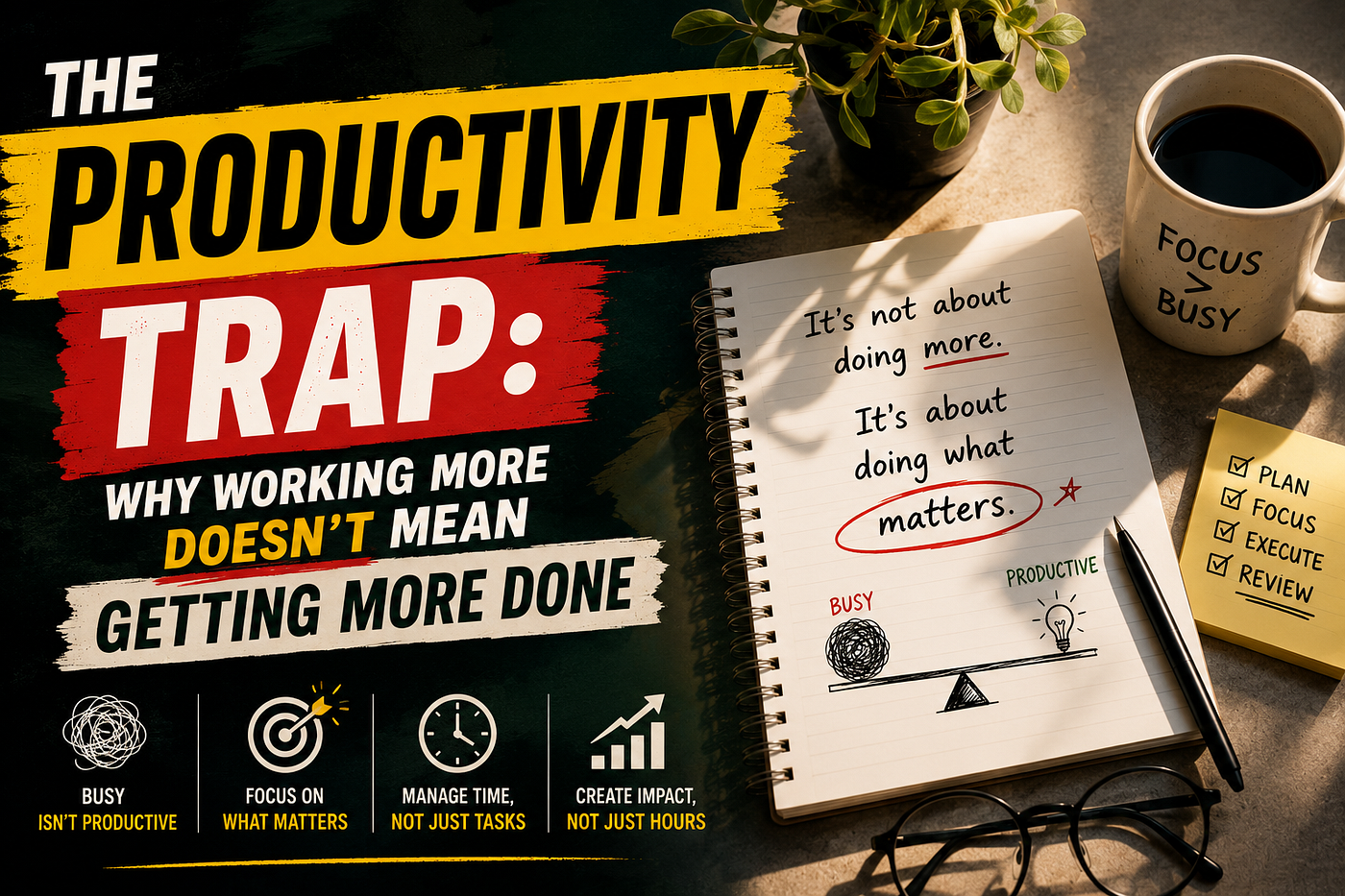
Last year I tracked my hours for a month, out of pure curiosity. Nothing scientific, just a simple spreadsheet where I logged when I started working and when I actually stopped. Then I compared those hours against what I’d actually finished each day.
The result embarrassed me a little. My longest days, the eleven- and twelve-hour marathons where I skipped lunch and felt like a productivity machine, produced roughly the same output as my six-hour days. Sometimes less. One particular thirteen-hour day ended with exactly one task completed, a task that should have taken ninety minutes.
That spreadsheet broke something I’d believed my entire working life. That time spent equals work done. It doesn’t. Not even close.
The Myth We Never Question
Most of us grew up absorbing one quiet assumption. Effort is measured in hours. Show up early, leave late, and you’re proving something: dedication, work ethic, and seriousness about your job. This idea runs so deep that admitting you got more done in six hours than someone else did in ten can feel like bragging, even when it’s just an honest observation about how attention actually works.
Factories built this belief, and it made sense there. A worker on an assembly line for ten hours genuinely produces more than one who works six, because the output is mechanical and repetitive. Your hands either did the task or they didn’t.
Knowledge work doesn’t follow that same math, and most of us are still applying factory logic to jobs that have nothing to do with a factory.
What Actually Happens After Hour Six
There’s a reason that the thirteen-hour day fell apart. Focus isn’t a switch you flip on in the morning and leave running until you go to bed. It’s closer to a battery, and like any battery, it drains with use and needs recharging, not just willpower to keep pushing through.
Researchers studying attention have found that most people can sustain genuinely focused, high-quality work for somewhere between four and six hours a day. Everything beyond that isn’t necessarily wasted, but it shifts into a different, weaker gear. You’re technically at your desk. You’re technically working. But the sharp thinking, the good decisions, and the creative problem-solving that started fading hours ago.
I noticed this pattern clearly once I started paying attention. My best writing, the paragraphs I didn’t need to rewrite three times, almost always happened in the first two hours after I sat down. By hour eight, I was producing sentences I’d delete the next morning anyway. I wasn’t creating value in those extra hours. I was creating extra editing work for my future self.
The Busy Trap
Here’s the part that stings a bit. Long hours often feel productive even when they aren’t, because staying busy triggers a kind of satisfaction that finishing early doesn’t. If you leave the office or close your laptop after six focused hours, there’s a nagging feeling that you should be doing more. Ten hours of scattered, half-focused effort somehow feels more justified, even when the actual output is worse.
I fell into this constantly during my early freelancing days. I’d stretch simple projects across entire days, not because they needed that long, but because finishing early made me anxious. Surely if it only took three hours, I was doing something wrong, or charging too little, or not working hard enough.
A client’s blunt comment jolted me back to reality. She told me she didn’t care how many hours I spent on her project. She cared whether the final result solved her problem. That single sentence rearranged how I thought about my time completely.
A Story About Two Freelancers
I want to share something I noticed watching two freelance writers I know, both working in similar niches, both charging similar rates.
The first treated every workday like a marathon. Ten, sometimes twelve hours, constantly available, constantly typing something, constantly exhausted by evening. Her output was decent, but her clients frequently asked for revisions, and her writing occasionally read like it had been written by someone running on fumes, because it had been.
The second worked in tight, deliberate blocks. Four hours in the morning, completely focused, phone in another room. Then she stopped. Genuinely stopped, no guilty half-working in the afternoon. Her clients rarely asked for major revisions. Her writing was sharper, more original, more alive.
Same industry. Similar experience level. Wildly different relationships with time. The second writer wasn’t working less because she was lazy. She understood something the first hadn’t figured out yet, that four focused hours beats ten scattered ones almost every single time.
Why This Matters Even More If You’re Just Starting Out
If you’re building something on the side, freelancing, running a small business, or trying to grow an online income while still working a regular job, this matters even more than it does for someone with unlimited time. You genuinely don’t have twelve spare hours a day. You might have two, or three, squeezed in around everything else life demands.
The instinct is to panic about that limited time and try to cram as much into it as possible, sacrificing sleep, skipping meals, and pushing through exhaustion because those extra hours feel like the only path to progress.
But two sharp, focused hours where you’re actually thinking clearly will move your work forward more than five exhausted hours where you’re just going through the motions, refreshing tabs, and rereading the same paragraph four times without absorbing it.
I’ve seen this play out with several people building small online businesses around Pakistan and South Asia, often juggling a day job with something on the side because financial stability isn’t guaranteed the way it might be for someone with a steady salary in a country with stronger social safety nets. The ones who burn out fastest are almost always the ones treating every free hour as mandatory work time. The ones who last and actually build something protect a smaller number of genuinely focused hours instead.
What Focused Hours Actually Look Like
This isn’t just about working fewer hours and hoping for the best. It requires some intention behind those hours, or you’re just trading one inefficient habit for another.
Removing the phone from the room, not just silencing it but actually removing it, changes things more than most people expect. Even a phone sitting face down on the desk pulls a small amount of attention away, just from being present and possible to check.
Working in blocks with a clear stopping point helps too. Telling yourself you have ninety minutes to finish a specific task creates a kind of useful pressure that an open-ended afternoon never does. Deadlines, even small ones you set for yourself, sharpen focus in a way that unlimited time never will.
And genuinely stopping when your focus runs out matters more than most people admit. Pushing through mental fatigue rarely produces good work. It usually just produces work you’ll need to redo later, which means you didn’t actually save time by pushing through; you just moved the real work to tomorrow while exhausting yourself today.
The Uncomfortable Truth
Somewhere along the way, many of us started treating exhaustion as proof of effort. If we’re tired, we must have worked hard. If we finished early and still feel fine, surely we didn’t push ourselves enough.
That belief quietly sabotages more people than almost any other productivity myth out there. Being tired isn’t the same as being productive. Sometimes it’s just evidence that you spent hours fighting against a brain that had already given you its best work and was asking, politely at first and then less politely, for a break.
My spreadsheet from last year taught me something simple that took embarrassingly long to actually believe. The goal was never to fill hours. It was always to finish things, well, and then stop. Everything else was just performance, mostly for myself, convincing nobody but me that I was working hard enough to deserve the rest I kept refusing to take.
메타데이터
- post_id
- 35627fd1815f
- slug
- why-working-more-doesnt-mean-getting-more-done-35627fd1815f
- url
- https://medium.com/@noorfatimamuhammadtariq02/why-working-more-doesnt-mean-getting-more-done-35627fd1815f
- canonical_url
- https://medium.com/@noorfatimamuhammadtariq02/why-working-more-doesnt-mean-getting-more-done-35627fd1815f
- author_url
- https://medium.com/@noorfatimamuhammadtariq02
- status
- ok
- fetched_at
- 2026-08-11 11:05:39