7 one-hit wonders … with a twist [Pt1]
15 minutes of fame? These guys got 3. But it was all they needed.
7 one-hit wonders … with a twist [Pt1]
15 minutes of fame? These guys got 3. But it was all they needed.
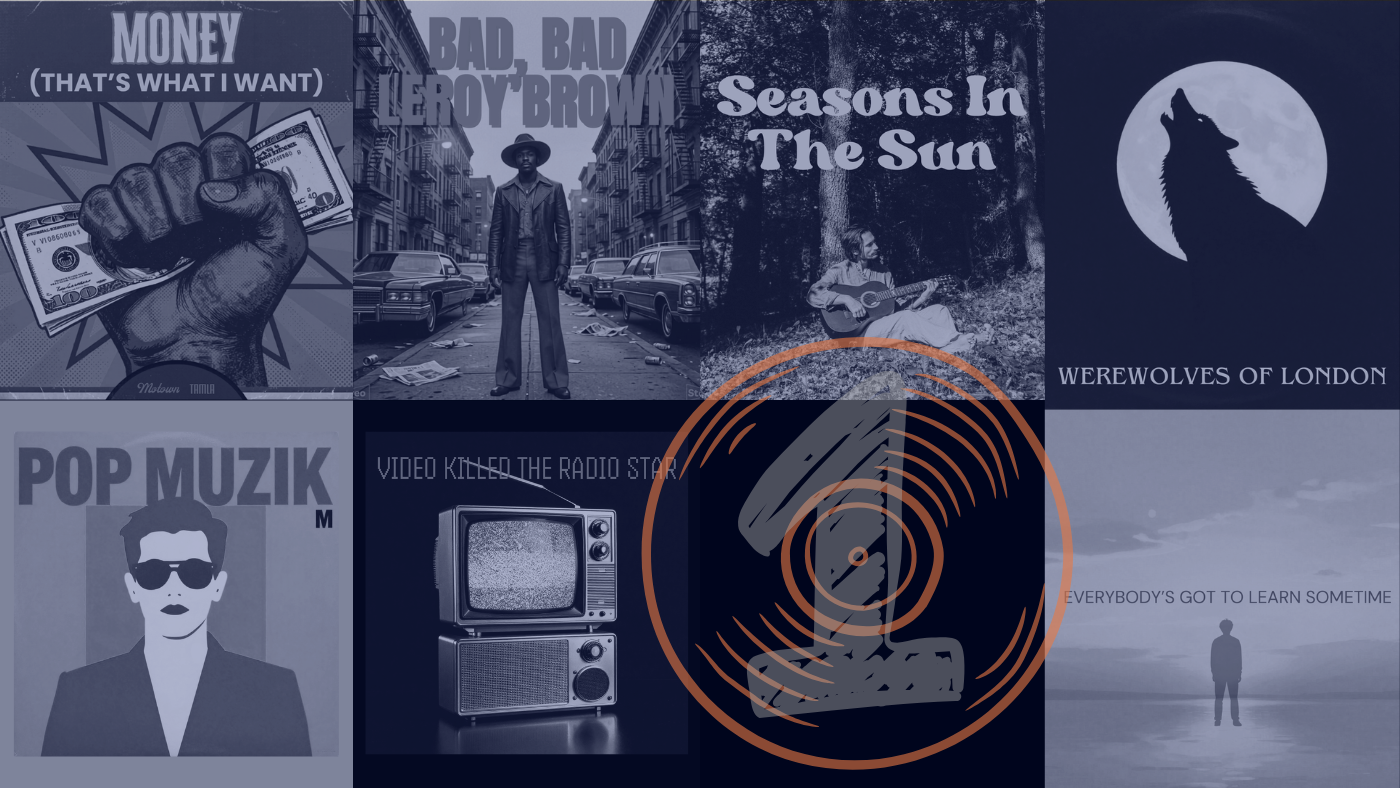
Image: Canva AI-generated
Fame, in pop music, is rarely fair. Whole careers of genuine brilliance pass without a single crossover moment, while somewhere in the margins, a song nobody saw coming detonates across the radio — and then nothing. One shot in the collective memory, then gone.
We call them one-hit wonders, usually with faint condescension, as though the solitary nature of the achievement diminishes it. It doesn’t. The one-hit wonder is pop music in its purest, most ruthless form; a song that catches the exact frequency of a particular moment.
But we have a twist. The seven songs collected here are all one-hit wonders represented by cover versions, selected purely on their own merits. At best, they rival the originals. At worst, they don’t disgrace themselves.
1. Money (That’s What I Want), Barrett Strong [1960]
Before Motown became Motown, there was a spontaneous afternoon in a Detroit studio and a piano riff that started everything. Berry Gordy and Barrett Strong began improvising; Benny Benjamin sat down at the drums, Brian Holland picked up a tambourine, and two teenagers who had wandered in off the street grabbed the bass and guitar. Nobody saw them again.
The song they stumbled into was a deliberate counterargument to the old standard The Best Things in Life Are Free — a flat rejection of its sentiment dressed up in one of R&B’s most irresistible grooves. That central riff, bluesy and insistent, locks in early and refuses to leave. Strong’s vocal matches it perfectly: raw-edged and hungry.
It reached number two on the R&B chart and became Motown’s first proper hit. The label would soon sand away this kind of roughness in pursuit of a smoother sound. Which makes Money something rarer than a classic — a glimpse of what Motown sounded like before it knew what it wanted to be.
Cover: David Gray, 2012
Gray is a British singer-songwriter who spent six years in obscurity before *White Ladder* changed everything. This was recorded as part of Jim Beam’s live music series.
[embed]Source: YouTube
2. Bad, Bad Leroy Brown, Jim Croce [1973]
Croce understood something most songwriters miss: a great character needs a great downfall. Leroy Brown has everything — the size, the swagger, the diamond rings, the Lincoln Continental, the razor in his shoe. He is the baddest man on the South Side of Chicago, and Croce spends the first half of the song making absolutely sure you believe it. The second half exists purely to dismantle him.
It works because Croce plays it completely straight. No winking, no nudge in the ribs. Leroy is presented with full conviction, which makes his humiliation — at the hands of a jealous husband — land with genuine comic weight.
It reached №1 in July 1973 and was the last single released in Croce’s lifetime. He died in a plane crash that September. His greatest character study became, almost immediately, his epitaph.
Cover: Frank Sinatra, 1974
It’s far from Sinatra’s best cover, but it earns its place here because … well, because it’s Sinatra covering Jim Croce. Who knew?
[embed]Source: YouTube
3. Seasons In The Sun, Terry Jacks [1974]
The song Jacks is synonymous with began life as something considerably darker. Jacques Brel’s original was a deathbed confession laced with bitterness — a dying man saying goodbye to the friend who had been sleeping with his wife, wishing him well through gritted teeth. Jacks softened the edges in translation, finding the original too macabre, and rewriting it in the shadow of a friend dying of leukaemia.
What emerged was a song about peaceful acceptance rather than romantic betrayal — a farewell without rancour, which is either a profound act of compassion or a significant loss of nerve, depending on your tolerance for sentiment.
The melody carries a genuine ache, and the three farewells accumulate quietly into something that earns its emotion rather than demanding it. He understood that his audience needed to grieve, not to judge. In 1974, they did exactly that — in their millions.
Cover: Black Box Recorder, 1998
BBR is an English indie trio who spent five years on the margins before a single moment of mainstream contact, before retreating back into cult status. This cover was recorded for 1998’s *England Made Me*, but it sat in the vault for 25 years.
[embed]Source: YouTube
4. Werewolves Of London, Warren Zevon [1978]
It started as a joke. Phil Everly watched a 1935 monster film, rang Zevon, and suggested he turn the title into a song-and-dance craze. Zevon, Leroy Marinell and Waddy Wachtel wrote it in roughly 15 minutes; nobody took it seriously, and Zevon’s wife, Crystal, transcribed the lyrics because the three of them couldn’t be bothered.
What followed was stranger still. Jackson Browne recognised something in the lyrics and began performing it at his own concerts. T Bone Burnett took it out on Bob Dylan’s Rolling Thunder Revue, improvising verses about Jimmy Hoffa and adult film stars. The song spent two years as other people’s material before Zevon recorded it himself, with Mick Fleetwood and John McVie locking the whole thing into a groove of gleeful menace.
The result is one of rock’s great comic set pieces — literate, absurdist, completely committed to its own ridiculousness. He had an entire career’s worth of material this good. The radio just wasn’t paying attention.
Cover: Adam Sandler, 2004
Sandler is a comedian who masquerades as an actor and, sometimes, singer. As a singer, he makes a good actor, but I’m giving you this on the assumption you’d be curious.
[embed]Source: YouTube
5. Pop Muzik, M [1979]
Robin Scott’s intentions were genuinely ambitious. He wanted to compress 25 years of pop music into a single track — a deliberate act of synthesis, a song about songs. What he produced sounded, on the surface, like pure nonsense: a loops-and-synths confection built around a lyric that barely qualifies as one. The paradox of Pop Muzik is that its apparent emptiness was entirely the point.
The song began in R&B and funk territory before a friend suggested synthesisers, at which point Scott [aka M] found his frequency. The result sits at the precise intersection of disco’s communal warmth and the cold geometry of what would shortly become new wave — a transitional record that belonged fully to neither world and was better for it. Talk about pop music. That’s all.
It reached №1 in the US and two in the UK. The song said everything.
Cover: Ex-Girl, 2001
Ex-Girl is a Japanese noise-rock trio from the planet Kero Kero whose live shows, homemade costumes, and frog-related props are the least strange thing about them. They’ve recorded five albums and this is off their fourth, *Back To The Mono Kero*.
[embed]Source: YouTube
6. Video Killed The Radio Star, The Buggles [1979]
The song was written in a flat above a monumental stonemason’s in Wimbledon, which feels appropriate. Trevor Horn and Geoff Downes were building something that would outlast almost everything around it — a meditation on obsolescence that has itself refused to become obsolete.
Horn had been reading J.G. Ballard and listening to Kraftwerk, and the combination produced a specific anxiety: the sense that something was ending before anyone had properly said goodbye. The lyrics reach back to the 1960s with genuine tenderness, mourning the casualness with which each generation discards what the previous one cherished. Melancholy dressed up in synthesisers bright enough to sound like celebration.
The Buggles topped 16 international charts, then watched the song acquire a second significance when it became the first video broadcast on MTV in August 1981. The medium the song had warned about adopted it as a theme tune. Horn had predicted video would kill the radio star. He hadn’t anticipated it would also immortalise the prediction.
Cover: Custard, 1996
Custard is a Brisbane indie band who spent the 90s being quietly loved in Australia. This cover was the B-side to the single *Leisuremaster*. No, I don’t remember it either.
[embed]
7. Everybody’s Got To Learn Sometime, The Korgis [1980]
James Warren wrote it in 15 minutes on a piano he couldn’t properly play, aiming for something slow and radio-friendly. What he didn’t realise was that he was writing philosophy. The lyric, stripped almost to nothing, came directly from his engagement with meditation and self-improvement — an internal reckoning dressed up as a love song. Most people heard the romantic reading. Warren always knew it was about something harder: the work of becoming a different person.
Phil Harrison’s synthesiser line establishes the mood immediately — melancholy with just enough forward motion to keep despair at bay. Most unexpectedly, the instrument punctuating each chorus is a guzheng, an 18-string Chinese zither, which introduces a delicate, slightly alien quality the song wears with complete naturalness.
The Korgis never came close to repeating it commercially. But Everybody’s Got to Learn Sometime has outlasted almost everything from its era. Warren spent fifteen minutes on it, and it repaid him for decades.
Cover: Erasure, 2003
Erasure is a synth-pop duo who spent the best part of three decades making the UK charts feel like a more joyful place. This is off their covers album *Other People’s Songs*.
[embed]
Covers with a twist
Stay tuned for part 2 coming very soon.
메타데이터
- post_id
- 358b57772ef4
- slug
- 7-one-hit-wonders-with-a-twist-pt1-358b57772ef4
- url
- https://medium.com/rock-on/7-one-hit-wonders-with-a-twist-pt1-358b57772ef4
- canonical_url
- https://medium.com/rock-on/7-one-hit-wonders-with-a-twist-pt1-358b57772ef4
- author_url
- https://medium.com/@sacott66
- status
- ok
- fetched_at
- 2026-06-22 08:06:21