Enslaved child or a Goddess
Once upon a time, during the reign of King Jay Prakash Malla, the kingdom of Nepal faced troubled times. The king was overwhelmed by…
Enslaved child or a Goddess
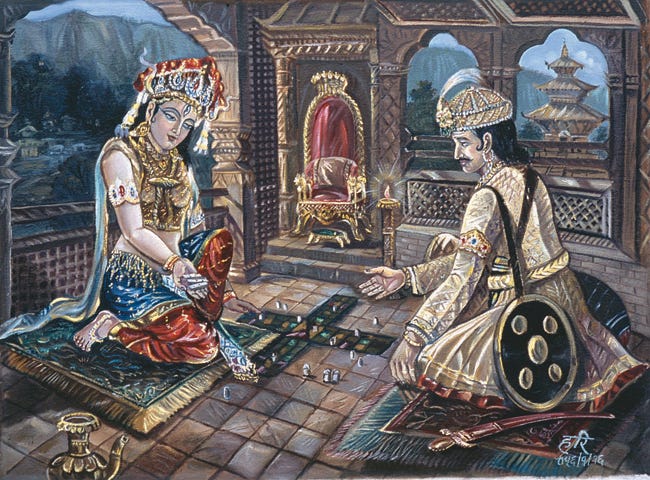
Photo by artist Hari Prasad Sharma
Once upon a time, during the reign of King Jay Prakash Malla, the kingdom of Nepal faced troubled times. The king was overwhelmed by conflicts and despair. One night, the goddess Taleju, protector of the land, appeared to him in secret. She offered her guidance and wisdom on one condition: her visits must remain a secret, and no one must ever see her.
The king agreed. From then on, the king and the goddess would meet every night, hidden by the darkness. They would play Tripasa (a dice game) and discuss the state of the kingdom.
After the king had sneaked out secretly many nights, his queen grew suspicious. When she asked him about his nightly absences, the king, bound by his promise to the goddess, could not answer.
One fateful night, the queen followed the king to his secret meeting with Taleju. The goddess quickly noticed her presence. Furious that the king had broken his promise, she vanished, promising never to return.
The king repented and prayed tirelessly to the goddess. Finally, she appeared to him in a dream and said she would return as a young girl, a child from the Newar Shakya clan. After a long search, the king found the girl who possessed the spirit of Taleju and he would find her again and again in every timeline in every century.
That girl was named Kumari. The living Goddes of Nepal.
Who is this little girl today?
Today, the goddess has taken shelter in the body of the little Aryatara Shakya, chosen at the age of only two years and eight months.
What attributes could this baby possibly have to be named a goddess?
To be God is to be perfect and to be perfect is to be inhuman. Her teeth must be flawlessly aligned and white, her skin in ideal condition, without any scars or marks, her eyes like those of a cow, legs slender like a deer’s, her voice as clear as one of a duck, but still a human, still a child. Thirty-two desired characteristics that define a goddess must be met.
Outward beauty might be enough to be a model, but a goddess’s character must be proven.
But how can a child who has hardly any perception of the world, let alone of herself, do such a thing?
How would you do it?
You wouldn’t be able to ask her hard-hitting philosophical questions, nor can you ask her the meaning of life.
The committee responsible for selecting the Kumari has established a process that is not fully disclosed to the public, but it is believed that the child must undergo a series of trials.
It’s believed that the little girl must walk a path surrounded by dead animals without fear. She must spend a night alone in the dark without crying. She must not tremble at loud noises. She may even be subjected to watching animals being sacrificed before her very eyes, and of course, the sight of their lives leaving their bodies must not make her flinch. A goddess must be brave. Once these tests are completed, they will separate the divine from the ordinary.
Once she is chosen, her life between the moment she passes the tests and the moment she bleeds for the first time is bound by a set of rules. Some of them are that.
-
She is not allowed to step on the floor, and she can go outside of her residence only on special occasions
-
She must always wear a red dress with full make-up, red being the color of the Goddess
- In the past, the Living Goddess was not allowed to get an education, as it was believed that she knew everything.
Certain things define our childhood, and when mentioned, they instantly awaken a feeling of nostalgia. It may be the Freddo chocolate for the UK, for many people in both Slavic and Latin cultures, it may be the butter cookie containers that store sewing supplies, buttons, or, in other words, everything but cookies. For others, it can be playing hide and seek, hopscotch, or jump rope outside with your friends during the summer vacation, right before you are called by your mother that it’s time for dinner. The sun is setting, and it’s getting chilly outside.
‘‘Come on, it’s time to go home’’
The Kumari won’t have any of those memories. She won’t be able to play outside with her peers because her feet must never touch the ground. She may not even live full-time with her family — no mother calling her across the street that it’s time to go home as the sun sets and no grandma around her to keep needles where sweets should be, tricking her into opening them.
And yet, she may not even miss the prospect of such a childhood. Former Kumaris speak with tenderness and gratitude. There is only one way to look at it. They were groomed from a young age into making this life theirs and not aspiring for anything different. They grew up investing their entire value in something momentary. This is all they had ever known.
But what happens once it’s all over?
The higher they fly, the harder they fall.
The shock of having to abandon the greatest thing about them, the most prestigious and important role a girl can hold, the greatest honor of their body being a shelter of a literal god, is something some would never recover from. Such is the case for Dhana Kumari Bajracharya, who is still living as a Kumari, still wearing the traditional clothes, giving out blessings, and living a life in near seclusion, a life that is not hers anymore. She never fully adjusted to life outside, even after seventy-five years, because she was not given the opportunity to make one of her own.
There is an emptiness that I can personally hear in ex-Kumaris’ answers when talking about their lives now. After all, there is no comparison between how a goddess and a woman are treated — when becoming one means you are no longer worthy, no longer considered a higher being.
One former Kumari, Rashmila Shakya, shares how she was scolded by her teacher for her poor academic level. But how can someone scold her, a god? Does he not have any shame?
Well, she is not a Goddess anymore; she would probably remind herself. Just an ordinary girl. Nothing would ever feel the same after that; there would always be an empty space where the validation of a whole country is supposed to go.
Their heads are probably spinning.
Why is everything so different?
Is that something everyone knows?
Everything is so confusing.
My feet hurt’; I’ve never walked for so long, and I can barely walk for 10 minutes.
Is that car coming at me? How do I cross this street?
These are not normal questions a teen or a pre-teen should have. Crossing the street is something you should know how to do long before 13. Who doesn’t know how to cross the street at almost 14?
Well, Kumari doesn’t. No one ever thought of her. They are just showing her now everything there is.
Would they have peace now that they are back in society and have accepted a new normal? Would they marry and have a family?
They can, in theory. It’s believed that marrying a former Kumari means the groom will die soon after the marriage. Wouldn’t that mean that everyone around them will be cautious to get too close? Don’t they deserve peace? How come even after giving their whole childhood to tradition, they are still given a hard time by that very same tradition? Is that even fair?
Not everyone is just sitting around and watching this happen.
There are many arguments against this, so much so that the case became a Public Interest Litigation (PIL) filed in Nepal in 2008 by human rights lawyer Pundari Prasad Aryal, who argued that the practice should be reviewed under child rights and constitutional protections. The petition requested the Court to investigate whether Kumaris were deprived of education, health care, and freedom of movement.
The 2008 Supreme Court verdict declared that the Kumari tradition could continue, provided it respects the child’s fundamental rights, particularly the right to education, health, and personal freedom.
But shouldn’t it be abolished altogether if so many Nepali people are against it? Isn’t the Kumari a child first and a goddess second? If so much is established, how come a child should go to such lengths, endure such exhaustion, and grow up in such an unnatural way? What possibly could be the argument against that?
Cultural Heritage and National Identity
Are all traditions equal and needed?
Sati Pratha was a Hindu funeral custom where a widow was expected, or when that was not enough, pressured or forced, to burn herself alive on her deceased husband’s pyre. Among high-caste or royal families, it was considered a sign of loyalty and devotion.
It was abolished in 1920 as one of Nepal’s earliest human rights reforms.
Only around a hundred years ago, it was lawful to burn alive a human being in the name of loyalty to a soul that no longer inhabits Earth, but it was recognized as an absolute abomination, and the government did right by its people to abolish it.
This example may be far-fetched, but through the lens of the present, the past may always seem unreasonable, considering the modern understanding we have now of the world and the people in it. There shouldn’t be another hundred years in which we look back, wondering why we dressed up a baby and cast her away from everything in the name of tradition.
That being said, I do not want this short article to be taken as your only source. Even though it might be futile, I want you, the reader, to understand how much religious and sentimental value this tradition holds for some Nepali people. I am not prying on other countries’ shortcomings in the name of being right and being superior, human history is flawed as a whole, and there is no nation morally superior to another.
Being able to understand that such traditions preserved the country in times of hardship doesn’t exclude the fact that sometimes we can let go of such practices, even though, looking back, we are thankful for their use in the name of future generations.
Sources
https://www.abc.net.au/news/2019-01-19/-i-was-a-living-goddess-kumari-nepal/10717398
https://globalpressjournal.com/asia/nepal/former-living-goddesses-struggle-to-regain-normal-lives/
https://www.bbc.com/audio/play/p076x0st
https://archive.nepalitimes.com/news.php?id=18515
https://whatthenepal.com/2024/01/16/life-of-the-living-goddess-kumari/
https://www.shankerhotel.com.np/blog/2020/11/28/kumari-tale-goddess-part-ii
https://ntb.gov.np/living-goddess-kumari?
https://nepaltournews.com/kumari-the-living-goddess-of-nepal/
https://apnews.com/article/nepal-living-goddess-hindu-tradition-0cd93fa79e3446ffdf995210f44b8f99
메타데이터
- post_id
- 35a57dc6aa26
- slug
- enslaved-child-or-a-goddess-35a57dc6aa26
- url
- https://medium.com/@emakborisova/enslaved-child-or-a-goddess-35a57dc6aa26
- canonical_url
- https://medium.com/@emakborisova/enslaved-child-or-a-goddess-35a57dc6aa26
- author_url
- https://medium.com/@emakborisova
- status
- ok
- fetched_at
- 2026-07-16 20:24:43




