Cameco And India: A Quiet Uranium Pact With Global Reach
As Canada and India near a US$2.8bn, 10-year uranium pact, Cameco is pulled to the centre of a nuclear fuel reshuffle stretching from…
Cameco And India: A Quiet Uranium Pact With Global Reach
As Canada and India near a US$2.8bn, 10-year uranium pact, Cameco is pulled to the centre of a nuclear fuel reshuffle stretching from Saskatchewan to New Delhi.
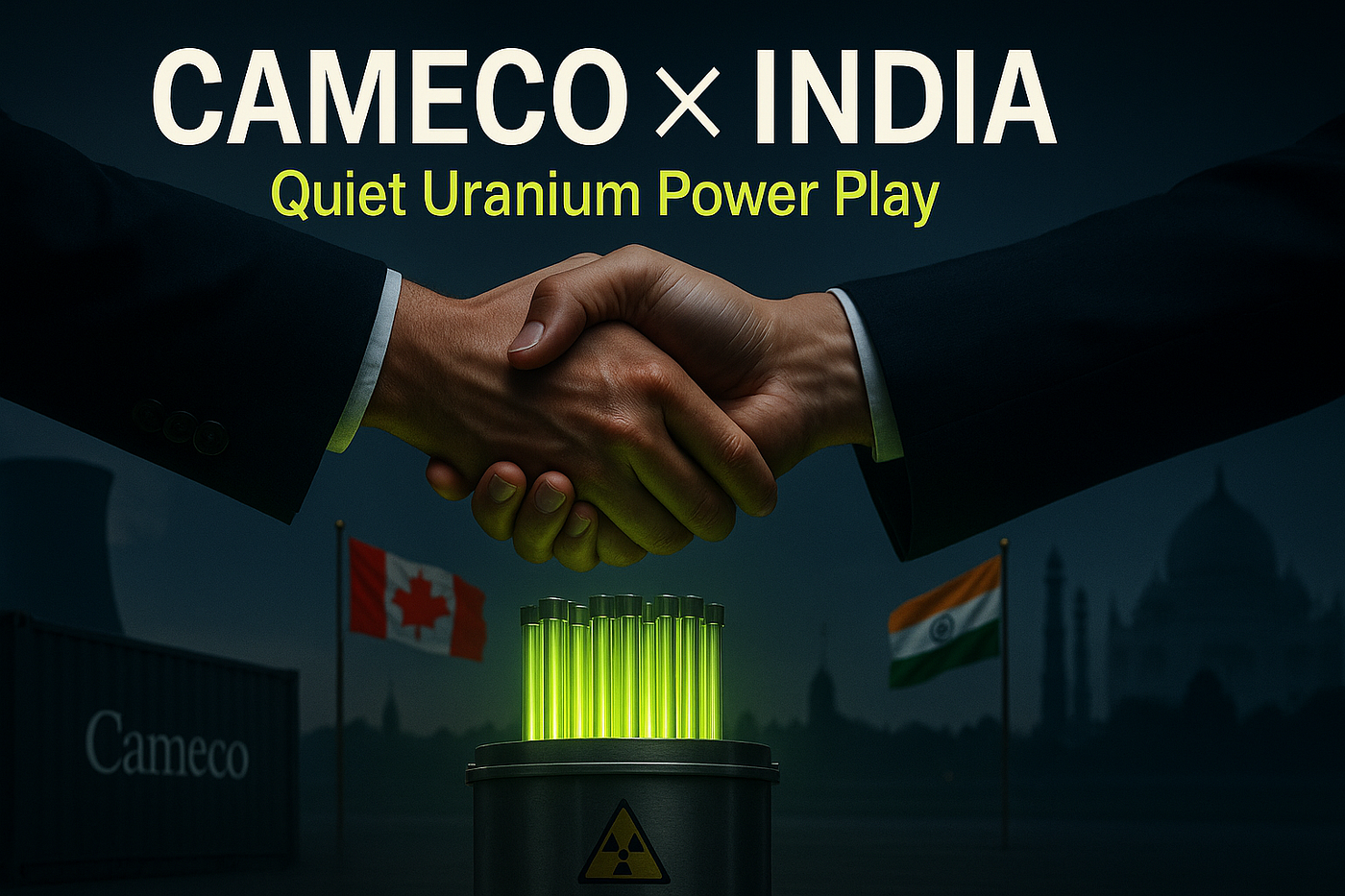
Picture created with ChatGPT
Anxious Markets, Careful Diplomats
On a late-summer afternoon in Johannesburg, a photographer’s lens caught what looked like a routine G20 sidelines handshake: India’s prime minister, Narendra Modi, gripping the hand of Canada’s Mark Carney, the newly installed prime minister and former central banker. The caption spoke of trade, friendship, renewed dialogue. It did not mention uranium.
In the markets, the mood was rather less placid. By the time the photograph hit the wires, rumours of a US$2.8 billion, 10-year uranium export pact between the two countries were already ricocheting through broker notes and Telegram chats. The Canadian producer at the centre of it, Cameco, saw its stock begin to edge higher as investors tried to model what a decade-long commitment to India’s nuclear fleet might mean for its earnings — and for the already tight uranium market.
The deal, if signed, would be astonishing in both scale and timing. It would come barely five years after diplomatic relations between Ottawa and New Delhi slumped into a chill, freezing broader trade talks. It would land at a moment when utilities across the world are scrambling to reduce their dependence on Russian nuclear fuel, while governments talk up new reactors faster than miners can sink fresh shafts. It would, in one stroke, bind a G7 democracy and a rising Asian power into a long-term energy pact built around one of the most politically charged commodities on earth.
Yet for all the noise, there is still little that is official. Neither government has published term sheets. Cameco declines to comment on “commercially confidential” contracts. Analysts reverse-engineer the leaked headline number against today’s long-term uranium price and arrive at back-of-the-envelope estimates: roughly 3.3 million pounds of U₃O₈ per year for ten years, perhaps 10% of the company’s annual sales volumes, a “very material” slice of its book. The rest is inference, history and guesswork.
Behind the speculation lies a tangle of contradictions. India wants to triple or quadruple its nuclear capacity but has limited domestic uranium and a complicated non-proliferation legacy. Canada long ago built its nuclear brand on non-proliferation and safeguards, then walked away from India after the 1974 test that used plutonium from a Canadian-linked reactor. Now it is considering becoming one of India’s primary long-term fuel suppliers. Investors, meanwhile, have only just rediscovered uranium after a lost decade of oversupply; they crave clarity, not a fresh geopolitical experiment.
The photograph from Johannesburg captures none of that. But it hints at something larger: a reset in a relationship that was badly damaged — and the possibility that Cameco, a once-unfashionable miner from the Saskatchewan prairie, is about to become a key instrument of that reset. The question, for both governments and shareholders, is whether this is a masterstroke of timing or the prelude to a fresh round of nuclear angst.
Cameco’s Strategic Turning Point
Cameco has been here before, in different guise. Born in the late 1980s out of a merger of Saskatchewan’s uranium interests, the company spent most of the next three decades as both champion and hostage of the nuclear cycle. When prices boomed on the back of pre-Fukushima reactor dreams, Cameco was the name utilities called first. When Japan’s disaster in 2011 triggered a long bear market, it mothballed its biggest mines, cut production and watched investors rotate away.
Over time, a kind of uneasy truce settled in. Cameco kept its high-grade Athabasca Basin mines on a short leash, preserving optionality for a future upturn. It cultivated a reputation as a disciplined seller, preferring long-term contracts to opportunistic spot sales. It signed a modest five-year, roughly US$350 million supply agreement with India in 2015, the first since the two countries normalised nuclear ties, and quietly executed it through to 2020.
Then the world changed.
A tight gas market, war in Ukraine, and a climate debate that suddenly rediscovered the virtues of steady baseload power pushed nuclear energy back into favour. Governments from Paris to Seoul reversed phase-outs. The United States began talking about sanctions on Russian nuclear fuel. Utilities who had run down their stockpiles and delayed contracting now faced a problem: there was less uncommitted uranium around than they had assumed, and the producers still standing were in no hurry to flood the market.
Cameco responded with a series of carefully sequenced moves: restarting the giant McArthur River mine, taking a stake in reactor-maker Westinghouse, rebuilding its contract book at higher prices. The mooted India deal would be the most ambitious of all. It would not just fill in a gap left by the expired 2015 contract. It would lock in a decade of deliveries to one of the few countries planning large-scale nuclear growth, at a price level far above the doldrums of the 2010s.
For Cameco’s management, the trade-off is stark. Commit a meaningful slice of future production to India at today’s term prices and you gain visibility, political goodwill and volume. But you also constrain your ability to pivot if prices move sharply higher — or if politics complicate the relationship once again. For India, hitching a portion of its energy future to a single foreign supplier offers security, but also introduces a new form of dependence just as it tries to diversify away from other kinds.
Somewhere between Saskatoon’s boardrooms and South Block in New Delhi, negotiators are trying to nail down those trade-offs in legal language. The rest of the world, watching from the gallery, is still left with questions. Is this the moment Cameco graduates from cyclical producer to strategic partner state? Or is it about to discover, once again, that uranium is never just a commodity?
Fuel, Geology And Policy Collide
Strip away the diplomatic choreography and the India deal comes down to three interlocking realities: India’s hunger for reliable, low-carbon power; Canada’s position as a high-grade uranium superpower; and Cameco’s need to turn finite assets into durable, politically acceptable cash flows.
India’s energy planners face a brutal arithmetic. The country’s electricity demand is expected to grow for decades as incomes rise and air conditioners, factories and data centres proliferate. Coal still dominates its grid. Solar and wind are scaling quickly but remain intermittent. Nuclear, at a little over 8 GW of installed capacity across roughly two dozen reactors, provides barely 3% of generation today — yet Delhi has spoken of taking capacity to 20 GW by 2030 and as high as 100 GW by 2047.
That ambition collides with the geology under India’s feet. The country has uranium deposits, but they are modest and often lower grade than the deep, exceptionally rich orebodies under northern Saskatchewan. India has long relied on imports — from Kazakhstan, from Russia, and in the past from Cameco — to keep certain reactors running. Domestic ore is prioritised for some indigenous designs; foreign-sourced uranium, under International Atomic Energy Agency safeguards, feeds others. The result is a system in which fuel security is always in the background.
Canada, by contrast, is almost embarrassingly well endowed. Its Athabasca Basin deposits host some of the highest-grade uranium reserves on earth, and its mining sector is seasoned in navigating the environmental, indigenous and regulatory sensitivities that come with extracting them. For decades, Canada has exported around 85% of its uranium, mainly to the US, Europe and parts of Asia. Now, as utilities seek to diversify away from Russian supply chains, Ottawa senses a chance to turn geology into foreign policy — and tax revenue.
Cameco sits at the intersection. Its mines in Saskatchewan can, in principle, meet the implied 33 million pounds of U₃O₈ over ten years that a US$2.8 billion contract suggests. But those pounds are not infinite. Years of market weakness saw production cut back; ramping up again requires capex, labour, and careful reservoir management underground. Committing a decade of shipments to India will shape how Cameco sequences its assets, whether it restarts or expands further projects, and how much material remains available for others.
The core opportunity, then, is to transform Cameco from a price-taker into one of the architects of the new nuclear cycle — to swap being whipsawed by spot prices for being the quiet counterparty behind a strategically vital bilateral relationship. The challenge is to do so without repeating the industry’s old mistake: assuming that today’s bullish narrative will last forever.
How The Deal Is Taking Shape
Even in its incomplete state, the prospective agreement already reads like a case study in how energy, trade and security now blur into one another. The outlines, as reported by Canadian and Indian media, are straightforward: a 10-year export contract, roughly US$2.8 billion in value, routed through Cameco, framed as part of a broader nuclear cooperation and trade reset. The legal underpinning is the Canada–India Nuclear Cooperation Agreement, in force since 2013, which enables Canadian uranium exports for civilian use under IAEA safeguards.
But around those outlines swirl a series of moving pieces. One is the diplomatic thaw itself. Two years ago, relations were strained enough that trade talks were suspended. Now, suddenly, both sides are talking about a high-ambition Comprehensive Economic Partnership Agreement and doubling bilateral trade by 2030. The uranium deal functions as both carrot and signal: Canada gets a flagship export into a growth market; India gets proof that hard feelings can be buried when interests align.
Another is India’s internal nuclear politics. Successive governments have faced domestic criticism over nuclear liability laws, land acquisition and safety. Imported reactors from US, French and Russian vendors have moved slowly. Against that backdrop, locking in fuel for existing and planned plants is a politically safer way to show progress. Uranium supplies can be quietly diversified away from a narrow set of suppliers; new construction announcements can be framed as climate policy rather than foreign dependence.
On the Canadian side, non-proliferation sensitivities never fully disappear. The 1974 test using plutonium from a Canadian-supplied reactor remains a scar in Ottawa’s institutional memory. The 2013 nuclear cooperation agreement, and the completed 2015–2020 Cameco contract, helped rebuild trust by proving that India would keep Canadian material under safeguards. But critics can still ask whether a much larger deal increases the risk — political if not technical — of Canada being blamed for anything that goes wrong in South Asia’s nuclear landscape.
For Cameco itself, the story is even more finely balanced. Analysts who have long urged the company to secure more long-term, higher-priced contracts now have their wish — or at least the prospect of it. A decade of committed volume to India could smooth cash flows, support further investment and justify the strategic bet on Westinghouse, which positions Cameco upstream and downstream in the fuel cycle.
Yet every contract has an opportunity cost. If the uranium bull market continues and term prices march higher, a deal struck today could look, in hindsight, like having sold a call option too cheaply. If sentiment sours again, investors may prefer the stability the India volumes bring — but governments, facing tighter budgets, may scrutinise whether Canada is over-privileging a single buyer at the expense of others.
In between lies execution risk: the agreement still has to be finalised; Cameco must deliver on its production plans; India must build and operate the reactors that will consume the fuel. None of those are givens.
What It Means For Markets And States
If the pact goes ahead broadly as sketched, its impact will extend well beyond Cameco’s quarterly numbers. For the uranium market, 3.3 million pounds a year dedicated to India for a decade effectively removes that volume from the pool of uncommitted supply. In a market where secondary supplies are fading and new mines take years to permit and build, such a long-term offtake acts like a weight on the scales. It encourages utilities elsewhere to accelerate their own contracting — not because they fear a literal shortage tomorrow, but because they can see that high-quality producers are increasingly spoken for.
For India’s grid, the deal is one cog in a far larger machine, but a meaningful one. Stable fuel supply underpins the case for extending lifetimes of existing reactors and for adding new units. Nuclear plants are capital-intensive but cheap to run once built; what worries planners is interruption, not day-to-day price. A 10-year commitment from a G7 source simplifies that calculus. It also complements India’s broader effort to hedge its energy security: domestic coal for base load, renewables for growth, gas where it can be procured, and nuclear as the low-carbon anchor that doesn’t depend on sunshine or wind.
For Canada, the implications are partly diplomatic, partly industrial. Successive governments have argued that critical minerals and energy can be tools of foreign policy. A marquee uranium deal with India turns that talking point into something concrete. It signals to other non-aligned or emerging economies that Canada is willing to be a long-term partner in their energy transitions — provided non-proliferation and governance boxes are ticked. That, in turn, could influence how Ottawa approaches everything from export credit to indigenous consultation at home: a mine delayed in Saskatchewan is not just lost tax revenue, it is a reputational risk to Canada’s reliability as a supplier.
And for investors, the India story becomes part of a broader re-rating of the sector. A decade ago, uranium equities were the preserve of contrarians and a handful of die-hard funds. Today, institutions that once swore off anything nuclear are peering back in. A prominent, government-backed, multi-billion-dollar contract offers exactly the sort of structural demand story they like to tell investment committees. It does not eliminate risk — mining never does — but it changes the conversation from “Will anyone ever need this stuff again?” to “Who will control the scarce, geopolitically acceptable supply?”
An Open-Ended Test For Nuclear’s Revival
In one sense, the prospective Cameco–India deal is just a line item: so many pounds of U₃O₈ at such-and-such a price, shipped from one continent to another under a familiar web of safeguards. Strip away the acronyms and the diplomacy, and it is simply a seller and a buyer trying to lock in terms before the market moves again.
In another sense, it is a test. A test of whether the nuclear renaissance that politicians now invoke is real enough for treasuries to underwrite and for companies to bet their balance sheets on. A test of whether countries that once distrusted each other over reactors can rebuild that trust on the back of climate goals and trade deals. And a test of whether a cyclical miner can reinvent itself as a strategic partner without forgetting that cycles, by definition, turn.
If the contract is signed broadly as advertised, Cameco will wake up one morning to find that a quiet handshake in Johannesburg has tied its future more tightly than ever to the fortunes of a distant, fast-growing power. If it falls apart, the questions it raised will not disappear. They will simply move on to the next negotiation, the next summit, the next company.
Either way, the message for investors and policymakers is the same: uranium is back at the heart of the energy story — and this time, the deals being struck are designed to last longer than the headlines that announce them.
메타데이터
- post_id
- 35b89a89ced0
- slug
- cameco-and-india-a-quiet-uranium-pact-with-global-reach-35b89a89ced0
- url
- https://medium.com/the-geopolitical-economist/cameco-and-india-a-quiet-uranium-pact-with-global-reach-35b89a89ced0
- canonical_url
- https://medium.com/the-geopolitical-economist/cameco-and-india-a-quiet-uranium-pact-with-global-reach-35b89a89ced0
- author_url
- https://medium.com/@johngalt88
- status
- ok
- fetched_at
- 2026-07-13 23:44:03