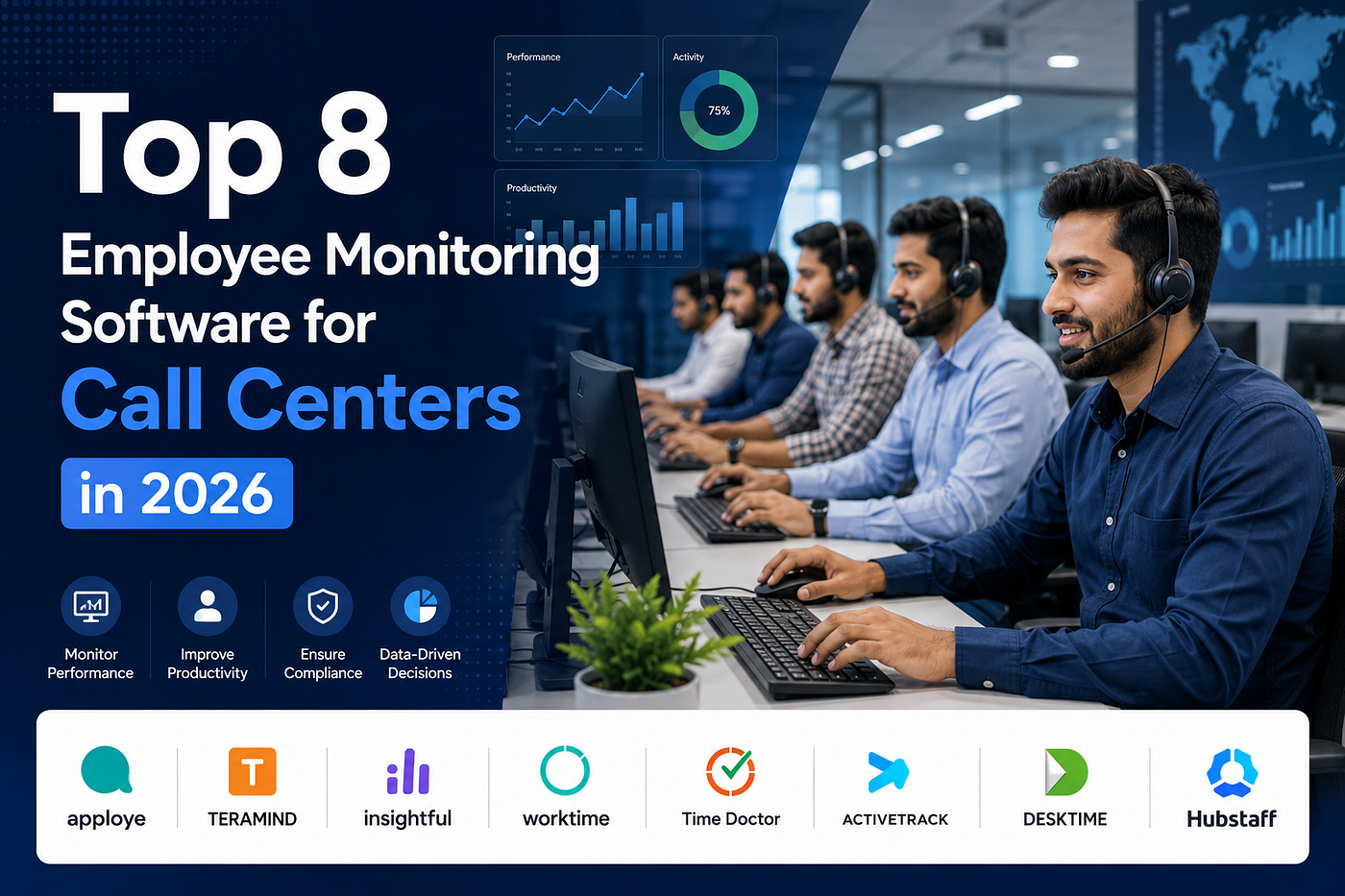
Top 8 Employee Monitoring Software for Call Centers in 2026
Running a call center in 2026 is an absolute logistical tightrope. Whether you are managing a fully remote BPO empire or a hybrid customer…
Top 8 Employee Monitoring Software for Call Centers in 2026
Running a call center in 2026 is an absolute logistical tightrope. Whether you are managing a fully remote BPO empire or a hybrid customer support team, you face the same chaotic variables every single day: unpredictable call spikes, agents missing from their desks right when the queue blows up, compliance risks with sensitive client data, and the endless challenge of figuring out who is actually working versus who has mastered the art of looking busy.
If you are still trying to track performance by simply staring at aggregate daily call counts or forcing your team to fill out manual spreadsheets, you are playing a losing game. It drains your time, damages your margins, and creates zero accountability.
That is exactly why modern operations rely on specialized data systems. To scale smoothly, you need real-time clarity into how every single minute is spent. To make your life easier, I have thoroughly tested, analyzed, and broken down the market’s absolute best solutions.
Here is my expert breakdown of the top 8 employee monitoring software for call centers in 2026.
1. Apploye
Apploye is the definitive industry standard for balancing robust call center oversight with an intuitive interface. Built specifically for remote teams and BPOs, this lightweight engine tracks active work time, monitors digital behavior, and manages back-office administration from a single dashboard.
Its standout “Real-Time Active View” lets you instantly see who is clocked in, active, or on an unauthorized break without an invasive big brother vibe. This visibility makes it easy to rebalance workloads and protect your SLAs during sudden ticket surges.
For visual proof of work, its versatile engine captures up to 60 random screenshots per hour, or can be disabled for senior staff.
Apploye also calculates engagement scores from mouse and keyboard interactions, automatically flagging disengaged staff if an eight-hour shift yields low activity.
Furthermore, its tracking is completely resilient; if an agent loses internet, the app logs data locally and syncs to the cloud once restored.
Combined with built-in client invoicing, shift scheduling, and non-invasive surveillance, Apploye serves as the ultimate operational command center for any growing contact center.
Features
- Automated & Flexible Time Capture: Provides precise clock-in/out logging with both manual and fully automated background tracking to ensure every billable second is accounted for.
- Real-Time Active View & Live Feed: Gives supervisors an instantaneous look at who is active across the entire organization, reducing the friction of managing distributed shifts.
- Granular Screen Monitoring: High-frequency, random screenshot capture (up to 60 per hour on advanced tiers) accompanied by optional note attachments for quick contextual reviews.
- Deep Application & URL Logging: Thoroughly logs every application opened and website visited during work hours, making it incredibly easy to identify non-work distractions.
- Integrated Payroll & Client Invoicing: Seamlessly translates approved employee timesheets into precise payroll calculations and professional, client-ready invoices based on custom project rates.
Pros and Cons
Pros:
- Outstanding, cost-effective scaling that accommodates both tiny startup teams and massive enterprise BPO footprints without breaking the budget.
- Exceptionally clean and easy-to-use dashboard, intuitive user experience that eliminates long onboarding cycles and allows new agents to begin tracking in seconds.
- Robust offline functionality ensures continuity of monitoring data even in regions with unstable or fluctuating internet connections.
- Combines employee activity metrics, project management logs, and financial admin tools into a single cohesive platform.
Cons:
- Highly advanced customization for broader teams may take a little more time.
2. Teramind
When your call center handles sensitive, regulated data like credit card details or healthcare records, your primary focus shifts from basic productivity to absolute security.
That is where Teramind dominates. Engineered as both a staff monitoring tool and an insider threat prevention system, this enterprise-grade powerhouse analyzes the exact context of an agent’s digital behavior.
Teramind records screens like a security camera, allowing supervisors to playback any segment of a shift. Its standout Optical Character Recognition (OCR) engine reads text directly from live screens, instantly catching it if an agent types a social security number or opens restricted files.
Additionally, its real-time policy engine lets you build custom rules. If a tier-one rep tries to download a mass CRM contact list, Teramind instantly blocks the transfer, locks the user out, and alerts your security team — turning raw data into proactive compliance defense.
Features
- Full-Session Screen Recording: High-definition video recording of all user workspace activity with historical playback and comprehensive auditing tools.
- Smart Optical Character Recognition (OCR): Scans and indexes all on-screen text, allowing managers to search for specific keywords, phrases, or sensitive patterns across historical recordings.
- Advanced Behavior Analytics: Measures baseline operational profiles for your staff and highlights anomalous actions that could indicate data leaks or insider risks.
- Automated Policy Enforcement: Instantaneous rule-triggering mechanisms that block unauthorized web uploads, clipboard copies, or file access on the fly.
- Keystroke & Email Monitoring: Tracks every single keystroke typed and monitors email interactions, including attachments, to prevent data filtration.
Pros and Cons
Pros:
- Unparalleled data security and regulatory compliance capabilities for highly restrictive industries like finance and healthcare.
- Deeply detailed forensic evidence collection is vital for internal investigations or external client security audits.
- The highly customizable rule builder gives you absolute authority over what actions are permitted on the company infrastructure.
Cons:
- The intense depth of monitoring and continuous video recording requires massive local storage or expensive cloud data configurations.
- The steep learning curve and highly complex administrative dashboard require a dedicated IT specialist to configure properly.
3. Insightful
If you prefer guiding your call center with high-level trends rather than micromanagement, Insightful is an exceptional option. It focuses on workforce analytics and operational efficiency, gathering systemic workflow data to reveal the broader narrative of how your center functions instead of hounding agents over minor time deviations.
The platform provides elegant visual dashboards breaking down time distribution across productive, unproductive, and neutral tools. For call centers, its standout feature is organizational benchmarking.
You can easily group agents by shifts, locations, or client accounts to compare performance — like analyzing why a morning shift is 15% more productive to pinpoint training gaps or structural bottlenecks.
Insightful also includes built-in burnout monitoring. By tracking long shifts, high activity density, and missed breaks, it flags when agents push too hard. In a high-stress, high-turnover industry like customer service, catching these risks early is an absolute lifesaver.
Features
- Workforce Productivity Labeling: Allows you to categorize applications and websites into custom productivity tiers specific to distinct call center roles.
- Real-Time Productivity Dashboards: Clean, executive-level visual summaries displaying operational efficiency across individual agents, teams, or entire departments.
- Employee Burnout Prevention Insights: Sophisticated tracking metrics that flag agents who are working excessive overtime or skipping regular break intervals.
- Automatic Time Tracking by App Usage: Eliminates the human error of manual timers by automatically mapping work hours based on active application engagement.
- Optional Blurred Screenshots: Preserves operational visibility while protecting sensitive agent or client privacy by automatically blurring captured screen media.
Pros and Cons
Pros:
- Highly polished, modern reporting dashboards that make it incredibly easy to deliver clean productivity data to executive stakeholders.
- Fantastic operational grouping features that simplify managing complex, multi-tiered contact center organizational charts.
- Strong focus on employee wellness and sustainability, helping lower the high turnover rates typical in BPO setups.
Cons:
- It is heavily reliant on aggregate analytics, meaning it lacks the granular, forensic threat-detection tools found in security-first platforms.
- The mobile application ecosystem is somewhat limited compared to its incredibly robust desktop monitoring suite.
4. WorkTime
Not every call center thrives under heavy surveillance; aggressive tracking can tank morale and spike turnover. If you want to monitor output without creating a Big Brother atmosphere, WorkTime is the perfect non-invasive choice.
Operating on the philosophy that you can measure productivity without spying, the software completely omits screenshots, keylogging, and webcam access. Instead, it purely tracks raw time metrics, attendance logs, and application usage. This delivers essential operational data — like active hours, idle intervals, and distraction scores — without collecting intrusive details.
For teams prioritizing retention, WorkTime is an easy sell. It serves as an optimization and coaching tool rather than a punitive system, keeping your queues optimized while protecting your agents’ digital privacy.
Features
- Zero-Surveillance Architecture: Intentionally built without screenshot capture, keylogging, or screen recording to fully respect agent privacy.
- Advanced Idle & Active Time Analysis: Pinpoints exactly how much of a shift was spent actively engaging with core tools versus sitting in an idle state.
- Distraction Score Metrics: Automatically calculates what percentage of an agent’s digital footprint is consumed by non-essential web browsing or social platforms.
- Attendance & Punctuality Auditing: Delivers pristine tracking of exact clock-in times, early departures, and extended shift absences.
- Remote vs. On-Site Comparison: Tailored reporting modules that contrast the productivity profiles of work-from-home agents against office-bound teams.
Pros and Cons
Pros:
- Fosters an internal culture of trust and high morale, virtually eliminating the standard employee pushback against tracking software.
- Incredibly lightweight software footprint that operates seamlessly in the background without degrading computer performance.
- Simpler regulatory compliance path due to the deliberate omission of capturing protected personal or financial data on screens.
Cons:
- Complete lack of visual proof makes it impossible to forensically verify mistakes or investigate specific behavioral disputes.
- Cannot fulfill strict client contracts that legally mandate visual screen auditing for high-security data management.
5. Time Doctor
Time Doctor is a seasoned veteran in the remote workforce management space, making it a highly reliable and popular choice for large-scale BPOs and outsourced call centers.
It excels at keeping distributed agents heavily focused on their immediate tasks by combining backend monitoring with active, front-facing employee engagement features.
The platform is famous for its proactive distraction alerts. If an agent drifts away from their dialer software and starts scrolling through social media or watching a video, Time Doctor detects the non-work activity and pops up an immediate, on-screen notification asking, “Are you still on task?”
This gentle, automated push is often all it takes to snap a distracted agent back to reality without requiring a supervisor to manually intervene.
Time Doctor also breaks down daily workflows into highly granular time categories, allowing you to see exactly how many hours are spent directly on phone calls, how much time is consumed by post-call documentation (ACW — After Call Work), and how much time is lost to general administrative overhead.
Furthermore, it boasts massive integration capabilities with core customer service platforms like Zendesk, Asana, and Freshdesk, ensuring your tracking data mirrors your actual support ticket workflows.
Features
- Interactive Distraction Reminders: Automated, intelligent pop-up triggers that remind agents to stay focused when unproductive apps or sites are accessed.
- Granular Task & Project Breakdown: Allows agents to toggle between specific clients or ticket queues, creating clean, segmented billing data.
- Comprehensive Integration Network: Connects natively with dozens of major CRM, project management, and helpdesk ecosystems to unify your tech stack.
- Automated Daily Email Summaries: Sends managers and executives clean daily digests outlining top performers, idle metrics, and team-wide time distribution.
- Webcam & Screen Verification Options: Includes optional, customizable screenshot captures alongside automated webcam snapshots for high-accountability environments.
Pros and Cons
Pros:
- Highly effective at driving immediate, real-time focus improvements among remote agents via automated nudges.
- Phenomenal out-of-the-box integrations with the industry’s most popular call center helpdesks and ticketing engines.
- Proven track record of handling massive, multi-national BPO enterprise deployments with thousands of active endpoints.
Cons:
- The front-facing pop-up notifications can occasionally feel intrusive or annoying to high-performing, self-motivated agents.
- The user interface layout feels a bit utilitarian and dated compared to sleeker, modern platforms.
6. ActivTrak
ActivTrak is an incredibly smart, cloud-based productivity platform that leverages automated coaching insights to help call center managers optimize their team structures.
Instead of operating as a traditional disciplinary tool, ActivTrak positions itself as a business intelligence platform focused entirely on workforce optimization and operational efficiency.
The system uses advanced cloud analytics to automatically categorize your call center workflows into clear buckets: focused work, collaborative hours, and administrative tasks.
What truly sets ActivTrak apart is its automated “Manager Coaching Insights.” The platform actively scans your historical team data to find specific operational trends and delivers written recommendations directly to your inbox.
For example, it will automatically flag that a specific agent’s focus has plummeted over the last two weeks while their idle time skyrocketed, suggesting it might be time for an alignment check-in.
It also provides brilliant workload balance charts that map out who on your team is consistently over-utilized (at risk of burning out) and who is under-utilized (capable of taking on more inbound call volume).
This enables you to make data-backed scheduling adjustments that optimize your entire operation.
Features
- Automated Workforce Classification: Uses advanced contextual algorithms to categorize digital activities into focused, collaborative, or distracting segments.
- Workload Balance Mapping: Clear, real-time charts highlighting the exact distribution of labor to prevent quiet quitting and employee burnout.
- AI-Driven Management Coaching Insights: Delivers automated, proactive notifications suggesting specific management interventions based on behavioral trends.
- Alarms & Security Trigger Logs: Monitors for unauthorized activities, such as an agent accessing personal cloud storage or inserting USB drives, and logs the event instantly.
- High-Level Trend Benchmarking: Compares historical team-wide performance data against current cycles to clearly illustrate long-term operational growth or regression.
Pros and Cons
Pros:
- Delivers deeply insightful, automated management advice that saves supervisors hours of manual data analysis.
- Excellent, balanced visual representations of team workloads that make shift scheduling a breeze.
- Focuses on a constructive coaching methodology rather than creating a punitive, high-stress work environment.
Cons:
- Raw time tracking mechanisms are secondary to its high-level analytics, which might frustrate managers seeking strict, second-by-second logging.
- Continuous screenshot capture and deep forensic investigation tools are gated behind expensive premium add-ons.
7. DeskTime
If your call center relies on a highly flexible, hybrid workforce where agents frequently shift between working from home and commuting into a physical office, DeskTime is an exceptionally reliable asset.
It is built entirely around automated, zero-stress time tracking, running quietly in the background without requiring your employees to constantly click start and stop buttons throughout the day.
DeskTime initiates its tracking protocols the exact millisecond an agent boots up their computer and stops the moment they log off for the evening.
It automatically categorizes every application and website into three strict, customizable designations: productive, unproductive, or neutral. For a call center environment, this is incredibly helpful.
You can designate your core VOIP software, CRM platform, and internal knowledge bases as highly productive, while social platforms and video streaming sites are flagged as unproductive.
DeskTime then aggregates this data into a continuous, real-time “Productivity Bar” that displays an agent’s efficiency rating as a clean percentage over the course of their shift.
It also features built-in shift scheduling and a dedicated document title tracking tool, which allows managers to see the exact files or specific ticket URLs an agent worked on without needing to look at high-volume screenshot files.
Features
- Automated Background Tracking: Completely removes human error from the equation by operating continuously from machine boot-up to shutdown.
- Real-Time Productivity Percentages: Delivers a dynamic, live efficiency score for every agent based on their active ratio of productive vs. unproductive tool usage.
- Granular Document Title Logging: Captures the specific titles of documents, emails, and web pages being accessed, providing deep context without massive screenshot storage.
- Built-In Shift & Absence Scheduling: Streamlines call center operations by managing employee schedules, vacation requests, and sick leave directly inside the tracking dashboard.
Pros and Cons
Pros:
- Total automation means your agents can focus entirely on customer support instead of managing their time-tracking software.
- The document title tracking feature provides brilliant, text-based contextual clarity without invading privacy through constant screenshots.
- Highly intuitive and effective shift-planning module that unifies schedule management with time audits.
Cons:
- Because it is entirely automated, it struggles to cleanly categorize offline work, such as physical training sessions or manual paper reviews, without manual adjustments later.
- Lacks deep, granular security parameters or automated threat-blocking rules for high-compliance environments.
8. Hubstaff
For call center operations that feature a mobile or field service element — such as dispatched tech support agents, traveling sales teams, or hybrid customer service reps who split time between a central office and on-site client visits — Hubstaff is an exceptional choice.
It is widely recognized for combining robust desktop monitoring with highly accurate GPS-based location tracking.
Hubstaff tracks desktop activity through standard keyboard/mouse engagement metrics and optional screenshot captures, giving you standard call center visibility.
However, where it truly shines is its mobile tracking ecosystem. Using advanced geofencing technology, Hubstaff can automatically clock an agent into their shift the exact moment they walk into a specific physical call center or client location, and clock them out when they leave.
You can assign specific financial budgets to different call center queues or client accounts, and the software will track labor costs in real time as agents log hours against them.
If a particular project starts burning through its allocated budget too quickly, Hubstaff fires off automated alerts, allowing you to re-strategize before your profit margins vanish.
Features
- Advanced GPS & Geofenced Time Tracking: Automatically coordinates clock-ins, clock-outs, and location history based on customizable physical geographic boundaries.
- Activity-Based Engagement Scores: Monitors input peripheral frequency to calculate a precise digital engagement percentage for every single work segment.
- Real-Time Project Budgeting & Alerts: Tracks ongoing labor costs against pre-set project budgets and warns management before cost overruns occur.
- Automated Invoicing & Payroll Pipelines: Accelerates corporate administration by automatically processing international payments and client bills based on validated time logs.
- Lightweight Multi-Platform Support: Operates flawlessly across macOS, Windows, Linux, iOS, and Android ecosystems with minimal system strain.
Pros and Cons
Pros:
- Unrivaled location-based monitoring and geofencing capabilities for call centers with mobile or hybrid field footprints.
- Phenomenal project financial tracking that protects your bottom-line profitability in real time.
- Highly reliable across all operating systems, providing unified visibility regardless of what hardware your team uses.
Cons:
- The activity scoring metrics are heavily based on raw keyboard and mouse movements, which can misrepresent an agent’s actual workload if they are locked into long, verbal phone calls.
- Setting up the advanced geofencing parameters and custom project budgets requires a bit of time and configuration during initial rollout.
The Definitive Call Center Software Showdown
To help you cut through the noise and see how these tools stack up side-by-side, I have put together this clear comparison matrix mapping out the core operational pillars that matter most to call center leadership:

The Expert Verdict: How to Choose Your System
Choosing the right digital platform is not about buying the tool with the absolute longest feature list. It is about choosing the system that matches your specific call center layout and company culture.
- If you want the overall best software to monitor employees that seamlessly blends real-time shift oversight, screenshot validation, and clean reports blowing your budget, Apploye is the absolute smartest choice for modern operations.
- If you are managing high-security accounts where data security is a strict legal requirement, invest heavily in Teramind.
- If you want to purely optimize your high-level workflows and track team health without getting lost in micromanagement, go with Insightful or ActivTrak.
- If you face massive team pushback regarding privacy and want to track purely operational time without any screen capturing, roll out WorkTime.
Take an honest look at your current call queues, find your biggest operational leak, and deploy the system that gives you the data to fix it. Your margins, your managers, and your peace of mind will thank you.
메타데이터
- post_id
- 35d64be1d3d1
- slug
- top-8-employee-monitoring-software-for-call-centers-in-2026-35d64be1d3d1
- url
- https://medium.com/@inzm_64707/top-8-employee-monitoring-software-for-call-centers-in-2026-35d64be1d3d1
- canonical_url
- https://medium.com/@inzm_64707/top-8-employee-monitoring-software-for-call-centers-in-2026-35d64be1d3d1
- author_url
- https://medium.com/@inzm_64707
- status
- ok
- fetched_at
- 2026-06-25 07:00:49






