Agentic AI Is About to Force Your Data & Analytics Governance Hand
Why most companies won’t fix it at their peril
Agentic AI Is About to Force Your Data & Analytics Governance Hand
Why most companies won’t fix it at their peril
The industry is in a familiar cycle. Vendors and consulting firms publish playbooks on “data & analytics governance.” Analysts warn about the risk of ungoverned AI. Conferences fill with panels on data stewardship, operating models, and metrics standards.
To be clear, by “governance,” I mean the end-to-end discipline that makes data, analytics, and increasingly AI-driven decisions controlled, auditable, and repeatable — not just catalogs and policies.
And yet, a large share of companies will continue doing what they’ve always done: ship analytics unevenly, tolerate messy definitions, accept duplicative dashboards, and muddle through. For years. Sometimes profitably.
That isn’t an argument against the necessity of governance. It’s an argument against the assumption that evidence and urgency alone will change behavior.
Given the magnitude of governance messaging in the market today, I keep coming back to a simple question: if governance is such an obvious “best practice,” why do so few organizations reach maturity — and what, realistically, does it take to get them there?
Company performance is not a referendum on data governance
Governance advocates often imply a straight line: better governance → better decisions → better business outcomes. Directionally true, but incomplete.
Business performance is an output of many forces: product-market fit, pricing power, distribution, brand, sales execution, cost structure, leadership, and timing. Data& Analytics governance competes with those priorities — often losing because it’s hard to attribute impact.
This “measurement gap” is documented: many data leaders struggle to demonstrate governance impact to leadership, and governance success is still measured through operational activity metrics rather than business outcomes.
So for a CEO, governance can look like a tax: important, but not urgent. The company is shipping, closing deals, delivering product. “We’ll clean it up later” becomes a rational decision.
Until “later” arrives as a crisis. In practice, governance becomes urgent only when something changes the incentive structure.
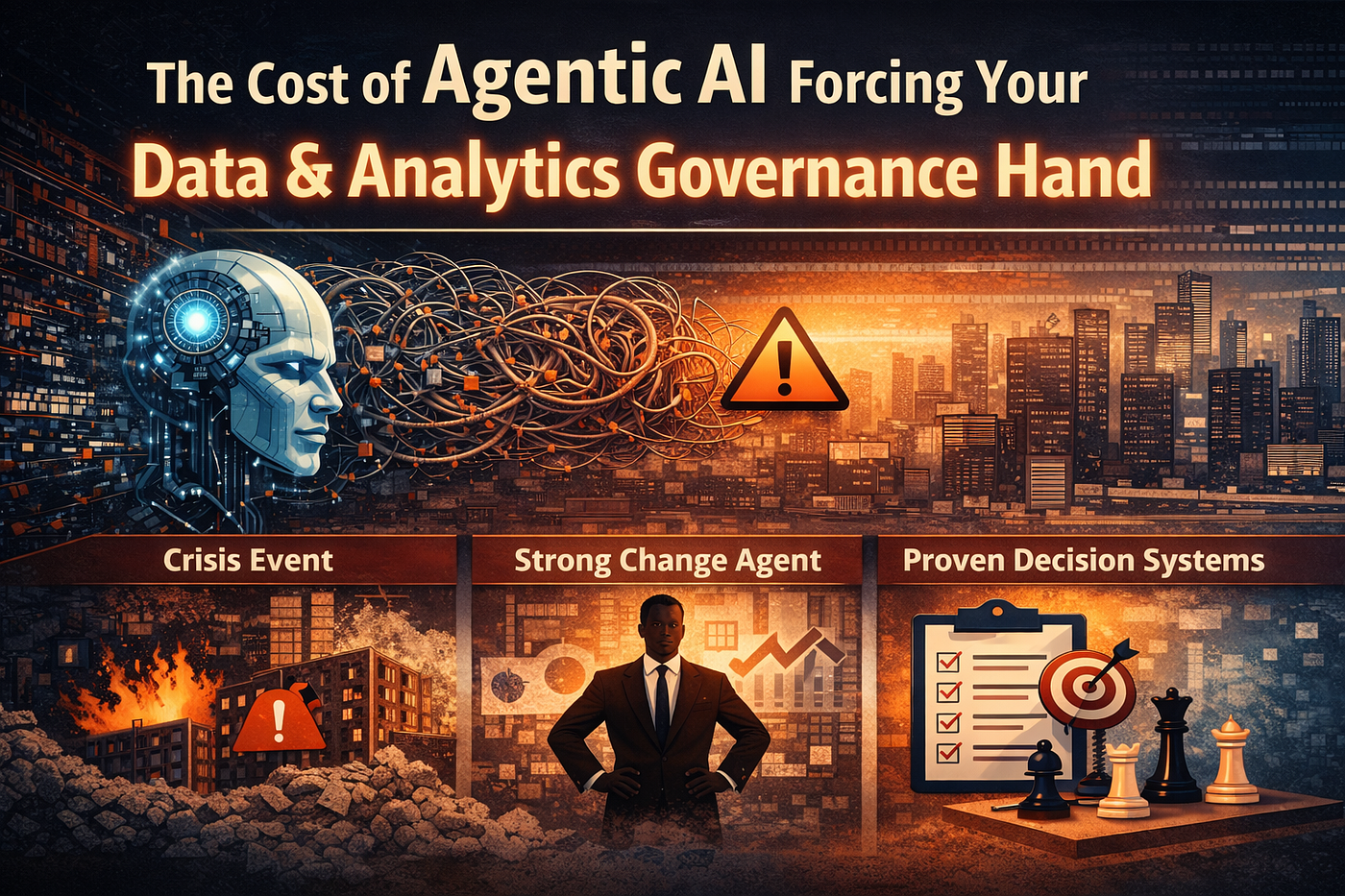
As autonomy rises, governance usually becomes urgent in one of three ways: a crisis forces it, a powerful sponsor drives it, or a decision use case proves value quickly.
Many firms get by with weak governance
A lot of organizations survive — sometimes for decades — with fragmented definitions and poor data discipline because:
- Humans compensate with meetings, tribal knowledge, and spreadsheets
- Power users build “shadow systems” that patch holes quickly
- Decision-making is slow enough that errors aren’t immediately visible
- The business can absorb inefficiency because margins or growth are strong
This is why governance so often fails: it requires sustained cross-functional behavior change, but it competes against projects promising immediate ROI, and it’s vulnerable to fading sponsorship.
Data quality expert Thomas C. Redman has argued that data governance failures are usually organizational — ownership and incentives — not technical. Misaligned incentives, unclear ownership, and lack of advocates are persistent blockers.
Many companies will keep underinvesting because the cost of the status quo is diffuse, while the cost of governance is immediate.
Agentic AI makes the trade-off uglier
Agentic AI changes the economics because it moves analytics from “insight” to “action.” If a system can take steps, trigger workflows, change data, or interact with production tools, governance stops being a “data program” and becomes a control system.
Not because companies have no controls, but because agentic systems raise the bar: you need decision-level guardrails, logging, and accountability that cut across teams and tools.
That’s part of why the Decision Intelligence Platforms Magic Quadrant is getting a lot of attention. It spotlights an inconvenient reality for many organizations: scaling AI isn’t only about better models or the nuances of machine learning — it’s about operating decisions (what’s allowed, what’s logged, what’s monitored, who owns outcomes).
The risk is no longer hypothetical. McKinsey highlights that organizations report risky behaviors from AI agents (improper data exposure, unauthorized access), citing a survey of security/IT professionals. Gartner has also warned that a large fraction of agentic AI projects will be canceled by 2027 due to costs and unclear business value — an outcome consistent with weak governance and fuzzy ownership.
In other words: agentic AI doesn’t only reveal governance gaps, it amplifies them.
Why leaders don’t feel the urgency
Because the evidence typically arrives in the wrong form, the governance argument is usually presented as:
- “You need better standards.”
- “You need stewardship.”
- “You need policies and guardrails.”
All true. But most organizations don’t respond to “need.” They respond to a forcing function — a moment when the cost of not changing becomes unavoidably personal and financial.
Which leads to the real question: what actually triggers the transition from “we should maybe someday” to “we must right now”?
Three ways governance becomes unavoidable
1) A shock event that makes the cost visible This can be a major outage, a compliance incident, a breach, a revenue miss linked to bad metrics, or an AI failure that becomes board-visible. InformationWeek points out the scale of unstructured data challenges and how they increase costs and compliance risks — problems that often remain abstract until they turn into an incident.
2) A uniquely positioned change agent with sustained authority Many governance programs fail due to insufficient sponsorship and lack of durable ownership. What’s rarer is a leader who can connect business outcomes to governance mechanics and has the mandate to standardize across functions.
That person is often not just a CDO. It can be a COO, CFO, or Chief Risk Officer — someone whose authority matches the cross-functional nature of governance.
3) A “decision system” use case that proves value quickly This is where Decision Intelligence Platforms (and decision-centric framing) can help. A decision system provides a bounded scope: define the decision, instrument it, govern it, and show measurable outcomes.
Instead of “enterprise data governance,” it becomes:
- pricing decisions
- claims decisions
- fraud decisions
- agentic workflow approvals
Value becomes demonstrable because the decision is measurable.
This aligns with surveys reporting that governance maturity is low at enterprise scale (for example, a 2025 analytics governance report cites low maturity and higher success among mature orgs), but maturity is more attainable when tied to concrete operating systems.
Yes, vendors are right — but still won’t “solve it” for most customers
Vendors and consultancies are correct to model best practices from high-maturity companies. The missing piece is that governance isn’t primarily a knowledge problem.
It’s an incentives problem. A power problem. A prioritization problem.
Until organizations experience a forcing function, governance stays optional. And when governance stays optional, “agentic AI at scale” becomes far harder than the hype implies.
In fact, we’re already seeing the outlines of the next wave of disappointment: organizations rush into agentic AI, encounter risky behaviors, skip risk assessments, and realize too late that autonomous systems require continuous monitoring and controls.
A more honest leadership message
If you’re a data or analytics leader, the goal shouldn’t be to win an argument about the relevance or importance of governance.
The goal should be to identify:
- What forcing function is coming (or can be created safely and strategically),
- Which decision system can prove the value of governance quickly, and
- Who has the authority to institutionalize it beyond a project cycle.
With evidence in hand, a sponsor creates credible urgency that rises to the top of the priority list. Without it, no action is likely since execs don’t yet feel the cost of not acting — personally, financially, and immediately.
Agentic AI is about to make that cost feel a lot less theoretical.
메타데이터
- post_id
- 35e7ebf5d307
- slug
- agentic-ai-is-about-to-force-your-data-analytics-governance-hand-35e7ebf5d307
- url
- https://medium.com/@gib.bassett/agentic-ai-is-about-to-force-your-data-analytics-governance-hand-35e7ebf5d307
- canonical_url
- https://medium.com/@gib.bassett/agentic-ai-is-about-to-force-your-data-analytics-governance-hand-35e7ebf5d307
- author_url
- https://medium.com/@gib.bassett
- status
- ok
- fetched_at
- 2026-07-30 08:49:30