Your Company Promised to Reskill You for AI. Most Won’t.
In the World Economic Forum’s most recent Future of Jobs Report, 77% of employers said they plan to reskill or upskill their workers for AI…
Your Company Promised to Reskill You for AI. Most Won’t.

In the World Economic Forum’s most recent Future of Jobs Report, 77% of employers said they plan to reskill or upskill their workers for AI by 2030.
According to Randstad Digital’s May 2026 report, 52% of technology professionals are already seeking AI training independently, because internal programs can’t keep pace.
That AI reskilling gap, between what companies have promised and what’s reached the people who need it, is key to understanding what’s happening right now. Indeed, the promise side is real: most CEOs have said it on earnings calls, and many L&D teams have it in their strategy plans. It seems that the delivery side is the problem.
If you’re just starting your career or are a mid-career professional waiting for your employer to train you on AI, this data is telling you something different. The training may not come. Or if it does, it will arrive eight months after the skill matters and consist of three lunch-and-learns and a LinkedIn Learning license rarely opened.
What’s actually happening inside companies
The promise often stalls because of how large institutions work. As we well know, AI tooling moves fast. A reskilling program designed in Q2 is stale by Q4. The MCP standard didn’t exist 18 months ago and is now baseline infrastructure. Agent harnesses, personal AI assistants, and evaluation frameworks; these are 2026 vocabulary that didn’t exist when most L&D budgets were locked in.
Most internal L&D teams are not built to ship technical training on a six-month cadence. They run annual cycles. They contract with vendors whose curricula are written by committee. They survey employees, prioritize, build, pilot, deliver — and by the time the program reaches you, the field has moved on.
The SME problem makes it worse. To teach AI engineering well, you need people who build AI engineering. Companies that have those people are using them to ship products, not to staff internal training sessions. The training that does happen often gets handed to whoever is available, which is rarely the person you wanted.
The result is the gap between the strategy deck and your inbox. The CEO says, “We’re investing in AI skills.” The L&D email three months later says, “We’re excited to announce a six-part webinar series on prompt engineering best practices.” Perhaps too little too late.
This is the friction between how fast the technology moves and how slowly large institutions move. But understanding it doesn’t help you. The training is still not coming.
What the data shows about who’s getting ahead
While corporate reskilling stalls, the people who are getting AI skills are getting them mostly on their own. The market is rewarding them disproportionately.
PwC’s 2025 Global AI Jobs Barometer found that roles requiring AI skills carry a 56% wage premium over comparable non-AI roles. A year earlier, that premium was 25%. It more than doubled in twelve months while corporate training programs were stuck in procurement.
LinkedIn ranks AI Engineer as the #1 fastest-growing job in the US for the second year running. Between 2023 and 2025, the platform tracked 75,000 new **AI Engineer roles** in the US alone — part of 1.3 million AI-related jobs added globally in two years. Median total compensation at major tech: around $245,000 (per Levels.fyi).
The professionals capturing this aren’t waiting for an HR email. They’re learning on personal time, with personal budget or getting reimbursed by their company, on their own initiative. Some are software engineers adding the LLM and agent layer to skills they already have. Some are data scientists moving from training models to shipping products. Some are mid-career PMs and analysts who decided they didn’t want to be the last person on their team to understand what their engineers were building.
If you’re a professional reading this, the question isn’t “when will my company train me.” The training is not coming, or it will come too late to matter, or it will be wrong. The question is “What’s the fastest credible path I can take on my own?”
The system isn’t built for the speed of the technology. The people who treat reskilling as a personal project are the ones the wage data is rewarding. The people waiting for institutional support may be the ones who will be told in 2028 that their roles are being “redesigned”.
What the path actually looks like
Some options, in rough order of effort:
Self-study: Free or cheap. Works if you have disciplined hours, a clear curriculum, and the patience to push through plateaus without a peer group. Most people who start this don’t finish. Of the ones who do, the strongest signal of success isn’t the courses they watched — it’s the project they shipped. Set clear goals if you pursue this path.
Employer-paid programs that actually work: They exist but are rarer than HR pages suggest. Some companies have built real ones, taught by practitioners and anchored to projects, not just video libraries. If your employer offers something concrete, take it. If a program is in the works, find out when it’s launching and whether it covers the skills you actually need; if the answer is vague, supplement with one of the other options below.
Cohort-based accelerators: Live courses, instructor-led, time-bounded. It costs more than self-study, less than a master’s. The good ones are taught by practitioners shipping production AI and culminate in a real artifact you can show: a fine-tuned model, a RAG system, a deployed agent.
Master’s degree: Two years, $60K–$100K, valuable signal but slow. If you have the time and budget and want the credential, fine. For most mid-career professionals, it’s the wrong instrument given the pace of AI change.
Just start building: The best engineers I know didn’t take a course first. They picked a problem, picked a tool, and built something, even if not perfect. Then something better. They put it on GitHub. That’s a credible path for the small minority of people with the right mix of curiosity, time, and stubbornness. For most, it’s not enough on its own, but combined with one of the above, it’s the strongest version.
What’s actually new in 2026
Five things to know if you’re choosing a path right now:
Personal AI agents are mainstream: Two years ago, “I use ChatGPT” was a differentiator. In 2026, it’s the baseline. Building an agent is the new differentiator.
MCP became infrastructure: Over 10,000 public MCP servers as of late 2025. Microsoft, OpenAI, and Anthropic all ship MCP support. If you’re learning AI in 2026, you need to know what MCP is and how to use it. This was not true in 2025.
Agent harnesses became the architectural layer: The frameworks that orchestrate how agents plan, execute, recover from errors, and manage context now sit on top of MCP and underneath the application. A year ago, this layer didn’t have a name. In 2026, it’s where the engineering work happens.
The job description shifted: AI Engineer in 2024 meant “person who calls OpenAI’s API.” AI Engineer in 2026 means agent design, RAG architecture, fine-tuning when it makes sense, evaluation pipelines, observability, and deployment. The bar moved.
The wage premium is accelerating: According to PwC, the AI wage premium is up from 25% to 56% in a year. The market is still rewarding the early movers, but the window is narrower than it was.
A note on something different for AI reskilling
All of the AI reskilling options above are viable. Here is another option.
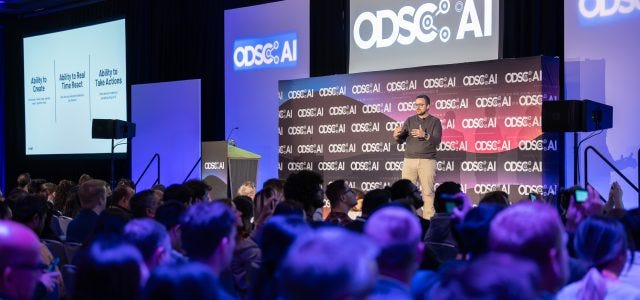
The ODSC AI Engineering Accelerator is the only one that ends at a conference. Seven weeks of live, cohort-based work, then three days alongside thousands of practitioners at ODSC AI West or East. The curriculum was designed in May 2026: personal AI, agent harnesses, MCP, and the current agent stack. The Accelerator ends with you in a room full of people doing this work in production.
메타데이터
- post_id
- 35ea88b7c785
- slug
- your-company-promised-to-reskill-you-for-ai-most-wont-35ea88b7c785
- url
- https://medium.com/@odsc/your-company-promised-to-reskill-you-for-ai-most-wont-35ea88b7c785
- canonical_url
- https://medium.com/@odsc/your-company-promised-to-reskill-you-for-ai-most-wont-35ea88b7c785
- author_url
- https://medium.com/@odsc
- status
- ok
- fetched_at
- 2026-06-09 19:06:51