The First Wedding in Lesvos Since Greece Legalised Same-Sex Marriage
There wasn’t a dry eye in the harbour of Sappho’s hometown
The First Wedding in Lesvos Since Greece Legalised Same-Sex Marriage
There wasn’t a dry eye in the harbour of Sappho’s hometown
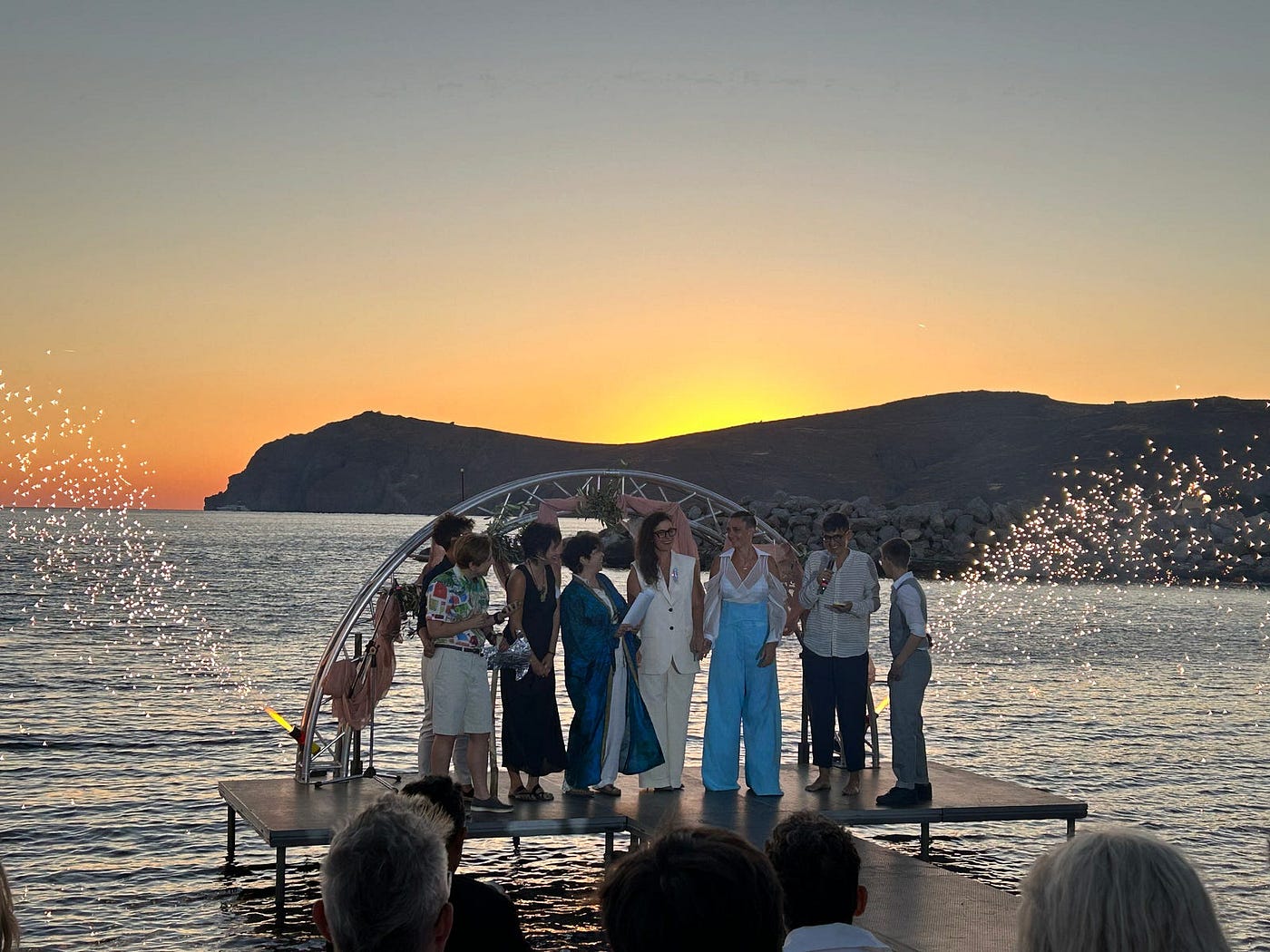
Sunset over Sappho’s Rock during the ‘Best Dyke’ speech at the lesbian wedding of the year. Photo: Clay Hand
Two of the world’s most prominent lesbian activists, Dragana Todorović and Evgenia Giakoumopoulou, stood in the back of a pick-up truck in the harbour of Eressos, a small town on the Greek island of Lesvos.
As the sun set into the sea, Guns N’ Roses’ Sweet Child O’ Mine blazed through the sound system as 200 members of their families, friends, colleagues, and the local Sapphic community welcomed the jubilant brides with cheers and tears.
As the birthplace of the poet Sappho, Eressos has been a place of pilgrimage for queer women since the 1970s; there’s a sizeable permanent community here, while hundreds, sometimes thousands of lesbians head to the island every year on “roots” trips.
This coastal town has hosted its fair share of ceremonies, unofficially held by friends over the decades, but this wedding ceremony — the first on the island of Lesvos since Greece legalised same-sex marriage in February — was seismically important.
“You came and I was crazy for you, and you cooled my heart that burned with longing,” said the wedding’s officiator, Tzeli Hadjidimitriou, quoting Sappho. “With these words, Sappho welcomed her loved ones here in Eressos, two-thousand six hundred years ago,” continued Tzeli, who’d driven in on a speed boat wielding a Labrys made of tin foil minutes before the couple’s truck pulled up.
Tzeli, who is a community elder, filmmaker and a rare “double Lesbian” (a queer woman born on the island of Lesvos), continued,
If someone had told me a few years ago, that here in front of the Aegean Sea, in the company of the statues of Sappho, on the edge of Greece, we would officially celebrate the love of two women, I would have thought of them as crazy, or as dreamers.

The Brides arrived in true dyke-fashion, designer clothes in a pick-up truck. Photo: Bea Uhart
From the hardest butch to the most stoic local, there wasn’t a dry eye in the harbour as the “Best Dykes” spoke effusively of the power couple’s love. Countless lesbian love stories have unfolded on these shores, and this ceremony felt like the culmination of generations of herstory. “I’d never seen my mum or dad cry,” said Dragana, while dykes who’d never considered marriage were suddenly scouring the crowd for the one.
The presence of both bridal families was another significant teary-eyed element to the big day. Dragana is Serbian, while Evgenia’s family are Greek; both nations are majority Christian-Orthodox. In Serbia, despite their most recent prime minister, Ana Brnabić, being an out-lesbian, same-sex marriage is illegal and there has been significant pushback at any attempt to shift this.
Greece became the first Christian-Orthodox nation to allow gay marriage (it passed with 176–76 votes early this year). Large rallies erupted on the streets of Athens in the aftermath of the ruling as concerned citizens brandishing crucifixes chanted prayers of absolution in the Greek capital’s Syntagma Square.
Witnessing such an intergenerational and international celebration of love felt like a victory. Queer marriage has been tirelessly fought for by activists the world over, and two world-renowned lesbian activists merged their lives together on that dreamy evening by the sea.
Dragana became an activist when she was six years old. “I was the little butch girl,” she said after her big day, who stood up for the bullied “effeminate” boy in her class. “That’s how my activism started,” she continues, “and I never stopped getting into fights… now I’m doing these fights in a grown-up way but it’s the same core.”
At 43 years old, Dragana is now the Executive Director of the EuroCentralAsian Lesbian Community (ELC), a network of lesbian-feminist activists who ensure that queer women have a seat at the table in international fora.
Earlier this year, the EL*C’s efforts led to the Parliamentary Assembly of the Council of Europe adopting the first-ever resolution on LBQ women. It is “the first international human rights standard focusing specifically on us,” says Dragana.
Power and diligence seem to drip from Dragana’s pores, she’s raised millions for grassroots lesbian organisations around the world, “and it’s only the beginning,” she promises — and she’s not lying!

The idyllic Sunset setting Photo: Sarani Heron
Evgenia, who’s 38 years old and undoubtedly her wife’s “number one fan,” has equally devoted her life to expanding LGBTQ+ rights. She currently heads up the Council of Europe’s Sexual Orientation, Gender Identity and Expression, and Sex Characteristics (SOGIESC) Unit.
Dragana describes Evgenia as someone who “embodies a lot of characteristics, as a person, and as a professional that can navigate the difficult space of fighting institutions from within.” Dragana also speaks of her admiration for her wife’s resilience, sense of duty and sacrifice for LGBTQI+ people. To which, Evgenia, who “spends [her] life bragging about Dragana,” queries: “Can we do these meetings weekly — I had no idea you felt any of this!”
“It was all about my brains this whole time,” says Evgenia, who’s also a boxer, with a short back-and-sides and a Labrys tattooed on her left bicep. “And you’re sexy,” adds Dragana. The couple seem mutually awed, inspired and smitten by the other.
The Labrys — “the ultimate lesbian symbol,” according to Dragana — played a sizeable role in their wedding day. The couple wore matching silver necklaces and wielded Tzeli’s jumbo tin foil Labrys to slice their wedding cake.
Evgenia explains that “lesbians are always seen as serious, fighters, castrators, hysterical whatever else… but I think we have so much damn humour and self-derision, making fun of our own dyke-drama and exaggerations.” She says that she rewatches their wedding videos and laughs out loud at the “ridiculousness and awesomeness” of the day.

The couple cut their cake with “the ultimate lesbian power symbol” — a labrys. Photo: Clay Hand
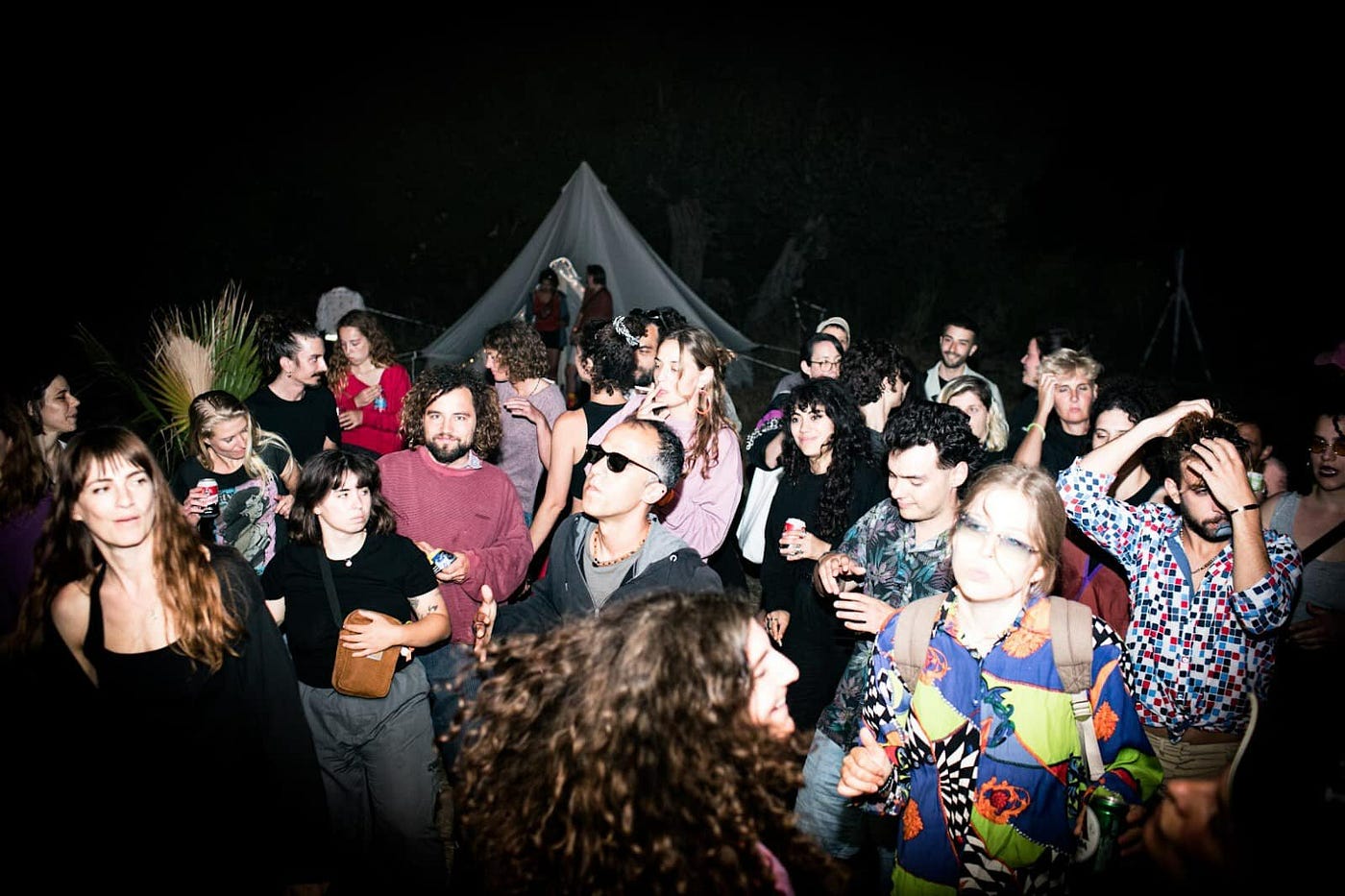
After the ceremony, the congregation was herded from the harbour to a lesbian bar on the shore. No expenses were spared; an abundance of food and bubbly awaited guests under a crescent moon.
Locals and lesbians took to the dancefloor en masse, though the most notably joyful dancer was Tzeli. This double lesbian has, after all, experienced firsthand how far Greece has come, and how far LGBTQ+ people have come as well.
To stand hand-in-hand in front of our loved ones with the state’s blessing is a brand-new phenomenon here. This was an evening to celebrate this time and this place, in which Sapphic dreams come true.
Read more about queer life on the Greek Island of Lesvos…
How about another Extraordinary Sapphic Love Story on these sacred shores?
메타데이터
- post_id
- 3607aece93c0
- slug
- the-first-wedding-in-lesvos-since-greece-legalised-same-sex-marriage-3607aece93c0
- url
- https://medium.com/prismnpen/the-first-wedding-in-lesvos-since-greece-legalised-same-sex-marriage-3607aece93c0
- canonical_url
- https://medium.com/prismnpen/the-first-wedding-in-lesvos-since-greece-legalised-same-sex-marriage-3607aece93c0
- author_url
- https://medium.com/@claredhand
- status
- ok
- fetched_at
- 2026-07-23 10:24:43