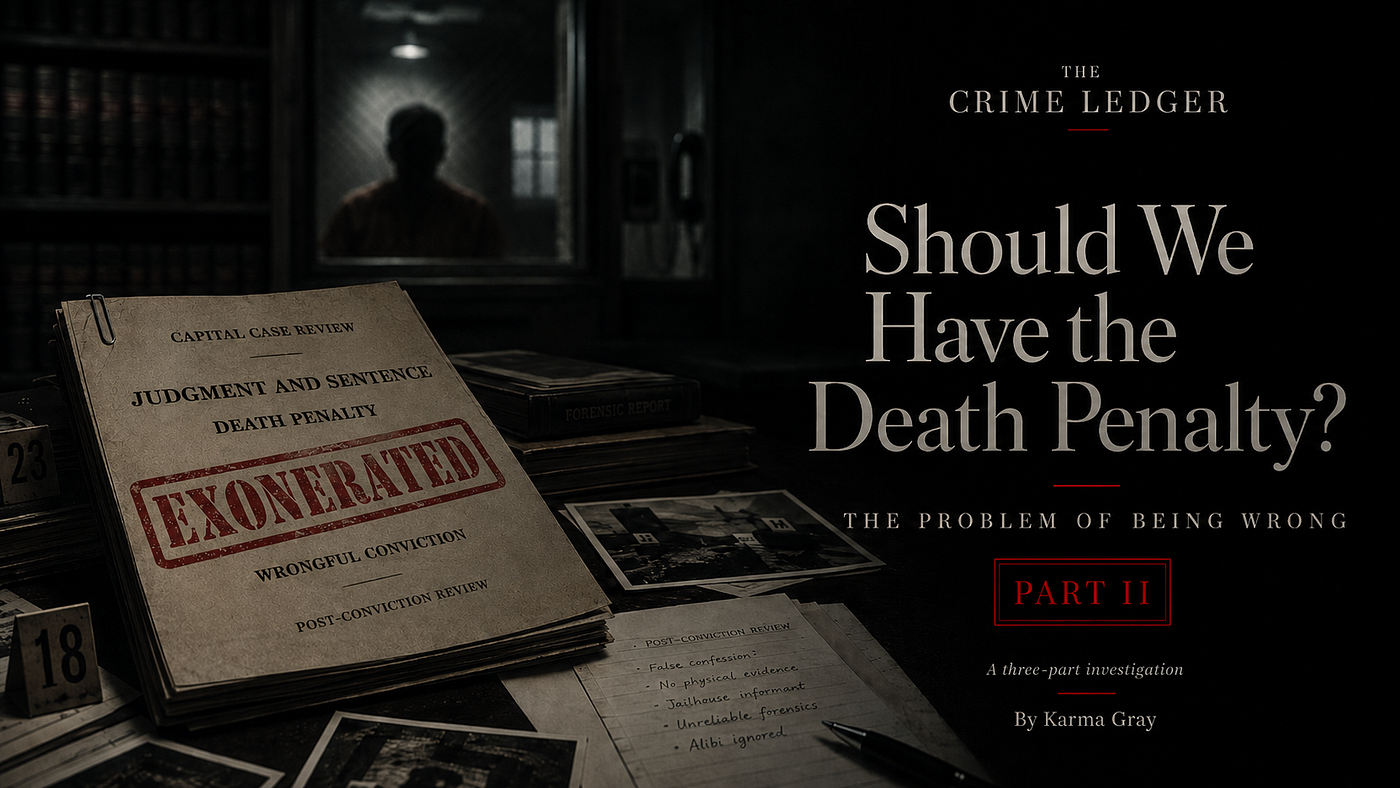
The State Wants to Kill Him. What If the State Is Wrong?
A judge sits above the room. A defendant stands below him. The lawyers have spent months turning grief into argument, evidence into…
The State Wants to Kill Him. What If the State Is Wrong?

A courtroom can make death sound clean, until the state gets it wrong.
A judge sits above the room. A defendant stands below him. The lawyers have spent months turning grief into argument, evidence into exhibits, and the dead into names spoken carefully for the record. Somewhere behind the courtroom benches, a family waits for the one sentence they believe can answer the thing that happened to them.
Death.
That is the brutal power of the death penalty. It does not pretend to be ordinary punishment. It is the state looking at a human being and saying: you have crossed so far beyond the boundaries of mercy that life itself is no longer yours to keep.
And there are crimes that make that argument hard to dismiss.
Some acts are so vicious, so deliberate, so devoid of remorse, that life imprisonment can feel like a legal formality dressed up as justice. For the families of victims, execution may seem less like revenge than recognition.
A final statement that the victim’s life was not cheap. That the killer does not get to breathe, eat, age, and exist while the person they took the life of never comes home.
That is the strongest case for the death penalty. Not bloodlust. Not cruelty. Moral equivalence.
But then the room gets colder.
Because the same system that claims the power to kill also gets things wrong.
Witnesses misremember. Police push too hard. (Yes, police brutality is still very prevalent in many parts of the world.) Forensics once treated as certainty collapse under advancements in science. Confessions are signed by people who should never have been left alone in an interrogation room. Juries solely make decisions based off of what sounds clean and coherent. Courts protect procedure. Years go by.
Then one day, a file reopens and the word innocent crawls out of it.
A wrongful prison sentence is a catastrophe. A wrongful execution is something else.
It is a mistake concerning a life.
That is where the argument stops being clean. The death penalty may satisfy our deepest instinct that some crimes deserve the ultimate punishment. But the question is not only whether the worst killers deserve death. The harder question is whether any justice system is wise enough, fair enough, and accurate enough to decide who they are.
Supporters see the death penalty as society’s final moral threshold.
Opponents see it as a power no flawed state should possess.
Both are staring at the same subject.
One says some crimes are too monstrous for anything less.
The other says some mistakes are too irreversible to risk.
And maybe that is why the debate never fizzles out. Because it is not really about killers alone. It is about us. About what we demand when grief turns into law. About whether justice can carry a blade without becoming vengeance.
The death penalty asks one question in public.
Should they die?
But underneath it, there is another question, quieter and far more dangerous.
What if we are wrong?
메타데이터
- post_id
- 3617c04facb6
- slug
- the-state-wants-to-kill-him-what-if-the-state-is-wrong-3617c04facb6
- url
- https://medium.com/@karmagray666/the-state-wants-to-kill-him-what-if-the-state-is-wrong-3617c04facb6
- canonical_url
- https://medium.com/@karmagray666/the-state-wants-to-kill-him-what-if-the-state-is-wrong-3617c04facb6
- author_url
- https://medium.com/@karmagray666
- status
- ok
- fetched_at
- 2026-06-09 15:37:30